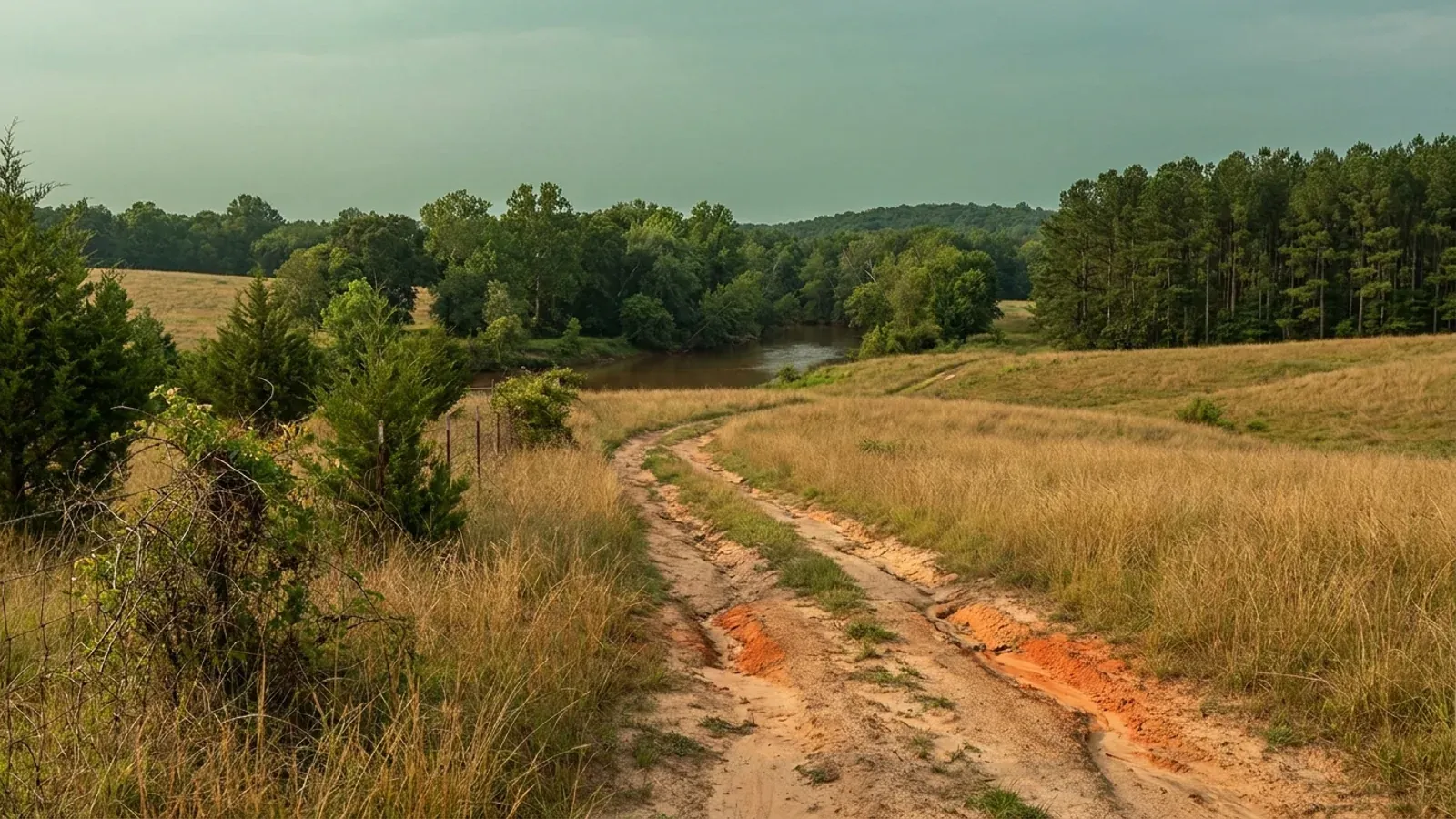
Rolling farmland and mixed hardwood near the fall line with red soil showing in a farm track, dense loblolly pine on one edge and a wooded creek bottom beyond.
Orange County 2018 NC Residential Code, statewide

Barndominium Builders in Orange County, NC

Orange County holds 152,498 people on the 2025 estimate across 398 square miles, with Hillsborough as its seat and Chapel Hill and Carrboro at its southern end. It grew 2.5 percent between 2020 and 2025 — the slowest of the Triangle's three core counties — and it is the most rural of them by a wide margin, with 20.9 percent of its land in farms against 11.7 percent in Wake and 8.8 percent in Durham. There is land here. What there also is, and what no competitor page mentions, is the tightest set of water-supply rules in the region. Section 4.2 of the Orange County Unified Development Ordinance establishes thirteen Watershed Protection Overlay Districts, covering the Orange County portions of every watershed the state has classified WS-II, WS-III or WS-IV, and the county drains into three river basins — the Cape Fear by way of the Haw River and New Hope arms of Jordan Lake, the Neuse by way of Falls Lake, and the Roanoke by way of Hyco Creek. In the University Lake and Cane Creek watersheds, which supply Chapel Hill and Carrboro their drinking water, the maximum residential density is one dwelling unit per five acres and the residential impervious surface limit is six percent. The erosion threshold is lower than the state's too: the county requires a Land Disturbing Permit above the thresholds in its own watershed matrix, which are 20,000 square feet across most of the county and 10,000 with a waiver in the most sensitive watersheds, against a state floor of more than one acre. And the Rural Buffer zoning district that rings Chapel Hill and Carrboro sets a two-acre minimum lot and says in its own purpose statement that it relies on individual wells and ground absorption systems. For a barndominium that is not a warning. It is a description of exactly the parcel this building type wants — provided the acreage is sized to the overlay before the plan is drawn.

Orange County at a glance

County
Orange County
City rules outside city limits
On part of unincorporated Orange County the land-use rules are a town's: the county's own ordinance adopts the Chapel Hill and Carrboro development ordinances by reference inside each town's Joint Development Review Area.
Population
152,498
ZIP codes
27231, 27243, 27278, 27302, 27510, 27514, 27516, 27517
Site visits
Same week across Orange County

Building conditions in Orange County

The building code does not change at a county line here. Under § 143-138(e) the North Carolina State Building Code applies throughout the state, and a city or county may adopt only a fire prevention code and floodplain regulations of its own — there is no general local amendment power, so there are no county amendments to look up. The edition in force is still the 2018 NC Residential Code, effective 1 January 2019; the 2024 edition has been delayed three times and carries no effective date at all. What genuinely differs is who issues the permit and inspects the work, what that office charges, how the parcel is zoned, what the local floodplain ordinance requires of the foundation — and two design numbers the code publishes county by county, the ultimate design wind speed and the seismic design category. The rest of Table R301.2 is set once for everyone: a flat 20 psf roof live load, a 12-inch frost line, Moderate weathering, and termite protection required everywhere in the state with no exemption. There is no ground snow load column in the residential code at all.

Build conditions for Orange County , North Carolina : ultimate design wind speed 115 mph. BUILD CONDITIONS ORANGE COUNTY, NCOrange County2018 NC RESIDENTIAL CODEULTIMATE DESIGN WIND SPEED115 mphTable R301.2(4) of the 2018 NC Residential Code does not name Orange County, so the county fallsto that table's unlisted default of 115 mph — the floor of the code, shared with 50 other…ZONING · RURAL BUFFER (RB)87,120 sq ft (2 acres) conventional…The RB district's stated purpose is rural residential andagricultural use buffering the more intensively developed parts of…WHO ISSUES THE PERMITOrange County Planning & InspectionsPermits and inspects in unincorporated Orange County and, byagreement, throughout the Town of Hillsborough. Chapel Hill and…
Build conditions for Orange County, drawn from the sourced facts on this page. Every figure above is cited in the quick-facts panel below, with its source and vintage.
Thirteen watershed overlay districts, across three river basins
Section 4.2.2 of the Orange County Unified Development Ordinance states that, in accordance with the state mandate, thirteen Watershed Protection District Overlays are established. They apply to the Orange County portion of every watershed the North Carolina Environmental Management Commission has classified WS-II, WS-III or WS-IV, and they overlay whatever base zoning the parcel already carries — where an overlay standard conflicts with the underlying district, Sec. 4.2.2(D) says the overlay always governs. The list runs University Lake and Cane Creek, critical area and protected watershed for each; Upper Eno critical area and protected; Lower Eno; Little River; Back Creek; South Hyco Creek; Flat River; Haw River; and Jordan Lake, defined as the Orange County portion of the Jordan Lake watershed extending five miles from the impoundment's normal pool elevation. The county's own watershed matrix sorts those into three river basins: the Cape Fear by the Haw River and New Hope arms, the Neuse by way of Falls Lake, and the Roanoke by Hyco Creek. Almost nowhere else in the Triangle does one county's stormwater answer depend on three separate basins.

Orange County Unified Development Ordinance Secs. 4.2.1–4.2.2 and Table 4.2.2.E, and Table 4.2.10 Orange County Watershed Matrix, orangecountync.gov, current edition amended 1 October 2024, read 6 September 2026.

One dwelling per five acres, and six percent impervious
The University Lake and Cane Creek reservoirs supply Chapel Hill and Carrboro, and the rules protecting them are the strictest residential limits in the county. Table 4.2.4 of the UDO sets a maximum density of one dwelling unit per five acres in all four of the districts covering them — University Lake critical area and protected watershed, Cane Creek critical area and protected watershed — with a narrow exception letting lots of record existing on 2 October 1989 (University Lake) or 19 October 1999 (Cane Creek) yield up to five lots as small as two acres. Table 4.2.5 then caps residential impervious surface in the same four districts at six percent, with a 12 percent allowance only for pre-existing sub-two-acre lots. Six percent of a five-acre lot is about 13,000 square feet, which sounds generous until you add a house, a shop apron, a turnaround and a driveway on a rural site. This is the number to design against before the pad is sited, not after.

Orange County Unified Development Ordinance Tables 4.2.4 and 4.2.5, orangecountync.gov, current edition amended 1 October 2024, read 6 September 2026. Both tables were read in two independent extraction modes that agree on the district-to-value pairing.

The erosion permit starts at 20,000 square feet, not an acre
Section 2.18.1(A) of the UDO requires a Land Disturbing Permit from the Orange County Erosion Control Officer before commencement of any land-disturbing activity in excess of the thresholds defined in the county's own Watershed Matrix at Table 4.2.10 — and the permit must be obtained before the activity starts. Those thresholds are 20,000 square feet across most of the county and 10,000 square feet, with a waiver required, in the most sensitive watersheds including the Upper Eno and its critical area. The state floor, by contrast, is more than one acre of disturbance on a tract — 43,560 square feet — with NC DEQ publishing civil penalties of up to $5,000 per day per violation, and state law permitting a delegated local programme to be stricter than the state minimum. Orange County is more than twice as strict, and in places more than four times. Disturbance means the pad, the driveway, the septic area, the trenching and the stockpiles together, which is how a single-house rural site crosses 20,000 square feet without anyone intending it.

Orange County Unified Development Ordinance Sec. 2.18.1 and Table 4.2.10, orangecountync.gov, read 6 September 2026; NC DEQ, Erosion and Sediment Control Laws and Rules, deq.nc.gov, read 5 September 2026 (G.S. Chapter 113A, Article 4).

The Rural Buffer district assumes a well and a septic system
Chapel Hill and Carrboro are ringed by a Rural Buffer, and Orange County zones it as the RB district. The UDO's own purpose statement for RB is worth reading before you tour a parcel: the district provides locations for rural residential developments and agricultural, silvicultural or horticultural uses which buffer or separate the more intensively planned parts of the county, and development in it is at very low densities — the minimum lot size per dwelling unit is two acres — relying on individual wells and ground absorption systems for domestic water supply and sewage disposal. The dimensional table sets the conventional minimum lot at 87,120 square feet, exactly two acres, with 40,000 square feet available under the Flexible Development subdivision process, and a 25-foot height limit that two feet may be added to for each additional foot of front and side setback. The district's applicability test says it is applied where urban services are not likely within 10 to 20 years. That is a zoning district written for the way a barndominium buyer actually lives.

Orange County Unified Development Ordinance Sec. 3.3, Rural Buffer (RB) District purpose, applicability and dimensional standards, orangecountync.gov, read 6 September 2026.

The Jordan Rules were only half delayed, and the surviving half is the half that touches land
Popular coverage says the Jordan Lake Rules were delayed. Orange County's own ordinance and its own watershed matrix show how partial that is. Sec. 1.1.9(F) of the UDO provides that the Jordan Water Supply Nutrient Strategy Rules and riparian buffer protection rules of 15A NCAC 02B .0265, .0267 and .0268 apply to all lands within the Jordan Lake watershed portion of Orange County, with the more restrictive of the county's and the state's standards governing. The footnote to Table 4.2.10 then records that Jordan Lake nutrient export regulations are not currently enforced, in compliance with a state mandate, and that the county will resume enforcement if and when that mandate is revised. NC DEQ's own account of the strategy matches: the new development stormwater rule .0265 and Stage Two of the existing development stormwater rule are the parts suspended, while agriculture, fertiliser management, wastewater, Stage One and the buffer rule .0267 remain in force. So the 50-foot riparian buffer a land buyer actually runs into was never the rule that got delayed.

Orange County Unified Development Ordinance Sec. 1.1.9(F) and the footnote to Table 4.2.10, orangecountync.gov, read 6 September 2026; NC DEQ, Jordan Lake Nutrient Strategy page, deq.nc.gov, read 5 September 2026; 15A NCAC 02B .0267, NC Office of Administrative Hearings, read 5 September 2026.

Who permits you here, and the town ordinance that applies outside town
Orange County Planning and Inspections states that it does all building permitting and inspections for the Town of Hillsborough as well as for areas outside municipal limits in the county's planning jurisdiction. Chapel Hill runs its own: the Town's Building and Development Services issues Town permits and its inspections are performed by Town staff. So does Carrboro, whose Inspections Division is responsible for enforcing the North Carolina State Building Code throughout the town's jurisdiction. Hillsborough is therefore the reverse of the usual arrangement — a county seat inspected by its county. Then there is the part that catches buyers out. Sections 1.1.9(D) and (E) of the county UDO adopt the Town of Chapel Hill Land Development Ordinance and the Town of Carrboro Land Use Ordinance by reference, as fully as though set forth in the county ordinance, applicable to the portion of the Transition Area inside each town's Joint Development Review Area under the Joint Planning Agreement adopted 2 November 1987. On that ground the land is unincorporated, the county inspects it, and the land-use standards being applied are a town's.

Orange County Planning and Inspections department page, orangecountync.gov/792, read 6 September 2026; Town of Chapel Hill Building Permits and Inspections, chapelhillnc.gov, read 6 September 2026; Town of Carrboro Inspections Division, townofcarrboro.org, read 6 September 2026; Orange County Unified Development Ordinance Secs. 1.1.6, 1.1.9(D)–(E) and 2.8.4, read 6 September 2026.

Also worth knowing before you build in Orange County

A minimum lot is not the same as a minimum usable lot
Orange County distinguishes the two, and for a septic parcel the second number is the one that binds. For lots outside a Watershed Protection Overlay District that use ground absorption wastewater systems, the county's district standards set a minimum usable lot area of 30,000 square feet for parcels between 40,000 square feet and 1.99 acres, and of at least 40,000 square feet for zoning lots two acres and larger. Usable area excludes what the site cannot actually take a system on. Under the Flexible Development option the required wastewater system area may instead sit in a recorded easement or septic lot within allowed open space. That distinction is the one that quietly kills otherwise attractive parcels — a tract can hold ten acres and still not hold 40,000 square feet of ground a soil scientist will sign off on, which is why the soil evaluation belongs before the purchase rather than after.

Orange County Unified Development Ordinance, Article 3 base district standards (standard 5, minimum usable lot area) and Section 7.12, orangecountync.gov, read 6 September 2026.

The most rural of the Triangle's three core counties
The 2022 Census of Agriculture puts Orange County 66th of North Carolina's 100 counties for land in farms: 687 farms across 53,068 acres, 20.9 percent of the county, at a median farm size of 37 acres and an average of 77. That is nearly double Wake County's 11.7 percent share and well over twice Durham County's 8.8 percent. Population is 152,498 on 398 square miles, or 384 people per square mile, and the 2020 to 2025 growth of 2.5 percent is the slowest in the Triangle's core — Wake grew 11.3 percent and Durham 6.9. The statewide median farm is 48 acres, so Orange's parcel fabric sits just under the state norm and well above what Wake or Durham can offer. The trade is explicit: more acreage, and a watershed overlay on a great deal of it.

USDA NASS 2022 Census of Agriculture county profiles from the qs.census2022 bulk file, nass.usda.gov, read 5 September 2026; U.S. Census Bureau Vintage 2025 county population estimates and 2025 Gazetteer land areas, read 5 September 2026.

The farm exemption stops at the dwelling, and buys you something when you build to code
Section 1.1.8 of the Orange County UDO applies the state rule directly: the provisions adopted under Chapter 160D, Article 7 do not apply to property used for bona fide farm purposes, except for any non-farm use of farm property, compliance with FEMA National Flood Insurance Program requirements including the Flood Insurance Rate Maps, and compliance with the county's flood damage prevention regulations. That is the zoning exemption. It is not a building-code exemption, because G.S. 143-138(b4)(1) defines a farm building as a nonresidential building or structure, so a dwelling never qualified. And G.S. 160D-903 makes the point affirmatively rather than as a warning: a county may not prohibit a dwelling on a bona fide farm lot of more than ten acres, nor require road frontage, nor require connection to public water or sewer — but only for a residence constructed in accordance with the North Carolina State Building Code. Build to the code and you gain a genuine land-use right. That is the trade, and it is a good one.

Orange County Unified Development Ordinance Sec. 1.1.8, orangecountync.gov, read 6 September 2026; N.C.G.S. §§ 143-138(b4)(1) and 160D-903, as transcribed in research on the North Carolina code and zoning regime, read 5 September 2026.

115 mph, no seismic listing, and nothing local to look up in the code
Table R301.2(4) of the 2018 NC Residential Code does not name Orange County, so it falls to that table's unlisted default of 115 mph ultimate design wind speed, which 51 of the 100 counties share. Orange is also absent from Table R301.2(7), the thirteen-county Seismic Design Category C list, whose note places every unlisted county in Category A or B. Name the edition on the plans: the 2018 code is in force and the 2024 edition, though adopted, has no effective date at all. There is no Orange County version of the building code either, because G.S. 143-138(e) provides that the Code shall apply throughout the State and no local government has a general power to amend it — the only instruments a county may adopt of its own are a fire prevention code and floodplain regulations. Everything genuinely local in Orange County is in the other body of law: the UDO's zoning, its thirteen watershed overlays, its 20,000 square foot erosion threshold and its Land Disturbing Permit.

2018 NC Residential Code, Tables R301.2(4) and R301.2(7), NC Office of the State Fire Marshal, ncosfm.gov, read 5 September 2026; N.C.G.S. § 143-138(e); OSFM press release on the delayed 2024 Code, 7 April 2025.
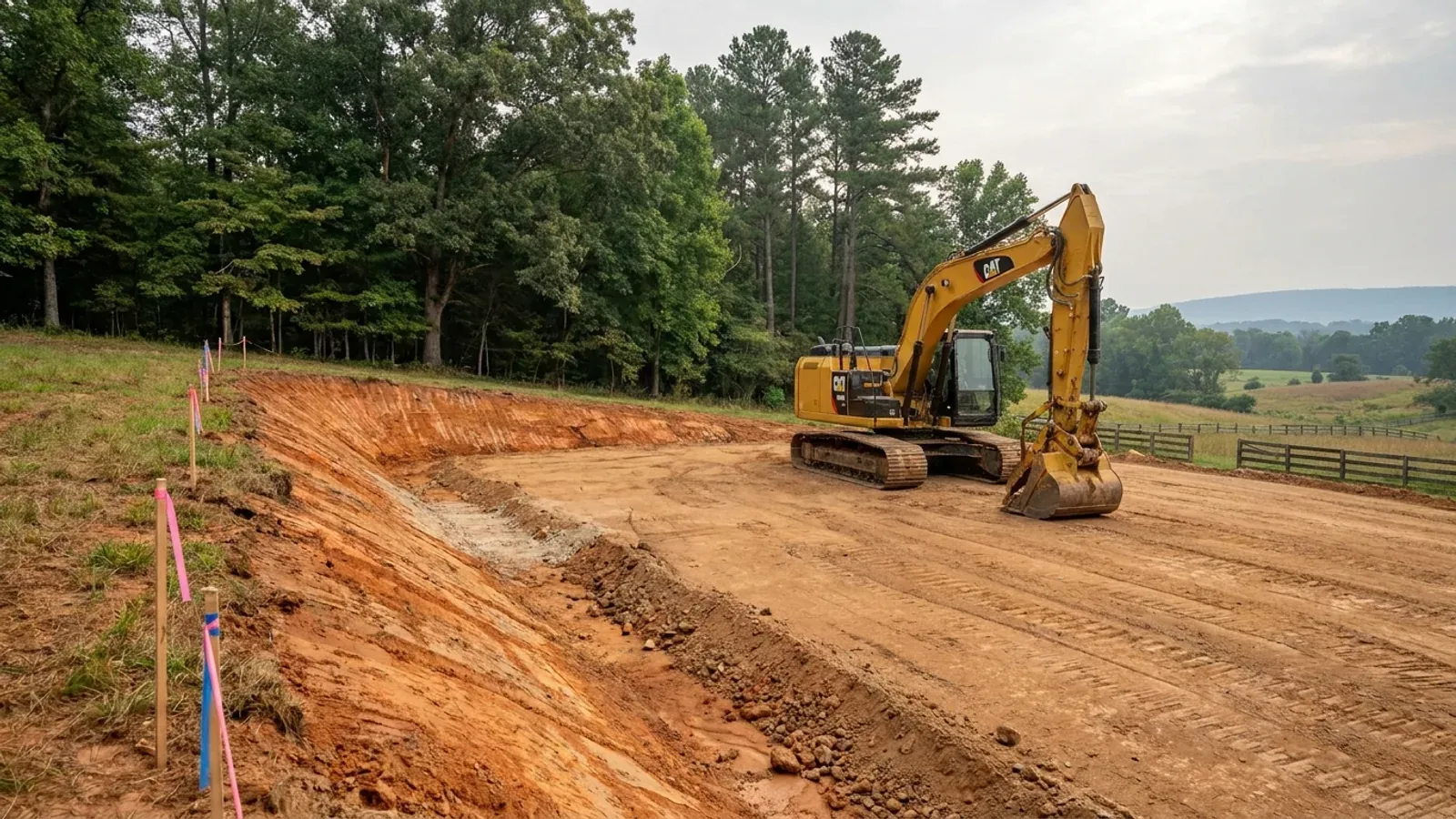
An excavator grading a compacted building pad on a cleared lot, with survey stakes, a drainage swale and a silt fence along the downhill edge.
Below the slab

The expensive surprises are in the ground, not the building

What moves a North Carolina budget is usually below grade, and the thing most often got wrong is which clay to worry about. Cecil — the red Piedmont clay everyone pictures, and the state soil — is kaolinitic and low shrink-swell; it does not heave. The soil that does is Iredell, formed over diabase and gabbro, which the USDA describes as vertic, very high shrink-swell, with a perched water table a foot or two down from December through April. The tell is colour: Cecil is red and Iredell is dark grey-brown, and they sit within a few miles of each other across the central Piedmont. West of that the question stops being clay and becomes slope, rock and colluvium; east of the fall line it becomes water, and in the Tidewater it becomes organic soil that subsides irreversibly once it is drained. Then the same ground decides the septic system, and North Carolina rewrote those rules recently enough that most of what is published about them is out of date. 15A NCAC 18E replaced the old subchapter on 1 January 2024 and was amended again on 1 June 2026: the site is classified on soil morphology — the word "percolation" does not appear anywhere in it — and there is no "provisionally suitable" any more, only suitable or unsuitable, on a single failed parameter. There is no statewide minimum lot size either; the area you need is derived from the soil result and then doubled, because a site that cannot fit both the initial field and its repair area is unsuitable. And the order matters more than people expect: the county health department's Improvement Permit and Construction Authorization come first, and the building permit is available on the strength of the Construction Authorization, not before it. One more thing that catches people: disturb more than an acre and you need an approved erosion and sedimentation control plan in hand before work starts, with penalties up to $5,000 a day, and a pad plus a drive plus a drainfield plus a laydown area crosses an acre faster than it sounds. So the site work, the foundation and the drainfield get resolved together rather than one at a time. We price the dirt before we price the building.

What a build looks like

Three stages every Orange County project passes through, from a raw parcel to a finished home. Site work first, because that is where the budget is decided.
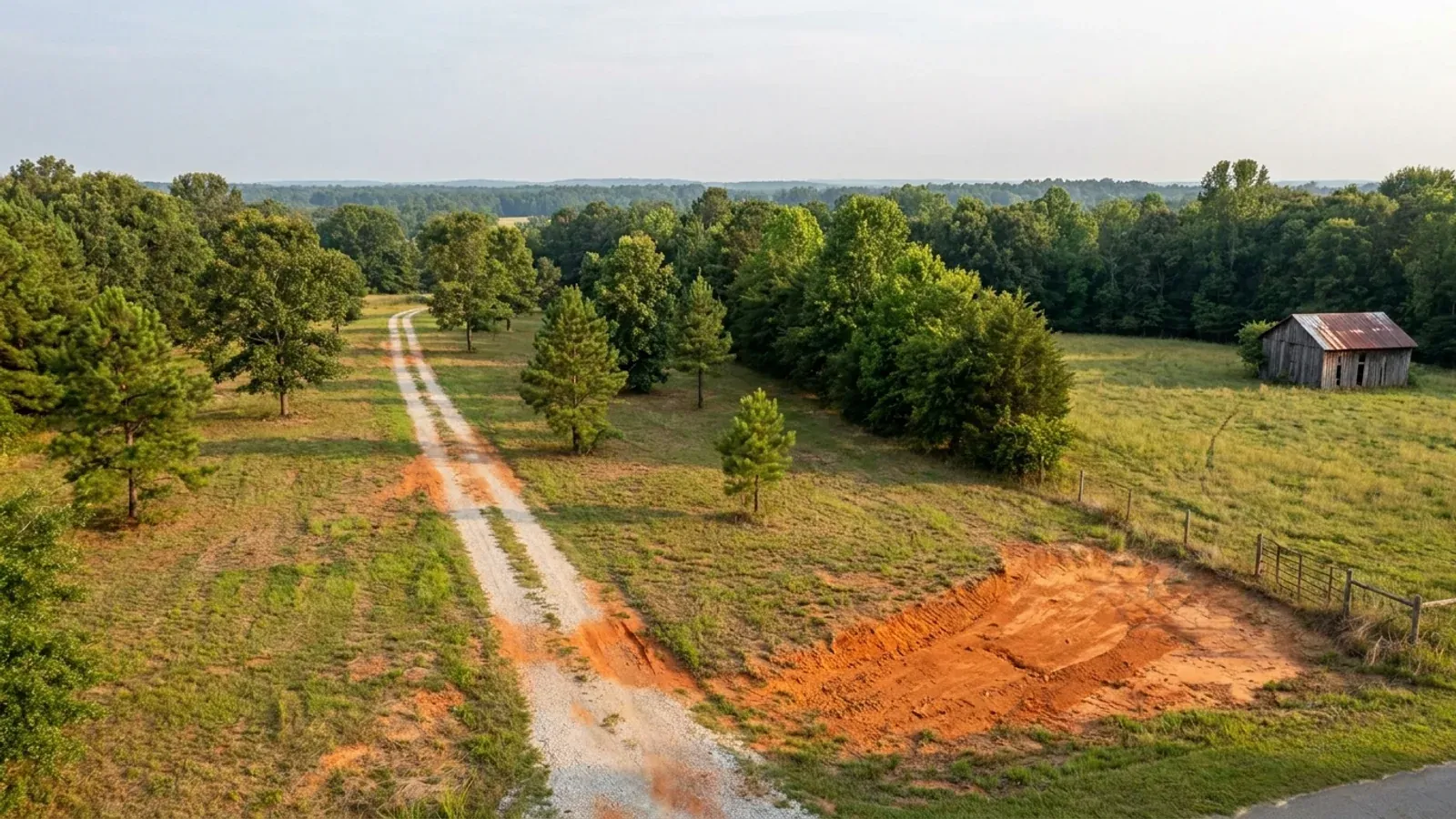
Aerial view of an undeveloped rural lot with cleared grass, a mixed oak, hickory and pine treeline, exposed red clay in one corner and a pale gravel access track.
Stage one

The parcel

Zoning, setbacks, flood zone and utility access get checked before anything is drawn.

An excavator grading a compacted building pad on a cleared lot, with survey stakes, a drainage swale and a silt fence along the downhill edge.
Stage two

Pad and permit

Clearing, grading and a compacted pad, while the septic authorization and the building submittal work through whichever offices cover your parcel.
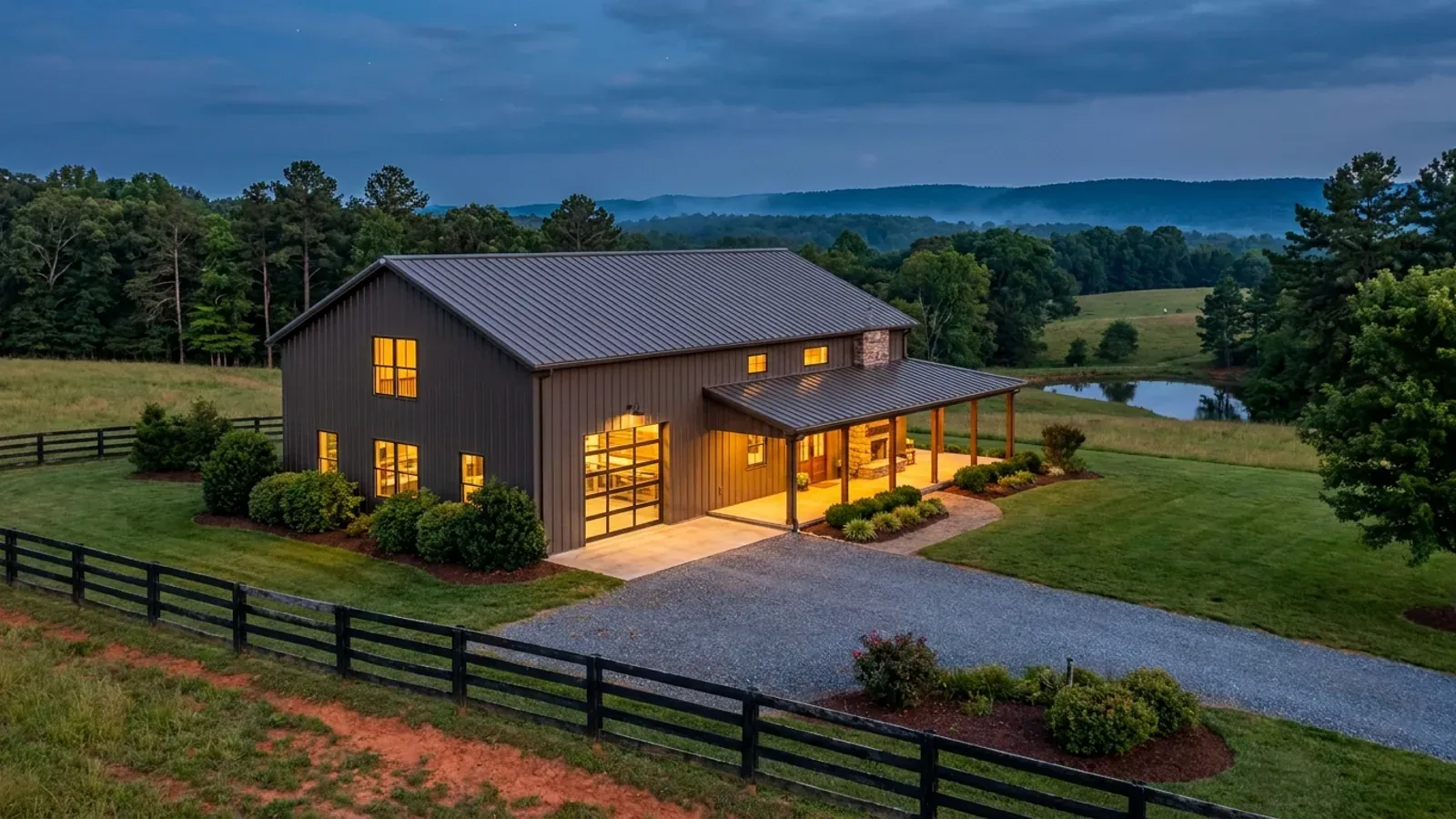
A finished barndominium at dusk with warm interior lighting glowing through its large windows.
Stage three

Frame to finish

Shell erected and dried in, then systems, insulation and interior finish through to CO.

Those are the rules where you are building in Orange County. Tell us what you want to build and we will draw it to them.

Where we build around Orange County

Orange County and the rural land around it. The buildable acreage for a project this size usually sits outside the town limits — which does not automatically put it under the county, because a town's zoning and building-code enforcement reach one to three miles past its limits into its extraterritorial jurisdiction. Inside the limits, in the ETJ, or in neither are three different answers to who issues your permit.

The Orange County service area, including the rural acreage outside the built-up edge, which is where the parcels big enough for a build like this usually sit. The map marks the territory we build in. It is not a branch location, and there is no office at this pin.

Nearby areas we build in

Others we cover nearby. Every North Carolina municipality sits inside a county — there are no independent cities here — but that does not settle who regulates a given parcel. A town's zoning, subdivision rules and building-code enforcement extend one to three miles beyond its limits, by population, into what the statute calls its extraterritorial jurisdiction; town taxes and town elections do not follow. So the office that issues the permit, what it charges and how the land is zoned can all differ from one card to the next, and the mailing address will not tell you which case you are in.

Building in Orange County: common questions

7 questions we get asked most often about building in Orange County. If yours is not on the list, ask it directly.

Who issues the building permit for land in Orange County?
Orange County Planning and Inspections, for most of the county — the department states that it does all building permitting and inspections for the Town of Hillsborough as well as for areas outside municipal limits within the county's planning jurisdiction. That is worth noticing: the county seat is inspected by the county, which is the reverse of the usual pattern in this state. Chapel Hill issues its own Town permits and inspects with Town staff through Building and Development Services, and Carrboro's Inspections Division enforces the North Carolina State Building Code throughout that town's jurisdiction, so a parcel inside either town's limits is permitted by the town. There is a third answer that catches people out, and it is peculiar to Orange. Sections 1.1.9(D) and (E) of the county UDO adopt the Town of Chapel Hill Land Development Ordinance and the Town of Carrboro Land Use Ordinance by reference, as fully as though set forth in the county's own ordinance, for the portion of the Transition Area inside each town's Joint Development Review Area under the Joint Planning Agreement adopted 2 November 1987. On that ground the parcel is unincorporated, the county inspects it, and the land-use standards being applied to it are a town's. Sec. 1.1.6(A) then applies the county ordinance in the unincorporated area outside existing municipal extraterritorial jurisdiction boundaries and established Joint Planning Areas. The document that settles it is the county zoning atlas and the Joint Planning Area Land Use Map, not the mailing address.
How much land do I need for a barndominium in the Chapel Hill or Carrboro watersheds?
Five acres, in the four districts that protect the drinking-water reservoirs, and the impervious cap matters as much as the acreage. Table 4.2.4 of the Orange County UDO sets a maximum residential density of one dwelling unit per five acres in the University Lake critical area and protected watershed and in the Cane Creek critical area and protected watershed, with a narrow allowance letting lots of record existing on 2 October 1989 for University Lake, or 19 October 1999 for Cane Creek, yield up to five lots as small as two acres. Table 4.2.5 caps residential impervious surface in those same districts at six percent, with 12 percent available only for pre-existing lots under two acres. Six percent of five acres is roughly 13,000 square feet. A 3,000 square foot barndominium footprint, a shop apron, a turnaround and 400 feet of drive can consume most of that, so on this ground the site plan drives the design rather than the other way round. Elsewhere in the county the base zoning district's own minimum applies — the Rural Buffer district's conventional minimum lot is 87,120 square feet, exactly two acres — but the UDO is explicit that the density permitted on a given parcel is whichever is less, the underlying district or the watershed overlay.
Do I need an erosion control permit before clearing the site?
In Orange County, at a much lower threshold than most people expect. Sec. 2.18.1(A) of the UDO requires a Land Disturbing Permit from the county's Erosion Control Officer before commencement of any land-disturbing activity in excess of the thresholds set in the county's Watershed Matrix at Table 4.2.10, and the permit must be in hand before work begins. Those thresholds are 20,000 square feet across most of the county and 10,000 square feet, with a waiver required, in the most sensitive watersheds including the Upper Eno and its critical area. The state's own floor, administered by DEQ's Land Quality Section or by a delegated local programme, is more than one acre — 43,560 square feet — with published civil penalties of up to $5,000 per day per violation, and state law permits a delegated local programme to be stricter. Orange County is. What counts toward the threshold is disturbance rather than building footprint: the pad, the driveway, the septic field and repair area, the utility trenching, and the laydown and stockpile areas together. The UDO also provides that where a permanent stormwater control measure is required as part of the work, the permit will not issue until a performance guarantee for constructing it is posted, and every permit expressly prohibits open burning of trees, limbs, stumps and construction debris.
Were the Jordan Lake Rules delayed, so I do not have to worry about them?
Half of them were, and the half that survived is the half a land buyer actually meets. Sec. 1.1.9(F) of the Orange County UDO provides that the Jordan Water Supply Nutrient Strategy Rules and riparian buffer protection rules of 15A NCAC 02B .0265, .0267 and .0268 apply to all lands within the Jordan Lake watershed portion of Orange County, and that where those and the county's own standards differ, the more restrictive governs. The footnote to the county's Table 4.2.10 records that Jordan Lake nutrient export regulations are not currently enforced, in compliance with a state mandate, and that the county will resume enforcement if and when the mandate is revised. NC DEQ's own account of the strategy agrees on which parts moved: the suspended items are the new development stormwater rule .0265 and Stage Two of the existing development stormwater rule, while agriculture, fertiliser management, wastewater, Stage One and the riparian buffer rule .0267 remain in force. The buffer is 50 feet in two zones — 30 feet of undisturbed vegetation and 20 feet of stable vegetation, measured from the top of bank on both sides of an intermittent or perennial stream. Buffers apply by river basin rather than by county line, and Orange County drains into three basins, so which way a parcel drains is the operative question. Both the state's programme and the county's ordinance are live documents; confirm the current position with the county before a plan is drawn.
What design figures apply to an Orange County barndominium?
Table R301.2(4) of the 2018 NC Residential Code does not name Orange County, so the county takes that table's unlisted default: an ultimate design wind speed of 115 mph, the floor of the code, shared by 51 of the 100 counties. Orange is also absent from Table R301.2(7), the list of thirteen Seismic Design Category C counties, and that table's note places every county not listed in Category A or B. Name the edition on the drawings — the 2018 code is in force, the 2024 edition has been adopted but has no effective date at all, and the two disagree about six counties' wind speeds and four counties' seismic category. Three figures that are true everywhere in the state: a flat 20 psf roof live load; no ground snow load column at all, because Section R301.2.3 is deleted; and a 12-inch frost line depth, with Section R403.3 frost-protected shallow foundations deleted, so there is no insulate-instead-of-dig alternative. Termite protection is required in all of North Carolina, and North Carolina deleted cold-formed steel framing from the accepted methods of providing it — so a steel-framed building still needs chemical treatment, a baiting system, pressure-treated wood or naturally durable wood. Because Section R301.1.2 requires other framing systems to demonstrate equivalent detailing, expect a barndominium here to be an engineered building, and note that Section 89C-25 contains no residential carve-out for engineering.
How is the permit fee calculated, and does the shop bay count?
That depends entirely on the county, and it is the most barndominium-specific budgeting question there is. There is no North Carolina permit fee: the rate differs county by county and so does the basis, and the basis is what decides whether an unheated shop bay is billable. Guilford County charges $150 plus $0.35 per heated square foot on a detached single-family structure, and Buncombe County charges a flat $500 up to 1,500 square feet plus $0.30 per square foot over, also on heated area only — in both, the unheated bay adds nothing. Wake County charges $75 plus $0.25 per square foot of gross floor area, expressly with no deduction for garage, corridors, stairs, closets or other features; Union County charges $0.84 per square foot on area under roof, heated or unheated; and New Hanover charges $0.441 per square foot under roof. In those, the bay is fully billable. So a 3,000 square foot barndominium that is half unheated workshop is billed on 1,500 square feet in Buncombe and 3,000 in Union — same building, same code, roughly double the fee. Ask the county for its own published schedule and ask what area it measures, because several schedules never define the term. Budget the health department separately: in most counties septic and well sit in a different department on a different schedule, and a buyer who reads only the building schedule under-budgets. A $10 Homeowners Recovery Fund fee also rides on a residential permit as a statewide obligation, whether or not a given schedule prints it. Every figure quoted here was read from that county's own published schedule on 5 September 2026; the Wake and Guilford pages state no effective date.
Which Orange County amendments to the building code should I check?
There are none to check, and that is worth stating plainly because the opposite advice is nearly universal in this trade. G.S. 143-138(e) provides that the North Carolina State Building Code shall apply throughout the State from the time of its adoption. The only two things a county may adopt of its own are a fire prevention code, which needs Residential Code Council approval and may not reach one- and two-family dwellings beyond what the Residential Code prescriptively requires, and floodplain management regulations. There is no general local power to amend the building code, so no county here can impose a stricter footing, framing or envelope requirement than the state code sets. What is genuinely local in Orange County is a different body of law entirely, and it is unusually substantial: zoning under Chapter 160D and the county UDO, the thirteen Watershed Protection Overlay Districts and their density and impervious limits, the Land Disturbing Permit at 20,000 or 10,000 square feet, the minimum usable lot area rules for ground absorption systems, the Joint Planning Agreement with Chapel Hill and Carrboro, the county fee schedule, and the health department that permits the septic system and the well. That list, not a mythical amendment package, is what a plan set has to satisfy.

Building in Orange County?

Start with the plan. Tell us what you want to build and we will draw it, then confirm which office issues the permit for your parcel, what it will let you put there, and what wind load it has to meet. That conversation costs nothing.