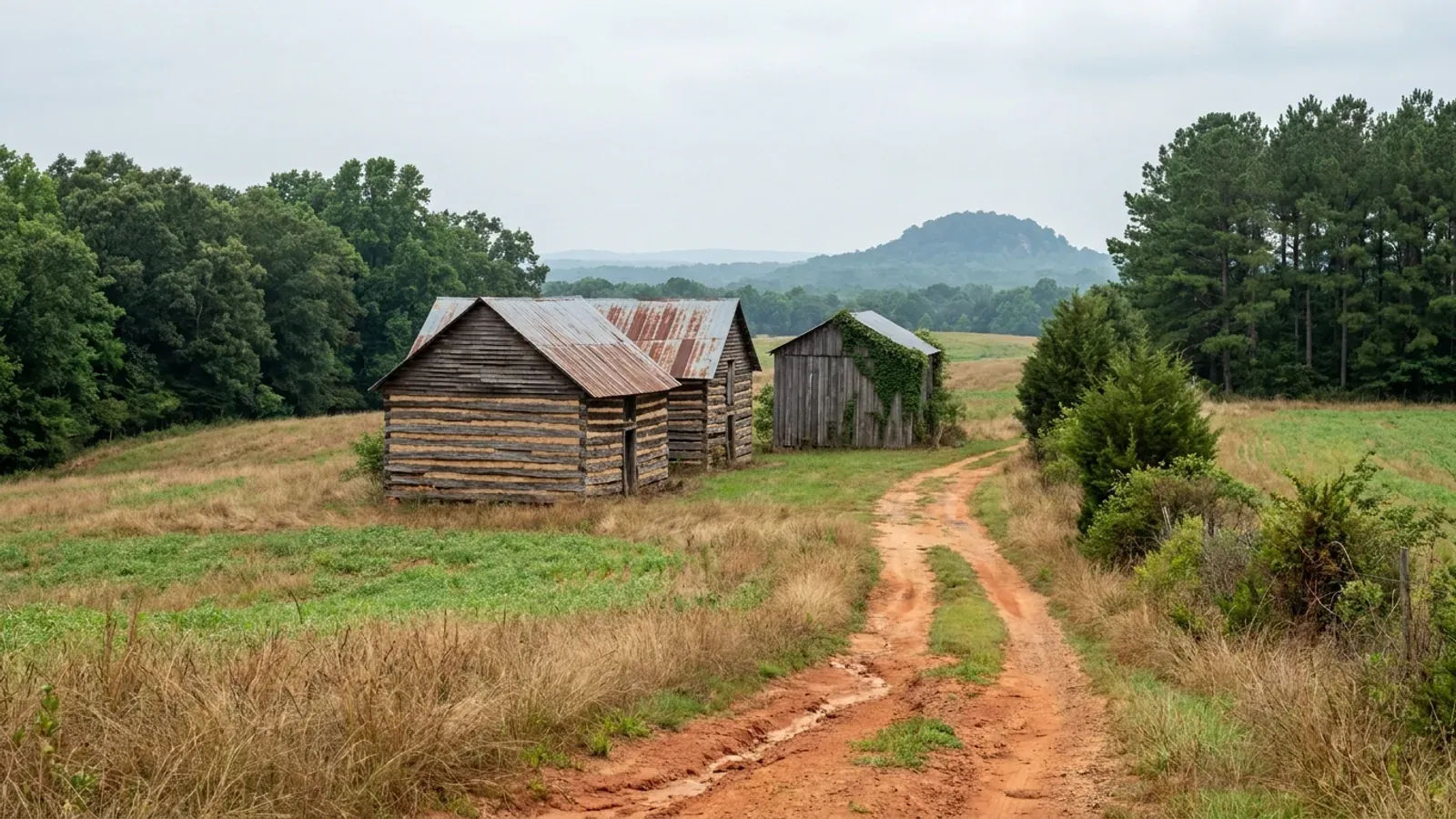
Rolling northern Piedmont farmland with red-orange clay, a red dirt track and a row of derelict flue-cured tobacco barns with rusting tin roofs at the field edge.
Alamance County 2018 NC Residential Code, statewide

Barndominium Builders in Alamance County, NC

Alamance County sits between the Triad and the Triangle with I-40 and I-85 running its length, 186,177 people across 423 square miles at 440 to the square mile, and the fastest growth of the Triad's three land counties at 8.6 percent since 2020. Burlington is the largest city, Graham is the county seat, Mebane straddles the Alamance-Orange line at the Triangle end, and Elon, Haw River, Swepsonville, Green Level, Saxapahaw and Snow Camp fill in between. Say the seat's name carefully, because it is the kind of thing that sends a supplier to the wrong end of the state: the city of Graham is in Alamance County. Graham County is a different place entirely — the far western mountain county beyond Asheville, about 300 miles away, with 8,190 people and one of the state's twelve special mountain wind regions. Nothing about building in one applies to the other. Two facts do most of the work on an Alamance land purchase, and both are checkable from the county's own pages. First, Alamance County states plainly that it does not have traditional zoning in the unincorporated areas — no zoning districts at all outside town and city limits — which is unusual enough that most buyers arrive not believing it. Second, and pulling the other way, its permit fee is one of the most barndominium-sensitive schedules in the Piedmont: $525 up to 1,500 gross square feet and $0.36 per square foot above that, with gross square footage defined in the schedule itself as including any floored area under roof — porches, garages, storage areas, basements. Randolph and Davidson, immediately west, price the same house on construction value and never measure it at all.

Alamance County at a glance

County
Alamance County
City rules outside city limits
Because Alamance County exercises no zoning in its unincorporated areas, a municipality's extraterritorial jurisdiction is not blocked by county regulation — a town's zoning, subdivision rules and building-code enforcement can reach one to three miles past its limits under G.S. 160D-202, on land the town neither taxes nor lets vote.
Population
186,177
ZIP codes
27201, 27215, 27217, 27244, 27249, 27253, 27258, 27302, 27340, 27349
Site visits
Same week across Burlington, Graham, Mebane and the rural county

Building conditions in Alamance County

The building code does not change at a county line here. Under § 143-138(e) the North Carolina State Building Code applies throughout the state, and a city or county may adopt only a fire prevention code and floodplain regulations of its own — there is no general local amendment power, so there are no county amendments to look up. The edition in force is still the 2018 NC Residential Code, effective 1 January 2019; the 2024 edition has been delayed three times and carries no effective date at all. What genuinely differs is who issues the permit and inspects the work, what that office charges, how the parcel is zoned, what the local floodplain ordinance requires of the foundation — and two design numbers the code publishes county by county, the ultimate design wind speed and the seismic design category. The rest of Table R301.2 is set once for everyone: a flat 20 psf roof live load, a 12-inch frost line, Moderate weathering, and termite protection required everywhere in the state with no exemption. There is no ground snow load column in the residential code at all.

Build conditions for Alamance County , North Carolina : ultimate design wind speed 115 mph. BUILD CONDITIONS ALAMANCE COUNTY, NCAlamance County2018 NC RESIDENTIAL CODEULTIMATE DESIGN WIND SPEED115 mphAlamance County is unlisted in Table R301.2(4) of the 2018 NC Residential Code and so takes thattable's default of 115 mph ultimate design wind speed. The city of Graham is in Alamance; Graham…ZONINGNo county zoning minimum exists — Al…The county's Planning Department page says it directly: AlamanceCounty does not currently have traditional zoning in the…WHO ISSUES THE PERMITAlamance County Inspections Departme…1946 Martin Street, Burlington — sharing a building with Planning,GIS and Environmental Health, which is unusual in North Carolina an…
Build conditions for Alamance County, drawn from the sourced facts on this page. Every figure above is cited in the quick-facts panel below, with its source and vintage.
Alamance County has no zoning outside the towns, and says so itself
This is the fact that changes an Alamance land purchase, and it comes from the county's own Planning Department rather than from an atlas. The county states that it does not currently have traditional zoning in the unincorporated areas, meaning it does not assign properties into zoning districts — residential, commercial, industrial — that control land use countywide outside town and city limits. Its own frequently-asked question puts it in four words: not in the unincorporated areas. Roughly a fifth of North Carolina's 100 counties are in that position and Alamance is a large, fast-growing one of them. The county is just as clear about the other half, and this is the half that matters for a build: land is not unregulated. Building permits, septic and well regulations, watershed and floodplain rules, subdivision standards and other development ordinances all still apply, and the county administers a Unified Development Ordinance covering subdivisions, watershed development, floodplain development, heavy industry and telecommunication towers. What is missing is a district, a use table and a setback schedule — not oversight.

Alamance County Planning Department, "Zoning in Alamance County" page and its FAQ, planning.alamancecountync.gov, read 6 September 2026; Alamance County Planning Department mission statement, same host.

The fee counts every floored square foot under roof, and the schedule says so
Alamance prices a new single-family dwelling at $525 up to 1,500 gross square feet and $0.36 per square foot above that, with electrical, plumbing and mechanical trade permits included in the total. Then it defines the term, which most schedules never do: gross square footage includes any floored area under roof — porches, garages, storage areas, basements. For a barndominium that is half unheated shop, that is the least favourable of the three bases in the Piedmont and the most predictable. Guilford County charges $150 plus $0.35 per heated square foot, so the shop bay is free there. Randolph and Davidson, immediately west, compute the fee from ICC construction valuation and never measure the building at all. Alamance measures all of it, and puts the definition in writing so there is nothing to argue about. Two related lines: a detached accessory building, garage or workshop is $0.25 per gross square foot with a $110 minimum and trade fees additional, and a house with fire sprinklers drops to $0.20 per gross square foot with a $400 minimum. The $10 Homeowner's Recovery Fee applies to licensed general contractors, and residential plan review for a new home is $110, credited against the permit.

Alamance County Permits and Inspection Fees 2025-2026, Residential Permit Fees and Other Residential Fees, inspections.alamancecountync.gov, read 6 September 2026; Guilford County Inspections Department fee panels, guilfordcountync.gov; Randolph County Permit Fee Schedule effective 1 July 2026; Davidson County Inspection Department Permit Fees effective 1 January 2017.

Graham the city is in Alamance County. Graham County is 300 miles away.
The county seat of Alamance is the city of Graham, population about 20,131. Graham County is a separate county in the far western mountains past the Blue Ridge, with 8,190 people — the state's second-smallest — and about 300 miles of road between them. The distinction is not pedantry, because the two answer to genuinely different numbers under the same code. Alamance County is unlisted in Table R301.2(4) of the 2018 NC Residential Code and takes its 115 mph default. Graham County is one of twelve counties the same table sends to Table R301.2(5), where the ultimate design wind speed is set by the building's first-floor finish elevation and runs from 115 mph below 2,700 feet up to 150 mph at 4,500 feet and above. Graham County is also on the Table R301.2(7) Seismic Design Category C list; Alamance is not. North Carolina has 21 towns sharing a name with a county and 15 of them sit in a different one, so a quote or a plan set specified for "Graham" is worth a second look before it is ordered.

2018 NC Residential Code, Tables R301.2(4), R301.2(5) and R301.2(7), NC Office of the State Fire Marshal; U.S. Census Bureau Vintage 2025 population estimates.

The Jordan Lake buffer was never suspended — and the state, not the county, runs it here
Southern and eastern Alamance drain through the Haw River into the Jordan Lake watershed, and the county maintains its own Jordan Lake page and a stormwater and buffer permit program map. The distinction worth carrying is the one popular coverage gets backwards. The legislature suspended parts of the Jordan Lake strategy — including the new-development stormwater rule at 15A NCAC 02B .0265 — but it did not suspend the riparian buffer rule at 02B .0267, which remains in force. The buffer is 50 feet in two zones: 30 feet of undisturbed vegetation, then 20 more of stable vegetation. And the administration here is unusual: the county states that Jordan Lake buffer rules in Alamance are administered by the NC Division of Water Resources rather than by the county, which is the opposite arrangement to Randolph, where the Randleman Lake buffer sits inside the county's own ordinance. What creates the buffer is a feature shown as a blue line on the USGS or NRCS soil survey map — and Alamance County Planning is certified by the State to provide stream location and classification assessments for properties in its jurisdiction, which is how you get one removed if the feature is a ditch or an ephemeral draw.

Alamance County Planning Department, "Jordan Lake One Water" and "Land Development" pages, planning.alamancecountync.gov, read 6 September 2026; NC DEQ Jordan Lake Nutrient Strategy page; 15A NCAC 02B .0265 and .0267, NC Office of Administrative Hearings.

Gibsonville pays 20 percent more, because of a county line
Alamance County's fee schedule carries a line most people never notice and nobody outside the county would guess: Gibsonville (Guilford County) — include additional 20% to total fees. Gibsonville is one of the towns that straddles the Alamance-Guilford line, with about 5,225 residents on the Guilford side and 4,651 on the Alamance side on the 2025 estimates, and Alamance County's inspections department serves the whole town. The surcharge applies to the part of it that is not in Alamance. It is a small number on a small population, but it is the clearest illustration on this page of the site's recurring point: the county line, not the town line and not the mailing address, is what decides how the fee is computed and by whom. Burlington splits the same way with 58,863 residents in Alamance and 2,633 in Guilford, and Mebane splits between Alamance and Orange at 17,209 and 4,743.

Alamance County Permits and Inspection Fees 2025-2026, General section, inspections.alamancecountync.gov, read 6 September 2026; U.S. Census Bureau Vintage 2025 sub-county population estimates, county-part records.

724 farms at a 46-acre median, and the fastest growth of the three land counties
Alamance has 724 farms on 68,769 acres — 25.4 percent of the county — averaging 95 acres with a median of 46, against a statewide median of 48. It ranks 51st of the state's 100 counties for land in farms while ranking 15th for population, which is the tightest of those two rankings among the Triad's land counties and tells you where the pressure is. Population grew 8.6 percent since the 2020 census base, a gain of 14,121 people, against Davidson's 6.7 percent and Randolph's 3.7. Density is 440 people per square mile across 423 square miles, more than double Randolph's 191. What makes Alamance different from the rest of the Triad ring is that it serves two metros at once: I-40 and I-85 run its length, Burlington is roughly half an hour from Greensboro and half an hour from Chapel Hill, and Mebane's eastern edge is inside Orange County. Buyers priced out of Orange and Chatham arrive here from one direction and Greensboro buyers from the other.

USDA NASS 2022 Census of Agriculture, county profiles; U.S. Census Bureau Vintage 2025 county population estimates and 2025 Gazetteer county file.

Also worth knowing before you build in Alamance County

Four departments, one building, and a fixed order to work through them
Alamance County relocated its Planning, Inspections, GIS and Environmental Health departments into a single building at 1946 Martin Street in Burlington, which is unusual in North Carolina and worth knowing, because a rural parcel needs all four and they normally sit in different offices. The county's own residential guidance sets the order. Planning, in that building, identifies the property and enters the parcel into the database — and if the property is inside a municipality you go to that town's Planning Department first instead. If there are no municipal utilities, Environmental Health determines whether there is a suitable site for a well and septic system on a soil evaluation application and a site visit. Once that is approved, the GIS Mapping Specialist assigns an address to the parcel. Only then does Environmental Health issue the permit that lets the well and septic go in, and only then does a completed building permit application, plan review fee and plan set go to Central Permitting. Incomplete applications are not accepted, and all contractor information must be on the application when submitted.

Alamance County Inspections Department, "Residential Permits" page, inspections.alamancecountync.gov, read 6 September 2026; Alamance County Planning Department home page, planning.alamancecountync.gov.

Alamance is 4A while Randolph and Davidson are 3A
Table N1101.7 of the 2018 NC Residential Code puts Alamance County in IECC climate zone 4A, along with Guilford, Forsyth, Orange, Chatham, Durham and Wake — while Randolph and Davidson, the two counties immediately west, are 3A. So the energy zone changes twice as you cross the Triad, and it is not intuitive from a map: three central Piedmont counties at the same latitude are not all in the same zone. The consequence is in the envelope. The air-impermeable insulation alternative to R-38 ceiling insulation is R-25 in zone 4 against R-20 in zone 3, and the code's fenestration and assembly U-factors differ between them. A plan package or kit quoted for "the Piedmont" has picked one of the two, and it is worth asking which before the insulation and glazing are priced.

2018 NC Residential Code, Table N1101.7, NC Office of the State Fire Marshal.

The design numbers, and the column that does not exist
Alamance County is unlisted in Table R301.2(4) of the 2018 NC Residential Code, so it takes that table's default of 115 mph ultimate design wind speed. It is absent from Table R301.2(7), the Seismic Design Category C list, whose own note places every county not listed in Category A or B. It is in IECC climate zone 4A. Three figures hold everywhere and belong on the drawings: a flat 20 psf roof live load, a 12-inch frost line depth, and termite protection required in all of North Carolina at a Moderate-Heavy severity under Section R318. There is no ground snow load column in the code at all, because Section R301.2.3 is deleted — so a snow-load number quoted for this county came from somewhere other than the code. And R403.3, frost-protected shallow foundations, is deleted here as well, so insulating a shallow footing instead of digging to depth is not an available route. Name the edition on the drawings: the 2018 code is in force and the 2024 edition, though adopted, has no effective date.

2018 NC Residential Code, Tables R301.2(1), R301.2(4), R301.2(7) and N1101.7 and Sections R301.2.3, R318 and R403.3, NC Office of the State Fire Marshal.

With no zoning district to set it, the septic result sets your lot size
In a zoned county the minimum lot size is printed in a table. In Alamance's unincorporated area there is no such table, so the binding minimum comes from the soil. 15A NCAC 18E replaced the old .1900 rules on 1 January 2024 and was amended again effective 1 June 2026; under .0509(a) a site is suitable or unsuitable with nothing in between, and the phrase "provisionally suitable" no longer exists anywhere in the subchapter. Sites are judged on soil morphology, not a percolation test — the word percolation does not appear in 18E at all. And .0508(b) makes a site unsuitable unless it can hold both the initial drainfield and a repair area meeting every setback, so whatever area the soil result gives you is effectively doubled. One wording note if you are reading Alamance's own pages: the county describes the health department issuing an Authorization to Construct, while the rule's own term under 18E .0201(c) is the Construction Authorization — the document whose issuance is what lets you obtain a building permit. Same step, and it comes before Central Permitting either way.

15A NCAC 18E .0201, .0501, .0508 and .0509, NC Office of Administrative Hearings; Alamance County Inspections Department "Residential Permits" page, inspections.alamancecountync.gov, read 6 September 2026.

The county's Unified Development Ordinance still reaches your project
No zoning districts does not mean no ordinance. Alamance County administers a Unified Development Ordinance and publishes application forms against it for watershed development, watershed waivers and variances, floodplain development permits, a flood hazard acknowledgement waiver, heavy industrial intent-to-construct and operations permits, telecommunication facilities, temporary residences and administrative appeals. Two of those matter to a barndominium buyer directly. A Temporary Residence Permit, with an RV alternate sewage disposal form, is the instrument for living on the parcel while the house goes up — a common plan on rural land and one that usually needs permission. And commercial development in the county goes through a Technical Review Committee, which is worth knowing if the shop end of the building is ever intended to host a business. The county adopted an update to its Land Development Plan in November 2020 as the guide behind all of it.

Alamance County Planning Department, "Land Development" page listing the Unified Development Ordinance and its application forms, planning.alamancecountync.gov, read 6 September 2026.
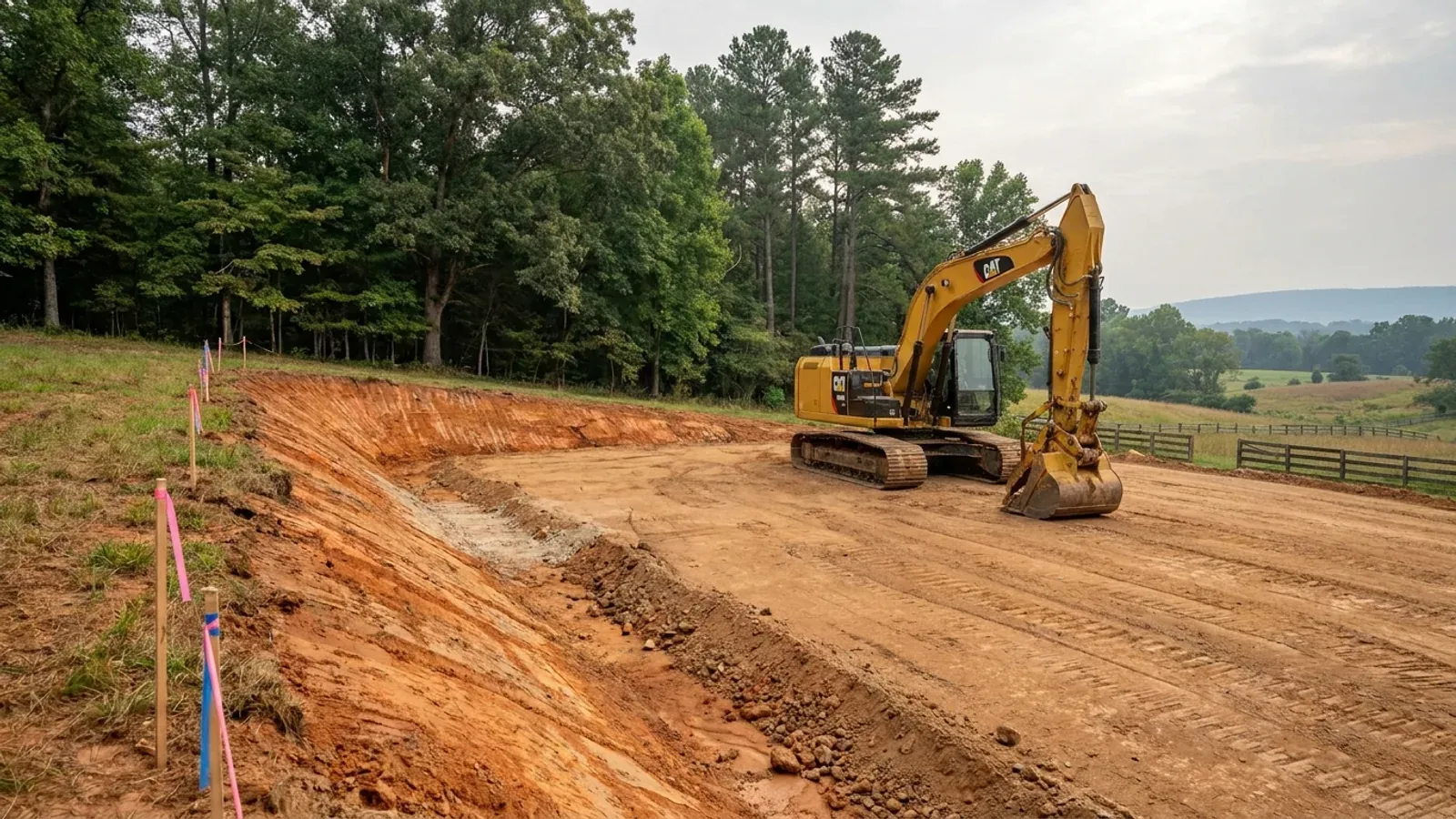
An excavator grading a compacted building pad on a cleared lot, with survey stakes, a drainage swale and a silt fence along the downhill edge.
Below the slab

The expensive surprises are in the ground, not the building

What moves a North Carolina budget is usually below grade, and the thing most often got wrong is which clay to worry about. Cecil — the red Piedmont clay everyone pictures, and the state soil — is kaolinitic and low shrink-swell; it does not heave. The soil that does is Iredell, formed over diabase and gabbro, which the USDA describes as vertic, very high shrink-swell, with a perched water table a foot or two down from December through April. The tell is colour: Cecil is red and Iredell is dark grey-brown, and they sit within a few miles of each other across the central Piedmont. West of that the question stops being clay and becomes slope, rock and colluvium; east of the fall line it becomes water, and in the Tidewater it becomes organic soil that subsides irreversibly once it is drained. Then the same ground decides the septic system, and North Carolina rewrote those rules recently enough that most of what is published about them is out of date. 15A NCAC 18E replaced the old subchapter on 1 January 2024 and was amended again on 1 June 2026: the site is classified on soil morphology — the word "percolation" does not appear anywhere in it — and there is no "provisionally suitable" any more, only suitable or unsuitable, on a single failed parameter. There is no statewide minimum lot size either; the area you need is derived from the soil result and then doubled, because a site that cannot fit both the initial field and its repair area is unsuitable. And the order matters more than people expect: the county health department's Improvement Permit and Construction Authorization come first, and the building permit is available on the strength of the Construction Authorization, not before it. One more thing that catches people: disturb more than an acre and you need an approved erosion and sedimentation control plan in hand before work starts, with penalties up to $5,000 a day, and a pad plus a drive plus a drainfield plus a laydown area crosses an acre faster than it sounds. So the site work, the foundation and the drainfield get resolved together rather than one at a time. We price the dirt before we price the building.

What a build looks like

Three stages every Alamance County project passes through, from a raw parcel to a finished home. Site work first, because that is where the budget is decided.
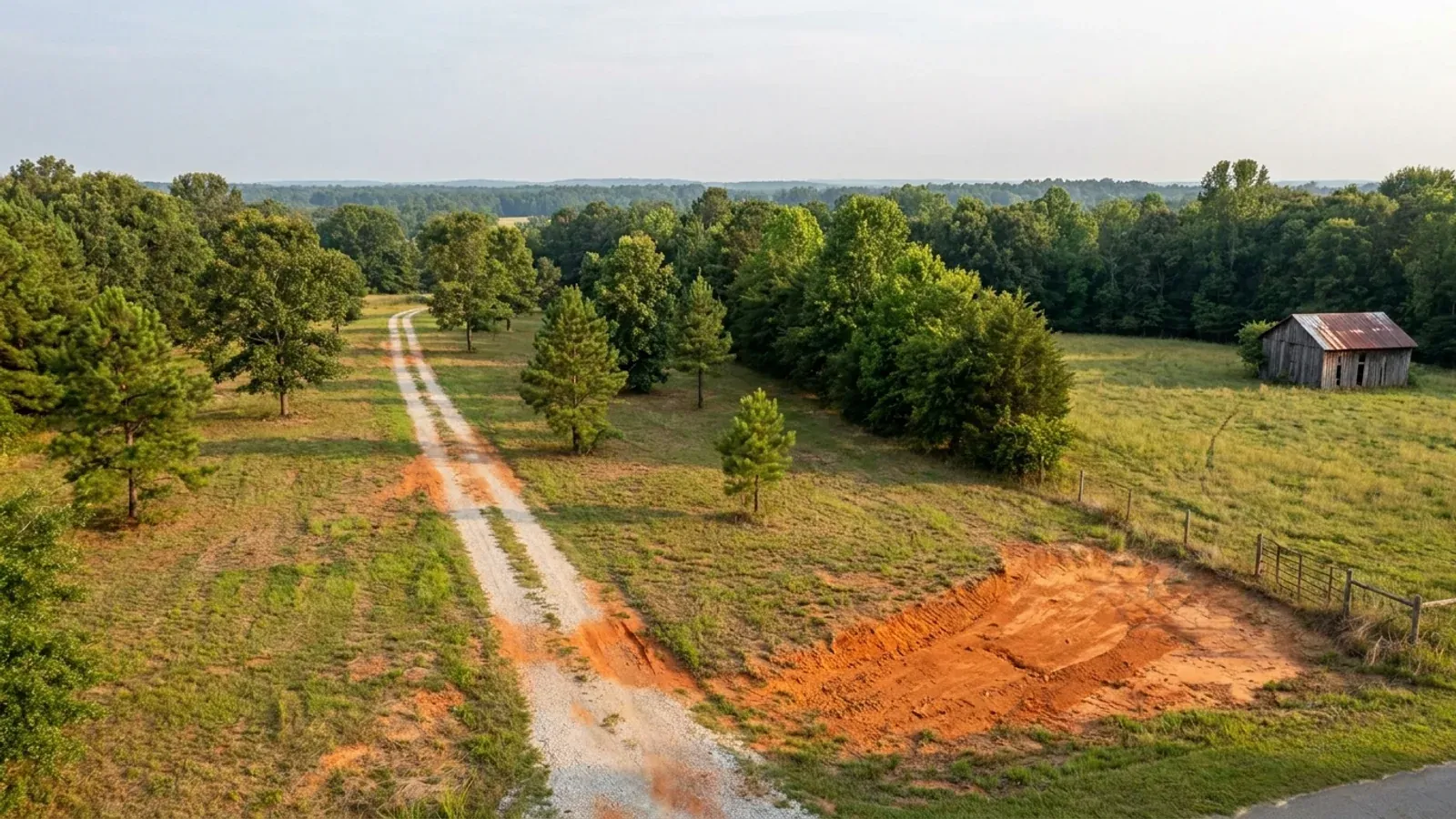
Aerial view of an undeveloped rural lot with cleared grass, a mixed oak, hickory and pine treeline, exposed red clay in one corner and a pale gravel access track.
Stage one

The parcel

Zoning, setbacks, flood zone and utility access get checked before anything is drawn.

An excavator grading a compacted building pad on a cleared lot, with survey stakes, a drainage swale and a silt fence along the downhill edge.
Stage two

Pad and permit

Clearing, grading and a compacted pad, while the septic authorization and the building submittal work through whichever offices cover your parcel.
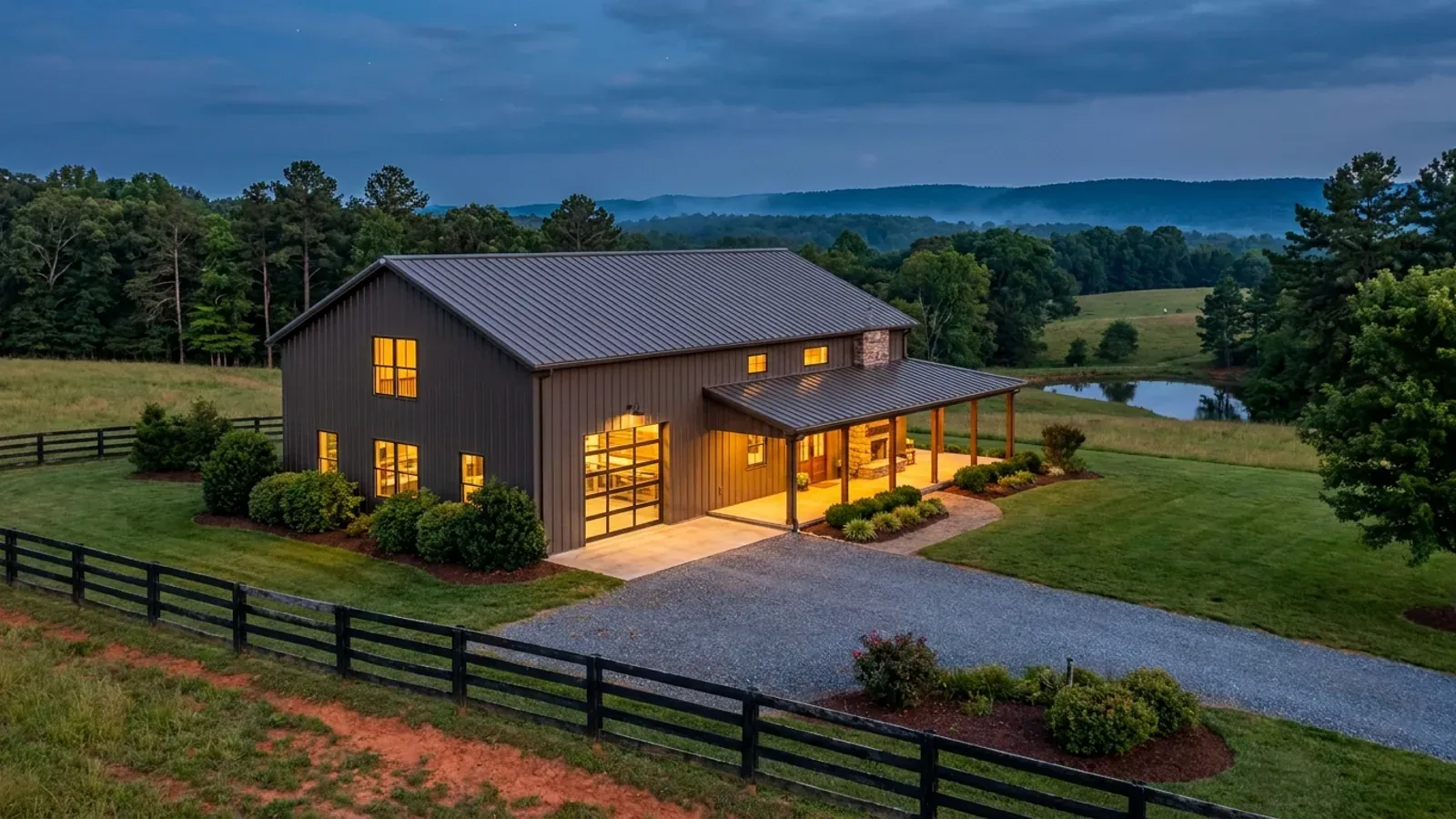
A finished barndominium at dusk with warm interior lighting glowing through its large windows.
Stage three

Frame to finish

Shell erected and dried in, then systems, insulation and interior finish through to CO.

Those are the rules where you are building in Alamance County. Tell us what you want to build and we will draw it to them.

Where we build around Alamance County

Alamance County and the rural land around it. The buildable acreage for a project this size usually sits outside the town limits — which does not automatically put it under the county, because a town's zoning and building-code enforcement reach one to three miles past its limits into its extraterritorial jurisdiction. Inside the limits, in the ETJ, or in neither are three different answers to who issues your permit.

The Alamance County service area, including the rural acreage outside the built-up edge, which is where the parcels big enough for a build like this usually sit. The map marks the territory we build in. It is not a branch location, and there is no office at this pin.

Nearby areas we build in

Others we cover nearby. Every North Carolina municipality sits inside a county — there are no independent cities here — but that does not settle who regulates a given parcel. A town's zoning, subdivision rules and building-code enforcement extend one to three miles beyond its limits, by population, into what the statute calls its extraterritorial jurisdiction; town taxes and town elections do not follow. So the office that issues the permit, what it charges and how the land is zoned can all differ from one card to the next, and the mailing address will not tell you which case you are in.

Building in Alamance County: common questions

9 questions we get asked most often about building in Alamance County. If yours is not on the list, ask it directly.

Is it true that Alamance County has no zoning?
Outside the towns, yes — and it is the county itself that says so. Alamance County's Planning Department states that it does not currently have traditional zoning in the unincorporated areas of the county, and that it does not assign properties into zoning districts such as residential, commercial or industrial that control land use countywide outside town and city limits. Its own FAQ answers the question in four words: not in the unincorporated areas. Roughly a fifth of North Carolina's 100 counties are in that position. But the county is equally explicit that this does not mean land is unregulated, and that half is the one that governs your build: building permits, septic and well regulations, watershed and floodplain rules, subdivision standards and other development ordinances all still apply, and there is a county Unified Development Ordinance behind them. Property inside Burlington, Graham, Mebane, Elon, Haw River, Swepsonville or Green Level is regulated by that municipality's zoning instead. So the practical question is not "is there zoning" but "am I inside a municipality or its extraterritorial jurisdiction" — and the Planning Department will confirm that from an address or parcel ID.
How does Alamance County calculate the permit fee, and does the shop bay count?
It counts, all of it, and the schedule says so in writing. A new single-family dwelling is $525 up to 1,500 gross square feet and $0.36 per square foot above that, with electrical, plumbing and mechanical included in the total — and the schedule's own note defines gross square footage as including any floored area under roof: porches, garages, storage areas, basements. That is the strictest of the three bases you meet in this part of the state. Guilford County charges $150 plus $0.35 per heated square foot, so an unheated shop adds nothing there. Randolph and Davidson compute the fee from International Code Council construction valuation and never measure the building. Alamance measures everything under the roof. A few related lines: a detached accessory building, garage or workshop is $0.25 per gross square foot with a $110 minimum and trade fees additional; a house with fire sprinklers drops to $0.20 per gross square foot with a $400 minimum; residential plan review for a new home is $110 and is credited toward the permit; and the $10 Homeowner's Recovery Fee applies to licensed general contractors. The schedule is headed 2025-2026 and prints an effective date of 1 July 2024, so confirm the current figures with the Inspections Department at 1946 Martin Street before you budget.
Is Graham in Alamance County or Graham County?
The city of Graham — the Alamance County seat, about 20,131 people — is in Alamance County. Graham County is a completely different place: the far western mountain county past the Blue Ridge, about 8,190 people and roughly 300 miles away. The distinction matters technically, not just geographically. Alamance County is unlisted in Table R301.2(4) of the 2018 NC Residential Code and takes its 115 mph default wind speed. Graham County is one of twelve counties that table sends to Table R301.2(5), where the design wind speed is set by the building's first-floor finish elevation and ranges from 115 mph below 2,700 feet to 150 mph at 4,500 feet and above — the same figure as a barrier-island site. Graham County also appears on the Seismic Design Category C list; Alamance does not. North Carolina has 21 towns sharing a name with one of its counties and 15 sit in a different one, so if a plan set, a kit quote or an engineer's letter is specified for "Graham", establish which one before anything is ordered.
How much land do I actually need for a barndominium in rural Alamance?
Whatever the soil says, doubled — because there is no county zoning district setting a minimum outside the towns. The controlling rule is 15A NCAC 18E, which replaced the old .1900 rules on 1 January 2024 and was amended again effective 1 June 2026. Sites are judged on soil morphology rather than a percolation test; the word percolation does not appear anywhere in the subchapter. Under .0509(a) a site is suitable or unsuitable with no middle category, and one failed parameter ends it. Under .0508(b) a site is unsuitable unless it can hold both the initial drainfield and a repair area meeting all setbacks and with access for maintenance — which is why the honest answer is the area the soil result gives you, times two. Two other layers can set a floor above that: the county's watershed development requirements where the parcel is in a protected watershed, and the Jordan Lake riparian buffer, 50 feet in two zones, where a mapped stream crosses the land. Get the soil evaluation before the offer, not after it.
Who issues the permit for my Alamance County address?
The Alamance County Inspections Department for the unincorporated county, from Central Permitting at 1946 Martin Street in Burlington — which also houses Planning, GIS and Environmental Health, so a rural parcel's four approvals happen in one building. If the property is inside Burlington, Graham, Mebane, Elon, Haw River, Swepsonville or Green Level, you start with that town's Planning Department instead, and the county's own residential guidance says so. There is also a third case, and Alamance is more exposed to it than a zoned county is. Under G.S. 160D-202 a municipality's zoning, subdivision regulation and building-code enforcement can reach one to three miles past its corporate limits, on land the town neither taxes nor lets vote in its elections — and a county can only block that where it is adopting and enforcing both zoning and subdivision regulation itself. Alamance is not doing that outside its municipalities. So on a rural-looking parcel here, checking the corporate and ETJ boundaries on the town's zoning map and with the register of deeds is the first question rather than the last.
Was the Jordan Lake rule suspended? Does it affect my land?
Part of it was and part of it was not, and the part that survived is the part that touches a land buyer. The legislature suspended the Jordan new-development stormwater rule at 15A NCAC 02B .0265. It did not suspend the riparian buffer rule at 02B .0267, which remains in force: 50 feet in two zones, 30 feet of undisturbed vegetation then 20 more of stable vegetation. Southern and eastern Alamance drains through the Haw River into the Jordan watershed, and the county publishes a Jordan Lake stormwater and buffer permit program map for exactly this question. One local detail worth having: the county states that the Jordan buffer rules in Alamance are administered by the NC Division of Water Resources rather than by the county — the opposite of Randolph next door, where the Randleman Lake buffer sits inside the county's own ordinance at Section 826. What creates a buffer is a feature shown as a blue line on the USGS or NRCS soil survey map, and an on-site determination good for five years can remove it if the feature turns out to be a ditch, an ephemeral draw or an unconnected pond. Alamance County Planning is certified by the State to carry out stream location and classification assessments in its jurisdiction.
What are Alamance County's design numbers?
Alamance is unlisted in Table R301.2(4) of the 2018 NC Residential Code, so it takes the default 115 mph ultimate design wind speed — the code's floor, shared with 51 of the 100 counties. It is not on the Table R301.2(7) list of Seismic Design Category C counties, which puts it in A or B. It is in IECC climate zone 4A, while Randolph and Davidson immediately west are 3A. Statewide and true everywhere: a flat 20 psf roof live load, a 12-inch frost line depth, Moderate weathering, and termite protection required in all of North Carolina at a Moderate-Heavy severity. There is no ground snow load column in the North Carolina code — Section R301.2.3 is deleted — so any snow figure quoted for this county did not come from the code, and R403.3 frost-protected shallow foundations is deleted too. Two points for a metal building: North Carolina removed cold-formed steel framing from the accepted methods of termite protection in R318.1, so a steel barndominium still needs chemical treatment, a baiting system, pressure-treated or naturally durable wood; and Section R301.1.2 requires a framing system outside the code's prescriptive scope to demonstrate equivalent detailing, which normally means drawings from a professional engineer licensed in North Carolina. Name the edition: the 2018 code is in force and the 2024 edition has no effective date.
Can I live in an RV on the land while the house is built?
It needs the county's permission and there is a named instrument for it. Alamance County Planning publishes a Temporary Residence Permit Application together with an RV Alternate Sewage Disposal Form, and staff responsibilities at the department list temporary residence permits explicitly. That is the route; talk to Planning at 1946 Martin Street before anything is parked, because the sewage disposal question is what usually decides it and Environmental Health sits in the same building. It is also worth separating this from the permit sequence itself, which runs Planning first, then Environmental Health's soil evaluation, then a GIS-assigned address, then the health department's authorisation for the well and septic, and only then the building permit application to Central Permitting. Nothing about a temporary residence shortens that order.
Do I need to check Alamance County's own building-code amendments?
There are none, and in a county with no zoning that answer surprises people twice over. N.C.G.S. § 143-138(e) provides that the North Carolina State Building Code shall apply throughout the State. The only things a city or county may adopt of their own are a fire prevention code — which needs Residential Code Council approval and cannot reach one- and two-family dwellings beyond what the Residential Code prescriptively requires — and floodplain management regulations. So the structural, foundation and energy requirements for your house are the same in unincorporated Alamance as inside Burlington and the same as in Randolph or Davidson. What varies, and what this page is about, is a different list: zoning where it exists, extraterritorial jurisdiction, the fee schedule and the basis it uses, the health department, watershed and floodplain regulation, and the wind, seismic and climate-zone values published county by county inside that one statewide code. In Alamance the first item on that list is mostly absent and the rest are very much present.

Building in Alamance County?

Start with the plan. Tell us what you want to build and we will draw it, then confirm which office issues the permit for your parcel, what it will let you put there, and what wind load it has to meet. That conversation costs nothing.