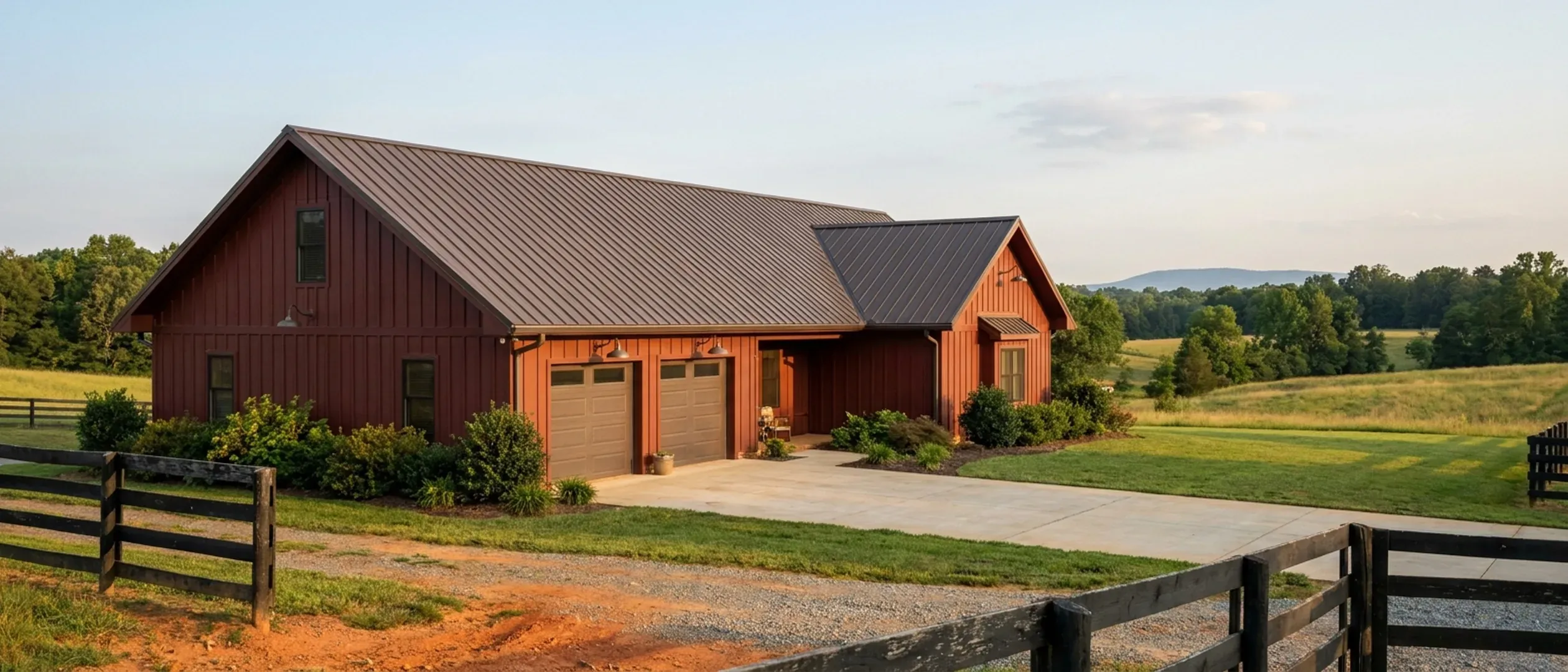
North Carolina Barndominium Law: The Farm Exemption and What It Buys You
Almost everything written about whether you can build a barndominium in North Carolina is a warning, and almost all of it misses the more interesting half of the answer. North Carolina's farm exemption does fail a dwelling — twice, and the second time in the operative sentence rather than by silence. But the reason it fails is that the General Assembly wrote building-code compliance into the exemption as a condition of it, and what the same statute grants in exchange is real and unusually generous: on a lot over ten acres in a majority-agricultural district a county may not prohibit your house, may not require road frontage, and may not make you connect to public water or sewer. That is a bargain, not a prohibition. You get the land-use right; code compliance is what you pay for it. This page sets out the statutes that produce that result, the one code that applies across the whole state, and the licensing rules that decide who may lawfully do what — with the counties that reprint the same provisions in their own ordinances. It states the law rather than anybody's credentials, and it is not legal advice; a North Carolina construction lawyer is the right reader for your specific facts.
Figures on this page are cited third-party or government data, not a quote from North Carolina Barndominium Builders.
The bargain at the centre of North Carolina's answer
Two statutes decide this, and they have to be read together. One is in the building-code chapter and one is in the planning and development chapter, and conflating them is where buyers get hurt — zoning and the building code are different instruments and their exemptions behave differently.
A farm building is defined as nonresidential, in the definition's first clause
N.C.G.S. § 143-138(b4) provides that building rules do not apply to farm buildings located outside the building-rules jurisdiction of any municipality, to greenhouses and therapeutic equine facilities inside one, to a primitive camp, or to a primitive farm building. Then § 143-138(b4)(1) defines the central term: a "farm building" means any nonresidential building or structure that is used for a bona fide farm purpose as provided in G.S. 160D-903(a). A building you intend to live in is outside that definition from the first adjective, however genuine the farm, however many acres, and whatever the county's zoning map says. The exemption people plan around never attaches to a dwelling at all.
And the zoning exemption grants the right on an express condition
N.C.G.S. § 160D-903(a) provides that county zoning regulations may not affect property used for bona fide farm purposes, and then defines what counts: activities incident to the farm include existing or new residences "constructed to the applicable residential building code" situated on the farm and occupied by the owner, lessee or operator, together with other buildings sheltering or supporting the farm use. Read that clause slowly. The farm residence does get a zoning exemption — and the statute writes the code requirement into the grant itself. The legislature closed the loop deliberately: you cannot use the farm to escape the Residential Code, because the sentence that exempts the farm residence from zoning only reaches residences already built to that code.
So the honest framing is a bargain, and this is what you actually get
N.C.G.S. § 160D-903(b) provides that a county zoning regulation shall not prohibit single-family detached residential uses constructed in accordance with the North Carolina State Building Code on lots greater than 10 acres in size, in zoning districts where more than fifty percent of the land is in use for agricultural or silvicultural purposes — with an exception for commercial and industrial districts permitting a broad variety of uses. The same subsection provides that a zoning regulation shall not require that a lot greater than 10 acres have frontage on a public road or a county-approved private road, or be served by public water or sewer lines, in order to be developed for single-family residential purposes. That is a statutory right rather than a local courtesy: no zoning prohibition, no forced frontage, no forced utility connection. The condition attached to every limb of it is the same phrase — constructed in accordance with the Code.
Counties reprint the same bargain in their own ordinances
This is not an academic reading of a statute nobody applies. Stanly County's Article III § 302 exempts a bona fide farm from the zoning ordinance — crop, timber and pasture land, farm buildings, and housing occupied by the farm owner, relatives or employees — and defines a bona fide farm by reference to G.S. 160D-903. Surry County's § 154.002-04, "Bona Fide Farms Exempt", adopted 17 April 2023, carries the operative sentence over word for word, including the requirement that residences be constructed to the applicable residential building code. Three counties, one statute, the same condition, all of it published by the jurisdictions themselves.
And one county puts the whole barndominium question on its fee schedule
The first thing printed on Camden County's building fee schedule is not a fee. It is a statement that on a qualifying bona fide farm a building permit is exempt unless any electrical installation is performed, any portion of the building is used for sleeping quarters, or the building is used for business rather than the personal use of the farmer and immediate family — naming Section 160D-903 of the General Statutes for the definition. A pole barn on a working farm can sit outside the permit. The moment it has a bedroom in it, or wiring, it does not. That is the entire question answered in a county's own document, and it matches the statutes exactly.
What proves a bona fide farm purpose, and it is a lower bar than people expect
§ 160D-903(a) says any of the following is sufficient evidence that property is being used for bona fide farm purposes, and that other evidence may also be considered: a farm sales tax exemption certificate issued by the Department of Revenue; a copy of the property tax listing showing the property is eligible for the present-use value program under G.S. 105-277.3; a copy of the owner's or operator's Schedule F from their most recent federal income tax return; or a forest management plan. Note both halves of that — any one is enough, and the list is a safe harbour rather than an exhaustive test. A forest management plan alone qualifies, which matters on timberland.
The wedding barn keeps the exemption; the barn you sleep in does not
§ 143-138(b4)(1a) provides that a farm building shall not lose its status as a farm building because it is used for public or private events, including weddings, receptions, meetings, demonstrations of farm activities, meals and other events taking place on the farm because of its farm or rural setting. § 160D-903(a) carries parallel agritourism language. So renting the barn out for events does not break the building-code exemption — and putting a bed in it does, because § 143-138(b4)(1) still says nonresidential. That is a sharp, checkable line and it runs in the opposite direction to most people's intuition.
Agritourism status carries a three-year clawback, measured forward
§ 160D-903(a) makes a building used for agritourism a bona fide farm purpose where the property is owned by a person holding a qualifying farm sales tax exemption certificate under G.S. 105-164.13E(a) or is enrolled in the present-use value program under G.S. 105-277.3 — and provides that failure to maintain those requirements for three years after the building was originally classified subjects it to the county's zoning and development ordinances in effect on the date the property no longer meets them. Not the ordinances in force when it was built. Letting an enrolment lapse inside three years exposes the building to whatever the county has adopted since.
One code, statewide — and the sentence you should not write
North Carolina's preemption is tighter than most states', and it produces a correction worth making explicitly, because the natural sentence to write here is false.
The Code applies throughout the State
N.C.G.S. § 143-138(e) provides that, except as otherwise provided in the section, the North Carolina State Building Code shall apply throughout the State from the time of its adoption. The only things a political subdivision may adopt of its own are a fire prevention code and floodplain management regulations — and the fire prevention code is barred from applying to dwellings subject to the North Carolina Residential Code beyond what that Code prescriptively requires, and has no force or effect until the responsible Code Council approves it. There is no general local building-code amendment power at all. So North Carolina has no local amendments to its building code for anyone to go and check, and a page telling you otherwise is describing a different state's regime.
Floodplain regulation is the one genuine local variable
The same subsection expressly permits local floodplain regulations to govern all types and uses of buildings in flood hazard areas, and lists what they may reach: substantial improvements, substantial damage, cumulative substantial improvements, lowest floor elevation, protection of mechanical and electrical systems, foundation construction, anchorage, acceptable flood-resistant materials and other measures the subdivision considers necessary. Foundation construction and anchorage are on that list. So on flood-prone ground the local rule genuinely can drive how a barndominium's foundation is built, and freeboard above base flood elevation is a real county-by-county question. That is the place where "check your county" is honest advice on this subject.
The edition in force, and the one that is not
The Office of the State Fire Marshal publishes that the 2018 codes were effective from 1 January 2019 and are currently effective, which puts the 2018 North Carolina Residential Code in force. The 2024 collection has been delayed repeatedly and carries no effective date of its own: it takes effect twelve months after the first day of the month following a State Fire Marshal certification, by letter to the Revisor of Statutes, that the adopted Code has been published, printed and distributed and available for purchase, and that the Residential Code Council is fully constituted under G.S. 143-136.1. The Office of the State Fire Marshal has separately stated that the 2024 Code may be used as an alternative method of construction if requested by a building owner or their agent — so an owner may elect it voluntarily.
The cycle is frozen by statute at six years
§ 143-138(d) requires the Residential Code Council to perform a comprehensive review and revise or amend the North Carolina Residential Code only every six years, effective the first day of January of the following year, with at least six months between adoption and effective date, and provides that the first such revision shall be adopted to become effective 1 January 2031 and every six years thereafter. Anyone building between now and then is building to a code the legislature has deliberately locked down, which is an unusual degree of certainty and worth knowing.
Two councils, not one, and the distinction matters on a residential page
Since the 2023 reorganisation, § 143-138(a) gives the Building Code Council oversight of codes applicable to commercial and multi-family construction and the Residential Code Council oversight of codes applicable to residential construction, including the North Carolina Residential Code. On a house, the body is the Residential Code Council. Sources still naming the Building Code Council for residential work are describing the position before that split.
Zoning itself is optional in North Carolina
County zoning here is an authority rather than an obligation. On the UNC School of Government's 2019 count, 69 counties zoned countywide, 12 zoned part of their territory, and 19 had no county zoning program at all. So "is my land zoned?" is a genuine question in this state rather than a formality, and the historical pattern the School describes is counties zoning around cities, lakes and densely populated townships while leaving rural areas unregulated. Anyone naming a specific county as unzoned should be asked for the county's own document, because the published counts do not come with names attached.
The forty-thousand-dollar permit exclusion is not what it is repeated as
§ 143-138(b5) excludes a permit requirement for construction, installation, repair, replacement or alteration performed in accordance with the current edition of the Code and costing forty thousand dollars or less in a single-family residence, farm building or commercial building — unless the work involves any of six listed things. Those six are: the addition, repair or replacement of load-bearing structures; the addition or change in the design of plumbing; the addition, replacement or change in the design of heating, air conditioning or electrical wiring, appliances or equipment, other than like-for-like replacement of electrical devices and lighting fixtures; the use of materials not permitted by the Code; the addition, as opposed to replacement, of roofing; and any changes to which the North Carolina Fire Code applies. A shell-to-dwelling finish-out fails three of those six at once, which is why the headline number is the least useful part of the provision.
Who may lawfully do what
This section states what the statutes require of the people who work on your building. It describes the law rather than anybody's standing under it, and it is the part of the subject where the North Carolina rules differ most sharply from what buyers assume.
What makes someone a general contractor here
N.C.G.S. § 87-1(a) defines a general contractor as any person, firm or corporation who, for a fixed price, commission, fee or wage, undertakes to bid upon or to construct, or who undertakes to superintend or manage, the construction of any building or improvement where the cost of the undertaking is forty thousand dollars or more — or who undertakes to erect a North Carolina labeled manufactured modular building meeting the North Carolina State Building Code. Note the measure: the threshold attaches to the cost of the undertaking. And note the second branch, which is joined by "or" and carries no dollar figure at all, so a modular building cannot be reasoned under a threshold that does not exist on that branch.
The permit counter is the real enforcement gate
§ 87-14(a)(1) requires an applicant for a building permit, where the cost is to be forty thousand dollars or more, to furnish satisfactory proof to the inspector that the applicant, or another person contracting to superintend or manage the construction, is licensed under Article 1 to carry out or superintend the construction, or is exempt from licensure under G.S. 87-1(b). § 87-14(b) makes it unlawful for the inspector to issue the permit otherwise, and makes a building inspector who violates the section guilty of a Class 3 misdemeanor subject only to a small statutory fine. A barndominium is essentially always above the threshold, so there is no route on which an unlicensed non-owner quietly pulls the permit.
§ 87-13 is about the claim, not the work — and it reaches implication
N.C.G.S. § 87-13 makes it a Class 2 misdemeanor for anyone who falsely claims or suggests, in connection with any business activities regulated by the Board, that a person, firm or corporation is licensed under the Chapter. The verb to notice is "suggests", which reaches implication and not only assertion — a badge, a shield, a stray adverb. When you are reading anyone's marketing in this state, the statute has already told you how much weight a claim of that kind is meant to carry, and the check is a public one: the Licensing Board for General Contractors runs a public licence search, and every North Carolina general contractor licence expires on 1 January, so the year matters as much as the number.
An unlicensed contractor cannot enforce its own contract
In Brady v. Fulghum, 309 N.C. 580 (1983), the North Carolina Supreme Court held that an unlicensed contractor may not enforce its own construction contract, and that the defect cannot be cured by obtaining a licence later. That is a consumer protection with a simple practical instruction attached: verify before signing, not afterwards. A related point worth knowing is that licensure here carries no insurance requirement of its own — § 87-10(a) and 21 NCAC 12A .0204 set financial responsibility as working capital or a surety bond, and a surety bond protects the customer rather than the contractor. Cover is a contract term to agree in writing, not something a licence number tells you.
The classification question almost nobody publishes
A North Carolina licence carries a classification and a limitation, and they answer different questions. The classification says what may be built — a Residential classification covers buildings governed by the Residential Code, while a Building classification is what is needed once a structure steps outside it, which a large shop, an event barn or a genuinely mixed use can do. The limitation — Limited, Intermediate or Unlimited — says how much may be undertaken per project. A licence reads as both at once. If your building has a commercial half, the classification is a question worth asking before the contract rather than at the permit counter.
The owner-builder route, and the affidavit that goes with it
§ 87-1(b)(2) exempts a person who constructs or alters a building on land they own, provided the building is intended solely for occupancy by that person and their family after completion and provided they comply with § 87-14. § 87-14(a)(1) sets out the verified affidavit that condition requires: that the applicant owns the property; that the applicant will personally superintend and manage all aspects of the construction and will not delegate that duty to any person not licensed under the Article; and that the applicant will be personally present for all inspections required by the Code, unless the plans for the building were drawn and sealed by an architect licensed pursuant to Chapter 83A of the General Statutes. The inspector transmits the affidavit to the Board, which shall verify entitlement, and where the applicant was not entitled the permit shall be revoked under G.S. 160D-1115.
Two things that are commonly misstated about that exemption
First, the twelve-month rule is a presumption rather than a ban: § 87-1(b)(2) provides that if the building is not occupied solely by that person and their family for at least 12 months following completion, it shall be presumed that they did not intend it solely for their own occupancy. That flips a burden of proof; it does not forbid a sale. Second, § 87-1(b) as printed carries no cap of one structure per year and no acreage or square-footage limit, which some states do impose. And the exemption is from Article 1 only — its own affidavit permits delegation solely to persons licensed under that Article, and it does not touch the trade articles at all.
Electrical, plumbing, heating and fire sprinklers are separate chapters and separate people
§ 87-43 provides that no person shall engage, or offer to engage, in the business of electrical contracting without holding the licence that article requires, and § 87-21(a)(5) reaches a person who installs or offers to install plumbing, heating or fire sprinkler systems. Those verbs are wider than the general contractor article's, and the practical consequence for anyone building here is straightforward: that work is performed by people holding those licences, and the owner-builder exemption does not reach it. § 143-138(b5) makes the same point from the other direction, by excepting plumbing, heating, air conditioning and electrical design changes from the minor-work permit exclusion.
Architects and engineers are treated asymmetrically, and the asymmetry costs money
§ 83A-13(c)(1) exempts a family residence, up to eight units attached with grade-level exit and not connected to other buildings, from the architect requirement, and § 83A-13(c)(2) exempts a building upon a farm for a farmer's use unless its nature substantially involves public health or safety — which the Board of Architecture reads as excluding a farm building open to or used by the public for assembly. § 83A-13(d) further provides that nothing in the chapter prevents an individual from making plans for buildings for himself, which the Board conditions on being the record owner, personally preparing and signing the plans, and keeping a possessional interest after construction; it is unavailable to a corporation. But § 89C-25, which lists the eleven activities the engineering chapter does not prevent, contains no residential, square-footage or dollar-value exemption at all — the two subdivisions most likely to have carried one were repealed in 2011 and a third in 2014. You may design a North Carolina house without an architect. Where Section R301.1.2 of the 2018 North Carolina Residential Code pushes an other framing system outside the prescriptive tables, there is no residential exemption covering the structural engineering.
The traps that cost the most
Each of these is built from statutory text rather than from anecdote, and each one is a decision made early that becomes expensive late.
Build the barn now, live in it later — the trap that has no grandfather clause
The sequence is familiar. A pole barn or steel shop goes up on the farm as a farm building under § 143-138(b4), outside a municipality, so building rules do not apply and no permit or inspection occurs. Living space is finished inside it later. At that moment it is no longer a farm building, because § 143-138(b4)(1) defines one as nonresidential, and the exclusion evaporates. What remains is a dwelling that must comply with the North Carolina Residential Code — and that was never inspected at footing, foundation, framing, rough-in or insulation, every one of which is an inspection of work now concealed. Nothing in § 143-138(b4) grandfathers a farm building into residential compliance: the exclusion is drafted as a description of what the building is and is used for, in the present tense. Change the use and you change the answer. § 160D-903(a) does not rescue it either, because that exemption reaches only residences constructed to the applicable residential building code.
The extraterritorial trap, which the mailing address hides
§ 143-138(e) provides that municipal jurisdiction includes areas within the corporate limits and extraterritorial jurisdiction areas established under G.S. 160D-202 or a local act, and county jurisdiction covers all other areas. The farm-building exclusion in § 143-138(b4) requires the building to be outside the building-rules jurisdiction of any municipality — so on rural land inside a town's extraterritorial area, the building-code exemption is gone even though the parcel is unincorporated and looks and feels rural. § 160D-903(c) preserves the zoning exemption for bona fide farm property in a city's extraterritorial jurisdiction, and expressly leaves county floodplain regulation applying. Two different instruments, two different answers, on the same acre.
Whether a city extends the accessory-building exemption is a city question
§ 160D-903(d) provides that a city may provide in its zoning regulation that an accessory building of a bona fide farm has the same exemption from the building code as it would have under county zoning. The verb is "may". So inside a municipality, whether an accessory farm building escapes the building code depends on what that city has actually adopted, and it is one of the genuinely city-by-city questions on this subject rather than one of the false ones.
Exemption does not mean nobody ever comes
Even a qualifying farm building remains subject under § 143-138(b4) to an annual safety inspection of any grandstand, bleachers or other spectator-seating structure. The commodity and materials storage category in § 143-138(b4)(1)d. carries its own placard duty, requiring a sign not less than 24 inches by 24 inches with a red background, white reflective stripes and a white reflective border, displaying the words "Ag. Exempt" in white reflective letters not less than 12 inches tall. "Exempt" is a description of which rules apply, not a description of being left alone.
And the rights a permit brings, which are the other side of the bargain
Paying the price of code compliance buys a set of statutory protections that go with the permit. § 160D-1104(c) prohibits an inspector from requiring affidavits attesting to Residential Code compliance in lieu of conducting the required inspections. § 160D-1104(d) bars a local government from requiring extra routine inspections without Residential Code Council approval, bars routine exterior sheathing inspections where the ultimate wind speed is less than 140 miles per hour, and bars a fee for re-inspecting items the department already approved. § 160D-1104(d2) bars a fee or a failed inspection where the permit holder cancels more than one business day ahead. § 160D-1104(e) requires the supervisor's name, phone number and email address on each permit. And § 143-139(b)(2) requires the State Fire Marshal to assign an official from the state marketplace pool where a required inspection has not been carried out.
Reading this because you are weighing a build? The next step is a plan drawn for your program.
What's different about North Carolina
The farm exemption fails a dwelling twice, and the second time affirmatively
§ 143-138(b4)(1) defines a farm building as any nonresidential building or structure used for a bona fide farm purpose. § 160D-903(a) then grants the farm-residence zoning exemption only to residences constructed to the applicable residential building code.
What the bargain actually gives you is a statutory right
§ 160D-903(b) bars a county from prohibiting a single-family detached dwelling on a lot over 10 acres in a majority-agricultural district, from requiring public-road or county-approved private-road frontage, and from requiring public water or sewer — for a dwelling built to the Code.
One code, statewide, with no local amendment power
§ 143-138(e) makes the State Building Code apply throughout the State. A local government may adopt only a fire prevention code, which cannot reach one- and two-family dwellings beyond the Residential Code's prescriptive requirements, and floodplain management regulations.
The 2018 Residential Code is in force and the 2024 edition has no effective date
The Office of the State Fire Marshal publishes the 2018 codes as currently effective. The 2024 collection turns on a State Fire Marshal certification, and an owner may elect it now as an alternative method of construction.
Zoning is permissive here, so the land-use answer starts with whether the land is zoned
On the UNC School of Government's 2019 count, 69 counties zoned countywide, 12 partially and 19 not at all. The counts are published; the names are not, so ask any county for its own ordinance.
The permit threshold sits at the permit counter
§ 87-14(a)(1) requires proof of licensure or a § 87-1(b) exemption before a permit issues on an undertaking of forty thousand dollars or more, and § 87-14(b) makes issuing one otherwise unlawful for the inspector.
There is an architect exemption for a residence and no engineer exemption at all
§ 83A-13(c)(1) exempts a family residence from the architect requirement. § 89C-25's eleven carve-outs include no residential exemption, and two of them were repealed in 2011 with a third in 2014.
Pros and cons, honestly
Pros
- The land-use right in § 160D-903(b) is real and generous: on a lot over 10 acres in a majority-agricultural district a county may not prohibit the dwelling, require road frontage, or require a public water or sewer connection.
- The condition attached to that right — construction in accordance with the North Carolina State Building Code — is a single, knowable, statewide document rather than a hundred local variants.
- Because § 143-138(e) preempts local building-code amendments, a design does not change at a county line, so plan review is a repeatable exercise rather than a research project.
- Proving a bona fide farm purpose is a lower bar than most people expect: § 160D-903(a) treats a forest management plan, a Schedule F, a present-use value listing or a farm sales tax exemption certificate as each sufficient on its own.
- A farm building does not lose its status by hosting weddings, receptions, meetings or meals under § 143-138(b4)(1a), so an event use and an exempt building can coexist.
- § 143-138(d) freezes the residential code onto a six-year cycle with the next comprehensive edition dated 1 January 2031, which is an unusual amount of regulatory certainty to build against.
- The permit brings statutory rights with it under § 160D-1104 — no affidavits in place of inspections, no invented routine inspections, no fee to re-inspect what already passed, and the supervisor's contact details on the permit.
Cons
- A dwelling is never a "farm building" under § 143-138(b4)(1), so no amount of genuine farming exempts the house from the building code.
- The zoning exemption for a farm residence in § 160D-903(a) reaches only residences constructed to the applicable residential building code, so it cannot be used to avoid the code either.
- Rural land inside a town's extraterritorial jurisdiction is inside that town's building-rules jurisdiction, which removes the farm-building exclusion even though the mailing address looks rural.
- Finishing living space inside an uninspected farm building leaves a dwelling whose concealed work was never inspected, and nothing in the statute grandfathers it into compliance.
- Agritourism status carries a three-year clawback that exposes the building to the county ordinances in force on the day it stops qualifying, not the ones in force when it was built.
- There is no residential exemption from the engineering chapter, so where the prescriptive code does not reach a post-frame or steel building the structural design has to be done by someone qualified to do it.
- § 87-13 makes claiming or suggesting licensure a criminal matter, which means marketing language is not evidence of anything and the public licence search is the only check worth relying on.
- The forty-thousand-dollar minor-work permit exclusion is repeated far more often than its six exceptions, and a shell-to-dwelling finish-out fails three of them at once.
Is a barndominium legal in North Carolina?
What does building to the code actually get me on farm land?
Can I put up the shop first and finish the living space later?
Do I need to check my county's building code amendments?
Which edition of the code applies to my build?
Do I have to hire a licensed general contractor?
Does an engineer have to be involved?
Is my land even zoned?
Questions answered? Tell us what you want to build and we will put real numbers against it.
Keep reading
The pages that answer the next question this one raises.
Permitting
How the statutes on this page turn into a stack of documents, and the order each county puts them in.
Read itBuild timeline and sequence
Where the septic Construction Authorization, the erosion plan and the engineered drawings land on a real schedule.
Read itFinancing, appraisal and insurance
Why the code-compliant, inspected version of the same building is the one a lender and an appraiser can work with.
Read itCustom plans
Drawings prepared for the code edition in force, the parcel's own design values, and the county that will review them.
Read itStanly County
A county whose zoning ordinance exempts a bona fide farm by direct reference to G.S. 160D-903.
Read itSurry County
A county that reprints the "constructed to the applicable residential building code" condition word for word.
Read itPasquotank and Camden Counties
Where a county fee schedule opens with the farm exemption and stops it at a bedroom or a wire.
Read itWant a real number instead of a range?
Start your plans and we will come back with a budget for what you actually want to build, not a national average. Send the parcel ID or an address when you have one and we will price it against your land. That conversation costs nothing.