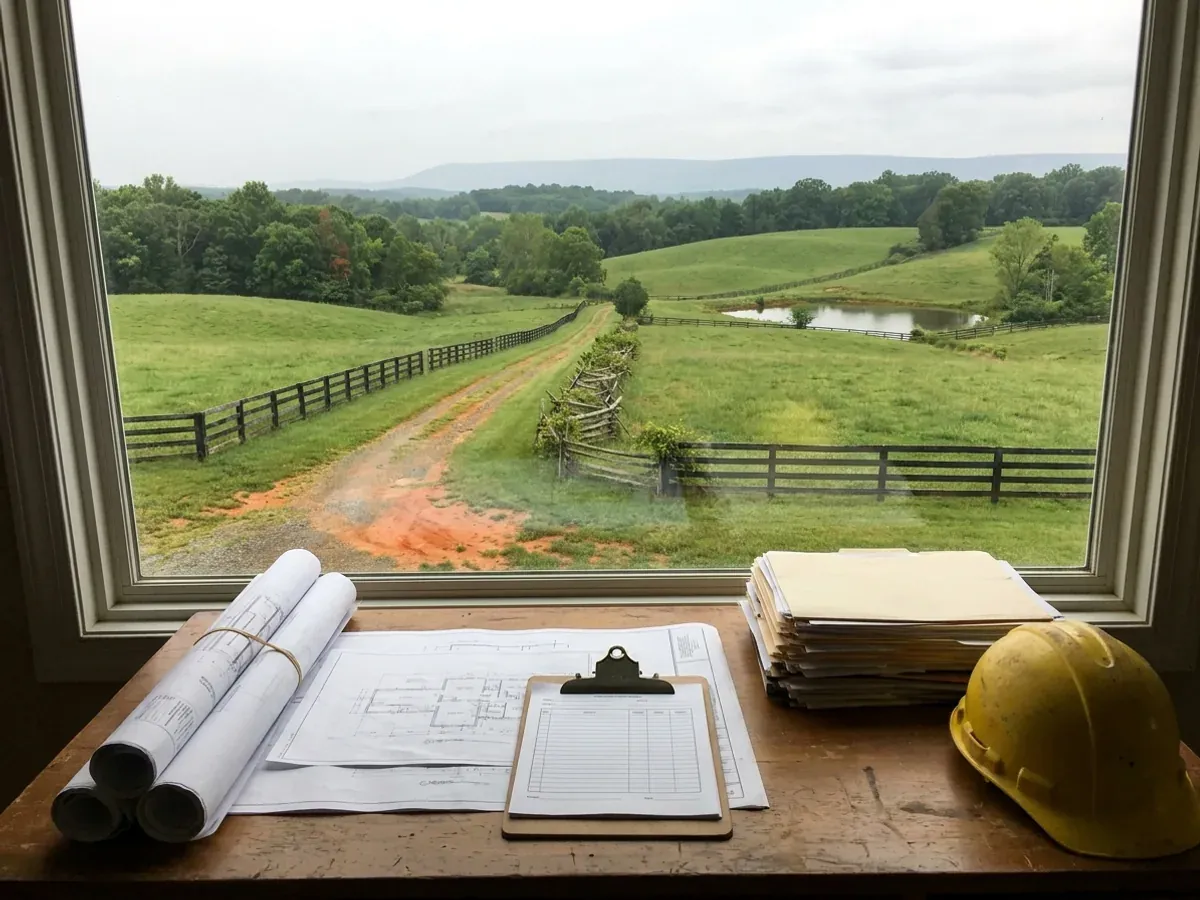
Permitting & Engineering in NC
North Carolina does not work the way most permit advice assumes. G.S. § 143-138(e) provides that the North Carolina State Building Code shall apply throughout the State, and the only codes a city or county may adopt of their own are a fire prevention code and floodplain management regulations — so there is no set of county building-code amendments to go and check. What changes from one parcel to the next is who enforces that single code on your land, which of its county-specific numbers apply to your site, and whether the package handed across the counter already carries the approvals it depends on.
How a permitting & engineering project runs
Four stages, in this order. The sequence matters more than it looks: getting engineering and permitting settled before anything is fabricated is what keeps a build from stalling.
Establish who actually has jurisdiction
This is the first question and it is not answered by a mailing address. § 143-138(e) states that municipal jurisdiction includes all areas within the corporate limits and the extraterritorial jurisdiction areas established under G.S. 160D-202, and that county jurisdiction covers all other areas of the county. A city's ETJ reaches one, two or three miles beyond its limits depending on population, and inside it the city enforces zoning, subdivision regulation and the building code — while city property tax and city voting do not follow. So a rural-feeling tract with a county address can be a city's file. Zoning is a separate instrument again, and in North Carolina it is permissive rather than mandatory: on UNC School of Government's 2019 count, most counties zone countywide, some zone only parts, and a number have no county zoning at all.
Name the edition, then read the numbers that belong to the site
The 2018 North Carolina Residential Code, effective 1 January 2019 and based on the 2015 IRC, is the edition in force — the Office of the State Fire Marshal lists the 2018 codes as currently effective on its own codes page. The 2024 collection has been delayed repeatedly and has no effective date; under the current delay provision it takes effect twelve months after the State Fire Marshal certifies both publication of the code and that the Residential Code Council is fully constituted. An owner may nonetheless elect the 2024 Code as an alternative method of construction. That matters because the two editions do not agree on every county, so every design figure gets its edition named alongside it.
Assemble the package around its prerequisites
A North Carolina permit application sits on top of approvals that have to exist first, and this is where rural projects stall. 15A NCAC 18E .0201(c) provides that upon issuance of the septic Construction Authorization the applicant may obtain a building permit, so the county health department is ahead of the inspections department in the queue. Where land disturbance on the tract exceeds one acre, the erosion and sedimentation control plan must be approved before work begins. Then the drawings themselves: sealed structural engineering where the frame leaves the prescriptive code under R301.1.2 and R301.1.3, foundation and anchorage detail, and, in a mapped flood hazard area, the elevation documentation the local floodplain ordinance requires.
Inspections, and the rights the permit carries
Inspections happen at the stages the Code fixes, on work that is about to be concealed, and § 160D-1104 gives the permit holder a set of statutory protections almost nobody publishes. An inspector is prohibited from requiring an affidavit attesting to Residential Code compliance in lieu of conducting a required inspection. A local government may not require routine inspections beyond those the Code specifies without Residential Code Council approval. Items already approved cannot be re-inspected for a fee. And the name, phone number and email address of each inspector's supervisor must be provided in or with each permit the department issues, along with notice of its informal internal review process.
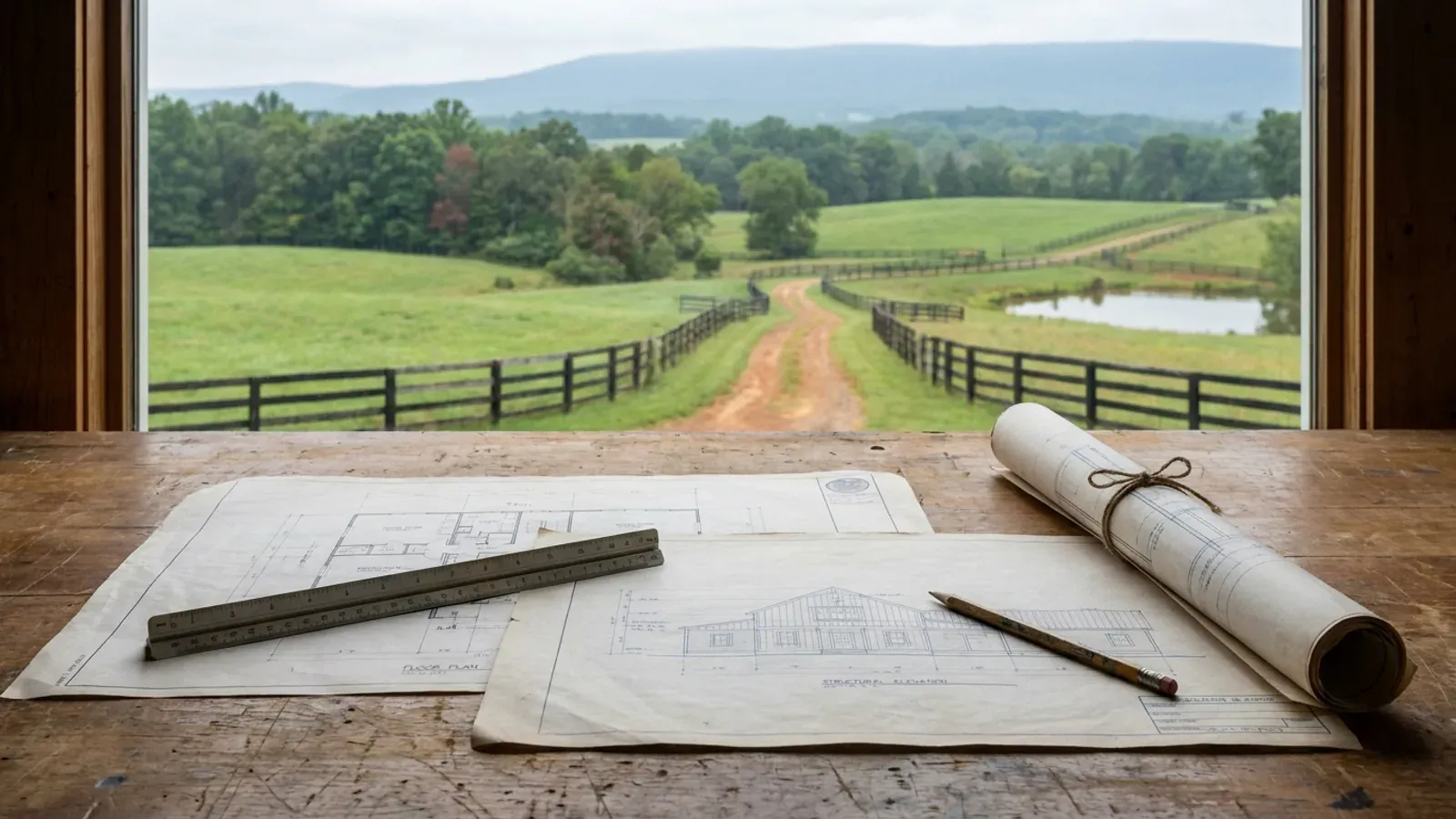
In NC the code is the same everywhere. Whose jurisdiction your land is in is not.
Two sentences of statute do most of the work here, and together they overturn the advice buyers usually get. The first is G.S. § 143-138(e): except as otherwise provided in that section, the North Carolina State Building Code shall apply throughout the State, and the only things a political subdivision may adopt of its own are a fire prevention code and floodplain management regulations — with the local fire code itself barred from reaching one- and two-family dwellings beyond what the Residential Code prescriptively requires, and void until the responsible Code Council approves it. There is no general local building-code amendment power in North Carolina. A county cannot adopt a stricter foundation, framing, structural or energy requirement for a house. So "check your county's amendments," which is what a reader will have been told everywhere else, describes a power North Carolina counties do not have. The second sentence is in the same subsection and it is the one worth acting on: municipal jurisdiction includes all areas within the corporate limits and the extraterritorial jurisdiction areas established as provided in G.S. 160D-202, and county jurisdiction includes all other areas of the county. Extraterritorial jurisdiction extends a city's reach beyond its own limits — one mile for a city under 10,000 people, two miles from 10,000 to 24,999, three miles at 25,000 or more, measured from the contiguous corporate boundary — and county commissioner approval is required to go past the first mile or where the county already exercises both zoning and subdivision authority there. Inside that ring the city enforces zoning, subdivision regulation, the building code and minimum housing standards. What does not follow the ring is just as striking: city property tax does not apply, and residents of an ETJ cannot vote in city elections. G.S. 160D-307 answers that partly by requiring a proportional number of ETJ residents on the city's planning board and board of adjustment, appointed by the county commissioners. The practical point for anyone buying land in North Carolina is simple and checkable: a rural-looking parcel with a county mailing address can be under a city's rules, and the address will not tell you. Ask which department has building-rules jurisdiction over the parcel before you make an offer, not after.
Where we deliver permitting & engineering
In North Carolina the city limit is a real boundary, but not the one most people expect. There are no independent cities here — every municipality sits inside one of the 100 counties — and under § 160D-202 a city runs zoning, subdivision and the building code one to three miles beyond its own limits, on a scale set by population, while city taxes and city elections stop at the corporate line. Land that looks entirely rural can be inside that extraterritorial jurisdiction, and the mailing address will not tell you. The code itself is not what changes when you cross the line: the State Building Code applies on both sides and enforcement is mandatory everywhere. What changes is who reviews the drawings, what they charge, how the land is zoned, and the ultimate design wind speed the code publishes for your county. Two parcels twenty miles apart can carry completely different engineering.
Serving clients across the entire region.
Every jurisdiction we build in has its own reviewer and its own fee schedule, and the code sets a different design wind speed county by county. The service area pages set out what applies where.
What actually decides the price
Square footage is the number everyone leads with, and it is rarely the one that moves a barndominium budget. These four do.
-
Which department has jurisdiction — and whether that is a surprise
Fee schedules, review queues and submittal formats belong to the issuing department, and which department that is depends on corporate limits and extraterritorial jurisdiction rather than on the postal address. Wake County's published permits and inspections fee schedule, for example, sets a residential permit fee of $75 plus $0.25 per square foot of gross floor area, states that the fee includes all trades and the temporary electrical construction pole if needed, and measures gross floor area inside the perimeter of the exterior walls with no deduction for garage — so on a barndominium the shop bay is inside the fee base. Its schedule also lists a $10 Homeowner Recovery Fee. A neighbouring city's schedule is its own document with its own arithmetic.
-
How far outside the prescriptive code the structure sits
The engineering scope, not the paperwork, is what usually moves this number. Section R301.1.2 provides that the code's requirements are based on platform and balloon-frame construction and that other framing systems must have equivalent detailing to ensure force transfer, continuity and compatible deformations; R301.1.3 sends elements exceeding the limits of R301 to accepted engineering practice, or permits whole-building design to the International Building Code. There is no residential shortcut around that engineering: § 83A-13(c)(1) exempts a family residence from needing an architect, but § 89C-25 contains no residential exemption from the engineering chapter — the subdivisions that would have supplied one were repealed in 2011 and 2014.
-
Whether the parcel is in a mapped flood hazard area
This is the one place on a North Carolina residential page where "it depends on your county" is honest. § 143-138(e) expressly preserves local floodplain regulation, and its list of what those regulations may govern includes lowest floor elevation, protection of mechanical and electrical systems, foundation construction, anchorage, acceptable flood-resistant materials and other measures the subdivision deems necessary. So a local floodplain ordinance genuinely can drive how the foundation is built. Freeboard above base flood elevation is locally adopted rather than a statewide residential mandate, so the figure comes from the ordinance that governs the parcel and is cited to it.
-
Which edition the design is drawn to, and which county numbers apply
The 2018 Residential Code governs and the 2024 edition may be voluntarily elected, and the two do not carry identical figures — they differ on the ultimate design wind speed for Bertie, Brunswick, Duplin, New Hanover, Onslow and Pender, and on the seismic design category for four counties. Granularity below the county line matters too. In the 2018 edition's Table R301.2(4), New Hanover County is a 140 mph zone west of Highway 17 and a 150 mph zone east of it, Dare County splits on U.S. 264, and Cumberland splits on I-95; Table R301.2(5) sets the figure for twelve mountain counties by first floor finish elevation rather than by county at all. Which side of a named road a lot sits on is a design input.
Permitting & Engineering in NC: common questions
8 questions we get asked most often about building in NC. If yours is not on the list, ask it directly.
Which county building-code amendments do I need to check before I design?
Which edition of the code is actually in force right now?
My land is outside any city limits. Who issues my permit?
Do I need zoning approval as well as a building permit, and what if my county has no zoning?
Can I pull the permit myself as the owner?
What inspections will my county require, and what is it not allowed to require?
What happens if the county inspector will not come out?
What is a barndominium permit likely to involve at the counter?
Keep reading
The pages that answer the next question this one raises.
Is It Legal in NC?
One statewide code, county zoning under Chapter 160D, and why a farm building is defined as nonresidential.
Read itHow Long Does It Take?
Where the permit sits in the schedule, and the extra inspections a local government is not allowed to add.
Read itWhere We Build
Which authority actually reviews your parcel, city by city.
Read itReady to put permitting & engineering against a real plan? Start there and the rest follows.
Tell us about the land
Send the parcel ID or an address and we will come back with what can be built on it, the wind load it has to meet, and a realistic budget range. That conversation costs nothing.