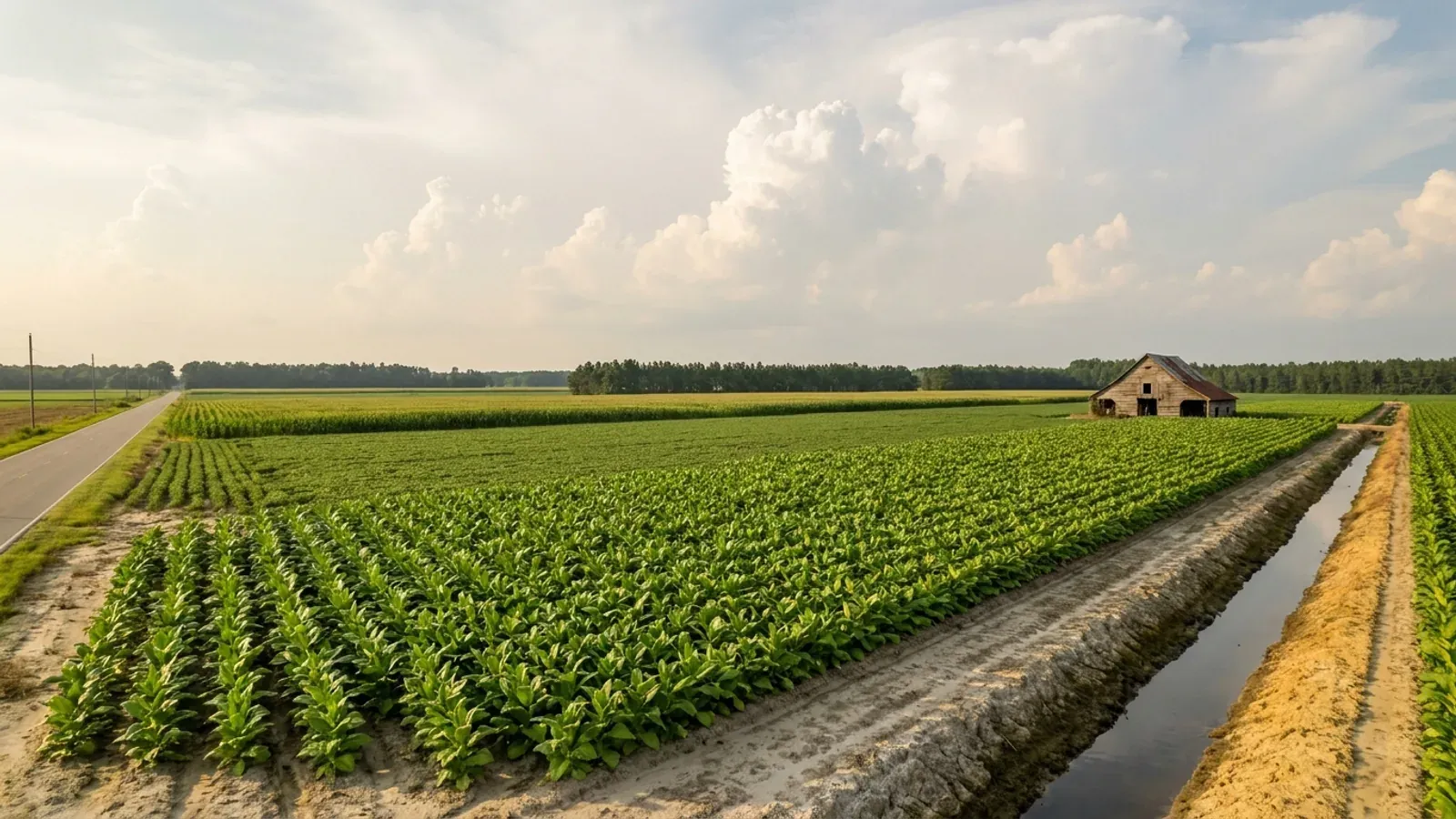
Flat eastern North Carolina cropland with long rows of green tobacco in grey-tan sandy soil, a straight field-edge ditch, dark loblolly pine windbreaks and a derelict tobacco barn in the distance.
Craven County 2018 NC Residential Code, statewide

Barndominium Builders in New Bern, NC

New Bern sits where the Trent runs into the Neuse, and almost everything that makes building here different from building in the Piedmont follows from that one geographic fact. Start with the design number, because Craven County has a simple one: Table R301.2(4) of the 2018 NC Residential Code names Craven at a flat 140 mph, with no road split and no waterway split, and both the 2018 and the 2024 editions agree on it. Craven is also absent from Table R301.2(7), so seismic sits in Category A or B. The complications are all about water. The Neuse riparian buffer rule at 15A NCAC 02B .0714 puts 50 feet — 30 feet of undisturbed vegetation and 20 feet of stable vegetation — along both sides of any intermittent or perennial stream that is approximately shown on the NRCS soil survey or the USGS National Map, whether or not anything is visible on the ground. Inside the twenty coastal counties, and Craven is one of them, that buffer is measured from the more restrictive of normal high water level and normal water level, which is not how it is measured upstream. The remedy is an on-site determination, and under this particular rule it expires five years from its date. Then there is flood. The city's own floodplain page records that Hurricane Florence came ashore in 2018 as a Category 1 with a wind field large enough to break all-time high-water records here: a storm surge of 10.41 feet and rainfall reaching 16 inches, producing some of the worst flooding the area has seen. That is not a marketing point, it is the reason New Bern's flood damage prevention ordinance carries a substantial-damage test that counts two flood events across ten years, not just one. Permitting is the city's own: the Inspections Division at 303 First Street handles building construction inside the city limits and inside New Bern's extraterritorial jurisdiction. Outside those, Craven County does. And the county has real land — 100,825 acres in farms, 22.3 percent of the county, at a median farm size of 65 acres, which is well above the state's 48.

New Bern at a glance

County
Craven County
City rules outside city limits
New Bern still exercises extraterritorial jurisdiction and enforces the building code inside it — the opposite of what is happening an hour down Highway 17 in Jacksonville.
Population
34,724
ZIP codes
28560, 28561, 28562, 28563, 28564, 28523, 28526, 28527, 28532, 28586
Site visits
Same week in New Bern and across Craven County

Building conditions in New Bern

The building code does not change at a county line here. Under § 143-138(e) the North Carolina State Building Code applies throughout the state, and a city or county may adopt only a fire prevention code and floodplain regulations of its own — there is no general local amendment power, so there are no county amendments to look up. The edition in force is still the 2018 NC Residential Code, effective 1 January 2019; the 2024 edition has been delayed three times and carries no effective date at all. What genuinely differs is who issues the permit and inspects the work, what that office charges, how the parcel is zoned, what the local floodplain ordinance requires of the foundation — and two design numbers the code publishes county by county, the ultimate design wind speed and the seismic design category. The rest of Table R301.2 is set once for everyone: a flat 20 psf roof live load, a 12-inch frost line, Moderate weathering, and termite protection required everywhere in the state with no exemption. There is no ground snow load column in the residential code at all.

Build conditions for New Bern , Craven County, North Carolina : ultimate design wind speed 140 mph. BUILD CONDITIONS NEW BERN, NCCraven County2018 NC RESIDENTIAL CODEULTIMATE DESIGN WIND SPEED140 mphTable R301.2(4) of the 2018 NC Residential Code names Craven County at a flat 140 mph — no roadsplit and no waterway split, unlike neighbouring Onslow — and the 2018 and 2024 editions agree on…WHO ISSUES THE PERMITCity of New Bern Inspections Division303 First Street. The city permits inside its limits and its ETJ;Craven County Planning & Inspections covers the balance of the…
Build conditions for New Bern, drawn from the sourced facts on this page. Every figure above is cited in the quick-facts panel below, with its source and vintage.
The Neuse buffer's on-site determination expires after exactly five years
New Bern sits on the Neuse, so 15A NCAC 02B .0714 is the buffer rule here, and it is not interchangeable with the other four in the state even though all five are 50 feet in two zones — 30 feet of undisturbed vegetation and 20 feet of stable vegetation. Under .0714(3)(a) a surface water is buffered if it is approximately shown on the most recent published NRCS soil survey stream layer, on the USGS National Map, or on other maps the Environmental Management Commission approves as more accurate. A blue line on a map puts the buffer on your land even where nothing is visible on the ground, and .0714(3)(g) states that no new clearing, grading or development may take place and no new building permits may be issued in violation of the rule. The remedy is the on-site determination at .0714(4), made by staff certified under G.S. 143-214.25A, which can release ditches, manmade conveyances, ponds with no stream connection and ephemeral streams. Two dates to hold onto and neither travels: this determination expires five years from its date, and the rule's existing-and-ongoing-use exemption runs from 22 July 1997. The Jordan rule at 02B .0267 has no expiry at all and a cutoff of 11 August 2009 — same geometry, different rule, different answer.

15A NCAC 02B .0714 and .0267, NC Office of Administrative Hearings, subchapter text read 5 September 2026.

Florence set the high-water record here, and the ordinance counts two floods, not one
The City of New Bern's own floodplain page states that the dominant sources of flooding here are storm surge and riverine flooding; that Hurricane Fran in 1996 brought winds just under 100 mph, an almost 10-foot storm surge and about 8 inches of rain; and that in 2018 Hurricane Florence came ashore as a Category 1 on the Saffir-Simpson scale but with a wind field massive enough to break all-time high-water records — a storm surge measured at 10.41 feet and rainfall reaching upwards of 16 inches, producing some of the worst flooding the area has experienced. That history is why the city's definition of substantial damage is worth reading before you buy a lot with an existing structure on it. It is not only the familiar single-event test at 50 percent of market value: it also captures flood-related damage sustained on two separate occasions in a ten-year period where the cost of repairs at each event averages 25 percent or more of the pre-damage market value. All new residential construction in the Special Flood Hazard Area must have the reference level elevated no lower than the Regulatory Flood Protection Elevation, and flood openings are required in enclosures below it. Permits are issued by Development Services at 303 First Street.

City of New Bern Development Services, Floodplain Development page, newbernnc.gov, read 6 September 2026.

43 percent of flooded buildings were outside the mapped floodplain
On 1 April 2026 the NC Department of Environmental Quality announced new advisory floodplain maps for five eastern North Carolina river basins — the Neuse, Lumber, Tar-Pamlico, White Oak and Cape Fear. New Bern is on the Neuse. The maps are explicitly advisory and nonregulatory, not used for legal or regulatory purposes, but they cover more ground than the FEMA regulatory maps do, including areas that flood while sitting well away from a stream. In the release DEQ Secretary Reid Wilson cites research finding that 43 percent of buildings flooded in the study period were outside the mapped FEMA floodplain. That is a state agency's own published figure and it answers the exact question a rural land buyer asks: the map says I am not in a flood zone, so am I safe? The department's answer is that the regulatory map is not the whole risk picture. For a specific parcel, North Carolina runs its own floodplain mapping program as a Cooperating Technical State rather than waiting on FEMA, and publishes both flood.nc.gov and a parcel-level lookup at fris.nc.gov showing effective and preliminary maps. Checking a lot takes about a minute and should happen before an offer, not after.

NC DEQ press release, 1 April 2026, "New advisory floodplain maps available for five Eastern North Carolina river basins", deq.nc.gov, body read 5 September 2026; NC Floodplain Mapping Program, flood.nc.gov, read 5 September 2026.

$550 for the first 1,000 square feet, trades billed separately, doubled if you start early
The City of New Bern's Schedule of Fees and Charges, effective 1 July 2026 and revised 9 June 2026, prices a new residential building permit at $550 for the first 1,000 square feet plus $0.25 per square foot over that. Unlike most North Carolina counties, New Bern does not fold the trades into that number: residential electrical is $75 plus $0.10 per square foot, plumbing $75 plus $10 per fixture, mechanical $125 per unit with ductwork at $75, gas piping $75 plus $20 per appliance and insulation $75, each as its own permit. Residential plan review is $75 and a reinspection is $75 each. A floodplain development permit is $100, a zoning compliance permit is $50 and the Homeowners Recovery Fee is $10. And under Administrative Fees the schedule carries one line worth remembering: starting work without a permit doubles the permit fee. For comparison, Craven County's own countywide schedule effective 1 September 2025 prices a residential building permit application at $0.17 per square foot with no fixed base — a completely different structure for a house a few miles outside the city line.

City of New Bern FY27 Schedule of Fees and Charges, effective 1 July 2026 (revised 06/09/2026), newbernnc.gov, extracted from the city's own PDF and read 6 September 2026 in two extraction modes that agree; Craven County Fee Schedule effective 1 September 2025, cravencountync.gov, read 6 September 2026.

Craven prices septic by bedroom count, not by system type
Outside the city, Craven County Environmental Health handles the soil work, and its schedule is organised around how many bedrooms the house has. The Soil Evaluation for an Improvement Permit is $200.00 for fewer than five bedrooms and $300.00 at five or more, and the Authorization to Construct a Septic System is again $200.00 under five bedrooms and $300.00 at five or more. Engineered plan review is $150.00 and a private well construction permit is $200.00. That basis matters because it is not how the neighbouring county does it: Onslow County prices the Improvement Permit at a flat $325 and then prices the Construction Authorization by the system type the soil turns out to require, on a ladder from $325 for Type I, II, IIIa and IIIc-g up to $1,000 for Type VI. In Craven the bedroom count on the plan drives the fee; in Onslow the soil does. The sequence is the same in both: 15A NCAC 18E .0201(c) provides that upon issuance of the Construction Authorization the applicant may obtain a building permit under G.S. 130A-338, so the septic file gates the building permit and sets the real start date.

Craven County Fee Schedule effective 1 September 2025, Environmental Health section, cravencountync.gov, extracted from the county's own PDF and read 6 September 2026 in two extraction modes that agree; Onslow County Environmental Health Fee Schedule FY 2026-2027, read 6 September 2026; 15A NCAC 18E .0201, NC Office of Administrative Hearings.

Craven County has the land New Bern does not
New Bern itself grew from a 2020 base of 31,319 to 34,724 on the 2025 estimate, and Craven County went from 100,726 to 105,025 — a 4.3 percent rise, with net migration of +4,585 over the period, which is more than the county's total gain and means people moving in rather than a natural increase carrying it. Unlike Onslow to the south, Craven has room: it ranks 33rd of North Carolina's 100 counties for land in farms, with 292 farms on 100,825 acres, 22.3 percent of a 707-square-mile county, at a median farm size of 65 acres against a statewide median of 48. Onslow, by comparison, is 67th at 10.9 percent and a 46-acre median. Density here is 149 people per square mile. The parcels are inland and west of the rivers — the Vanceboro, Cove City, Dover and Ernul side, up the Neuse and along N.C. 43 and U.S. 70 — where the ground is well away from any Area of Environmental Concern and the governing questions become septic, the mapped buffer and the flood map rather than CAMA. Jones County, immediately southwest and one of the least populated counties in the state at 20 people per square mile, holds 66,287 acres in farms at a median farm size of 116 acres.

U.S. Census Bureau Vintage 2025 population estimates for places and counties and 2025 Gazetteer land areas; USDA NASS 2022 Census of Agriculture county profiles.

Also worth knowing before you build in New Bern

Inside a coastal county the buffer is measured from a different line
This is the part of the Neuse buffer rule that catches people who learned it upstream. Rule .0714(8)(a) sets where Zone 1 begins, and it gives three cases. On intermittent and perennial streams it starts at the most landward limit of the top of bank or the rooted herbaceous vegetation and runs 30 feet on all sides, measured horizontally perpendicular to the stream — and where a stream begins, ends, goes underground, enters or exits a culvert, or enters or exits a wetland, the distance is taken as a radius around that point rather than as a strip. On ponds, lakes and reservoirs it starts at normal water level. And in the twenty Coastal Counties, within the Division of Coastal Management's jurisdiction, it starts at the most landward limit of the normal high water level or the normal water level, whichever is more restrictive. Craven County is one of the twenty named on NC DEQ's own CAMA Counties page, so that third case is the one that governs a New Bern parcel on tidal water. It can move the start of the buffer landward of where a Piedmont reading of the same rule would put it.

15A NCAC 02B .0714(8), NC Office of Administrative Hearings, read 5 September 2026; NC DEQ Division of Coastal Management, CAMA Counties page, deq.nc.gov, body read 6 September 2026.

Craven County publishes two different residential rates, a penny apart
This is small money and a large lesson. Craven County's Planning and Inspections fee page lists new construction or renovation, residential, at $0.18 per square foot. The countywide Craven County Fee Schedule effective 1 September 2025 lists the same thing, under Building Permit Application Fees citing G.S. 160D-1101, at $0.17 per square foot. Both are the county's own published documents, both were read on 6 September 2026, and the PDF figure was extracted in two modes that agree with each other. On a 3,000 square foot building the difference is thirty dollars, which nobody will notice — but the fact that a county's two published sources disagree at all is the reason to get a fee quoted at the counter rather than assembled from a website. The same schedule also draws a distinction that matters far more to a barndominium than a penny does: the building permit is priced per square foot, while insulation is priced at $0.06 per heated square foot and new construction mechanical at $0.10 per heated square foot. The word heated appears on some lines and not on others, in the same table. Ask which measurement the building line uses on your drawings before you budget.

Craven County Planning & Inspections, Fees page, cravencountync.gov, read 6 September 2026; Craven County Fee Schedule effective 1 September 2025, same host, extracted from the county's own PDF and read 6 September 2026.

There is a soil series named Craven, and it is clay, not sand
The USDA soil series called Craven has its type location in Craven County, four miles northwest of Vanceboro on N.C. 43, on the USGS Vanceboro quadrangle. Its Official Series Description, revised February 2026, classifies it as a fine, mixed, subactive, thermic Aquic Hapludult on Coastal Plain uplands formed in marine sediments: moderately well drained, medium surface runoff, and a saturated hydraulic conductivity class of moderately low. Depth to the seasonal high water table is 24 to 36 inches from December through April. The Bt horizons, from roughly 9 inches down to 46, are silty clay and clay described as very firm, sticky and plastic, with continuous clay films on the faces of peds. Depth to bedrock is greater than 60 inches and rock fragment content is 0 to 3 percent by volume. None of that is a reason not to build, but it does dispose of the assumption people bring east with them — that the Coastal Plain is all sand and digging is easy. On the Craven series it is firm clay with a winter water table two to three feet down and slow conductivity, which is exactly the combination that drives the septic design, and therefore the schedule.

USDA-NRCS Official Series Description, CRAVEN series, revised 02/2026, soilseries.sc.egov.usda.gov, read 6 September 2026. A bogus series name on the same host returned a genuine HTTP 404.
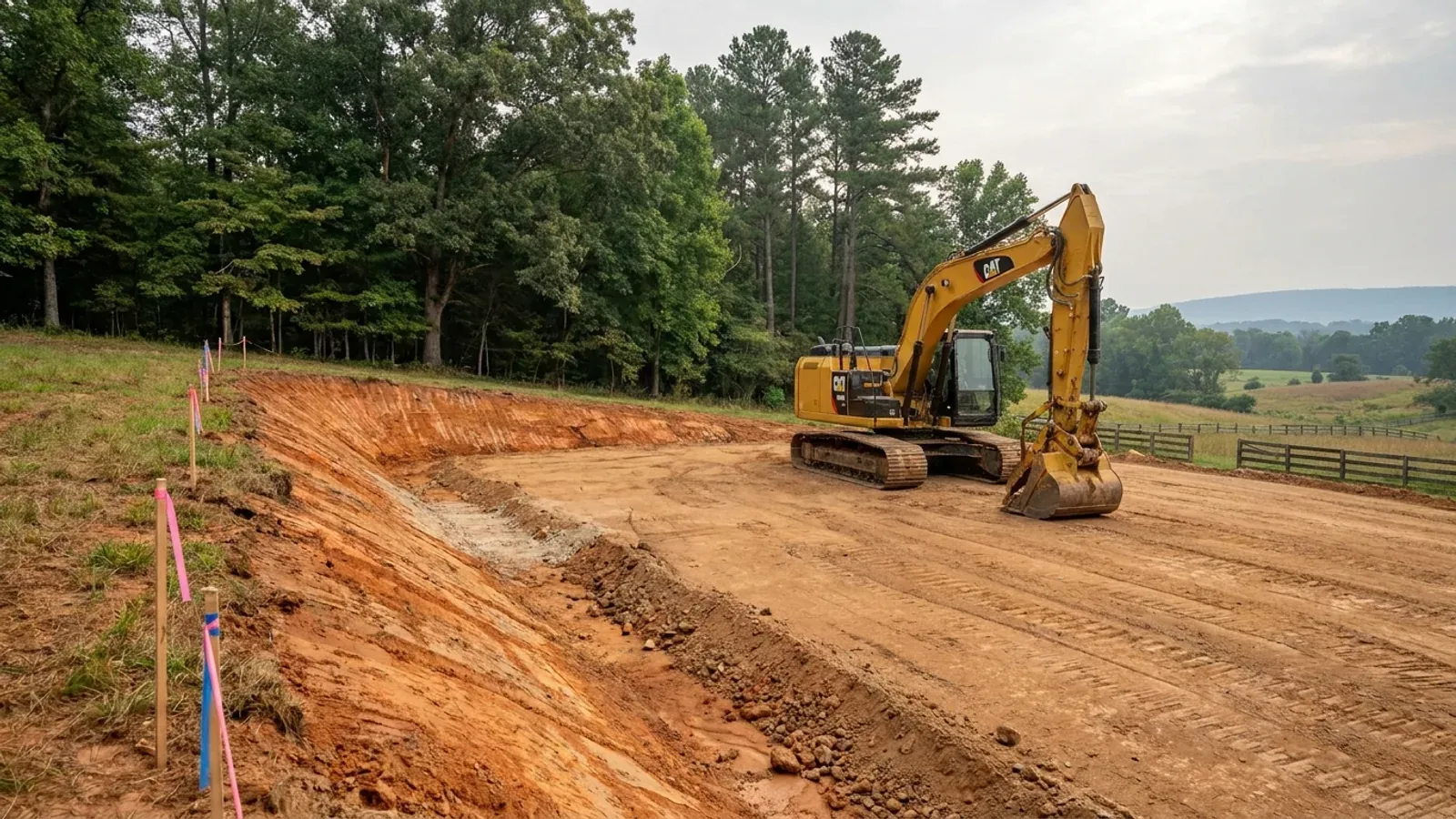
An excavator grading a compacted building pad on a cleared lot, with survey stakes, a drainage swale and a silt fence along the downhill edge.
Below the slab

The expensive surprises are in the ground, not the building

What moves a North Carolina budget is usually below grade, and the thing most often got wrong is which clay to worry about. Cecil — the red Piedmont clay everyone pictures, and the state soil — is kaolinitic and low shrink-swell; it does not heave. The soil that does is Iredell, formed over diabase and gabbro, which the USDA describes as vertic, very high shrink-swell, with a perched water table a foot or two down from December through April. The tell is colour: Cecil is red and Iredell is dark grey-brown, and they sit within a few miles of each other across the central Piedmont. West of that the question stops being clay and becomes slope, rock and colluvium; east of the fall line it becomes water, and in the Tidewater it becomes organic soil that subsides irreversibly once it is drained. Then the same ground decides the septic system, and North Carolina rewrote those rules recently enough that most of what is published about them is out of date. 15A NCAC 18E replaced the old subchapter on 1 January 2024 and was amended again on 1 June 2026: the site is classified on soil morphology — the word "percolation" does not appear anywhere in it — and there is no "provisionally suitable" any more, only suitable or unsuitable, on a single failed parameter. There is no statewide minimum lot size either; the area you need is derived from the soil result and then doubled, because a site that cannot fit both the initial field and its repair area is unsuitable. And the order matters more than people expect: the county health department's Improvement Permit and Construction Authorization come first, and the building permit is available on the strength of the Construction Authorization, not before it. One more thing that catches people: disturb more than an acre and you need an approved erosion and sedimentation control plan in hand before work starts, with penalties up to $5,000 a day, and a pad plus a drive plus a drainfield plus a laydown area crosses an acre faster than it sounds. So the site work, the foundation and the drainfield get resolved together rather than one at a time. We price the dirt before we price the building.

What a build looks like

Three stages every New Bern project passes through, from a raw parcel to a finished home. Site work first, because that is where the budget is decided.
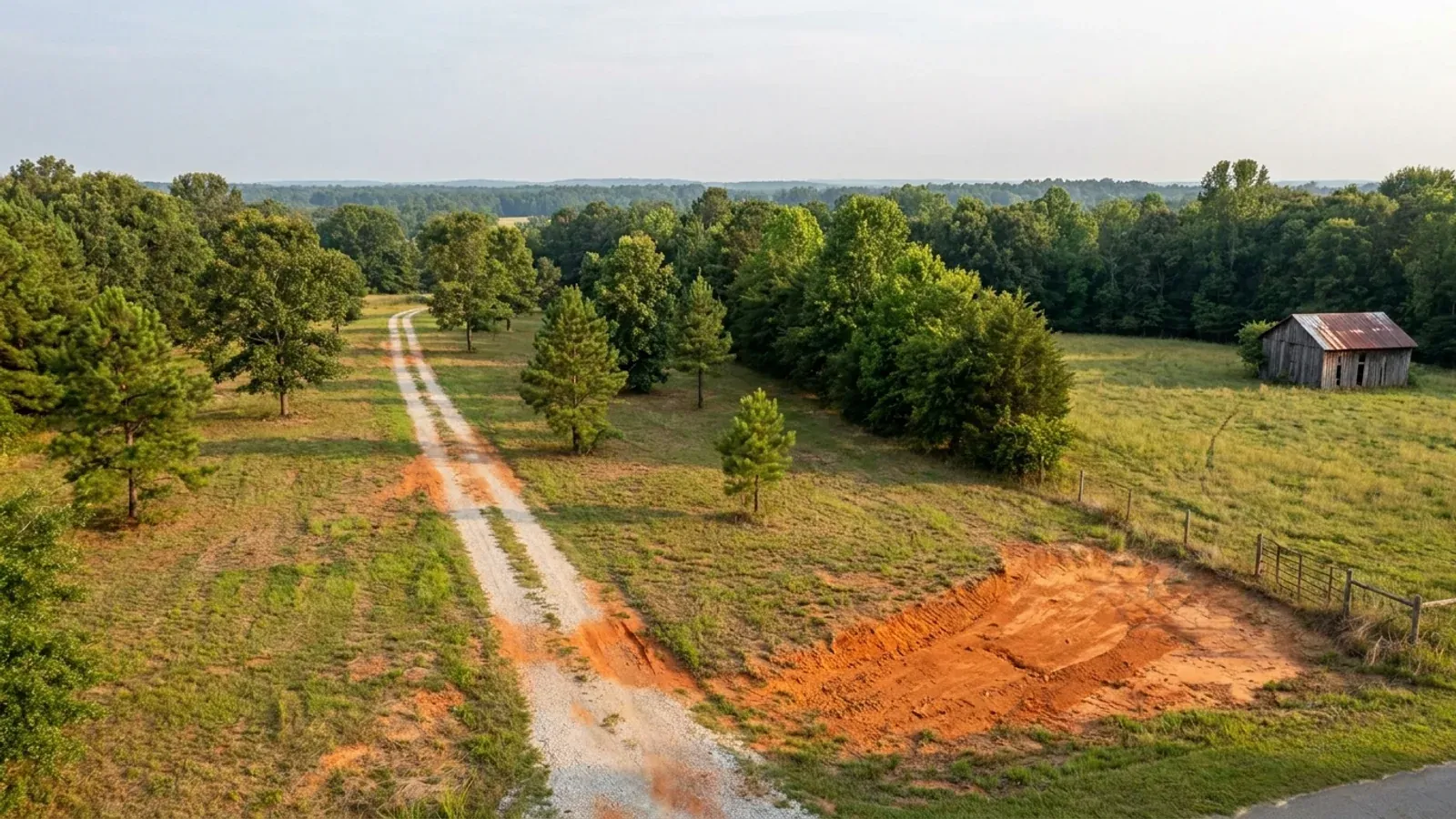
Aerial view of an undeveloped rural lot with cleared grass, a mixed oak, hickory and pine treeline, exposed red clay in one corner and a pale gravel access track.
Stage one

The parcel

Zoning, setbacks, flood zone and utility access get checked before anything is drawn.

An excavator grading a compacted building pad on a cleared lot, with survey stakes, a drainage swale and a silt fence along the downhill edge.
Stage two

Pad and permit

Clearing, grading and a compacted pad, while the septic authorization and the building submittal work through whichever offices cover your parcel.
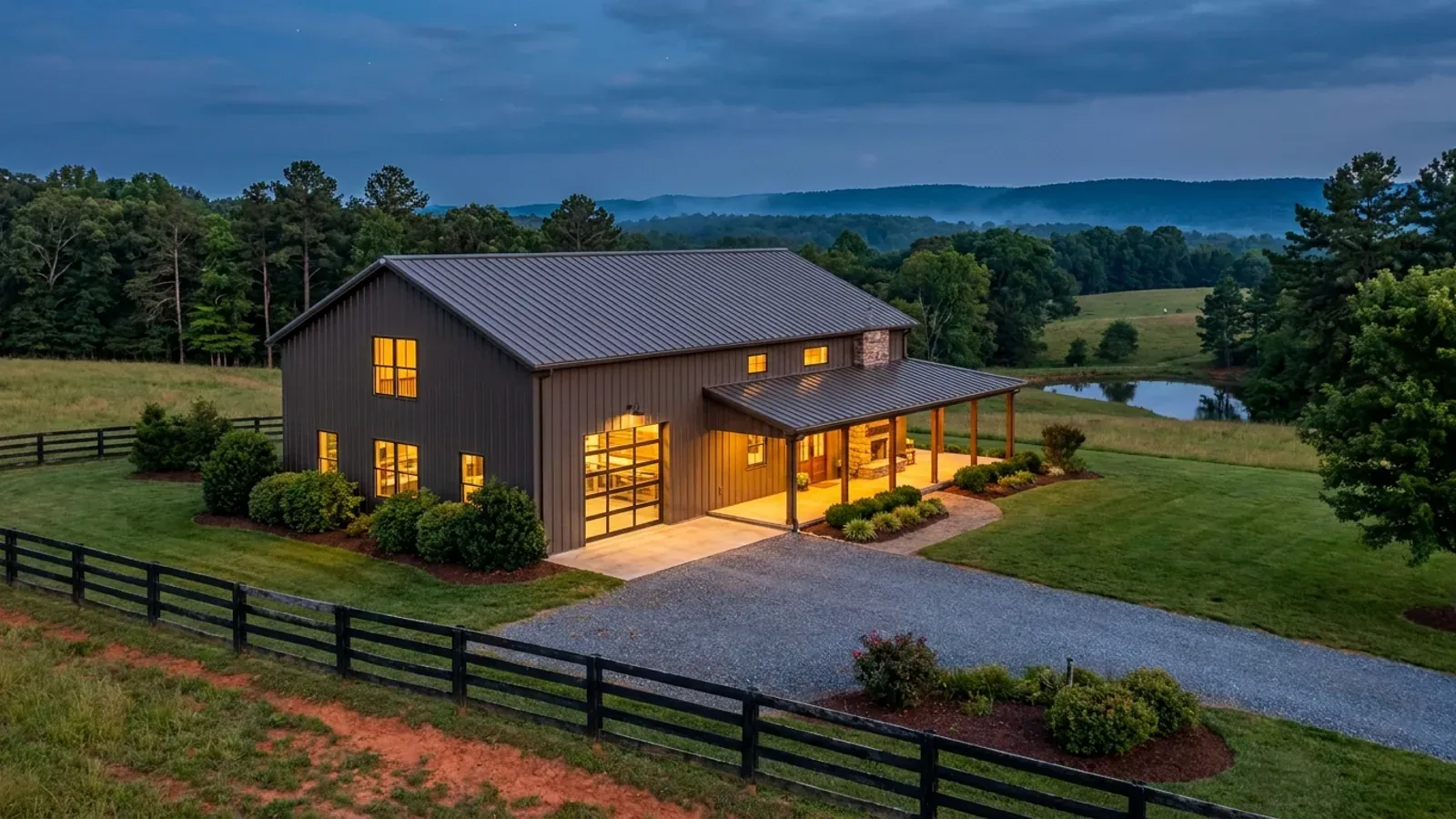
A finished barndominium at dusk with warm interior lighting glowing through its large windows.
Stage three

Frame to finish

Shell erected and dried in, then systems, insulation and interior finish through to CO.

Those are the rules where you are building in New Bern. Tell us what you want to build and we will draw it to them.

Where we build around New Bern

Craven County and the rural land around it. The buildable acreage for a project this size usually sits outside the town limits — which does not automatically put it under the county, because a town's zoning and building-code enforcement reach one to three miles past its limits into its extraterritorial jurisdiction. Inside the limits, in the ETJ, or in neither are three different answers to who issues your permit.

The New Bern service area, including the rural acreage outside the built-up edge, which is where the parcels big enough for a build like this usually sit. The map marks the territory we build in. It is not a branch location, and there is no office at this pin.

Nearby areas we build in

Others we cover nearby. Every North Carolina municipality sits inside a county — there are no independent cities here — but that does not settle who regulates a given parcel. A town's zoning, subdivision rules and building-code enforcement extend one to three miles beyond its limits, by population, into what the statute calls its extraterritorial jurisdiction; town taxes and town elections do not follow. So the office that issues the permit, what it charges and how the land is zoned can all differ from one card to the next, and the mailing address will not tell you which case you are in.

Building in New Bern: common questions

6 questions we get asked most often about building in New Bern. If yours is not on the list, ask it directly.

Who issues the building permit in New Bern?
The city does, and its reach goes past the city line. The City of New Bern states that its Inspections Division is responsible for permitting, inspecting and code compliance of all building construction — new, renovation and repairs — within the city limits and the extraterritorial jurisdiction of the City of New Bern, and that the same division enforces the FEMA flood program, nuisance abatement and the minimum housing code. Under G.S. 160D-202 a city's zoning, subdivision regulation and building-code enforcement extend one mile beyond the corporate limits under 10,000 population, two miles at 10,000 to 24,999 and three miles at 25,000 or more, measured from the contiguous corporate boundary — while city property tax, city voting and city business licensing all stop at the corporate line, so a parcel can be regulated by a council its owner cannot vote for. G.S. 160D-307 answers part of that by requiring extraterritorial residents on the city's planning board and board of adjustment. Outside the city and its extraterritorial jurisdiction, Craven County Planning & Inspections issues the permit. Some things stay with the county everywhere: septic and wells through Craven County Environmental Health, CAMA minor permits on the county's planning schedule, and — a line that only exists here — a $70.00 charge on the county's own schedule for New Bern sewer inspections. Worth noting the contrast an hour down Highway 17: Jacksonville is transferring all of its extraterritorial jurisdiction to Onslow County this year under Session Law 2026-56. New Bern is not.
What does the Neuse riparian buffer actually stop me doing?
It puts 50 feet of protected ground on both sides of any stream that a map says is there, and it can hold up the building permit. 15A NCAC 02B .0714 divides that 50 feet into Zone 1, the inner 30 feet, which must stay undisturbed vegetation except for uses the rule specifically allows, and Zone 2, the outer 20 feet, which must stay stable vegetation but may be graded and revegetated so long as the health of Zone 1 is not compromised. The trigger is cartographic rather than visual: the rule applies if the feature is approximately shown on the most recent published NRCS soil survey stream layer, on the USGS National Map, or on other maps approved by the Environmental Management Commission — so a dry draw or an old farm ditch drawn as a blue line thirty years ago is buffered today. Rule .0714(3)(g) provides that no new clearing, grading or development shall take place and no new building permits shall be issued in violation of the rule. The way out is the on-site determination at .0714(4), performed by staff certified under G.S. 143-214.25A, which can take a feature off the map where it is a ditch or a manmade conveyance other than a modified natural stream, a pond or lake not fed by and not discharging to an intermittent or perennial stream, an ephemeral stream, or simply not there. Two things about that determination are specific to this rule and do not carry over to the state's other buffer programmes: it expires five years from its date, and the existing-and-ongoing-use exemption dates from 22 July 1997. One more local wrinkle: because Craven is one of the twenty coastal counties, Zone 1 begins at the more restrictive of normal high water level and normal water level, not at the top of bank.
Do I need a CAMA permit to build in New Bern?
Only if the work falls inside an Area of Environmental Concern, and most parcels do not. Craven County is one of exactly twenty counties named on NC DEQ's own CAMA Counties page, and that roster is statutory rather than geographic — being on it does not put a permit on your land. The AEC that reaches ordinary building lots is the Estuarine Shoreline AEC at 15A NCAC 07H .0209(a)(1): 75 feet landward of normal high water or normal water level along estuarine waters, estuaries, sounds, bays and fresh and brackish public trust waters, extending to 575 feet where the adjacent water is classified Outstanding Resource Waters by the Environmental Management Commission. New Bern's whole waterfront sits on two such rivers, so riverfront lots here are exactly the case the AEC is written for, while a parcel out toward Vanceboro or Cove City generally is not in one at all. Inside the AEC, .0209(d)(10) requires new development to sit at least 30 feet landward of the water line — and a residence is not on that subsection's list of exceptions — and .0209(d)(2) caps impervious surface at 30 percent of the AEC portion of the lot, which is a limit that a shop apron and a gravel turnaround reach quickly. For a single-family home the permit is normally a CAMA Minor Permit, decided under 15A NCAC 07J .0209(c) by a Local Permit Officer, a city or county employee trained by the Division of Coastal Management and working under contract with it. On the fee, read both documents: 15A NCAC 07J .0204(b)(6)(B), amended effective 1 April 2026, sets the minor development permit application fee at $119.00 payable to the permit-letting agency, while Craven County's own fee schedule effective 1 September 2025 lists a CAMA Minor Permit at $100.00. Both were read on 6 September 2026 — ask the Local Permit Officer which figure the counter is taking. Adjacent riparian landowners must be notified and have 30 days to comment.
How much of the flood risk here is on the map?
Less than the map suggests, and the state says so itself. On 1 April 2026 NC DEQ released new advisory floodplain maps for five eastern river basins — the Neuse, Lumber, Tar-Pamlico, White Oak and Cape Fear. They are explicitly advisory and nonregulatory and are not used for legal or regulatory purposes, but they cover more ground than the regulatory maps, including areas that flood while sitting well away from a stream, and in that release DEQ Secretary Reid Wilson cites research finding that 43 percent of buildings flooded in the study period were outside the mapped FEMA floodplain. New Bern is on the Neuse. The city's own account of what that looks like on the ground is worth reading alongside the number: Hurricane Fran in 1996 brought an almost 10-foot storm surge and about 8 inches of rain, and Hurricane Florence in 2018 came in as a Category 1 but with a wind field large enough to break all-time high-water records — a 10.41-foot surge and rainfall upwards of 16 inches. So the practical advice is to look at three things rather than one. The effective regulatory map, through the state's own parcel lookup at fris.nc.gov, because North Carolina runs its floodplain mapping as a Cooperating Technical State rather than waiting on FEMA. The new advisory maps, because they are disclosure rather than regulation and they show more. And the city's flood damage prevention ordinance, which sets the Regulatory Flood Protection Elevation your reference level must reach. Freeboard — the height above base flood elevation — is set by that local ordinance, not by a single statewide number for private homes, so ask the city's floodplain administrator for the figure that applies to your parcel.
What will the permits cost, and does the shop bay count?
It depends on which side of the city line you are, and the two schedules are built differently. Inside New Bern, the city's Schedule of Fees and Charges effective 1 July 2026 and revised 9 June 2026 sets a new residential building permit at $550 for the first 1,000 square feet plus $0.25 per square foot over that, and then bills the trades separately — electrical $75 plus $0.10 per square foot, plumbing $75 plus $10 per fixture, mechanical $125 per unit with ductwork at $75, gas piping $75 plus $20 per appliance, insulation $75. Plan review is $75, a reinspection is $75 each, a floodplain development permit is $100, a zoning compliance permit is $50, the Homeowners Recovery Fee is $10, and starting work without a permit doubles the permit fee. Outside the city, Craven County's schedule effective 1 September 2025 prices a residential building permit application at $0.17 per square foot with no fixed base, plus a $75 minimum permit fee for all trades, a $10 technology fee, a $25 certificate of occupancy, a $40 flood development permit and a $25 zoning permit. On whether the shop bay counts, neither schedule says outright — but Craven's is instructive, because it uses the word heated on some lines and not on others in the same table: insulation is $0.06 per heated square foot and new construction mechanical is $0.10 per heated square foot, while the building permit line is plain per square foot. Do not assume either way. Ask the office that will issue your permit what area it measures on the building line, and note the small discrepancy already sitting in Craven's own publications: the department's web page says $0.18 per square foot and the countywide schedule says $0.17.
Which local building-code amendments apply in New Bern?
None, and it is worth saying plainly because it is the opposite of the standard advice in this trade. G.S. 143-138(e) provides that the North Carolina State Building Code shall apply throughout the State from the time of its adoption. The only two things a local government may adopt of its own are a fire prevention code and floodplain management regulations. So there is no New Bern amendment package to track down and no city or county here can impose a stricter structural, foundation or energy requirement on a dwelling than the state code sets. What is genuinely local is zoning under Chapter 160D, the fee schedule, the health department, extraterritorial jurisdiction, and floodplain regulation — and floodplain is the real exception rather than a technicality. G.S. 143-138(e) itself allows local floodplain regulations to modify the State Building Code for flood protection, covering floor elevation, mechanical and electrical systems, foundation construction and flood resistance, and those particular modifications do not require Residential Code Council approval. In a city with New Bern's flood history, the flood damage prevention ordinance is therefore the local document that actually changes how a building is designed, and it is the one to read. One more design point that is statewide rather than local and catches steel buyers out: termite protection is required across the whole state under Section R318, and North Carolina deleted cold-formed steel framing from the accepted methods, so building in steel does not satisfy it here the way it does under the model code.

Building in New Bern?

Start with the plan. Tell us what you want to build and we will draw it, then confirm which office issues the permit for your parcel, what it will let you put there, and what wind load it has to meet. That conversation costs nothing.