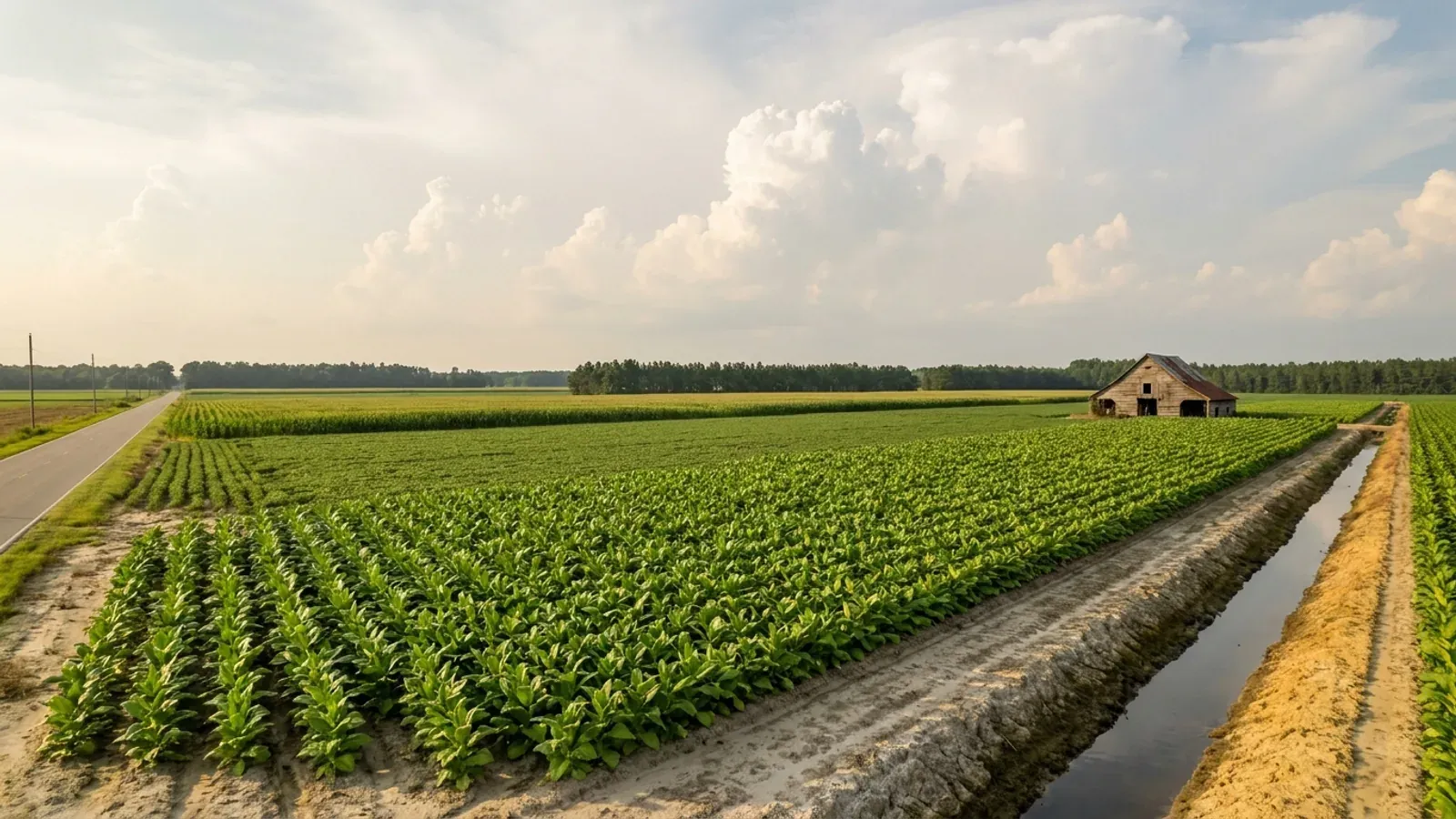
Flat eastern North Carolina cropland with long rows of green tobacco in grey-tan sandy soil, a straight field-edge ditch, dark loblolly pine windbreaks and a derelict tobacco barn in the distance.
Pitt County 2018 NC Residential Code, statewide

Barndominium Builders in Pitt County, NC

Pitt County is the ninth largest farm county in North Carolina by acreage — 367 farms across 151,433 acres, 36.3 percent of the county, at a median farm size of 84 acres against a statewide median of 48 — and that is the reason this page exists. Eighty-four acres is not a hobby parcel. This is the flat Inner Coastal Plain, tobacco and sweet potato country, with the Tar River running through the middle of it and 182,936 people on the 2025 estimate, more than half of them inside Greenville. Three things shape a barndominium here and none of them are the wind number, although the wind number is worth knowing: Pitt County is one of the 49 counties named in Table R301.2(4) of the 2018 NC Residential Code, at 130 mph, which is the threshold where § R301.2.1.1 narrows the prescriptive path. The three that actually decide your project are the permit fee, the septic soil evaluation and the buffer. Pitt charges a flat fee for a site-built home rather than a per-square-foot or valuation-based one, which makes it the odd county out in North Carolina and puts a $300 step in the middle of a floor plan. The soil evaluation is the real gate, because the ground here is well-drained Norfolk sand rather than Piedmont clay and the question a soil scientist is answering is about drainage, not about heave. And parts of the county drain to the Tar-Pamlico system, where a 50-foot riparian buffer applies by river basin rather than by county — with a grandfather date of its own that is not the one most sources quote.

Pitt County at a glance

County
Pitt County
City rules outside city limits
Three Pitt municipalities issue their own building permits, and a city's zoning, subdivision and building-code enforcement can reach up to three miles past its limits under G.S. 160D-202.
Population
182,936
ZIP codes
27812, 27828, 27829, 27834, 27837, 27858, 27884, 28513, 28530, 28590
Site visits
Same week across Pitt County and Eastern NC

Building conditions in Pitt County

The building code does not change at a county line here. Under § 143-138(e) the North Carolina State Building Code applies throughout the state, and a city or county may adopt only a fire prevention code and floodplain regulations of its own — there is no general local amendment power, so there are no county amendments to look up. The edition in force is still the 2018 NC Residential Code, effective 1 January 2019; the 2024 edition has been delayed three times and carries no effective date at all. What genuinely differs is who issues the permit and inspects the work, what that office charges, how the parcel is zoned, what the local floodplain ordinance requires of the foundation — and two design numbers the code publishes county by county, the ultimate design wind speed and the seismic design category. The rest of Table R301.2 is set once for everyone: a flat 20 psf roof live load, a 12-inch frost line, Moderate weathering, and termite protection required everywhere in the state with no exemption. There is no ground snow load column in the residential code at all.

Build conditions for Pitt County , North Carolina : ultimate design wind speed 130 mph. BUILD CONDITIONS PITT COUNTY, NCPitt County2018 NC RESIDENTIAL CODEULTIMATE DESIGN WIND SPEED130 mphPitt County is named in Table R301.2(4) of the 2018 NC Residential Code at 130 mph, with no roadsplit and no elevation rule. The 2024 edition, which has no effective date, carries the same…WHO ISSUES THE PERMITPitt County Permitting & InspectionsAll of unincorporated Pitt County, on a flat fee. Farmville,Winterville and Greenville issue their own building permits, and…
Build conditions for Pitt County, drawn from the sourced facts on this page. Every figure above is cited in the quick-facts panel below, with its source and vintage.
Ninth in the state for farm acreage, at a median of 84 acres
The 2022 Census of Agriculture puts Pitt County ninth of North Carolina's 100 counties for land in farms: 367 farms across 151,433 acres, 36.3 percent of the county, at an average farm size of 413 acres and a median of 84. The statewide median is 48. That gap between the average and the median is the whole story of eastern North Carolina agriculture — a small number of very large row-crop operations alongside a lot of ordinary holdings — and for a buyer it means the parcels that come to market here are genuinely large. It also means the county sits well inside the reach of G.S. 160D-903(b), which bars a county from prohibiting a single-family residence on a bona fide farm tract of more than ten acres, or from requiring road frontage or a public water and sewer connection for it, provided the residence is constructed in accordance with the North Carolina State Building Code.

USDA NASS 2022 Census of Agriculture, county profiles; N.C.G.S. § 160D-903.

One flat fee, and a $300 step at 2,500 square feet
Pitt County's Manual of Fees, effective 6 October 2025, prices a new site-built home as two flat figures rather than by square foot or by construction value: $1,200.00 at 2,500 square feet or less and $1,500.00 above it. Those rows carry an asterisk which the schedule's own footnote defines as all permits included — building, electrical, mechanical, plumbing and gas — so the trades are not billed separately. That structure has two consequences a barndominium buyer can act on. The shop bay costs nothing extra in permit terms, because there is no per-square-foot rate for it to be measured against. And there is a $300 cliff sitting exactly at 2,500 square feet, which turns a floor-plan decision into a published, checkable fee decision. An accessory structure is $300.00 up to 400 square feet and $500.00 above it, and work done without a permit is charged at double the permit fee.

Pitt County Manual of Fees, pittcountync.gov/1248/Manual-of-Fees, effective Monday 6 October 2025 superseding 18 August 2025, read 5 September 2026. Figures of $600 and $750 circulate in search results for these rows; the county's own live page gives $1,200.00 and $1,500.00.

The Tar-Pamlico buffer, and its grandfather date is not the one you will be quoted
Parts of Pitt County drain to the Tar-Pamlico system, where 15A NCAC 02B .0734 protects a 50-foot riparian buffer in two zones — 30 feet of undisturbed vegetation and 20 feet of stable vegetation — measured from the most landward limit of the top of bank on all sides of an intermittent or perennial stream, and taken as a radius where a stream begins, ends, goes underground or enters a culvert. The rule's exemption for existing and ongoing uses runs from 1 January 2000, not from the 22 July 1997 date the Neuse rule uses one county to the west, and no built-upon area may be added within the buffer where it did not exist before that date. All five North Carolina buffer programmes are 50 feet in two zones, which makes them look like one rule with five names; they are not, and the dates are where they diverge. Two more details worth having: an on-site determination expires five years from its date, and the rule expressly excludes Ocracoke Island. Buffers apply by river basin, not by county line, so the operative question on any given parcel is which system it drains to.

15A NCAC 02B .0734, Items (2), (3), (4), (6) and (8), full subchapter text read from the NC Office of Administrative Hearings, 6 September 2026; compared against 15A NCAC 02B .0714 (Neuse), read the same day.

Pitt is not a CAMA county, and that surprises people
The Coastal Area Management Act applies to a closed list of exactly twenty counties, published by the NC Division of Coastal Management: Beaufort, Bertie, Brunswick, Camden, Carteret, Chowan, Craven, Currituck, Dare, Gates, Hertford, Hyde, New Hanover, Onslow, Pamlico, Pasquotank, Pender, Perquimans, Tyrrell and Washington. Pitt County is not one of them, and neither are Lenoir, Martin, Edgecombe, Duplin, Jones or Halifax. Beaufort and Craven, which Pitt borders on two sides, are. So a parcel on the Tar River in Pitt County has no CAMA question at all, while a parcel a few miles downstream in Beaufort County may — and even there the trigger is not being in a CAMA county, it is being in an Area of Environmental Concern, which for an estuarine shoreline reaches 75 feet landward of normal high water, or 575 feet where the adjacent water is classified Outstanding Resource Waters.

NC DEQ Division of Coastal Management, CAMA Counties, deq.nc.gov, read 5 September 2026; 15A NCAC 07H .0209(a)(1), NC Office of Administrative Hearings, read 5 September 2026.

The ground is grey-tan sand, and the Piedmont colour rule does not apply here
The representative soil of the inner Coastal Plain in Pitt County is the USDA Norfolk series: fine-loamy, kaolinitic, thermic Typic Kandiudults, formed in marine or fluviomarine deposits. Kaolinitic means low-activity clay, so shrink-swell is low and the soil does not heave. It is well drained, with a seasonal high water table at 40 to 72 inches from January through March — deep enough that a conventional slab or crawlspace is straightforward — and the profile runs from a grayish brown 10YR 5/2 loamy sand surface through a yellowish brown 10YR 5/6 sandy loam subsoil. In the North Carolina Piedmont there is a well-known tell in which a dark grey-brown soil over diabase warns of very high shrink-swell while red kaolinitic clay does not. That is a Piedmont rule about crystalline parent material and it has nothing to say about Pitt County. Here the parent material is marine sediment and the design question is drainage, not movement.

USDA NRCS Official Series Description, NORFOLK series, soilseries.sc.egov.usda.gov/OSD_Docs/N/NORFOLK.html, read 5 September 2026.

The septic soil evaluation is the real gate, and Pitt prices it as one line
Under 15A NCAC 18E .0201(c) the applicant may obtain a building permit upon issuance of the Construction Authorization, so on a well-and-septic parcel the health department, not the inspections department, sets your start date. Two features of the current rules decide most sites. The classification is binary — .0509(a) removed the old provisionally suitable category, so a single failing parameter fails the lot — and .0508(b) makes a site unsuitable without a repair area, which effectively doubles the suitable ground a soil scientist has to find. Pitt County prices the whole front end as a single line rather than as a separate Improvement Permit and Authorization to Construct: Initial Lot Evaluation, Design and Inspection at $400.00, with $100.00 more for a non-conventional system and $300.00 for a Type IV, V or VI system, so a conventional gravity system on a rural lot is $400.00 and a pump or advanced system is $700.00. A revision costs $50.00 without a site visit and $100.00 with one. A private well permit is $290.00, and unlike some counties Pitt bills the water sample testing on top — coliform $80.00, lead $160.00, pesticide, petroleum and inorganic panels $160.00 each.

Pitt County Manual of Fees, pittcountync.gov/1248/Manual-of-Fees, effective 6 October 2025, read 5 September 2026; 15A NCAC 18E .0201, .0508 and .0509, NC Office of Administrative Hearings, read 5 September 2026.

Also worth knowing before you build in Pitt County

The erosion permit is priced by the disturbed acre
NC DEQ requires an approved erosion and sediment control plan before work begins wherever more than one acre of land on a tract will be disturbed, with civil penalties published at up to $5,000 per day per violation, and a delegated local programme may be stricter than the state floor. Disturbance means the pad, the driveway, the septic area and the laydown and stockpile ground together, which is how an ordinary single-house rural site crosses an acre without anyone intending it to. Pitt County publishes its own line for this under Planning: Erosion Control Single Family Lot Plans at $50.00 per disturbed acre. On a long farm-lane driveway to a back building site, that acre count is worth doing on paper before the dozer is booked.

Pitt County Manual of Fees, pittcountync.gov/1248/Manual-of-Fees, effective 6 October 2025, read 5 September 2026; NC DEQ, Erosion and Sediment Control Laws and Rules, deq.nc.gov, read 5 September 2026 (G.S. Chapter 113A, Article 4; 15A NCAC 04).

Growing, but on a coastal-plain pattern rather than a metro one
Pitt County was 16th in North Carolina by population on the 2025 Census estimate at 182,936, up from 171,817 in 2020 — a gain of 9,137 and 6.5 percent — across 652 square miles at 280 people per square mile. That growth is unusual for the inner Coastal Plain, where most counties are flat or falling: Edgecombe next door is +0.5 percent, Lenoir +1.3, Beaufort +0.0. Pitt grows because Greenville, East Carolina University and the regional medical economy sit inside it. What that means for land is the opposite of the Triangle ring counties: acreage here is abundant and the competition for it is local rather than in-migrant, which is why the median farm size stays at 84 acres instead of fragmenting.

U.S. Census Bureau Vintage 2025 county population estimates and 2025 Gazetteer land areas; USDA NASS 2022 Census of Agriculture.
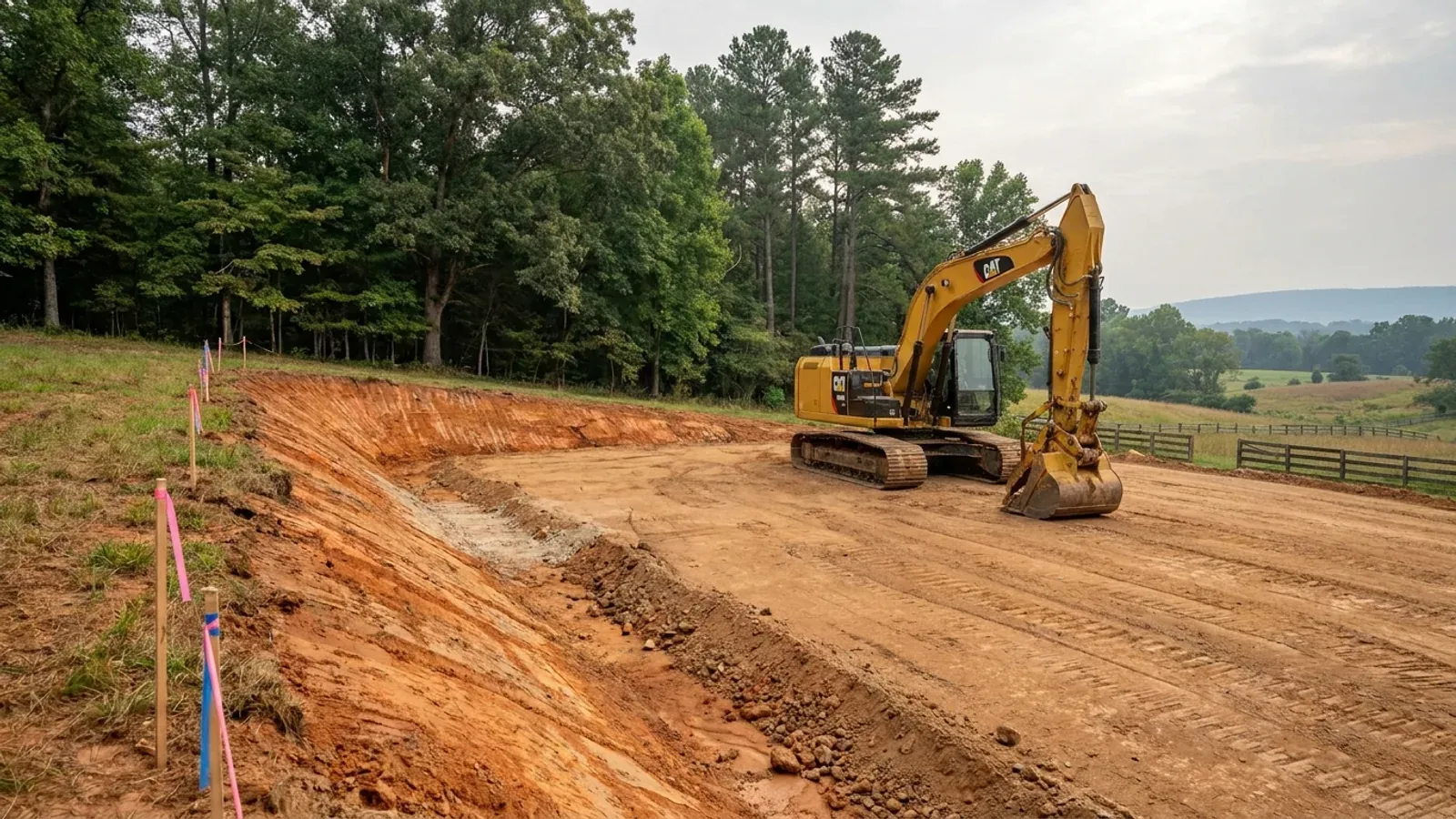
An excavator grading a compacted building pad on a cleared lot, with survey stakes, a drainage swale and a silt fence along the downhill edge.
Below the slab

The expensive surprises are in the ground, not the building

What moves a North Carolina budget is usually below grade, and the thing most often got wrong is which clay to worry about. Cecil — the red Piedmont clay everyone pictures, and the state soil — is kaolinitic and low shrink-swell; it does not heave. The soil that does is Iredell, formed over diabase and gabbro, which the USDA describes as vertic, very high shrink-swell, with a perched water table a foot or two down from December through April. The tell is colour: Cecil is red and Iredell is dark grey-brown, and they sit within a few miles of each other across the central Piedmont. West of that the question stops being clay and becomes slope, rock and colluvium; east of the fall line it becomes water, and in the Tidewater it becomes organic soil that subsides irreversibly once it is drained. Then the same ground decides the septic system, and North Carolina rewrote those rules recently enough that most of what is published about them is out of date. 15A NCAC 18E replaced the old subchapter on 1 January 2024 and was amended again on 1 June 2026: the site is classified on soil morphology — the word "percolation" does not appear anywhere in it — and there is no "provisionally suitable" any more, only suitable or unsuitable, on a single failed parameter. There is no statewide minimum lot size either; the area you need is derived from the soil result and then doubled, because a site that cannot fit both the initial field and its repair area is unsuitable. And the order matters more than people expect: the county health department's Improvement Permit and Construction Authorization come first, and the building permit is available on the strength of the Construction Authorization, not before it. One more thing that catches people: disturb more than an acre and you need an approved erosion and sedimentation control plan in hand before work starts, with penalties up to $5,000 a day, and a pad plus a drive plus a drainfield plus a laydown area crosses an acre faster than it sounds. So the site work, the foundation and the drainfield get resolved together rather than one at a time. We price the dirt before we price the building.

What a build looks like

Three stages every Pitt County project passes through, from a raw parcel to a finished home. Site work first, because that is where the budget is decided.
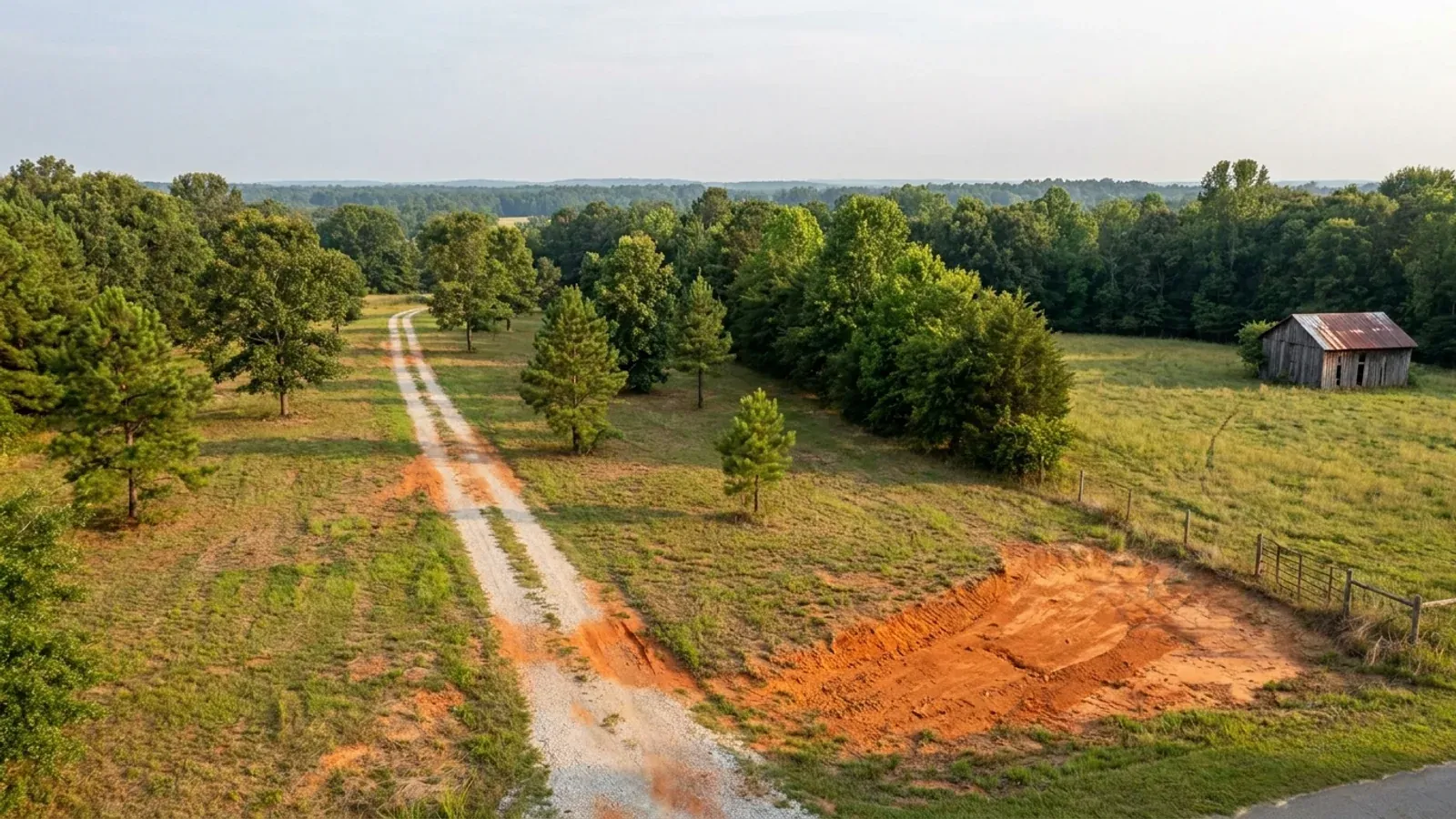
Aerial view of an undeveloped rural lot with cleared grass, a mixed oak, hickory and pine treeline, exposed red clay in one corner and a pale gravel access track.
Stage one

The parcel

Zoning, setbacks, flood zone and utility access get checked before anything is drawn.

An excavator grading a compacted building pad on a cleared lot, with survey stakes, a drainage swale and a silt fence along the downhill edge.
Stage two

Pad and permit

Clearing, grading and a compacted pad, while the septic authorization and the building submittal work through whichever offices cover your parcel.
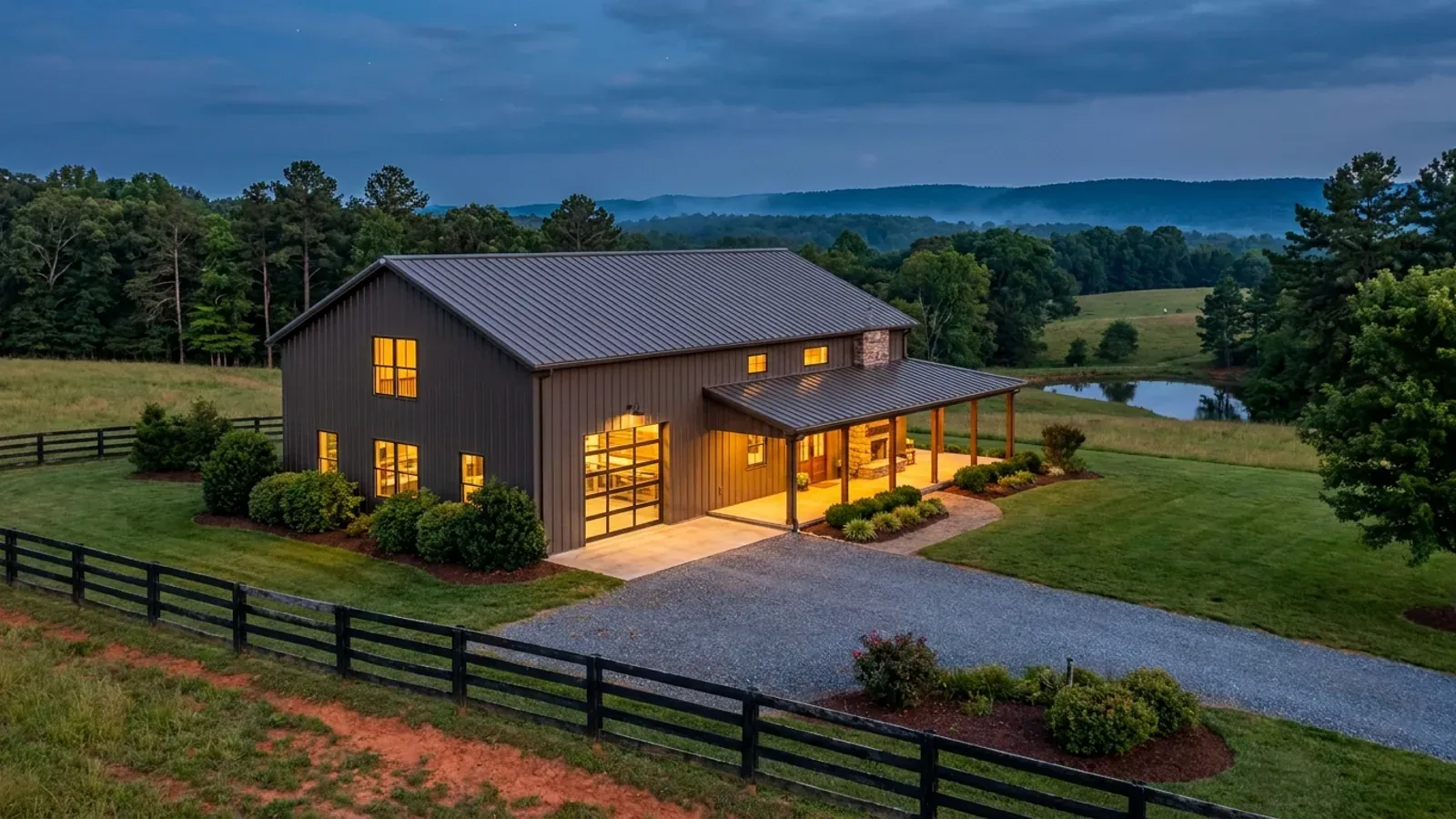
A finished barndominium at dusk with warm interior lighting glowing through its large windows.
Stage three

Frame to finish

Shell erected and dried in, then systems, insulation and interior finish through to CO.

Those are the rules where you are building in Pitt County. Tell us what you want to build and we will draw it to them.

Where we build around Pitt County

Pitt County and the rural land around it. The buildable acreage for a project this size usually sits outside the town limits — which does not automatically put it under the county, because a town's zoning and building-code enforcement reach one to three miles past its limits into its extraterritorial jurisdiction. Inside the limits, in the ETJ, or in neither are three different answers to who issues your permit.

The Pitt County service area, including the rural acreage outside the built-up edge, which is where the parcels big enough for a build like this usually sit. The map marks the territory we build in. It is not a branch location, and there is no office at this pin.

Nearby areas we build in

Others we cover nearby. Every North Carolina municipality sits inside a county — there are no independent cities here — but that does not settle who regulates a given parcel. A town's zoning, subdivision rules and building-code enforcement extend one to three miles beyond its limits, by population, into what the statute calls its extraterritorial jurisdiction; town taxes and town elections do not follow. So the office that issues the permit, what it charges and how the land is zoned can all differ from one card to the next, and the mailing address will not tell you which case you are in.

Building in Pitt County: common questions

7 questions we get asked most often about building in Pitt County. If yours is not on the list, ask it directly.

What does a building permit cost in Pitt County?
Pitt County's Manual of Fees, effective 6 October 2025, prices a new site-built home as a flat fee by size rather than by square foot or by construction value: $1,200.00 at 2,500 square feet or less and $1,500.00 above it. Those rows carry an asterisk that the schedule's own footnote defines as all permits included — building, electrical, mechanical, plumbing and gas — so there are no separate trade permits to add. That structure is genuinely unusual in North Carolina, and it is good news for a barndominium, because a county that charges per square foot of area under roof is measuring the shop bay and Pitt is not. It does put a $300 step exactly at 2,500 square feet, which is a design decision with a published price attached. Other rows worth knowing: an accessory structure is $300.00 to 400 square feet and $500.00 above; a renovation is $1,000.00; a modular home is $1,000.00; a demolition is $200.00; a re-inspection is $100.00; and work performed without a permit is charged at double the permit fee. One caution on research you may do yourself: figures of $600 and $750 for the site-built rows circulate widely in search results and are not what the county's live page says. Two other notes: the county's page carries its own disclaimer that it is not an official transcript, and these are county figures — a build inside Greenville, Winterville or Farmville is on that municipality's schedule instead.
Is Pitt County a CAMA county?
No. The Coastal Area Management Act applies to a closed list of exactly twenty counties published by the NC Division of Coastal Management — Beaufort, Bertie, Brunswick, Camden, Carteret, Chowan, Craven, Currituck, Dare, Gates, Hertford, Hyde, New Hanover, Onslow, Pamlico, Pasquotank, Pender, Perquimans, Tyrrell and Washington — and Pitt is not on it. Neither are Lenoir, Martin, Edgecombe, Duplin, Jones or Halifax, several of which touch tidal or coastal-plain river systems. This catches people out because Pitt County has a river running through it and sits an hour from the sound, but the list is statutory and closed rather than geographic. Two counties Pitt borders, Beaufort and Craven, are on it — and even there, being in a CAMA county is not the trigger. The trigger is being in an Area of Environmental Concern. The one that reaches ordinary building lots is the Estuarine Shoreline AEC under 15A NCAC 07H .0209(a)(1), which extends 75 feet landward from normal high water, or 575 feet where the adjacent water is classified Outstanding Resource Waters by the Environmental Management Commission. A parcel fifteen miles inland in a CAMA county generally is not in any AEC at all. What does apply on a Pitt County waterfront parcel is the riparian buffer rule, which is a different instrument administered by a different division.
Does a riparian buffer apply to my land in Pitt County?
It depends on which river basin the parcel drains to and whether a mapped stream crosses it, and the honest answer is that this is a parcel question rather than a county question — buffer rules apply by basin, and no basin follows a county line. Parts of Pitt County drain to the Tar-Pamlico system, which is covered by 15A NCAC 02B .0734. Where it applies, the buffer is 50 feet in two zones: 30 feet of undisturbed vegetation and 20 feet of stable vegetation, measured horizontally from the most landward limit of the top of bank on all sides of an intermittent or perennial stream, and taken as a radius where a stream begins, ends, goes underground or enters a culvert. The surprise for rural buyers is the trigger: a surface water is subject to the rule if it is approximately shown on the most recent NRCS soil survey map showing stream layers or on the USGS National Map, whether or not there is a visible stream on the ground. And Item (3)(g) provides that no new clearing, grading or development may take place and no new building permits may be issued in violation of the rule, so a blue line on a map can stop a permit. The remedy is the on-site determination under Item (4): where the maps inaccurately depict a surface water, the landowner requests one from the Authority, made by staff certified under G.S. 143-214.25A, and it expires five years from its date. Item (5) is what it can release — farm ditches and manmade conveyances, manmade ponds with no stream connection, ephemeral streams, and the plain absence of a waterbody on the ground. One citation warning: nearly every secondary source still cites 15A NCAC 02B .0259 for the Tar-Pamlico buffer. That rule was transferred to .0610, .0611, .0612 and .0734 effective 15 June 2020.
What is the ground like to build on in Pitt County?
Easier than most of the state, and the reason is worth understanding rather than just being told. The representative soil of the inner Coastal Plain here is the USDA Norfolk series — fine-loamy, kaolinitic, thermic Typic Kandiudults, formed in marine or fluviomarine deposits on coastal plain uplands and marine terraces. Kaolinite is a low-activity clay, so shrink-swell is low and the soil does not heave. The series is well drained with moderate permeability and a seasonal high water table at 40 to 72 inches from January through March, which is deep enough that a conventional slab or a crawlspace is straightforward. The profile is grey-tan and yellow rather than red: a grayish brown 10YR 5/2 loamy sand surface, a light yellowish brown 10YR 6/4 loamy sand, then a yellowish brown 10YR 5/6 sandy loam to sandy clay loam subsoil with iron masses. Two things not to carry here from elsewhere in the state. The Piedmont colour rule — under which dark grey-brown soil over diabase signals very high shrink-swell — is about crystalline parent material and does not describe this ground. And the organic muck soils that make the outer Coastal Plain difficult are a Tidewater condition, not an inner Coastal Plain one. What you should still expect is a real septic soil evaluation, because a well-drained soil is not automatically a suitable one, and a flat landscape drains slowly on the surface even where it drains well through the profile.
Do I need the septic permit before the building permit in Pitt County?
Yes, and on a rural parcel it is the item that sets the whole schedule. Under 15A NCAC 18E the county health department evaluates the soil and site and, if it classifies the site suitable, issues an Improvement Permit fixing the design daily flow, the bedroom count, the setbacks and the location of both the initial dispersal field and the repair area. Rule .0201(c) then provides that upon issuance of the Construction Authorization the applicant may obtain a building permit in accordance with G.S. 130A-338. Two features of the rules decide most sites and both are recent. The classification is binary: .0509(a) removed the old provisionally suitable category, so one failing parameter fails the lot rather than downgrading it. And .0508(b) makes a site unsuitable without a repair area, so the area a soil scientist has to find is effectively double the field itself — which is why there is no statewide minimum lot size and why acreage alone never answers the question. Pitt County prices the front end as one line, Initial Lot Evaluation, Design and Inspection at $400.00, with $100.00 more for a non-conventional system and $300.00 for a Type IV, V or VI system; the original Authorization to Construct is not separately priced, only revisions at $50.00 without a site visit and $100.00 with one. A private well permit is $290.00 with water sample testing billed separately. If a site is classified unsuitable, the rules entitle you to a signed written report describing the unsuitable characteristics and citing the rules relied on — which is what a soil scientist works from when designing an alternative.
What design figures do plans for a Pitt County barndominium have to meet?
Pitt County is named in Table R301.2(4) of the 2018 NC Residential Code at an ultimate design wind speed of 130 mph, flat across the county with no road split and no elevation rule, and the 2024 edition carries the same figure. That is a step above the code's floor — 51 of the 100 counties take the table's unlisted default of 115 mph, and Pitt is one of the 49 named — and the step is meaningful, because § R301.2.1.1 uses 130 mph as the point where the prescriptive path narrows and construction has to follow one of the listed high-wind methods. That is relevant to a barndominium specifically, because North Carolina deleted AISI S230, the prescriptive standard for cold-formed steel framing, from that list of methods; a steel-framed house here goes to ASCE 7, the International Building Code or an engineered design rather than a prescriptive table. Pitt County is absent from Table R301.2(7), the list of Seismic Design Category C counties, and that table's note places every county not listed in Category A or B. The county is nowhere near the wind-borne debris region, which North Carolina defines as a map line east of the Intracoastal Waterway rather than as a wind speed, so the 130 mph figure triggers no opening-protection requirement. Three figures that hold everywhere in the state: a flat 20 psf roof live load, no ground snow load column at all because Section R301.2.3 is deleted, and termite protection required in all of North Carolina under Section R318 — with the North Carolina-specific twist that cold-formed steel framing was deleted from the accepted methods of termite protection, so building in steel does not exempt a house from treatment or baiting.
Are there Pitt County building-code amendments I need to check?
No, and this is the opposite of the advice given nearly everywhere in this trade. G.S. 143-138(e) provides that the North Carolina State Building Code shall apply throughout the State from the time of its adoption. The only two things a county or city may adopt of its own are a fire prevention code — which needs Residential Code Council approval and may not reach one- and two-family dwellings beyond what the Residential Code prescriptively requires — and floodplain management regulations. There is no general local building-code amendment power in North Carolina at all, so there is no Pitt County package to hunt down and no county here can impose a stricter structural, foundation or energy requirement on a house than the state code sets. What genuinely is local is a different list, and it is what the rest of this page is about: the zoning ordinance under Chapter 160D, the fee schedule, the health department, extraterritorial jurisdiction, and floodplain regulation. Floodplain is the real exception to the uniformity — § 143-138(e) lets local floodplain regulations modify the State Building Code for flood protection, covering floor elevation, mechanical and electrical systems, foundation construction and flood resistance, and those modifications do not require Building Code Council or Residential Code Council approval. So the one place a local government can out-legislate the state code is on flood.

Building in Pitt County?

Start with the plan. Tell us what you want to build and we will draw it, then confirm which office issues the permit for your parcel, what it will let you put there, and what wind load it has to meet. That conversation costs nothing.