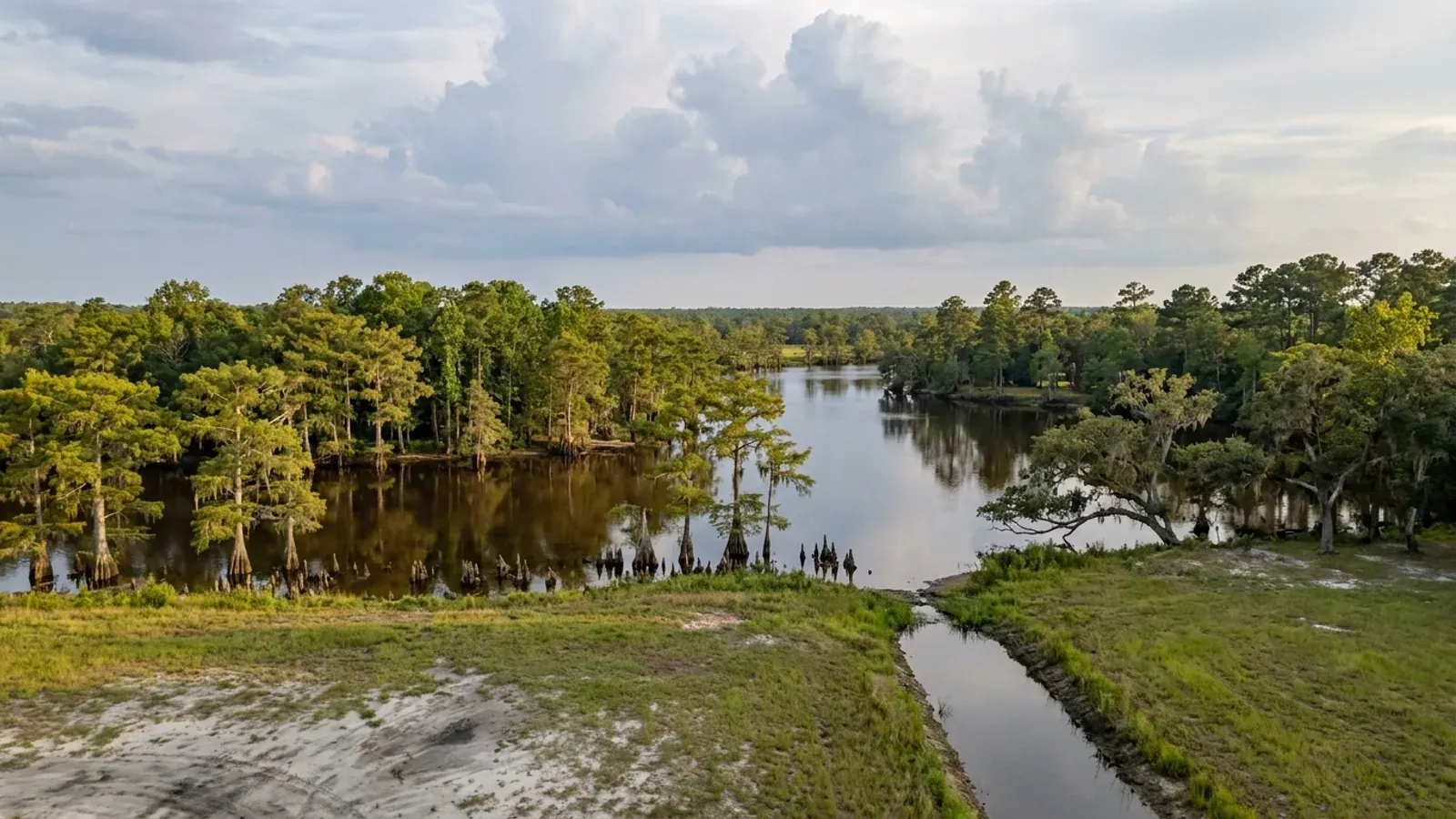
A still, dark blackwater river channel with buttressed bald cypress and knees in the shallows, loblolly pine and gum on the far bank and a flat grassy field edge in front.
Onslow County 2018 NC Residential Code, statewide

Barndominium Builders in Jacksonville, NC

Jacksonville is the commercial hub of Onslow County and the home of Marine Corps Base Camp Lejeune and Marine Corps Air Station New River, and both of those facts shape what a barndominium project looks like here. Inside the city limits, this is a permitting page rather than a land page. The city's own FY 2026-2027 fee schedule, effective 1 July 2026, prices a new residential structure at $0.52 per square foot with a $520 minimum, covering building, electrical, plumbing, mechanical and fuel piping in one number — and then does something no other schedule found in this state does: it offers a reduction of $0.08 per square foot for each of those trades you are not proposing, provided you notify permitting staff. A shop bay with no wiring, no plumbing and no gas is exactly that case. The city also inspects and permits under its own Unified Development Ordinance, and its planning jurisdiction is shrinking rather than growing: it removed 337 parcels and 1,037 acres from its extraterritorial jurisdiction in 2020, and under Session Law 2026-56 the remainder is transferring to Onslow County altogether. Design figures come from the county's row in the code, and the line runs through town. Table R301.2(4) of the 2018 NC Residential Code splits Onslow at Highway 17 and again at the Intracoastal Waterway; the city's own State Roads page identifies Marine Boulevard as U.S. 17, so a Jacksonville parcel takes 130 mph or 140 mph depending on which side of Marine Boulevard it is on, and the 150 mph zone does not reach this far inland. The land question is honest and it points outward. Jacksonville's population has barely moved — 72,732 on the 2025 estimate against a 2020 base of 72,635 — while the city's own census page puts the median age at about 23 against a state figure of 37.4, which is what a garrison town looks like in the data and why per-capita statistics here mislead. Acreage for a barndominium is not inside the city limits. It is northwest toward Richlands and Catherine Lake, west into Duplin County, or south into Pender.

Jacksonville at a glance

County
Onslow County
City rules outside city limits
Jacksonville's extraterritorial jurisdiction is not being frozen, it is being ended — Session Law 2026-56 transfers all of it to Onslow County, after the city had already given 1,037 acres back in 2020.
Population
72,732
ZIP codes
28540, 28541, 28542, 28543, 28544, 28545, 28546, 28547
Site visits
Same week in Jacksonville and across Onslow County

Building conditions in Jacksonville

The building code does not change at a county line here. Under § 143-138(e) the North Carolina State Building Code applies throughout the state, and a city or county may adopt only a fire prevention code and floodplain regulations of its own — there is no general local amendment power, so there are no county amendments to look up. The edition in force is still the 2018 NC Residential Code, effective 1 January 2019; the 2024 edition has been delayed three times and carries no effective date at all. What genuinely differs is who issues the permit and inspects the work, what that office charges, how the parcel is zoned, what the local floodplain ordinance requires of the foundation — and two design numbers the code publishes county by county, the ultimate design wind speed and the seismic design category. The rest of Table R301.2 is set once for everyone: a flat 20 psf roof live load, a 12-inch frost line, Moderate weathering, and termite protection required everywhere in the state with no exemption. There is no ground snow load column in the residential code at all.

Build conditions for Jacksonville , Onslow County, North Carolina : ultimate design wind speed 130 / 140 mph. BUILD CONDITIONS JACKSONVILLE, NCOnslow County2018 NC RESIDENTIAL CODEULTIMATE DESIGN WIND SPEED130 / 140 mphTable R301.2(4) of the 2018 NC Residential Code splits Onslow County at Highway 17. The city's ownState Roads page identifies Marine Boulevard as U.S. 17, so the line runs through Jacksonville;…WHO ISSUES THE PERMITCity of Jacksonville Planning & Insp…City Hall, 815 New Bridge Street. Inside the limits the citypermits; outside them Onslow County Central Permitting does, and th…
Build conditions for Jacksonville, drawn from the sourced facts on this page. Every figure above is cited in the quick-facts panel below, with its source and vintage.
$0.52 a square foot — and $0.08 back for every trade you are not proposing
The City of Jacksonville's FY 2026-2027 fee schedule, effective 1 July 2026, prices a new residential structure at $0.52 per square foot with a $520 minimum, and that single number covers building, electrical, plumbing, mechanical and fuel piping. Its footnote is the part that matters to a barndominium: the schedule instructs the applicant to notify permitting staff if electrical, mechanical, plumbing or fuel piping is not being proposed, in order to receive a fee reduction of $0.08 per square foot per trade not proposed — subject to the $520 floor. Four trades not proposed is $0.32 per square foot off the rate. An unheated, unwired, unplumbed shop bay is precisely the case the footnote contemplates, and the burden is on the applicant to raise it. The same schedule prices a detached residential accessory building as a flat fee rather than by area: no charge at a maximum dimension of 12 feet, $208 for one over 12 feet but under 401 square feet, and $286 at 401 square feet and greater. Attached or detached is therefore a fee question here as well as a design one.

City of Jacksonville FY 2026-2027 Fee Schedules, effective 1 July 2026, jacksonvillenc.gov, extracted from the city's own PDF and read 6 September 2026 in two extraction modes that agree.

The county's wind line runs through the city, on Marine Boulevard
Onslow County is one of ten coastal counties that Table R301.2(4) of the 2018 NC Residential Code splits at a named line rather than at the county boundary: 130 mph west of Highway 17, 140 mph east of Highway 17 as far as the Intracoastal Waterway, and 150 mph east of the Waterway. The City of Jacksonville's own State Roads page identifies Marine Boulevard as U.S. 17, listing it from U.S. 258 to Chaney Creek and from Chaney Creek to Bell Fork Road within the city limits. So the design line does not run around Jacksonville, it runs through it — two lots on opposite sides of the same boulevard answer to different ultimate design wind speeds. The 150 mph zone is east of the Intracoastal Waterway and does not reach the city at all. The 2024 edition, adopted but with no effective date, redraws Onslow's zones again around the townships of Swansboro and Stump Sound, so a drawing set should name its edition as well as its zone.

2018 NC Residential Code, Table R301.2(4) and its Onslow footnote, NC Office of the State Fire Marshal, read 5 September 2026; City of Jacksonville, State Roads page, jacksonvillenc.gov, read 6 September 2026.

A planning jurisdiction going backwards, twice
Most North Carolina cities that touch extraterritorial jurisdiction are arguing about how far it should reach. Jacksonville is on the other side of that trend and has been for six years. In 2020 the city initiated an amendment removing 337 parcels and 1,037.1 acres from its extraterritorial jurisdiction across five areas — Onslow Pines, Gum Branch Road, Ramsey Road, Halltown Road and Piney Green — and stated that roughly half of those parcels were undeveloped. Then, under Session Law 2026-56, the city was required to transition all of its remaining extraterritorial jurisdiction to Onslow County, planning, zoning, permitting and building inspections together. The county held a community information meeting on 8 September 2026, took the proposed zoning to its Planning Board on 17 September 2026, and set a Board of Commissioners hearing for October. For a buyer this is the single most consequential fact on the page: land at the Jacksonville edge that a city office regulated in 2025 is answering to a county office now, under county zoning districts that were being assigned this autumn.

City of Jacksonville, ETJ Reduction 2020 page, jacksonvillenc.gov, read 6 September 2026; Onslow County Planning & Development, ETJ 2026 Transition page, onslowcountync.gov, read 6 September 2026.

Every per-capita number in this city is computed on a median age of about 23
The City of Jacksonville's own census page states that the median age for the city is approximately 23, that this makes it the youngest city in America on 2018 Census estimates, and that the state median age is 37.4. Its About page puts the average age at 22.8 and attributes it directly to the military presence. The same city page cautions that the 2020 count understates the resident population, estimating the true figure at around 80,000 against a counted 73,504, because some military members and young children were not counted. The measured series says the same thing in a different way: 72,732 people on the 2025 estimate against a 2020 base of 72,635 — a net change of fewer than a hundred people in five years, in a county that added 12,700. Jacksonville's population turns over rather than grows. Any statistic that divides by this city's population — houses per capita, income per capita, permits per thousand residents — is measuring a garrison, not a housing market, and should be treated accordingly.

City of Jacksonville, Census page and About Jacksonville page, jacksonvillenc.gov, read 6 September 2026; U.S. Census Bureau Vintage 2025 population estimates for places and counties.

The small city fees that are easy to miss
Three lines on the City of Jacksonville's FY 2026-2027 schedule are worth writing down before a budget is set. The zoning permit is $55.00 and the schedule notes it is no longer included in conjunction with any other permit, so it is a separate line now rather than a bundled one. A floodplain development permit is $50.00 and a floodplain development review is a further $25.00. A driveway permit is $50.00. And the enforcement figure: a Unified Development Ordinance violation carries a civil penalty of $50.00 per violation per day, not to exceed $5,000 per annum. Separately, the Planning and Inspections Department gave notice that from 1 July 2026 charge accounts are no longer accepted, a 2.75 percent convenience fee applies to credit card transactions, and a $0.75 processing fee applies to payments by check.

City of Jacksonville FY 2026-2027 Fee Schedules, effective 1 July 2026, and the Planning & Permitting department notice on payment changes, jacksonvillenc.gov, read 6 September 2026.

This is a routing page, and the honest route is outward
There is very little barndominium land inside Jacksonville's limits, and the county-level numbers show why. Onslow County ranks 67th of North Carolina's 100 counties for land in farms: 342 farms on 53,032 acres, 10.9 percent of a 762-square-mile county, at a median farm size of 46 acres. Camp Lejeune and Marine Corps Air Station New River hold a large share of the ground, the Intracoastal Waterway and Topsail Island take the southeastern edge, and the New River's estuarine shorelines take much of what remains. What is left at a workable size sits inland and northwest, around Richlands, Half Moon, Belgrade and Catherine Lake — all of it in the county's 130 mph zone west of Highway 17, all of it permitted by Onslow County rather than the city, and all of it clear of any Area of Environmental Concern. Beyond the county line the ring opens up: Duplin County holds 254,164 acres in farms at a median farm size of 90 acres and is not a CAMA county at all, and Pender County holds 78,903 acres at a median of 33.

USDA NASS 2022 Census of Agriculture county profiles; U.S. Census Bureau 2025 Gazetteer land areas; NC DEQ Division of Coastal Management CAMA Counties page, read 6 September 2026.

Also worth knowing before you build in Jacksonville

The city sits on estuarine water, which is what puts CAMA on the table
The New River runs through Jacksonville and opens into Wilson Bay below the downtown, and the city describes more than a decade of work pledged to restoring water quality in that river. That matters for permitting because the New River is estuarine water, and 15A NCAC 07H .0209(a)(1) sets an Estuarine Shoreline Area of Environmental Concern reaching 75 feet landward of normal high water or normal water level along estuarine waters, sounds, bays and fresh and brackish public trust waters — 575 feet where the adjacent water is classified Outstanding Resource Waters. Onslow is on NC DEQ's closed list of twenty CAMA counties. Inside an AEC, 15A NCAC 07H .0209(d)(10) requires new development to sit at least 30 feet landward of the water line, and .0209(d)(2) caps impervious surface at 30 percent of the AEC portion of the lot — a limit a shop apron and a turning circle reach quickly. Under 15A NCAC 07J .0209(c) a minor development permit is decided by a Local Permit Officer, who is a city or county employee working under contract with the Division of Coastal Management, so the planning office is where to ask which desk holds that role for a given riverfront lot.

15A NCAC 07H .0209 and 15A NCAC 07J .0209, NC Office of Administrative Hearings, read 5 and 6 September 2026; NC DEQ CAMA Counties page, read 6 September 2026; City of Jacksonville, About Jacksonville page, read 6 September 2026.

Camp Lejeune makes this the strongest VA construction loan market in the state
Onslow County's population is built around Camp Lejeune and Marine Corps Air Station New River, which makes Jacksonville about as concentrated a population of Department of Veterans Affairs loan-eligible borrowers as exists in North Carolina. Two practical notes. The guaranty is administered through participating lenders and lenders differ sharply on whether they will underwrite new construction at all, so that question belongs to a lender before it belongs to a builder. And the building has to appraise: Fannie Mae's Selling Guide at B4-1.3-05, page-stamped 4 June 2025, states that loans on unique or nontraditional housing types — its own examples are earth houses, geodesic domes and log houses — are eligible provided the appraiser has adequate information to form a reliable opinion of value, and that comparable sales need not match the subject's design. Where recent comparables of the same design do not exist, the appraiser may work from older sales, sales in competing neighbourhoods or other reliable market data; where there is no evidence of market acceptance at all, the property is ineligible. Give the appraiser the engineering and the drawings, not just the address.

Fannie Mae Selling Guide B4-1.3-05, Improvements Section of the Appraisal Report, page-stamped 06/04/2025, read 5 September 2026; City of Jacksonville, About Jacksonville page, jacksonvillenc.gov, read 6 September 2026.

Onslow's Flight Path Overlay stops at the city line, and the county's noise overlay is empty
Onslow County's zoning ordinance establishes a Flight Path Overlay to keep land uses compatible with air operations at Camp Lejeune and Marine Corps Air Station New River. Article 11 Section 11.3.E caps any building or structure in the overlay at 100 feet, and Section 11.3.B prohibits uses producing smoke or dust that impairs pilot visibility, direct or reflective light emissions and glare of an intensity and direction that impairs pilot visibility, and electromagnetic emissions interfering with navigation signals or aircraft radio. That glare clause is the one that a metal-clad building has to think about. It applies in the county's planning jurisdiction, not inside Jacksonville — Section 1.5.B excludes the city — so a parcel that moves from city to county under Session Law 2026-56 may move into it. Two related county overlays, the Military Coordination Overlay tied to the Onslow County Joint Land Use Study and the Noise Attenuation Overlay, are established in the ordinance and both are marked reserved, meaning no standards are yet attached to either.

Onslow County Zoning Ordinance, Article 1 Section 1.5.B and Article 11 Sections 11.3, 11.5 and 11.6, onslowcountync.gov, extracted from the county's own PDFs and read 6 September 2026.
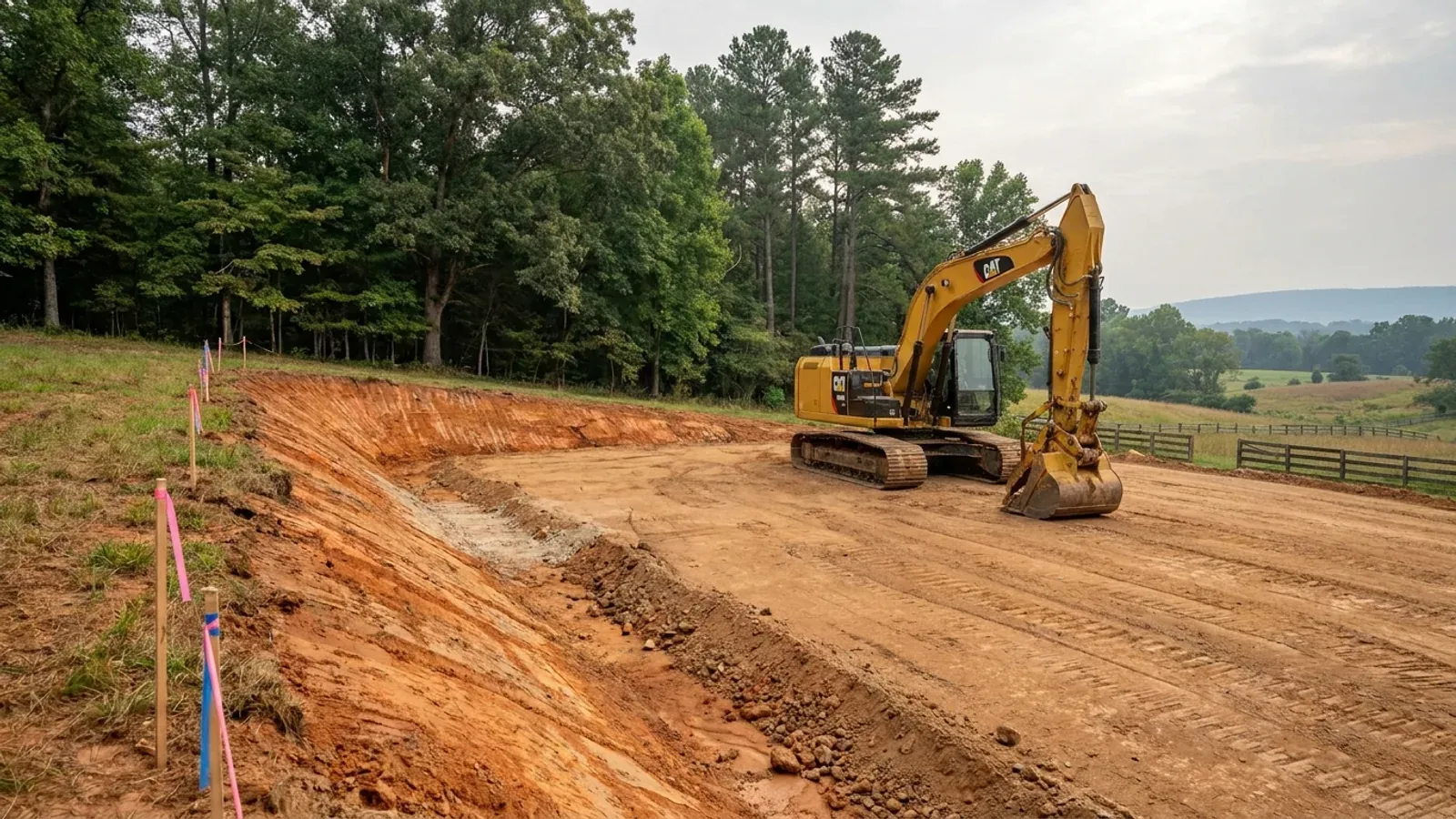
An excavator grading a compacted building pad on a cleared lot, with survey stakes, a drainage swale and a silt fence along the downhill edge.
Below the slab

The expensive surprises are in the ground, not the building

What moves a North Carolina budget is usually below grade, and the thing most often got wrong is which clay to worry about. Cecil — the red Piedmont clay everyone pictures, and the state soil — is kaolinitic and low shrink-swell; it does not heave. The soil that does is Iredell, formed over diabase and gabbro, which the USDA describes as vertic, very high shrink-swell, with a perched water table a foot or two down from December through April. The tell is colour: Cecil is red and Iredell is dark grey-brown, and they sit within a few miles of each other across the central Piedmont. West of that the question stops being clay and becomes slope, rock and colluvium; east of the fall line it becomes water, and in the Tidewater it becomes organic soil that subsides irreversibly once it is drained. Then the same ground decides the septic system, and North Carolina rewrote those rules recently enough that most of what is published about them is out of date. 15A NCAC 18E replaced the old subchapter on 1 January 2024 and was amended again on 1 June 2026: the site is classified on soil morphology — the word "percolation" does not appear anywhere in it — and there is no "provisionally suitable" any more, only suitable or unsuitable, on a single failed parameter. There is no statewide minimum lot size either; the area you need is derived from the soil result and then doubled, because a site that cannot fit both the initial field and its repair area is unsuitable. And the order matters more than people expect: the county health department's Improvement Permit and Construction Authorization come first, and the building permit is available on the strength of the Construction Authorization, not before it. One more thing that catches people: disturb more than an acre and you need an approved erosion and sedimentation control plan in hand before work starts, with penalties up to $5,000 a day, and a pad plus a drive plus a drainfield plus a laydown area crosses an acre faster than it sounds. So the site work, the foundation and the drainfield get resolved together rather than one at a time. We price the dirt before we price the building.

What a build looks like

Three stages every Jacksonville project passes through, from a raw parcel to a finished home. Site work first, because that is where the budget is decided.
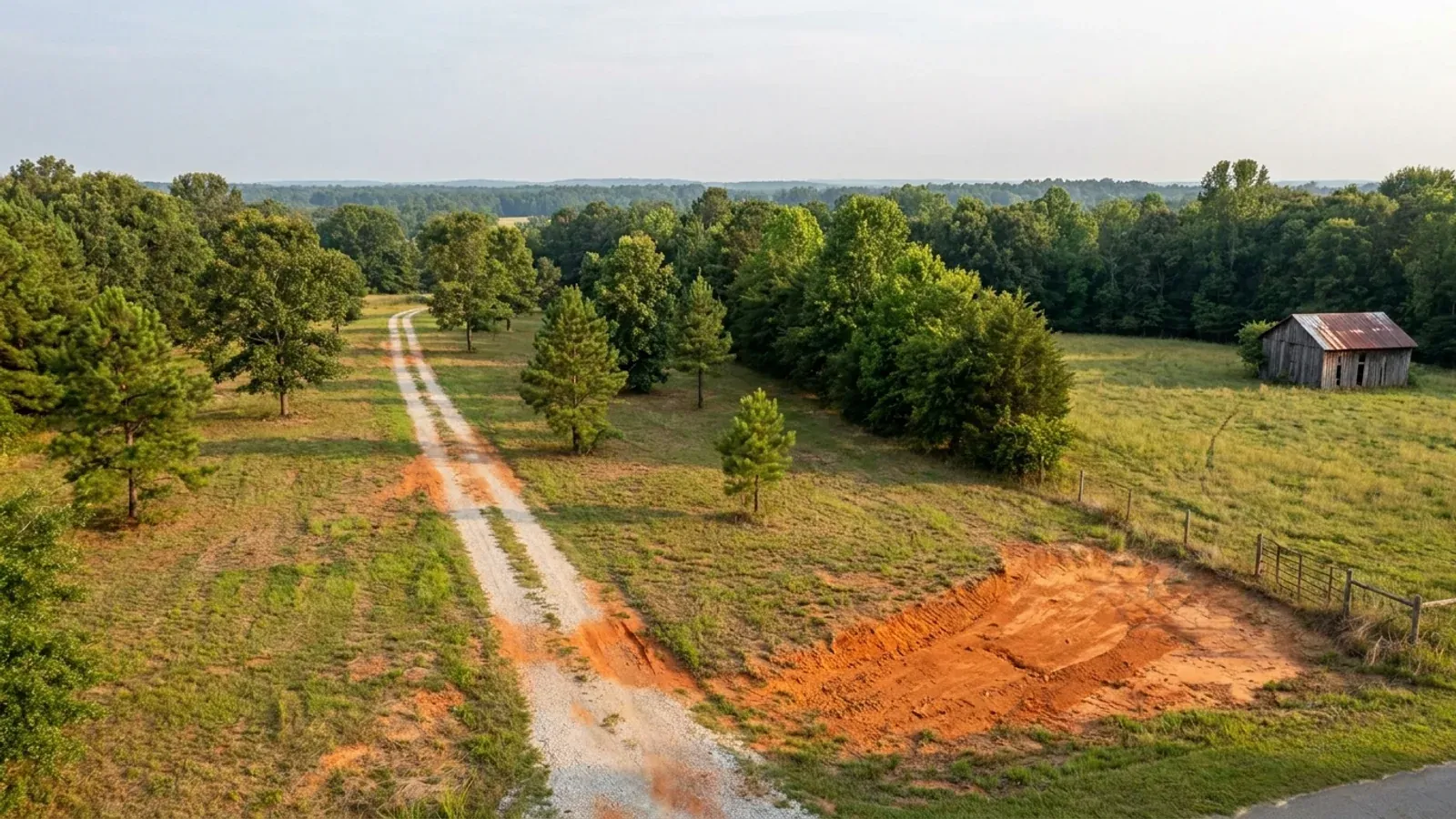
Aerial view of an undeveloped rural lot with cleared grass, a mixed oak, hickory and pine treeline, exposed red clay in one corner and a pale gravel access track.
Stage one

The parcel

Zoning, setbacks, flood zone and utility access get checked before anything is drawn.

An excavator grading a compacted building pad on a cleared lot, with survey stakes, a drainage swale and a silt fence along the downhill edge.
Stage two

Pad and permit

Clearing, grading and a compacted pad, while the septic authorization and the building submittal work through whichever offices cover your parcel.
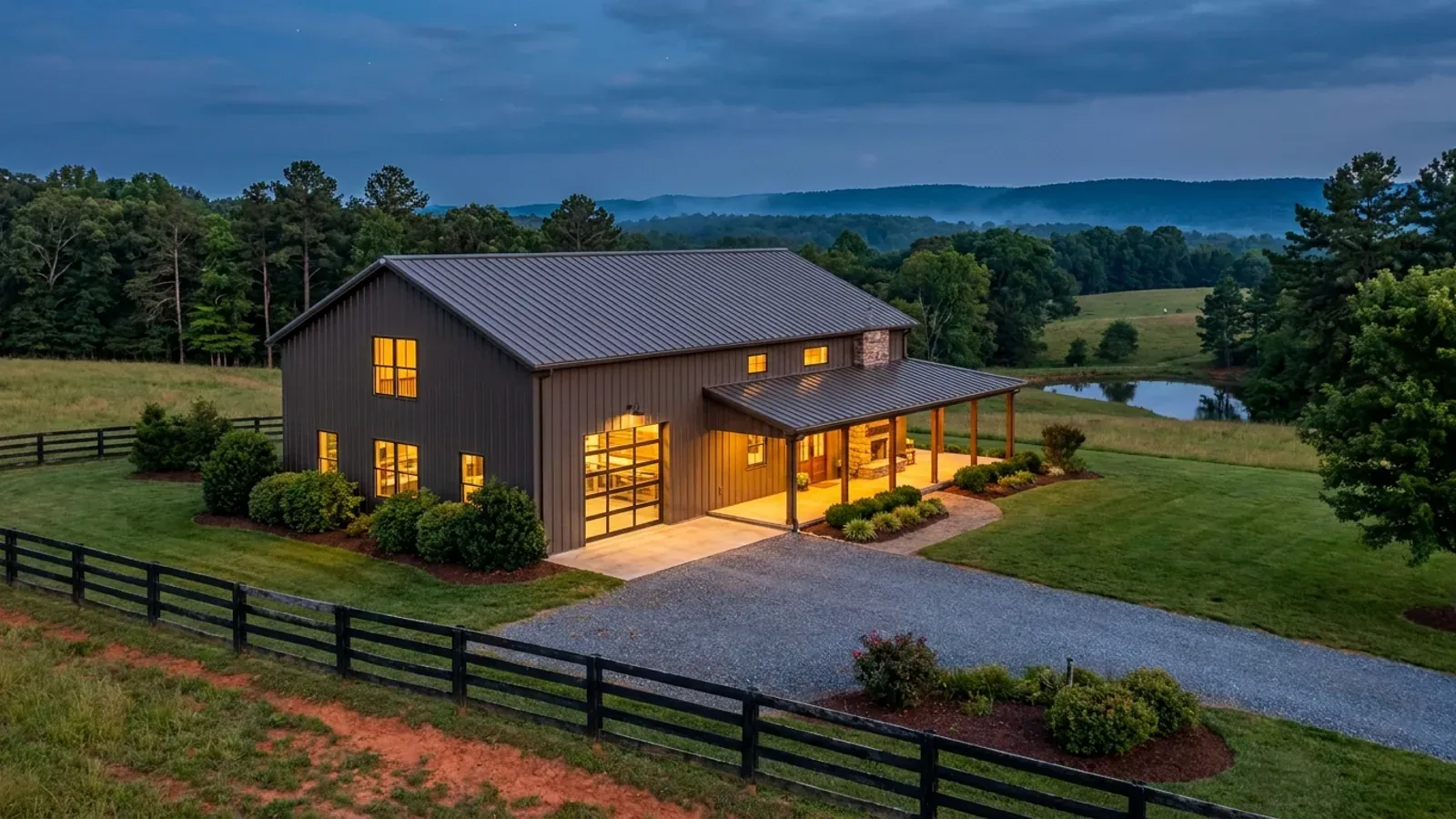
A finished barndominium at dusk with warm interior lighting glowing through its large windows.
Stage three

Frame to finish

Shell erected and dried in, then systems, insulation and interior finish through to CO.

Those are the rules where you are building in Jacksonville. Tell us what you want to build and we will draw it to them.

Where we build around Jacksonville

Onslow County and the rural land around it. The buildable acreage for a project this size usually sits outside the town limits — which does not automatically put it under the county, because a town's zoning and building-code enforcement reach one to three miles past its limits into its extraterritorial jurisdiction. Inside the limits, in the ETJ, or in neither are three different answers to who issues your permit.

The Jacksonville service area, including the rural acreage outside the built-up edge, which is where the parcels big enough for a build like this usually sit. The map marks the territory we build in. It is not a branch location, and there is no office at this pin.

Nearby areas we build in

Others we cover nearby. Every North Carolina municipality sits inside a county — there are no independent cities here — but that does not settle who regulates a given parcel. A town's zoning, subdivision rules and building-code enforcement extend one to three miles beyond its limits, by population, into what the statute calls its extraterritorial jurisdiction; town taxes and town elections do not follow. So the office that issues the permit, what it charges and how the land is zoned can all differ from one card to the next, and the mailing address will not tell you which case you are in.

Building in Jacksonville: common questions

6 questions we get asked most often about building in Jacksonville. If yours is not on the list, ask it directly.

Does Jacksonville's permit fee charge me for a shop bay I am not wiring or plumbing?
Not necessarily, and this is the most useful sentence on the page. The City of Jacksonville's FY 2026-2027 fee schedule, effective 1 July 2026, sets a new residential structure at $0.52 per square foot with a $520 minimum, and that one rate covers building, electrical, plumbing, mechanical and fuel piping together. Its footnote then instructs the applicant to notify permitting staff if electrical, mechanical, plumbing or fuel piping is not being proposed, in order to receive a fee reduction of $0.08 per square foot for each trade not proposed, with the caveat that the fee cannot drop below the minimum. Four trades not proposed is $0.32 per square foot. Nothing in the schedule says the department will work this out for you — the language puts the notification on the applicant, so it is a question to raise at intake rather than to discover afterwards. The schedule also treats a detached accessory building completely differently from an attached one: no charge at a maximum dimension of 12 feet, $208 above 12 feet but under 401 square feet, and $286 at 401 square feet and greater, as flat fees rather than per square foot. Whether the shop is attached to the dwelling or stands apart from it therefore changes the permit fee as well as the design, and it is worth pricing both ways before the drawings are fixed.
Who permits my land — the city or Onslow County?
Inside the city limits, the City of Jacksonville Planning and Inspections Department, at City Hall, 815 New Bridge Street, under the city's Unified Development Ordinance. Outside them, Onslow County Central Permitting at 234 Northwest Corridor Boulevard. What has changed in 2026 is the strip in between. Onslow County states that under Session Law 2026-56 the city has been required to transition all of its remaining extraterritorial jurisdiction to the county, and that this covers planning, zoning, permitting and building inspections. The county ran a community information meeting on 8 September 2026, took proposed county zoning designations to its Planning Board on 17 September 2026 and scheduled a Board of Commissioners public hearing for October, and it publishes an address look-up tool so an owner can check whether a specific parcel is in the transfer. This is not the first narrowing either: in 2020 the city removed 337 parcels and 1,037.1 acres of extraterritorial jurisdiction across Onslow Pines, Gum Branch Road, Ramsey Road, Halltown Road and Piney Green. If you are buying just outside the line, do not rely on a mailing address, a real-estate listing or last year's advice — run the address through the county's tool and confirm with both offices which one will be issuing the permit when you actually build.
What wind speed applies to a Jacksonville lot?
One of two, and which one depends on the side of Marine Boulevard. Table R301.2(4) of the 2018 NC Residential Code — the edition in force — does not give Onslow County a single figure. Its footnote sets a 130 mph zone west of Highway 17, a 140 mph zone east of Highway 17 as far as the Intracoastal Waterway, and a 150 mph zone east of the Waterway. The city's own State Roads page identifies Marine Boulevard as U.S. 17 within the city limits, running from U.S. 258 to Chaney Creek and from Chaney Creek to Bell Fork Road, so that boundary runs through Jacksonville rather than around it. The 150 mph zone lies well east of here and does not reach the city. Two cautions. The wind-borne debris region is a separately adopted geographic boundary that runs east of the Intracoastal Waterway, and it is never to be worked out from a wind figure. And the 2024 edition, which has been adopted but carries no effective date at all, redraws Onslow's zones again — it drops the 130 zone and rewrites the footnote around the townships of Swansboro and Stump Sound. Any set of drawings for a Jacksonville parcel should state the edition it was engineered to and the zone it assumed, and that assumption is worth checking against the plan reviewer's reading of the map before the steel is ordered. Onslow County is not on the Seismic Design Category C list in Table R301.2(7), so seismic is Category A or B here.
Is there land in Jacksonville for a barndominium, or should I be looking outside the city?
Almost certainly outside, and the numbers are checkable rather than a matter of opinion. Jacksonville's measured population went from a 2020 base of 72,635 to 72,732 on the 2025 estimate — under a hundred people in five years — while Onslow County added 12,700. That is not a city short of demand; it is a city whose population turns over on a posting cycle. The land shortage is structural: Onslow County ranks 67th of the 100 counties for land in farms, with 342 farms on 53,032 acres, only 10.9 percent of a 762-square-mile county, because Camp Lejeune and Marine Corps Air Station New River hold a very large share of the ground and the Waterway and the estuarine shorelines take much of the rest. Where the acreage is: northwest and inland — Richlands, Half Moon, Belgrade, Catherine Lake — permitted by Onslow County rather than the city, in the county's 130 mph zone, and generally in no Area of Environmental Concern. Past the county line, Duplin County holds 254,164 acres in farms at a 90-acre median and is not a CAMA county at all, and Pender County holds 78,903 acres at a 33-acre median. Each of those moves you to a different fee schedule, a different health department and a different row in the code's wind table, which is a reason to choose the county deliberately rather than to end up in one.
Can I use a VA construction loan for this, and will it appraise?
Those are two separate questions and it is worth keeping them apart. On the loan: the Department of Veterans Affairs guarantees construction lending, but the guaranty is administered through participating lenders, and lenders vary a great deal in whether they will underwrite ground-up construction at all — let alone a post-frame or metal-clad house. Ask that of a lender before anything else, because a yes or no there determines the shape of the whole project. On the appraisal, there is a published standard worth reading. Fannie Mae's Selling Guide at B4-1.3-05, page-stamped 4 June 2025, provides that loans secured by unique or nontraditional housing types — the guide's own examples are earth houses, geodesic domes and log houses — are eligible provided the appraiser has adequate information to develop a reliable opinion of market value, and that comparable sales are not required to match the subject's design. Where the appraiser cannot find recent comparable sales of the same design, the property is still acceptable if sound adjustments can be made against the comparables that do exist and marketability can be demonstrated using older sales, sales in competing neighbourhoods or other reliable market data. The failure condition is stated just as plainly: where there is no evidence of market acceptance and the characteristics are too different, the property is ineligible. What helps in practice is documentation. A North Carolina barndominium is normally an engineered building — Section R301.1.2 requires other framing systems to demonstrate equivalent detailing, and G.S. 89C-25 carries no residential exemption from the engineering requirement — so there will be sealed drawings from a professional engineer licensed in North Carolina, and handing those to the appraiser is a better use of them than filing them.
Which Jacksonville building-code amendments do I need to check?
None, because there are none to check. G.S. 143-138(e) provides that the North Carolina State Building Code shall apply throughout the State from the time of its adoption, and there is no general power for a city or county to amend it. The only two things a local government may adopt of its own are a fire prevention code and floodplain management regulations. So no Jacksonville ordinance can impose a stricter structural, foundation or energy requirement on a dwelling than the state code already sets, and any advice telling you to go looking for a municipal amendment package here is describing a different state's system. What is genuinely local is a different list and it is the substance of this page: zoning under the city's Unified Development Ordinance and Chapter 160D, the city's own fee schedule, extraterritorial jurisdiction — which is being transferred outright this year — and floodplain regulation. That last one is the real exception: G.S. 143-138(e) does let local floodplain regulations modify the State Building Code for flood protection, covering floor elevation, mechanical and electrical systems, foundation construction and flood resistance, and those particular modifications do not require Residential Code Council approval. The city charges $50.00 for a floodplain development permit and $25.00 for a floodplain development review, and it maintains flood zone maps and an address lookup. On a low-lying parcel near the New River that ordinance, not the building code, is the document that changes the design.

Building in Jacksonville?

Start with the plan. Tell us what you want to build and we will draw it, then confirm which office issues the permit for your parcel, what it will let you put there, and what wind load it has to meet. That conversation costs nothing.