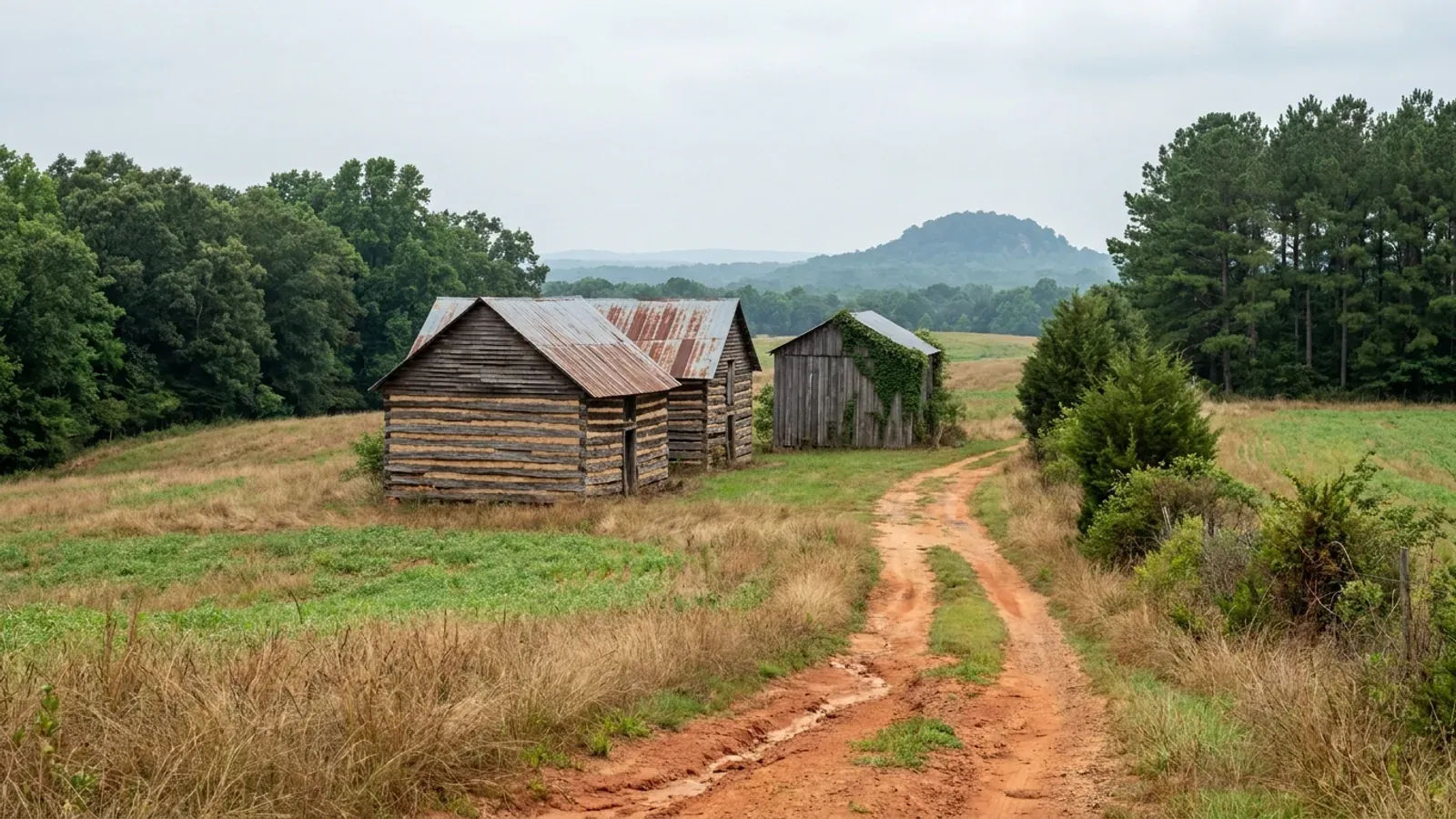
Rolling northern Piedmont farmland with red-orange clay, a red dirt track and a row of derelict flue-cured tobacco barns with rusting tin roofs at the field edge.
Guilford County 2018 NC Residential Code, statewide

Barndominium Builders in Greensboro, NC

Greensboro is the seat of Guilford County and, at 308,667 people, the third-largest city in North Carolina. It is also a two-kinds place: Guilford holds 562,234 residents on 646 square miles at 870 to the square mile, and the acreage a barndominium wants is in the ring — Rockingham to the north at 30.2 percent farmland, Randolph to the south at 26.2 percent and the largest farm count in the Triad, Alamance to the east at 25.4 percent. This page is worth reading anyway, because Guilford County publishes the single most useful permit fee in the state for this building type. There is no North Carolina permit fee; the basis differs county by county, and Guilford prices a new detached single-family structure at $150 plus $0.35 per HEATED square foot. Heated. An unheated shop bay adds nothing to that base. Wake County charges $75 plus $0.25 per square foot and states there is no deduction for a garage; Union County charges $0.84 per square foot on area under roof, heated or unheated; Harnett measures heated area plus the garage. So a 3,000 square foot barndominium that is half workshop is billed on 1,500 square feet in Guilford and on 3,000 in Union — identical drawings, identical statewide code, a different question asked of them. Two boundaries decide whether that number is yours. Guilford County Inspections serves unincorporated Guilford and seven contract towns; the Cities of Greensboro and High Point run their own inspections inside their own limits. And Greensboro is where extraterritorial jurisdiction in North Carolina began — more than a century ago the General Assembly let the city impose sanitary regulations a mile beyond its limits, and the modern version of that power still reaches land the city neither taxes nor lets vote.

Greensboro at a glance

County
Guilford County
City rules outside city limits
Extraterritorial jurisdiction in North Carolina began in Greensboro: more than a century ago the General Assembly let the city impose sanitary regulations up to a mile past its limits. The modern power under G.S. 160D-202 carries city zoning, subdivision rules and building-code enforcement onto land the city does not tax and whose residents cannot vote in its elections.
Population
308,667
ZIP codes
27401, 27403, 27405, 27406, 27407, 27410, 27455
Site visits
Same week across Guilford and the Triad ring

Building conditions in Greensboro

The building code does not change at a county line here. Under § 143-138(e) the North Carolina State Building Code applies throughout the state, and a city or county may adopt only a fire prevention code and floodplain regulations of its own — there is no general local amendment power, so there are no county amendments to look up. The edition in force is still the 2018 NC Residential Code, effective 1 January 2019; the 2024 edition has been delayed three times and carries no effective date at all. What genuinely differs is who issues the permit and inspects the work, what that office charges, how the parcel is zoned, what the local floodplain ordinance requires of the foundation — and two design numbers the code publishes county by county, the ultimate design wind speed and the seismic design category. The rest of Table R301.2 is set once for everyone: a flat 20 psf roof live load, a 12-inch frost line, Moderate weathering, and termite protection required everywhere in the state with no exemption. There is no ground snow load column in the residential code at all.

Build conditions for Greensboro , Guilford County, North Carolina : ultimate design wind speed 115 mph. BUILD CONDITIONS GREENSBORO, NCGuilford County2018 NC RESIDENTIAL CODEULTIMATE DESIGN WIND SPEED115 mphGuilford County is unlisted in Table R301.2(4) of the 2018 NC Residential Code, so it takes thattable's default of 115 mph ultimate design wind speed — the floor of the code, shared with 51 of…WHO ISSUES THE PERMITCity of Greensboro inspections insid…Guilford County Inspections covers unincorporated Guilford plusseven contract towns and the Piedmont Triad Airport Authority. The…
Build conditions for Greensboro, drawn from the sourced facts on this page. Every figure above is cited in the quick-facts panel below, with its source and vintage.
In Guilford County the shop bay is free
This is the best permit-fee fact in North Carolina for this building type and it belongs to Guilford. There is no statewide permit fee — the basis takes six different forms across the counties — and Guilford County Inspections prices a new detached single-family structure at $150 plus $0.35 per HEATED square foot. Heated. An unheated shop bay, garage or covered porch adds nothing to that base. Now the contrast, from the counties' own schedules: Wake County charges $75 plus $0.25 per square foot and states there is no deduction for a garage; Union County charges $0.84 per square foot on area under roof, heated or unheated, with detached unheated structures at $0.24; Harnett County's square-foot brackets are computed on heated area plus the garage. So a 3,000 square foot barndominium that is half workshop is billed on 1,500 square feet in Guilford and on 3,000 in Union. Same drawings, same code, a different question asked of them — and it is the kind of difference that is worth knowing before you choose which side of a county line to buy on.

Guilford County Inspections Department fee panels, guilfordcountync.gov; Wake County, Union County and Harnett County published residential permit fee schedules, wake.gov, unioncountync.gov and harnett.org. Read 5–6 September 2026.

That fee is the county's, and Greensboro is not in the county's territory
Guilford County Inspections publishes its own service area, and the third-largest city in the state is deliberately not in it. The department serves all unincorporated Guilford County and, by contract, Jamestown, Oak Ridge, Pleasant Garden, Sedalia, Stokesdale, Summerfield, Whitsett and the Piedmont Triad Airport Authority. The Cities of Greensboro and High Point run their own inspections inside their own limits. Guilford County's Unified Development Ordinance, adopted 19 November 2020, draws the same line for land use, applying to properties in unincorporated Guilford County and outside municipal extraterritorial jurisdictions. So there are three answers, not two, and the $150 plus $0.35 per heated square foot is only the third: inside the Greensboro limits, city inspections and city rules; inside a municipal extraterritorial jurisdiction, that city's zoning, subdivision regulation and building-code enforcement even though the parcel pays no city tax; outside both, Guilford County. Settle which of the three a parcel is in before you price anything — with Greensboro at 308,667 people, its limits and its extraterritorial area together cover a great deal of the county.

Guilford County Inspections Department, guilfordcountync.gov/government/departments-and-agencies/inspections; Guilford County Planning and Development, Codes and Ordinances, guilfordcountync.gov, Unified Development Ordinance adopted 19 November 2020; U.S. Census Bureau Vintage 2025 sub-county population estimates. Read 5–6 September 2026.

North Carolina's extraterritorial jurisdiction started in Greensboro
The rule that catches more rural land buyers than any other in this state began at this city's edge. More than a century ago the General Assembly gave the City of Greensboro authority to impose sanitary regulations up to a mile beyond its city limits — the immediate quarrel was hog-keeping just outside town — and the NC League of Municipalities traces the modern power to that grant. Similar authority spread to other cities after the Second World War; in 1949 four municipalities received extraterritorial zoning by local act; the 1958 Municipal Government Study Commission recommended extending it to every municipality over 2,500 on the reasoning that health and safety problems arising outside the city do not always respect city limits; statewide authority followed in 1959. What that history left is G.S. 160D-202 and an asymmetry worth stating plainly. Inside a city's extraterritorial jurisdiction the city's zoning, subdivision regulation, building-code enforcement and minimum housing standards apply. Outside the corporate line, city property tax, city voting, city law enforcement, city trash collection and city business licensing all stop. G.S. 160D-307 answers part of it by seating extraterritorial residents on the city's planning board and board of adjustment, appointed by the county commissioners.

NC League of Municipalities, "Why Extraterritorial Jurisdiction Still Matters", Southern City, published 7 March 2025, nclm.org; UNC School of Government, Extraterritorial Jurisdiction for Planning and Development Regulation, sog.unc.edu. Both read 6 September 2026.

Guilford prices the septic soil evaluation per bedroom
Guilford County publishes no line item called an Improvement Permit. It prices the two halves of a septic approval separately, and the first half is charged per bedroom: Residential Soil Evaluations at $100 PER BEDROOM, then an Authorization to Construct at $100 for a type I or II system — $140 for a type IIIb, $450 for an alternative type IV, V or VI, $550 for an alternative design, $200 for an innovative wastewater approval, $35 for an AOWE or EOP. A three-bedroom house is $300 on the evaluation line, not $100; a five-bedroom plan is $500. And the bedroom count is not a soft number here: Guilford's own permit guidance requires the bedroom count on the plans to match the permit application and the septic design, and explicitly requires a permit amendment when it changes. For a barndominium with a loft, a flex room or a bonus space over the shop, that turns a drawing decision into a priced one — worth making deliberately at design stage rather than discovering at plan review. A well permit is $450, with water sampling priced separately and additively: $65 trip fee, $50 bacteria, $70 inorganic and nitrate, $75 pesticide, $75 petroleum, and $335 for the complete set.

Guilford County Department of Health and Human Services, Public Health, Environmental Health fee schedule, and Guilford County permit guidance, guilfordcountync.gov, read 5 September 2026.

The acreage is in Rockingham, Randolph and Alamance
Guilford County holds 562,234 people on 646 square miles — 870 to the square mile — and the 2022 Census of Agriculture puts 22.9 percent of it in farms: 775 farms on 94,798 acres at a median farm size of 35 acres, 37th of the 100 counties. Very little of that is inside Greensboro, a city of 308,667. The ring is where the land is, and it is unusually good in three directions at once. Rockingham County, north, is 30.2 percent farmland — 769 farms on 109,295 acres at a 60-acre median, 24th in the state for farmland acreage. Randolph County, south, is 26.2 percent — 1,238 farms on 131,301 acres, the 17th-largest farmland acreage in North Carolina and the largest farm count anywhere in the Triad, at a 49-acre median. Alamance County, east, is 25.4 percent with 724 farms on 68,769 acres at a 46-acre median, and it grew 8.6 percent since 2020. All three are inside a Greensboro commute; all three are places where a 10 to 50 acre parcel is an ordinary purchase rather than a search. Note that the fee basis travels with you: Randolph County prices from construction valuation rather than square feet, so the heated-area advantage is a Guilford advantage.

USDA NASS, 2022 Census of Agriculture, county profiles for Guilford, Rockingham, Randolph and Alamance; U.S. Census Bureau, Vintage 2025 county and sub-county population estimates and 2025 Gazetteer county file, census.gov.

115 mph, and the energy-zone line on the southern county boundary
Guilford County is unlisted in Table R301.2(4) of the 2018 NC Residential Code, so it takes that table's default of 115 mph ultimate design wind speed — the code's floor, shared with 51 of the 100 counties. Worth holding onto when somebody offers to sell hurricane-rated construction in the Triad: the wind premium in this state is real, large and confined to a coastal strip. Guilford is also absent from Table R301.2(7), the thirteen-county Seismic Design Category C list, so it sits in A or B under that table's note, and nothing in the Piedmont is inside the wind-borne debris region, which the code draws as a map line east of the Intracoastal Waterway rather than as a wind speed. The criterion that does move around Greensboro is the energy code: Table N1101.7 puts Guilford, Rockingham, Alamance and Caswell in IECC climate zone 4A but Randolph and Davidson, immediately south, in 3A — so two of the three ring counties share the city's envelope requirement and one does not. Statewide and unchanged: a flat 20 psf roof live load, a 12-inch frost line depth, Moderate weathering, and no ground snow load column in the code at all, because Section R301.2.3 is deleted. Name the edition on the drawings; the 2018 code is in force and the 2024 edition has no effective date.

2018 NC Residential Code, Tables R301.2(1), R301.2(4), R301.2(7) and N1101.7, Section R301.2.3 and Chapter 2 definitions, NC Office of the State Fire Marshal, read 5 September 2026.

Also worth knowing before you build in Greensboro

Seven contract towns, a clearance certificate, and two things that happen at $40,000
Guilford County Inspections works inside seven towns by contract — Jamestown, Oak Ridge, Pleasant Garden, Sedalia, Stokesdale, Summerfield and Whitsett — and five of them, plus the Piedmont Triad Airport Authority, require a Development Clearance Certificate before a permit application can even be filed: Jamestown, Oak Ridge, Sedalia, Summerfield and Whitsett. Two more requirements land together at a single dollar figure, and both come from state law rather than from the county. A lien agent must be appointed on any project of $40,000 or more. And an owner acting as their own general contractor must file a notarised Owner-Contractor Exemption Affidavit at that same $40,000 threshold. A barndominium is essentially always over it. The figure is the one in N.C.G.S. § 87-1(a), and § 87-14(b) makes it unlawful for an inspector to issue a permit for a job at or above it without a licence or a recorded exemption — which is exactly why the affidavit exists and why the permit office asks for it before anything else.

Guilford County Inspections Department, guilfordcountync.gov, read 5–6 September 2026; N.C.G.S. § 87-1(a) and § 87-14.

The trade permits are separate, flat, and doubled if you start early
Guilford County prices trade permits flat and separately at $75 each — Building, Electrical, Plumbing, Mechanical, Fuel Piping and Gas Logs — and the panel states that the trade schedule includes permitting, applicable plan review and required trade inspections, and that fees are doubled if work commences before issuance. Two ambiguities are worth knowing before you build a budget on the published page rather than a phone call. First, a separate $75 plan review panel exists on the same page, with the first re-review free, the second $75 and each after that $150, which the schedule does not reconcile against the trade panel's statement that plan review is already included. Second, and more consequential: every other residential line on the schedule — additions, upfits, accessory buildings, accessory structures, decks — is tagged "+ Trade fee(s)", and the Detached Single-Family Structures line is not. So whether a new detached house pays $150 plus $0.35 per heated square foot on its own, or that plus four $75 trade permits, is genuinely unresolved on the page as published. The basis is not in doubt; the total is. Guilford's schedule also states no effective date on either the inspections or the environmental health page.

Guilford County Inspections Department fee panels, guilfordcountync.gov, read 5–6 September 2026.
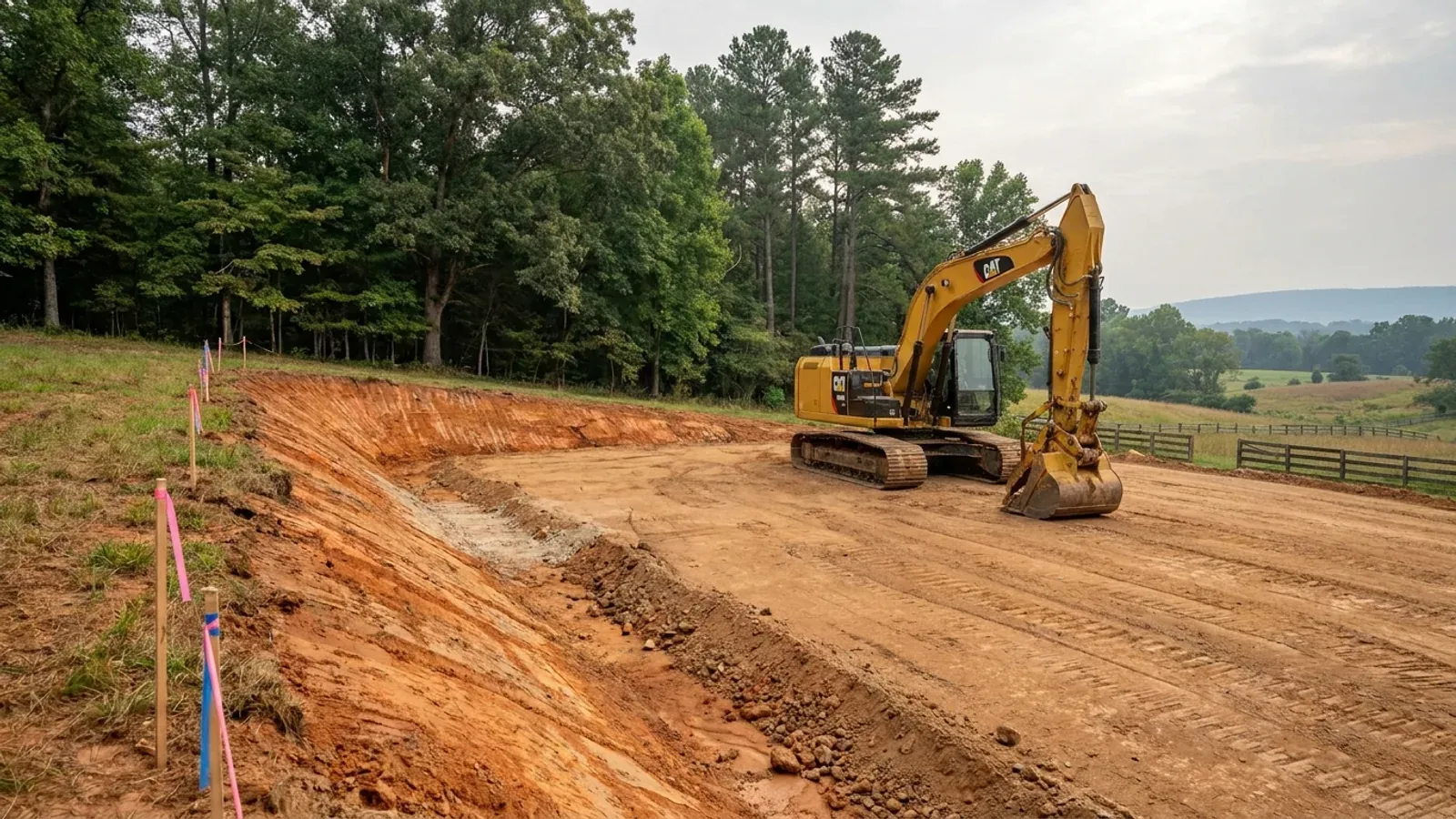
An excavator grading a compacted building pad on a cleared lot, with survey stakes, a drainage swale and a silt fence along the downhill edge.
Below the slab

The expensive surprises are in the ground, not the building

What moves a North Carolina budget is usually below grade, and the thing most often got wrong is which clay to worry about. Cecil — the red Piedmont clay everyone pictures, and the state soil — is kaolinitic and low shrink-swell; it does not heave. The soil that does is Iredell, formed over diabase and gabbro, which the USDA describes as vertic, very high shrink-swell, with a perched water table a foot or two down from December through April. The tell is colour: Cecil is red and Iredell is dark grey-brown, and they sit within a few miles of each other across the central Piedmont. West of that the question stops being clay and becomes slope, rock and colluvium; east of the fall line it becomes water, and in the Tidewater it becomes organic soil that subsides irreversibly once it is drained. Then the same ground decides the septic system, and North Carolina rewrote those rules recently enough that most of what is published about them is out of date. 15A NCAC 18E replaced the old subchapter on 1 January 2024 and was amended again on 1 June 2026: the site is classified on soil morphology — the word "percolation" does not appear anywhere in it — and there is no "provisionally suitable" any more, only suitable or unsuitable, on a single failed parameter. There is no statewide minimum lot size either; the area you need is derived from the soil result and then doubled, because a site that cannot fit both the initial field and its repair area is unsuitable. And the order matters more than people expect: the county health department's Improvement Permit and Construction Authorization come first, and the building permit is available on the strength of the Construction Authorization, not before it. One more thing that catches people: disturb more than an acre and you need an approved erosion and sedimentation control plan in hand before work starts, with penalties up to $5,000 a day, and a pad plus a drive plus a drainfield plus a laydown area crosses an acre faster than it sounds. So the site work, the foundation and the drainfield get resolved together rather than one at a time. We price the dirt before we price the building.

What a build looks like

Three stages every Greensboro project passes through, from a raw parcel to a finished home. Site work first, because that is where the budget is decided.
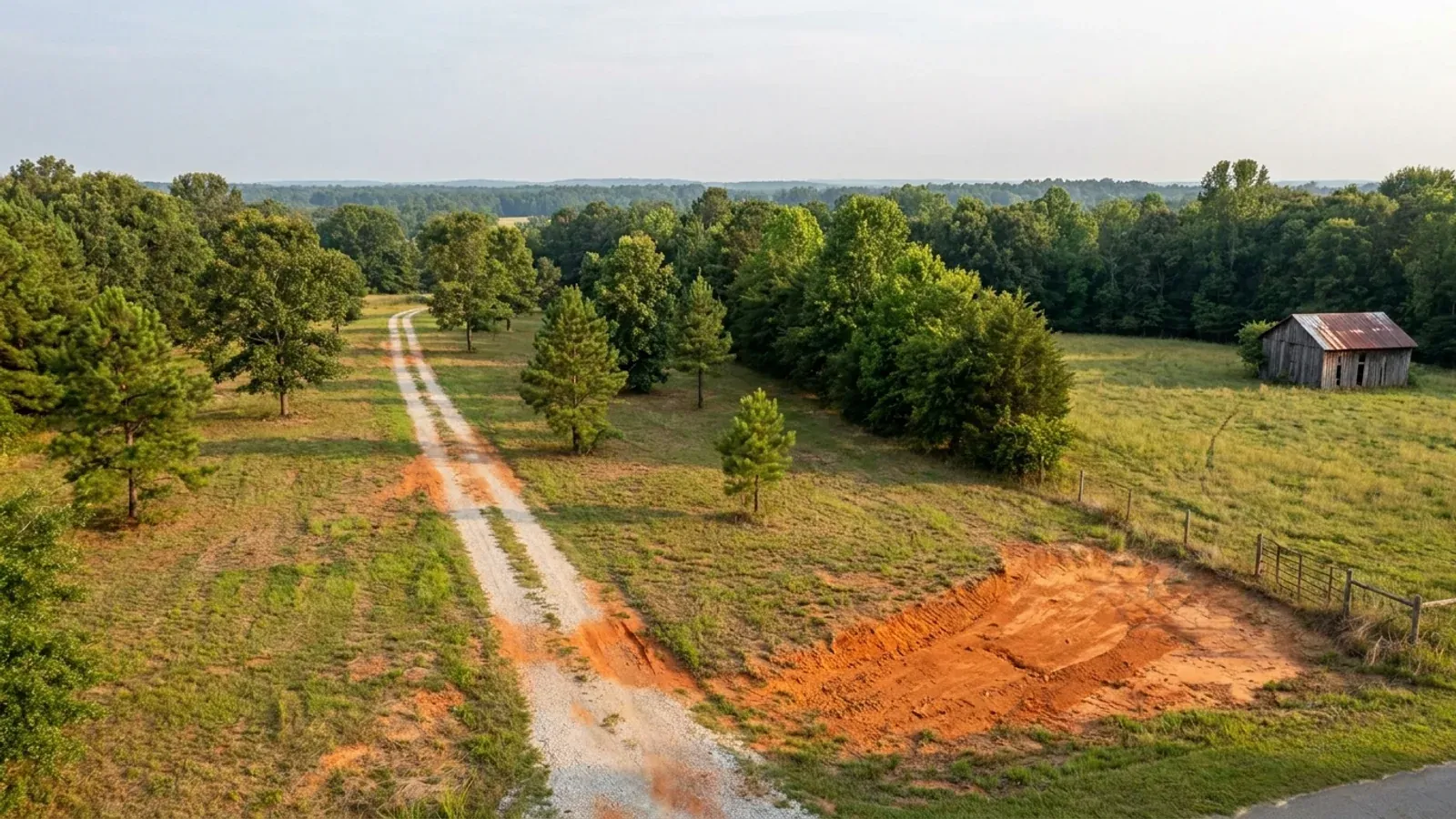
Aerial view of an undeveloped rural lot with cleared grass, a mixed oak, hickory and pine treeline, exposed red clay in one corner and a pale gravel access track.
Stage one

The parcel

Zoning, setbacks, flood zone and utility access get checked before anything is drawn.

An excavator grading a compacted building pad on a cleared lot, with survey stakes, a drainage swale and a silt fence along the downhill edge.
Stage two

Pad and permit

Clearing, grading and a compacted pad, while the septic authorization and the building submittal work through whichever offices cover your parcel.
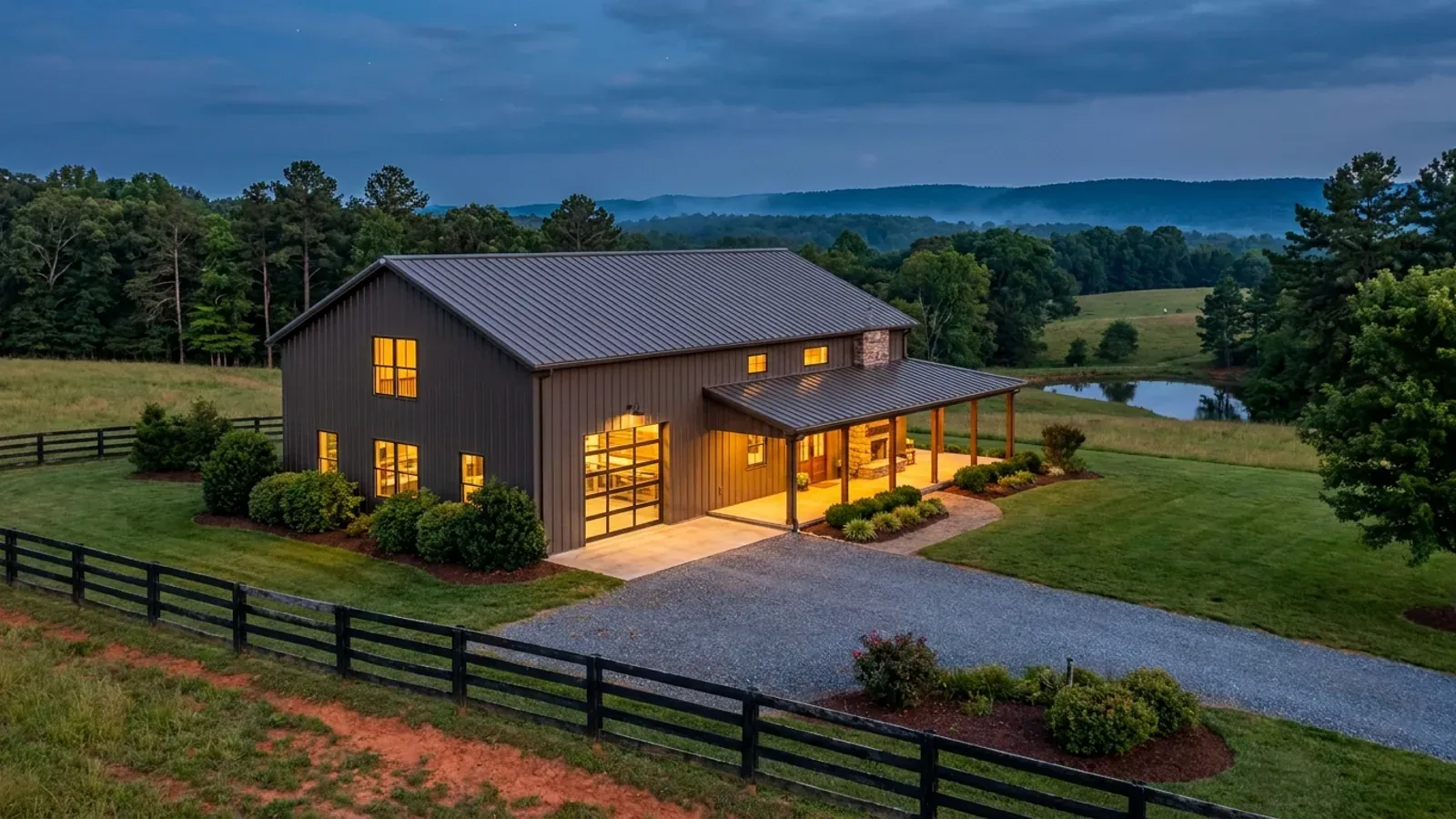
A finished barndominium at dusk with warm interior lighting glowing through its large windows.
Stage three

Frame to finish

Shell erected and dried in, then systems, insulation and interior finish through to CO.

Those are the rules where you are building in Greensboro. Tell us what you want to build and we will draw it to them.

Where we build around Greensboro

Guilford County and the rural land around it. The buildable acreage for a project this size usually sits outside the town limits — which does not automatically put it under the county, because a town's zoning and building-code enforcement reach one to three miles past its limits into its extraterritorial jurisdiction. Inside the limits, in the ETJ, or in neither are three different answers to who issues your permit.

The Greensboro service area, including the rural acreage outside the built-up edge, which is where the parcels big enough for a build like this usually sit. The map marks the territory we build in. It is not a branch location, and there is no office at this pin.

Nearby areas we build in

Others we cover nearby. Every North Carolina municipality sits inside a county — there are no independent cities here — but that does not settle who regulates a given parcel. A town's zoning, subdivision rules and building-code enforcement extend one to three miles beyond its limits, by population, into what the statute calls its extraterritorial jurisdiction; town taxes and town elections do not follow. So the office that issues the permit, what it charges and how the land is zoned can all differ from one card to the next, and the mailing address will not tell you which case you are in.

Building in Greensboro: common questions

7 questions we get asked most often about building in Greensboro. If yours is not on the list, ask it directly.

Is it true that an unheated shop bay does not count toward the permit fee in Guilford County?
On the county's own schedule, yes — and it is the sharpest cost difference between neighbouring North Carolina counties for this building type. Guilford County Inspections prices a new detached single-family structure at $150 plus $0.35 per heated square foot. The word is heated, and an unheated shop bay, garage or covered porch does not add to that base. Compare the counties that measure gross area: Wake charges $75 plus $0.25 per square foot and says there is no deduction for a garage; Union charges $0.84 per square foot on area under roof whether heated or not; Harnett measures heated area plus the garage. On a 3,000 square foot barndominium that is half workshop, that is 1,500 billable square feet in Guilford and 3,000 in Union. Two cautions before you turn it into a number. The Detached Single-Family Structures line does not carry the "+ Trade fee(s)" tag that every other residential line on the schedule carries, so whether four separate $75 trade permits are added is unresolved on the published page. And a separately permitted accessory building is charged at $0.20 per unheated square foot or $0.35 per heated square foot, so putting the shop on its own permit changes the answer. Call the department before you commit to a total.
Who issues my building permit — the City of Greensboro or Guilford County?
It depends on which of three areas your parcel is in, and the answer changes the fee basis, not just the address on the envelope. Guilford County Inspections publishes its service area as all unincorporated Guilford County plus, by contract, Jamestown, Oak Ridge, Pleasant Garden, Sedalia, Stokesdale, Summerfield, Whitsett and the Piedmont Triad Airport Authority. The Cities of Greensboro and High Point run their own inspections inside their own limits, so a Greensboro city-limits address is a city permit. Between the two sits the extraterritorial jurisdiction: under G.S. 160D-202 a city of Greensboro's size may enforce its zoning, subdivision regulation and building code up to three miles beyond its corporate boundary, on land that pays the city no property tax and cannot vote in its elections. Guilford County's own Unified Development Ordinance, adopted 19 November 2020, is written to that boundary — it governs properties in unincorporated Guilford County and outside municipal extraterritorial jurisdictions. Check the city's official zoning map and the county register of deeds for a specific parcel; rural-looking land near Greensboro is routinely under city rules.
Can I actually buy land and build inside Greensboro?
Occasionally, and rarely at the acreage this building type wants. Greensboro is 308,667 people and Guilford County runs 562,234 on 646 square miles — 870 to the square mile. The county is 22.9 percent farmland with 775 farms on 94,798 acres at a 35-acre median, which is respectable for a metropolitan county and still not where the buildable tracts are. The ring answers it in three directions. Rockingham County to the north is 30.2 percent farmland, 769 farms on 109,295 acres, 60-acre median. Randolph County to the south is 26.2 percent with 1,238 farms on 131,301 acres — the largest farm count in the Triad and the 17th-largest farmland acreage in the state — at a 49-acre median. Alamance to the east is 25.4 percent, 724 farms on 68,769 acres, 46-acre median, growing 8.6 percent since 2020. All three are a normal commute. One thing to carry with you: the fee basis does not travel. Randolph prices its permit off construction valuation rather than heated square feet, so the Guilford advantage is specifically a Guilford advantage.
What does the septic approval cost in Guilford County?
It is priced per bedroom, which almost nobody expects. Guilford County publishes no line called an Improvement Permit; it charges Residential Soil Evaluations at $100 per bedroom and then an Authorization to Construct at $100 for a type I or II system, $140 for a IIIb, $450 for an alternative type IV, V or VI, $550 for an alternative design and $200 for an innovative wastewater approval. So a three-bedroom house is $300 on the evaluation line and a five-bedroom plan is $500. The county's permit guidance also requires the bedroom count on the plans to match the permit application and the septic design, with any change requiring a permit amendment — so a loft or a flex room over the shop is a decision with a price on it. A well permit is $450 and water sampling is additive: $65 trip fee, $50 bacteria, $70 inorganic and nitrate, $75 pesticide, $75 petroleum, $335 for the full set. And the order of operations is set by rule, not by the county: 15A NCAC 18E .0201(c) provides that the building permit follows the Construction Authorization, so the septic result comes first. Under .0509(a) that result is binary — suitable or unsuitable — since "provisionally suitable" was abolished when the 18E rules took effect on 1 January 2024.
What are the design numbers in Guilford County?
Guilford County is unlisted in Table R301.2(4) of the 2018 NC Residential Code, so it takes that table's default of 115 mph ultimate design wind speed — the floor of the code, and the figure 51 of the 100 counties carry. It is not on the Table R301.2(7) list of thirteen Seismic Design Category C counties, so it sits in A or B under that table's note. The wind-borne debris region does not reach the Triad; the code defines it as a map line east of the Intracoastal Waterway rather than as a wind-speed trigger, so Section R301.2.1.2's impact glazing and shutters are not a Guilford requirement. On energy, Table N1101.7 puts Guilford in IECC climate zone 4A along with Rockingham, Alamance and Caswell, while Randolph and Davidson to the south are 3A. Statewide and true here: a flat 20 psf roof live load, a 12-inch frost line depth, Moderate weathering, and termite protection required in all of North Carolina at a Moderate-Heavy severity — with the catch that a steel building does not satisfy it, because cold-formed steel framing was deleted from the accepted methods of termite protection. There is no ground snow load column in the code, since Section R301.2.3 is deleted, and R403.3 — the frost-protected shallow foundation route — is deleted too, which matters for a slab design.
Do I need an engineer for a metal or post-frame building here?
Usually yes, and North Carolina gives you no way around the cost. Section R301.1.2 requires framing systems outside the code's prescriptive scope to demonstrate equivalent detailing, which is where most metal and post-frame barndominiums land. And the exemption a buyer expects does not exist: § 83A-13(c)(1) exempts a family residence from the architect requirement, but § 89C-25 has no equivalent residential carve-out for engineering — the subdivisions that would have provided one were repealed in 2011 and 2014. So a Guilford County barndominium is normally an engineered building sealed by a professional engineer licensed in North Carolina, and that is a real line in the budget rather than a surprise at plan review. One related point worth knowing if you are considering acting as your own general contractor: under § 87-14(a)(1) an owner-builder must personally superintend the work, may not delegate it to unlicensed persons and must be personally present at every inspection — unless the plans were drawn and sealed by a licensed architect.
Should I check Greensboro's or Guilford County's building-code amendments?
No — there are none to check, and that is worth saying because most sites in this trade imply the opposite. N.C.G.S. § 143-138(e) provides that the North Carolina State Building Code applies throughout the State from the time of its adoption. The only two things a city or county may adopt of their own are a fire prevention code, which requires Residential Code Council approval and may not reach one- and two-family dwellings beyond what the Residential Code prescriptively requires, and floodplain management regulations. There is no general local building-code amendment power in this state at all, so neither Greensboro nor Guilford County can impose a stricter structural, foundation or energy requirement on a house than the statewide code does. What genuinely varies — and what actually decides your build — is a different list: zoning and subdivision regulation under Chapter 160D, the extraterritorial jurisdiction, which office issues the permit, the fee schedule and the basis it is calculated on, the health department, floodplain and watershed regulation, and the wind, seismic and climate-zone values published county by county inside that single statewide code.

Building in Greensboro?

Start with the plan. Tell us what you want to build and we will draw it, then confirm which office issues the permit for your parcel, what it will let you put there, and what wind load it has to meet. That conversation costs nothing.