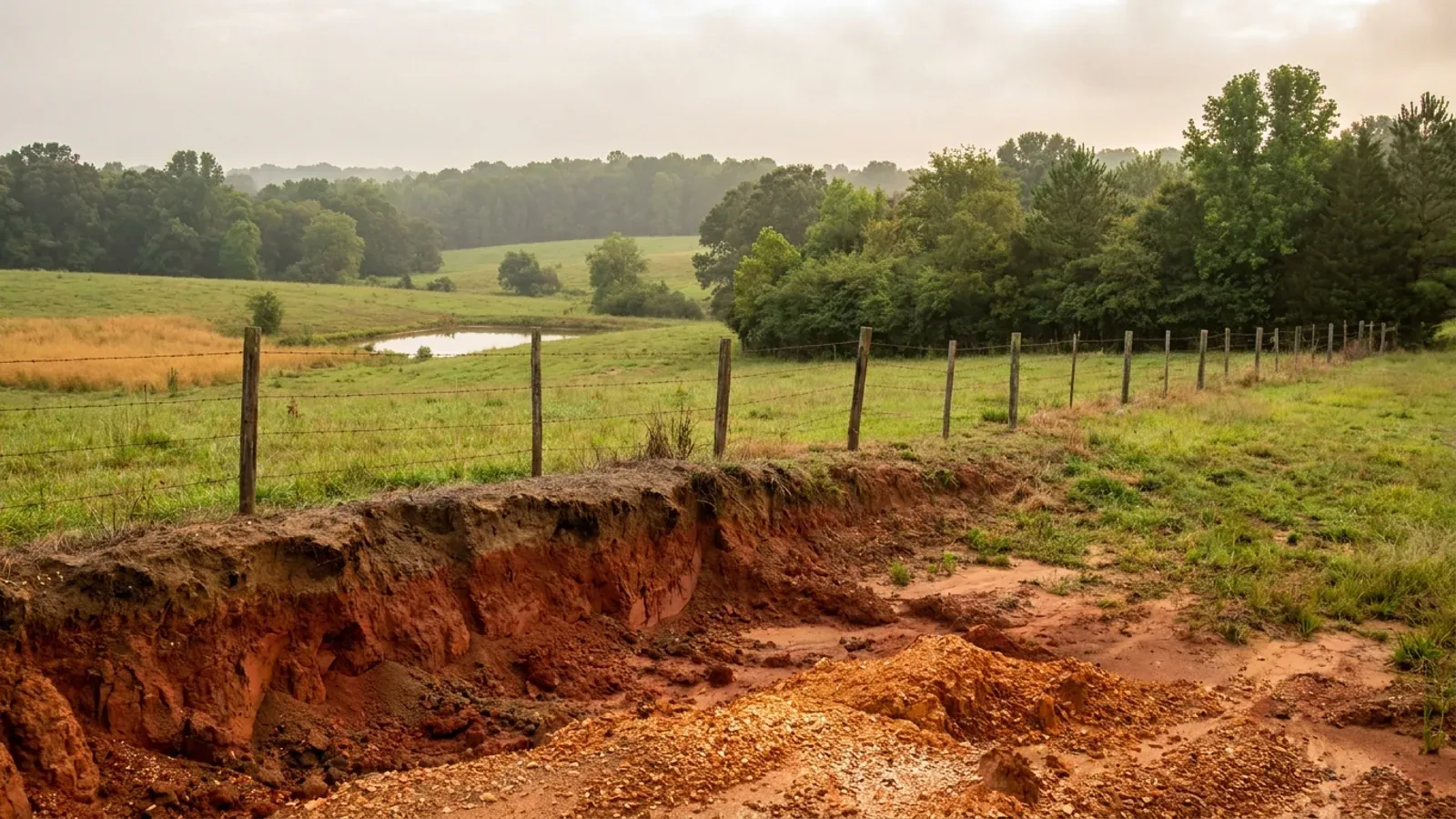
Barndominium Builders in Union County, NC
Union County is the rare place that is both halves of the argument at once. It is Charlotte's southeast ring — 267,674 people in 2025, up 12.4 percent from its 2020 base on net migration of 24,718 — and it is also, on the 2022 Census of Agriculture, the fourth-largest farmland county in North Carolina: 882 farms working 212,066 acres, 52.4 percent of everything inside the county line. Only Sampson, Robeson and Duplin have more land in farms, and all three are eastern row-crop and hog counties two hours away from any comparable job market. Union's median farm is 35 acres, the smallest of those ten. So the county is simultaneously the commuter ring and the farm belt, and the parcels come off it in barndominium sizes. The towns run west to east along a gradient: Waxhaw, Weddington, Marvin and Wesley Chapel on the Mecklenburg side; Indian Trail and Stallings on Highway 74; Monroe, the county seat, at 42,644 and up 23.1 percent since 2020; then Unionville, Wingate and Marshville out toward the Anson line. Fourteen municipalities have residents here, a fifteenth has limits with nobody in them, and 81,858 of the county's 267,674 people live outside all of them. Two things on this page matter more than the acreage. The first is the permit fee, because Union charges by the square foot on total gross building floor area under roof — heated or unheated — at $0.84 attached against $0.24 for a detached structure, which makes the position of the shop bay a 3.5-times decision on the fee alone. The second is the Goose Creek watershed, where a federally endangered mussel has put 200-foot riparian buffers on land that looks exactly like the rest of the county.
Union County at a glance
- County
- Union County
- City rules outside city limits
- Fifteen municipalities have territory in Union County, and under G.S. 160D-202 a city may enforce its zoning, subdivision rules and the building code up to one mile past its limits below 10,000 people, two miles at 10,000 to 24,999 and three miles at 25,000 or more — on land that pays it no property tax and cannot vote in its elections.
- Population
- 267,674
- ZIP codes
- 28079, 28103, 28104, 28108, 28110, 28112, 28173, 28174
- Site visits
- Same week across Monroe, Waxhaw, Indian Trail and Marshville
Building conditions in Union County
The building code does not change at a county line here. Under § 143-138(e) the North Carolina State Building Code applies throughout the state, and a city or county may adopt only a fire prevention code and floodplain regulations of its own — there is no general local amendment power, so there are no county amendments to look up. The edition in force is still the 2018 NC Residential Code, effective 1 January 2019; the 2024 edition has been delayed three times and carries no effective date at all. What genuinely differs is who issues the permit and inspects the work, what that office charges, how the parcel is zoned, what the local floodplain ordinance requires of the foundation — and two design numbers the code publishes county by county, the ultimate design wind speed and the seismic design category. The rest of Table R301.2 is set once for everyone: a flat 20 psf roof live load, a 12-inch frost line, Moderate weathering, and termite protection required everywhere in the state with no exemption. There is no ground snow load column in the residential code at all.
Union County Development Services building permit fee schedule, effective 1 August 2026 (public notice 1 July 2026), unioncountync.gov, showpublisheddocument/11800; read in a browser 5 September 2026. The host serves an Akamai edge "Access Denied" response to non-browser clients on every path, real and nonexistent alike, so its status codes carry no information.
USDA NASS, 2022 Census of Agriculture, county profiles for North Carolina (cp37179), nass.usda.gov; growth ranking from U.S. Census Bureau Vintage 2025 county estimates (co-est2025-alldata).
15A NCAC 02B .0601, .0602 and .0605, Site Specific Water Quality Management Plan for the Goose Creek Watershed (Yadkin Pee-Dee River Basin), NC Office of Administrative Hearings rule PDFs at reports.oah.state.nc.us, read 6 September 2026; programme list from NC DEQ Riparian Buffer Protection Program, deq.nc.gov.
Union County Environmental Health fee page, unioncountync.gov/government/departments-a-e/environmental-health/environmental-health-fees, read in a browser 5 September 2026. The page states no effective date.
U.S. Census Bureau, Vintage 2025 sub-county population estimates, sub-est2025_37.csv, SUMLEV 157 county-part records for Union County (FIPS 37179), downloaded from www2.census.gov 6 September 2026; City of Monroe Permit Center page, monroenc.org/240/Permit-Center, read 6 September 2026.
Union County Development Services building permit fee schedule, effective 1 August 2026, unioncountync.gov, showpublisheddocument/11800; read in a browser 5 September 2026.
Also worth knowing before you build in Union County
- Growth without density — 267,674 people across 633 square miles
- Union County grew from a 2020 census base of 238,179 to an estimated 267,674 in July 2025, up 12.4 percent, with net migration of 24,718 over the period. It is the eighth-largest county in North Carolina by population and among the ten fastest-growing, tied with Harnett on the rate. It is also the largest county in the Charlotte ring by land area at 633 square miles, and at 423 people per square mile it is under a fifth the density of Mecklenburg next door, at 2,356. Eight of the state's eleven fastest-growing counties are ring counties rather than core counties, which is the buy-land-here, work-there pattern in a single statistic.
- The design numbers here are the plain ones — and that is worth saying
- Union County is absent from Table R301.2(4) of the 2018 NC Residential Code, so it takes that table's unlisted default of 115 mph ultimate design wind speed, and absent from Table R301.2(7), the Seismic Design Category C list, whose own note places every county not listed in A or B. Table N1101.7 puts it in IECC climate zone 3A. Three more figures hold here as everywhere: a flat 20 psf roof live load, a 12-inch frost line depth, and Moderate weathering. There is no ground snow load column in the code at all — Section R301.2.3 is deleted — so a ground snow figure quoted for a Union County build came from somewhere other than the code. Name the edition on the drawings: the 2018 code governs, and the 2024 edition has no effective date.
- Monroe is a city; the county seat is not the default permit office
- Monroe reached an estimated 42,644 people in July 2025 from a 2020 base of 34,637 — up 23.1 percent, one of the fastest-growing North Carolina places over 25,000. Its Permit Center states that its work is the administration and enforcement of the NC State Building Code and City of Monroe ordinances within the City of Monroe, and it handles building, occupancy, zoning, erosion control, stormwater, water and sewer and fire permits through its own online system. That matters on a page like this because two of Union's neighbours run the opposite arrangement: Mecklenburg County enforces the building code on a consolidated countywide basis, and Cabarrus County's Construction Standards division states it provides building inspections and permitting services for all areas within Cabarrus County. Three adjacent counties, three different answers to who issues your permit.
- Union's farm exemption is a zoning right with a price written into it
- Two separate statutes do work people tend to blur together. G.S. 143-138(b4)(1) defines a farm building, for building-code purposes, as a nonresidential building or structure — so a dwelling is outside that exemption from the start, whatever it is built next to. Then G.S. 160D-903(a) grants the farm-residence zoning exemption only to a residence constructed to the applicable residential building code, and G.S. 160D-903(b) bars a county from prohibiting a dwelling on an agricultural lot over ten acres, or requiring road frontage, or requiring connection to public water and sewer — again only for a dwelling constructed in accordance with the North Carolina State Building Code. On a Union County tract over ten acres in bona fide agricultural use, that is a real and specific gain: no zoning prohibition, no frontage requirement, no forced utility connection. Code compliance is what the legislature charged for it.
U.S. Census Bureau, Vintage 2025 county population estimates (co-est2025-alldata.csv) and 2025 Gazetteer county file, census.gov.
2018 NC Residential Code, Tables R301.2(1), R301.2(4), R301.2(7) and N1101.7 and Section R301.2.3, NC Office of the State Fire Marshal.
City of Monroe Permit Center, monroenc.org/240/Permit-Center, read 6 September 2026; Cabarrus County Construction Standards, cabarruscounty.us, read 6 September 2026; Mecklenburg County LUESA Fee Ordinance zoning schedules; populations from U.S. Census Bureau Vintage 2025 sub-county estimates.
N.C.G.S. § 143-138(b4)(1) and § 160D-903(a) and (b), as reproduced at codes.findlaw.com.
The expensive surprises are in the ground, not the building
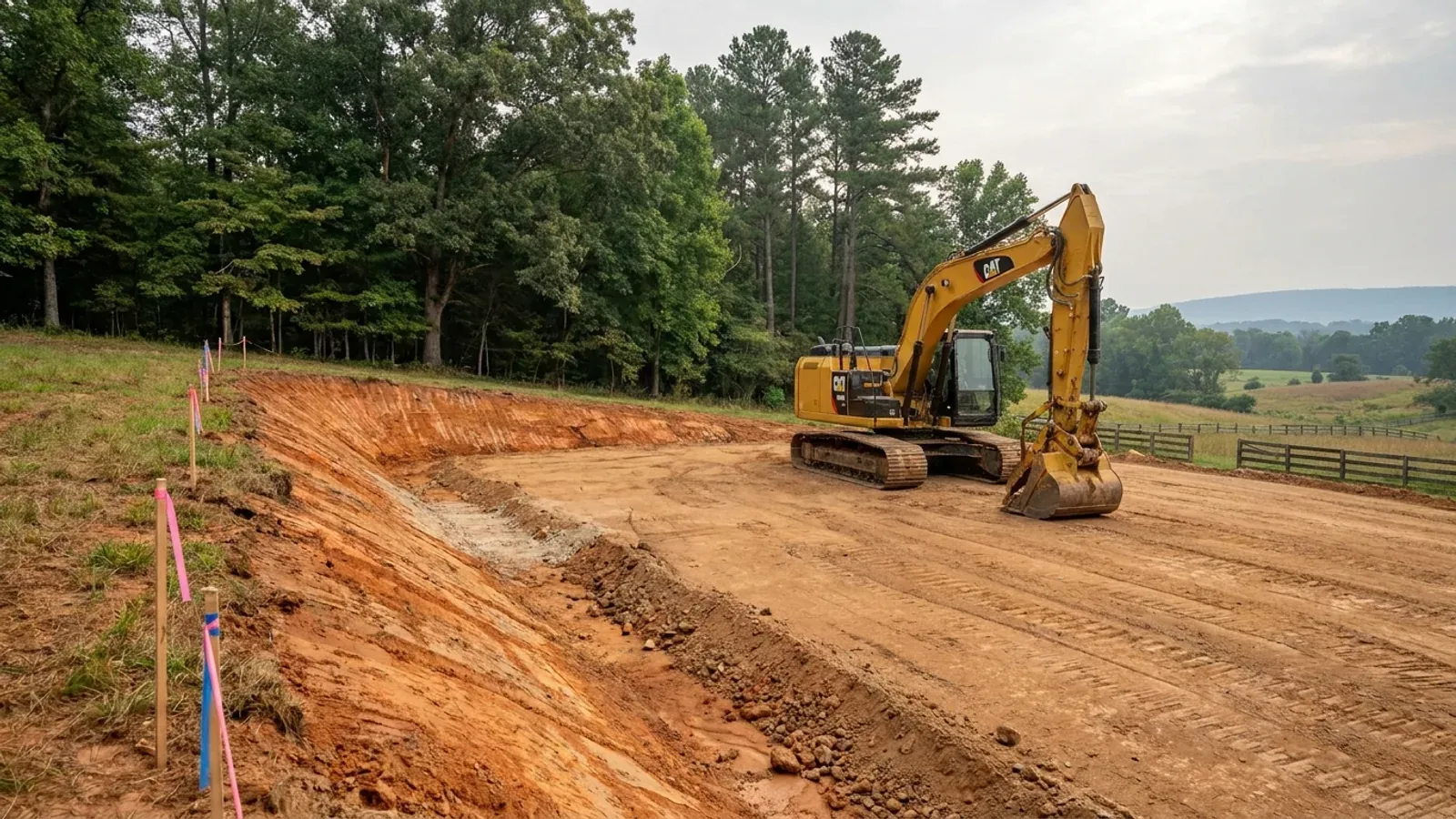
What moves a North Carolina budget is usually below grade, and the thing most often got wrong is which clay to worry about. Cecil — the red Piedmont clay everyone pictures, and the state soil — is kaolinitic and low shrink-swell; it does not heave. The soil that does is Iredell, formed over diabase and gabbro, which the USDA describes as vertic, very high shrink-swell, with a perched water table a foot or two down from December through April. The tell is colour: Cecil is red and Iredell is dark grey-brown, and they sit within a few miles of each other across the central Piedmont. West of that the question stops being clay and becomes slope, rock and colluvium; east of the fall line it becomes water, and in the Tidewater it becomes organic soil that subsides irreversibly once it is drained. Then the same ground decides the septic system, and North Carolina rewrote those rules recently enough that most of what is published about them is out of date. 15A NCAC 18E replaced the old subchapter on 1 January 2024 and was amended again on 1 June 2026: the site is classified on soil morphology — the word "percolation" does not appear anywhere in it — and there is no "provisionally suitable" any more, only suitable or unsuitable, on a single failed parameter. There is no statewide minimum lot size either; the area you need is derived from the soil result and then doubled, because a site that cannot fit both the initial field and its repair area is unsuitable. And the order matters more than people expect: the county health department's Improvement Permit and Construction Authorization come first, and the building permit is available on the strength of the Construction Authorization, not before it. One more thing that catches people: disturb more than an acre and you need an approved erosion and sedimentation control plan in hand before work starts, with penalties up to $5,000 a day, and a pad plus a drive plus a drainfield plus a laydown area crosses an acre faster than it sounds. So the site work, the foundation and the drainfield get resolved together rather than one at a time. We price the dirt before we price the building.
What we build in Union County
All nine services are available in Union County. What a build costs depends far more on the parcel than on square footage, so we price against your land rather than publishing a rate card.
Barndominium Kits
Engineered shell packages drawn to your own county's wind and seismic numbers under the 2018 NC Residential Code, with the exclusions written down.
Custom Plans
Barndominium floor plans drawn for your parcel, your county's design figures and the septic system your bedroom count will actually need.
Metal Homes
Metal building homes finished to live in — envelope, insulation, condensation control and interior finish specified to your NC county's climate zone.
What a build looks like
Three stages every Union County project passes through, from a raw parcel to a finished home. Site work first, because that is where the budget is decided.
The parcel
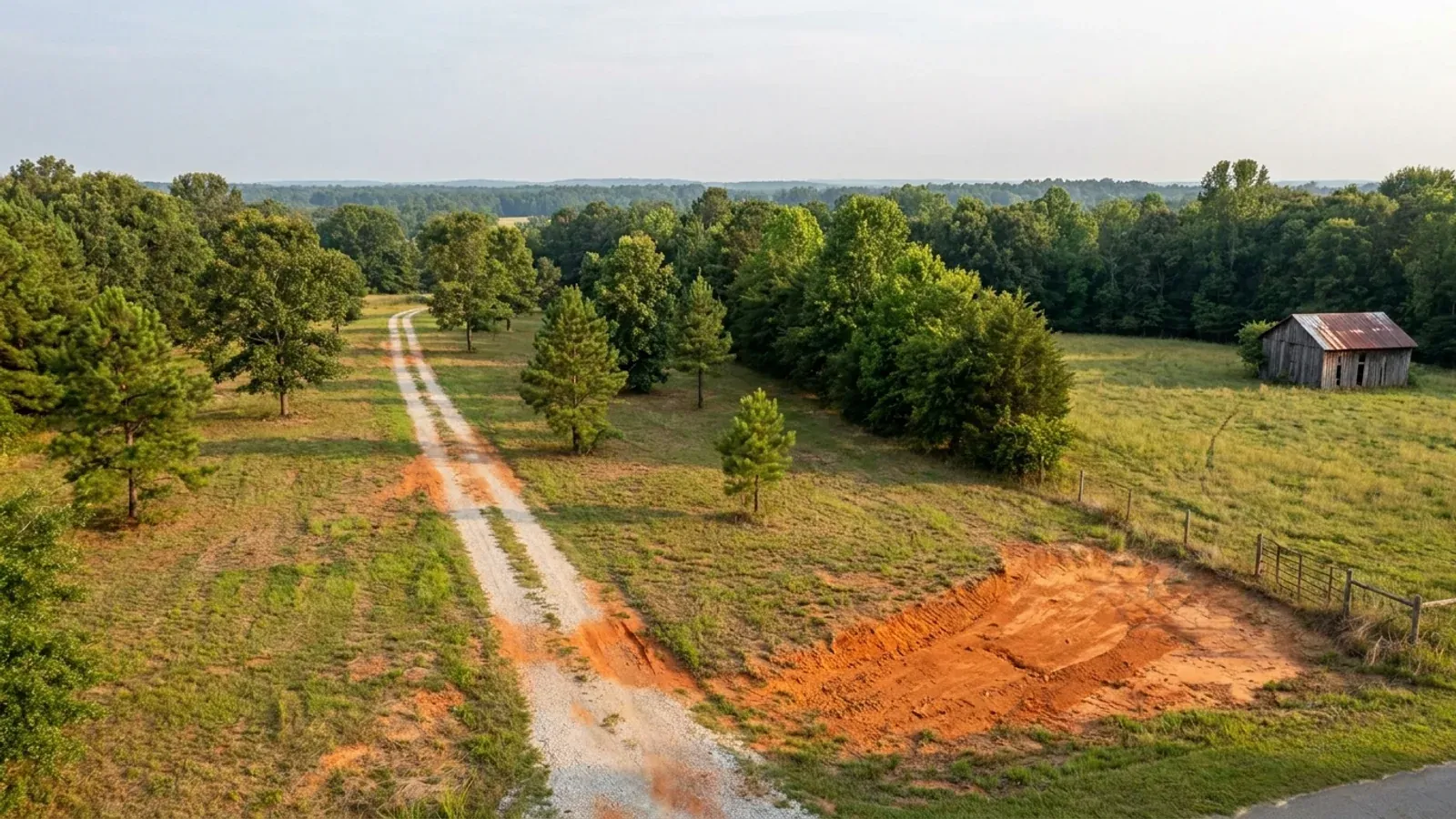
Zoning, setbacks, flood zone and utility access get checked before anything is drawn.
Pad and permit
Clearing, grading and a compacted pad, while the septic authorization and the building submittal work through whichever offices cover your parcel.
Frame to finish
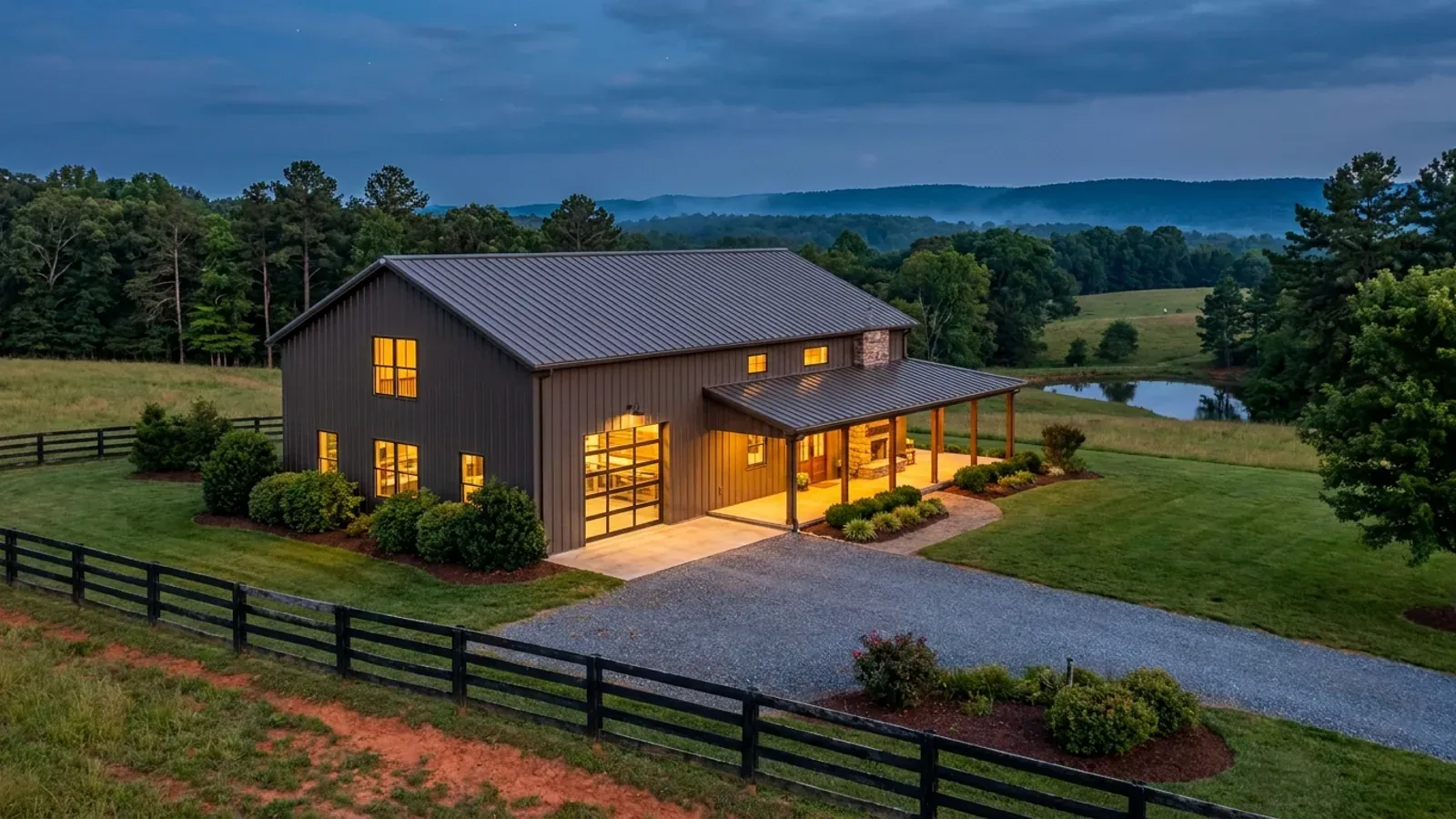
Shell erected and dried in, then systems, insulation and interior finish through to CO.
Those are the rules where you are building in Union County. Tell us what you want to build and we will draw it to them.
Where we build around Union County
Union County and the rural land around it. The buildable acreage for a project this size usually sits outside the town limits — which does not automatically put it under the county, because a town's zoning and building-code enforcement reach one to three miles past its limits into its extraterritorial jurisdiction. Inside the limits, in the ETJ, or in neither are three different answers to who issues your permit.
Keep reading
The questions that usually come next once you know what Union County allows.
Barndominium Cost Guide
What the named, dated sources actually publish for North Carolina, with a calculator built on the same figures.
Read itIs It Legal in North Carolina?
Why a "farm building" is defined as nonresidential, and the ten-acre right § 160D-903(b) gives you in exchange for building to the code.
Read itHow Long Does It Take?
Census build-duration data, and what actually sets the permit clock where you are building.
Read itNearby areas we build in
Others we cover nearby. Every North Carolina municipality sits inside a county — there are no independent cities here — but that does not settle who regulates a given parcel. A town's zoning, subdivision rules and building-code enforcement extend one to three miles beyond its limits, by population, into what the statute calls its extraterritorial jurisdiction; town taxes and town elections do not follow. So the office that issues the permit, what it charges and how the land is zoned can all differ from one card to the next, and the mailing address will not tell you which case you are in.
Building in Union County: common questions
8 questions we get asked most often about building in Union County. If yours is not on the list, ask it directly.
Should the shop bay be attached to the house or detached in Union County?
Who issues the building permit for my Union County land?
What does a septic permit cost in Union County, and what do I have to provide?
How much land does a barndominium need here?
What is the Goose Creek watershed and does it affect my parcel?
Do I need an erosion control plan?
Are there Union County building-code amendments I should look up before designing?
Does a steel building let me skip termite treatment in Union County?
Building in Union County?
Start with the plan. Tell us what you want to build and we will draw it, then confirm which office issues the permit for your parcel, what it will let you put there, and what wind load it has to meet. That conversation costs nothing.