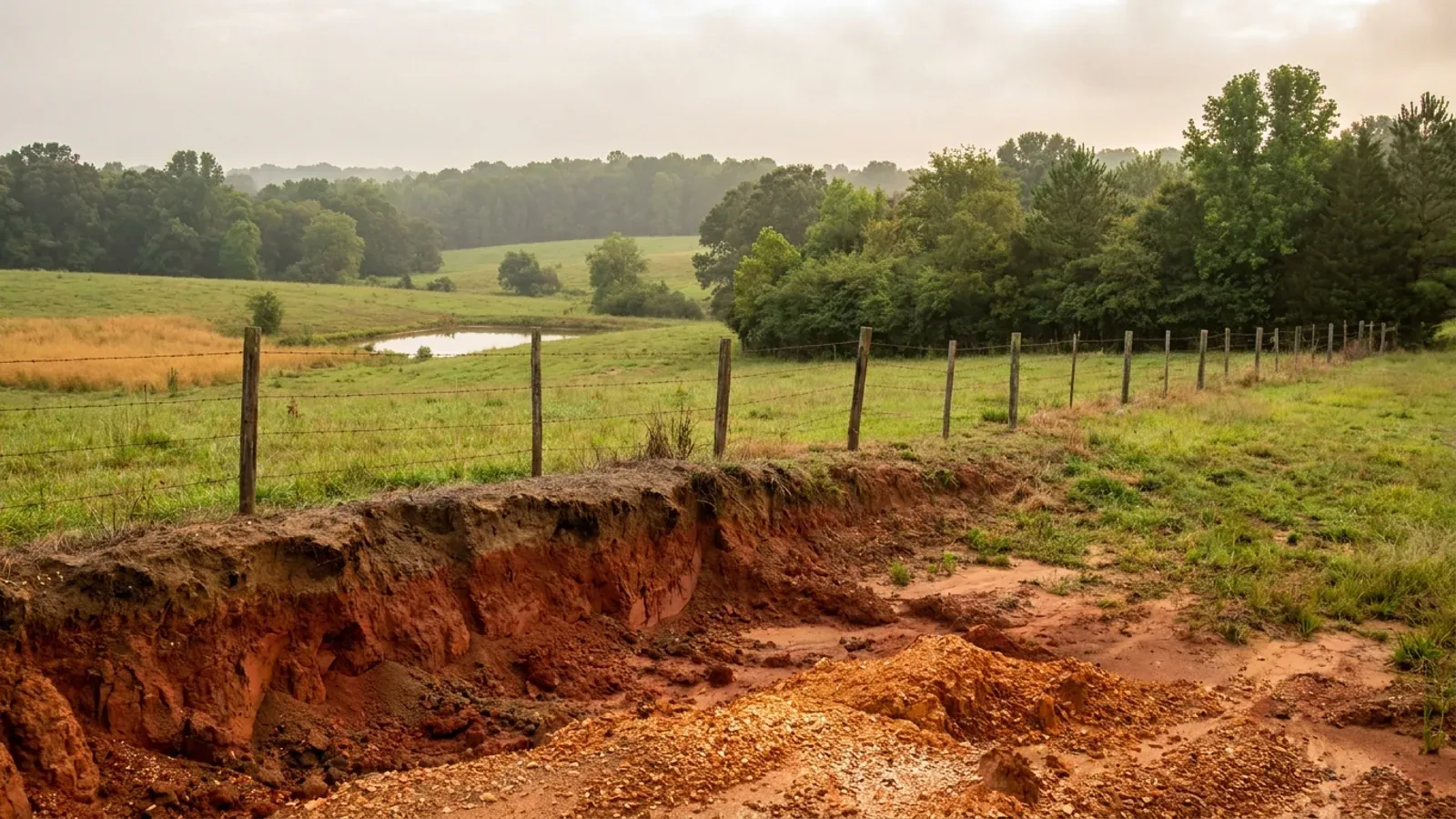
Rolling southern Piedmont farmland with vivid red clay exposed at a field edge, mixed oak, hickory and pine woodland and a small farm pond.
Cabarrus County 2018 NC Residential Code, statewide

Barndominium Builders in Cabarrus County, NC

Cabarrus County is Charlotte's northeast ring, and the first honest thing to say about it is that most of it is already a town. The Census Bureau's Vintage 2025 sub-county file splits the county's 249,725 residents into six municipal parts — Concord 114,598, the Cabarrus part of Kannapolis 50,152, Harrisburg 20,742, the Cabarrus part of Midland 5,151, Mount Pleasant 1,816 and the Cabarrus part of Locust 709 — leaving a balance of 56,557 people outside every one of them. That is 22.6 percent of the county's population, on a county of only 361 square miles, at 691 people per square mile — a density only Gaston, at 693, and Mecklenburg itself, at 2,356, exceed anywhere in the Charlotte ring. Growth has been 10.6 percent since the 2020 base, on net migration of 19,048. The farmland numbers follow from that. The 2022 Census of Agriculture counts 630 Cabarrus farms working 64,227 acres — 27.8 percent of the county, at a median farm of 30 acres, the smallest median in the Charlotte ring and one of the smallest in the state. Where the land actually is, the county's own Development Ordinance says plainly: the Agricultural/Open Space district is described as comprising mostly lands found on the eastern side of the county, which should remain agrarian, and for which public utilities will not be planned. Two consequences run through this whole page. The first is that a rural Cabarrus parcel is a well-and-septic parcel by design, and the septic answer comes from Cabarrus Health Alliance, a public health authority rather than a county department. The second is the ground: Cabarrus sits on the Concord Plutonic Suite, a belt of gabbro, norite and metadiabase named for the county seat — and mafic rock is the parent material of the one Piedmont soil that genuinely heaves.

Cabarrus County at a glance

County
Cabarrus County
City rules outside city limits
Cabarrus County appoints extraterritorial jurisdiction members to three municipal boards — the Concord Planning and Zoning Commission, the Harrisburg Planning and Zoning Board and the Mount Pleasant Planning and Adjustment Board — so rural-looking land outside those town limits can still be under town zoning while the county issues the building permit.
Population
249,725
ZIP codes
28025, 28027, 28075, 28081, 28083, 28107, 28124
Site visits
Same week across Concord, Kannapolis, Harrisburg and Mount Pleasant

Building conditions in Cabarrus County

The building code does not change at a county line here. Under § 143-138(e) the North Carolina State Building Code applies throughout the state, and a city or county may adopt only a fire prevention code and floodplain regulations of its own — there is no general local amendment power, so there are no county amendments to look up. The edition in force is still the 2018 NC Residential Code, effective 1 January 2019; the 2024 edition has been delayed three times and carries no effective date at all. What genuinely differs is who issues the permit and inspects the work, what that office charges, how the parcel is zoned, what the local floodplain ordinance requires of the foundation — and two design numbers the code publishes county by county, the ultimate design wind speed and the seismic design category. The rest of Table R301.2 is set once for everyone: a flat 20 psf roof live load, a 12-inch frost line, Moderate weathering, and termite protection required everywhere in the state with no exemption. There is no ground snow load column in the residential code at all.

Build conditions for Cabarrus County , North Carolina : ultimate design wind speed 115 mph. BUILD CONDITIONS CABARRUS COUNTY, NCCabarrus County2018 NC RESIDENTIAL CODEULTIMATE DESIGN WIND SPEED115 mphCabarrus County is absent from Table R301.2(4) of the 2018 NC Residential Code, so it takes thattable's unlisted default of 115 mph ultimate design wind speed.ZONING · AO AGRICULTURAL/OPEN SPACE AND CR CO…3 acres in AO, 2 acres in CR, under…Chapter 5 § 5-5 of the Cabarrus County Development Ordinance setsconventional subdivision standards for AO at a maximum density of…WHO ISSUES THE PERMITCabarrus County Construction Standar…65 Church Street SE, Concord, 704-920-2128, for building permits andinspections throughout the county. Zoning in the unincorporated…
Build conditions for Cabarrus County, drawn from the sourced facts on this page. Every figure above is cited in the quick-facts panel below, with its source and vintage.
Three-quarters of the county is already inside a town
The Census Bureau's Vintage 2025 sub-county file gives Cabarrus County six municipal parts and a balance: Concord 114,598, the Cabarrus part of Kannapolis 50,152, Harrisburg 20,742, the Cabarrus part of Midland 5,151, Mount Pleasant 1,816, the Cabarrus part of Locust 709 — and Balance of Cabarrus County, meaning everything outside all six, 56,557. The six parts and the balance sum exactly to the county's 249,725. So 22.6 percent of the county's people live outside every municipality, on a county of just 361 square miles at 691 people per square mile — nearly twice Iredell's 369 and more than twice Rowan's 303, and exceeded in the Charlotte ring only by Gaston at 693 and Mecklenburg at 2,356. This is not a county where you look for land by driving around; it is one where you look at a zoning map first.

U.S. Census Bureau, Vintage 2025 sub-county population estimates, sub-est2025_37.csv, SUMLEV 157 county-part records for Cabarrus County (FIPS 37025), downloaded from www2.census.gov 6 September 2026; land area from the 2025 Gazetteer county file.

The ordinance says where the land is: the eastern side
You do not have to infer where unincorporated Cabarrus survives — the county's Development Ordinance says it. Chapter 3 describes the Agricultural/Open Space district as comprising mostly lands usually found on the eastern side of the county which, because of soil type and topography, should remain agrarian, and adds that public utilities will not be planned for these areas. The Countryside Residential district is described as land with a strong rural, pastoral feel, kept at very low overall densities and permitting only the standard single-family detached dwelling, created after the county's area planning process found townships that had grown by as much as 80 percent in a decade. Read together, those two paragraphs are the county telling you that the buildable rural acreage is east of Concord and Harrisburg, toward Mount Pleasant and the Stanly line, and that it is not going to be sewered.

Cabarrus County Development Ordinance, Chapter 3 (Establishment of Districts), amended 19 January 2021, cabarruscounty.us/files/assets/public/planning-and-development/planning-and-zoning/documents/chapter3-development-ordinance.pdf, read 6 September 2026.

Three acres in AO, two in CR — and the table does not permit public water or sewer
Chapter 5 § 5-5 of the Development Ordinance sets the conventional subdivision standards, and the numbers are unusually blunt. Agricultural/Open Space: maximum density 0.33 dwelling units per acre, minimum lot area 3 acres, minimum average lot width 150 feet, front yard 75 feet on a minor collector and 50 feet on a local road, side yard 20 feet, rear yard 30 feet, maximum height 40 feet, maximum impermeable surface 15 percent. Countryside Residential: 0.50 units per acre, 2 acres, and 20 percent impermeable. In both districts the row for public water and sewer reads that it is not permitted, with a footnote allowing governmental water to individual lots for public health reasons. And the § 5-6 dimensional table carries a second footnote that no lot may be smaller than one acre and that all lots must meet Cabarrus Health Alliance requirements for septic system installation before any zoning or building permit is approved. Two things follow for a barndominium. The 40-foot height cap is generous by Piedmont county standards and will take a tall shop bay. The 15 percent impermeable cap in AO is not generous at all once you add a slab, an apron and a gravel drive — on three acres that is about 19,600 square feet of everything.

Cabarrus County Development Ordinance, Chapter 5 (District Development Standards) §§ 5-5 and 5-6, amended 18 January 2022, cabarruscounty.us/files/assets/public/planning-and-development/planning-and-zoning/documents/chapter5-development-ordinance.pdf, read 6 September 2026.

Septic is not a county department here — it is Cabarrus Health Alliance, and it charges by the acre
On-site wastewater and well evaluations in Cabarrus County are done by the Environmental Health Division of Cabarrus Health Alliance, a public health authority rather than a county health department, and its published fee schedule is priced differently from its neighbours. The application for a soil evaluation is $350 for the first acre and $350 for each additional acre where applicable — so on a large tract the evaluation cost scales with the ground you ask to have looked at. The Construction Authorization, the county's septic tank permit, is then priced by design flow: $350 at 360 gallons per day or less for one to three bedrooms, $450 at 600 gpd or less for four to five bedrooms, $550 at 601 gpd or more for six bedrooms or more, with an additional $150 for any system with a pump. A repair application is $50 and the repair permit $100; a repeat layout or redesign is $200; an existing-system approval is $150; a site revisit is $75 plus $25 for each additional visit. A drinking water well application is $50 and the permit $500, with redesign $100 and abandonment $150. The private-professional route is priced against the same table: an Engineered Option Permit or Authorized On-site Wastewater Evaluator notice of intent to construct is $35 under G.S. 130A-336.1(b) and 130A-336.2(b), and the Session Law 2023-90 route runs at 100 percent of the normal fee for the Improvement Permit alone and 40 percent for the Construction Authorization.

Cabarrus Health Alliance Environmental Health Fee Schedule, cabarrushealth.org/737/Environmental-Health-Fee-Schedule, read 6 September 2026. The published schedule states no effective date.

The Concord Plutonic Suite — and why the red clay rule of thumb fails here
Cabarrus County is the type area for a belt of mafic rock. The U.S. Geological Survey's national geologic names lexicon records the Concord Plutonic Suite as syntectonic gabbro, syenite and metadiabase plutons in the Charlotte belt, comprising the named Concord, Farmington, Linwood, Barber, Bear Poplar, Mecklenburg, Pineville and Weddington plutons and other small intrusive bodies in Cabarrus, Davie, Iredell, Rowan and Mecklenburg Counties. Major rock types are gabbro, norite and hornblende gabbro; coarse-grained augite and biotite-hornblende syenite; and undeformed metadiabase. One of the dated gabbro samples comes from the Harrisburg 7.5-minute quadrangle in Cabarrus County. That matters because of what forms on top of it. Cecil, the state soil and the red clay everyone pictures, is kaolinitic with low shrink-swell and does not heave. The Iredell series does: USDA classes it fine, mixed, active, thermic Oxyaquic Vertic Hapludalfs — note Vertic — with very high shrink-swell in the argillic horizon, slickensides, very slow permeability and a perched water table one to two feet down from December through April. Its parent material is stated as diabase, diorite, gabbro and other rocks high in ferro-magnesian minerals, which is precisely the Concord suite. The tell a buyer can actually use is colour: Cecil is red, and Iredell's surface is dark greyish brown. On a Cabarrus lot that distinction is a live question rather than a theoretical one, and Section R401.4 of the residential code lets the building official require a soil test where soil characteristics are questionable.

USGS National Geologic Map Database, Geolex unit references for Concord, ngmdb.usgs.gov/Geolex/UnitRefs/ConcordRefs_1190.html, read 6 September 2026, citing Goldsmith, Milton and Horton, Geologic map of the Charlotte 1x2 degree quadrangle, USGS I-1251-E, 1988; USDA NRCS Official Series Descriptions, IREDELL and CECIL, soilseries.sc.egov.usda.gov.

The shop building is sized by your acreage, and a bona fide farm gets the largest allowance
Chapter 7 of the Development Ordinance is the county's performance-based standards, and two provisions in it speak directly to a barndominium. The first, § 7-3(7), permits a barn or greenhouse as a primary structure in the AO, CR, LDR and MDR districts — that is, before any dwelling exists — but only when agriculture as defined in Chapter 2 is the primary use of the parcel; it may not be used as a dwelling unit and it must meet the district's primary-structure setbacks. The second is the Rural Home Occupation, which is where the county puts a hard ceiling on a working shop, and it scales with the land: under one acre, 50 percent of the base of the residence as listed on the county tax card; one to five acres, that same 50 percent or 2,500 square feet, whichever is less; five to ten acres, 3,000 square feet; ten to fifteen, 3,500; fifteen to twenty, 4,000; over twenty acres, 4,500; and over twenty acres where the tract qualifies as a bona fide farm, 5,000 square feet. Permitted non-occupant employees run from one to five on the same scale. The occupation may be carried out in no more than one building separate from the primary residence, sited to the side or rear, with outside storage screened. If the plan is to run a business out of the shop, those numbers are the constraint, and they are the reason the acreage question and the building question are the same question here.

Cabarrus County Development Ordinance, Chapter 7 (Performance Based Standards) § 7-3, amended 19 July 2021, cabarruscounty.us/files/assets/public/planning-and-development/planning-and-zoning/documents/chapter7-development-ordinance.pdf, read 6 September 2026.

Also worth knowing before you build in Cabarrus County

630 farms, 64,227 acres, and a 30-acre median
The 2022 Census of Agriculture counts 630 Cabarrus County farms working 64,227 acres, an average of 102 acres and a median of 30. That is 27.8 percent of the county's land and ranks Cabarrus 55th of North Carolina's 100 counties for acres in farms — a fraction of Union County's 212,066 acres next door. But the median is the number that matters to a buyer, and at 30 acres it is the smallest of any ring county around Charlotte: Union is 35, Lincoln 36, Catawba 38, Rowan 40, Iredell 41, Gaston 45, Stanly 45, Cleveland 55, Anson 75. Only Mecklenburg itself, the metropolitan core with 2.3 percent of its land in farms, comes in lower at 13. The statewide median is 48. Cabarrus does not have much farmland left, and what it has has already been divided into small pieces.

USDA NASS, 2022 Census of Agriculture, county profiles for North Carolina (cp37025), nass.usda.gov.

The county ordinance stops at the town line, and at the ETJ line
Section 1-3 of the Cabarrus County Development Ordinance states its own jurisdiction twice over: the ordinance is effective everywhere throughout the county outside corporate municipalities except for any areas lying within the extraterritorial planning areas established for such a municipality, and everywhere within the corporate limits or extraterritorial planning areas of any municipality that has adopted a resolution authorising the ordinance to apply there. Section 1-4 then exempts bona fide farms, owner-operated or leased, from the ordinance entirely — while providing that any farm property used for non-farm purposes is subject to it. The ordinance is adopted under Chapter 160D of the General Statutes, and it carries its own updating clause: where it cites a statute section that is later amended or superseded, it is deemed amended to refer to the corresponding section. That last provision matters more than it sounds, because Chapter 160D replaced the old county planning statutes and a good deal of secondary writing about North Carolina zoning still cites the repealed numbering.

Cabarrus County Development Ordinance, Chapter 1 (General Provisions) §§ 1-2, 1-3 and 1-4, amended 18 January 2022, cabarruscounty.us/files/assets/public/planning-and-development/planning-and-zoning/documents/chapter1-development-ordinance.pdf, read 6 September 2026.

Growth of 10.6 percent onto 361 square miles
Cabarrus County grew from a 2020 census base of 225,821 to an estimated 249,725 in July 2025 — up 10.6 percent, with net migration of 19,048. It is the tenth-largest county in North Carolina by population and among the fifteen fastest-growing, and it does that on 361 square miles, one of the smallest land areas in the Charlotte ring — only Lincoln at 296 and Gaston at 356 are smaller. Union next door has 633 square miles, Iredell 574, Rowan 512. The arithmetic of that is the whole planning problem: the same amount of growth has less room to land in, which is why the county's ordinance spends its language on density caps and impervious limits rather than on use restrictions.

U.S. Census Bureau, Vintage 2025 county population estimates (co-est2025-alldata.csv) and 2025 Gazetteer county file, census.gov.

The design numbers, and the one that does not exist
Cabarrus County is absent from Table R301.2(4) of the 2018 NC Residential Code, so it takes that table's unlisted default of 115 mph ultimate design wind speed, and absent from Table R301.2(7), the Seismic Design Category C list, whose own note places every unlisted county in A or B. Table N1101.7 puts Cabarrus in IECC climate zone 3A. Statewide values that apply here as everywhere: a flat 20 psf roof live load, a 12-inch frost line depth, Moderate weathering, and termite protection required across the whole state at a Moderate-Heavy severity. There is no ground snow load column in the code at all — Section R301.2.3 is deleted — so any ground snow figure quoted for a Cabarrus build came from somewhere other than the code. Also deleted: Section R403.3, frost-protected shallow foundations. Name the edition on the drawings; the 2018 code governs and the 2024 edition has no effective date.

2018 NC Residential Code, Tables R301.2(1), R301.2(4), R301.2(7) and N1101.7 and Sections R301.2.3, R318 and R403.3, NC Office of the State Fire Marshal.
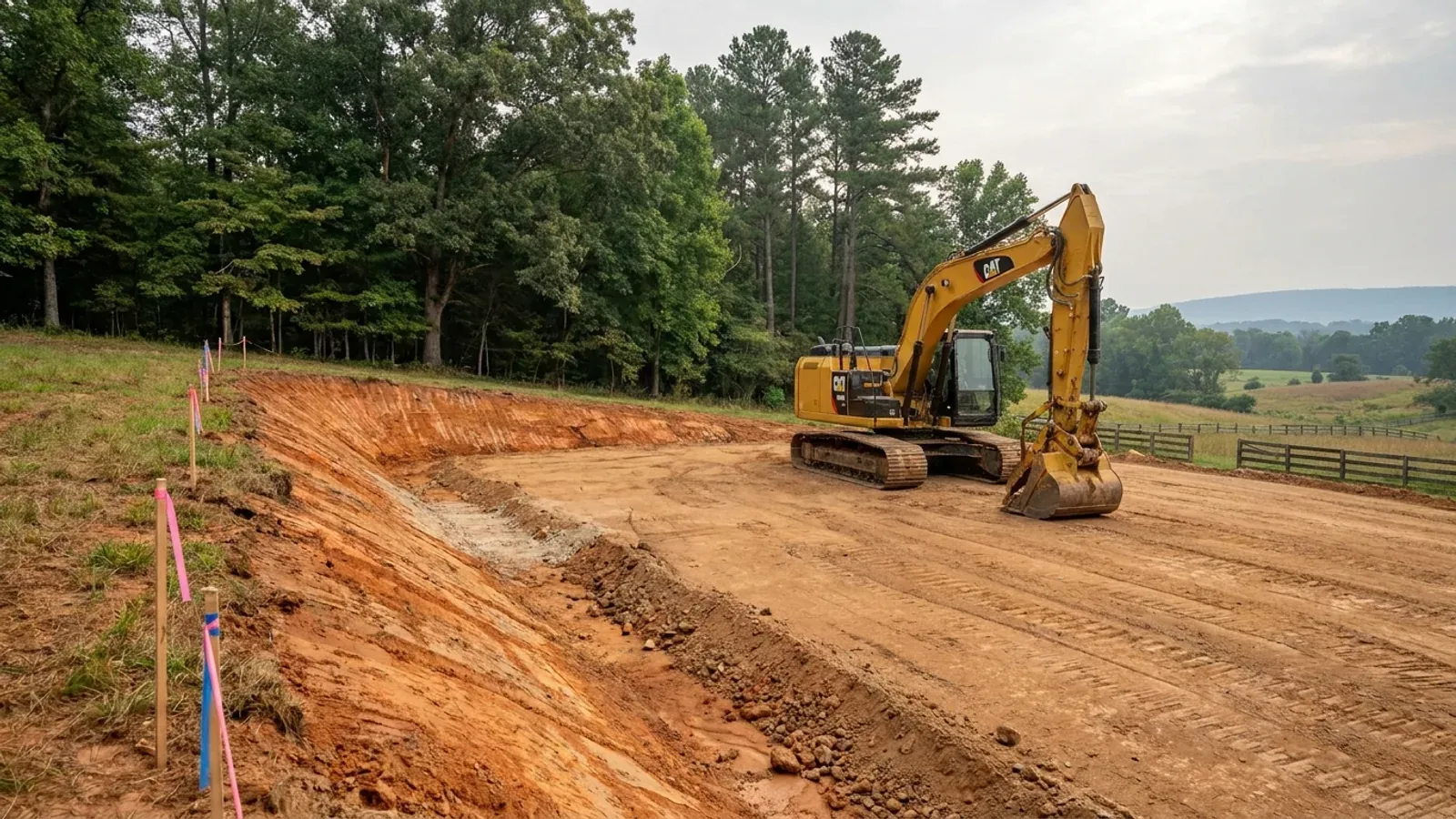
An excavator grading a compacted building pad on a cleared lot, with survey stakes, a drainage swale and a silt fence along the downhill edge.
Below the slab

The expensive surprises are in the ground, not the building

What moves a North Carolina budget is usually below grade, and the thing most often got wrong is which clay to worry about. Cecil — the red Piedmont clay everyone pictures, and the state soil — is kaolinitic and low shrink-swell; it does not heave. The soil that does is Iredell, formed over diabase and gabbro, which the USDA describes as vertic, very high shrink-swell, with a perched water table a foot or two down from December through April. The tell is colour: Cecil is red and Iredell is dark grey-brown, and they sit within a few miles of each other across the central Piedmont. West of that the question stops being clay and becomes slope, rock and colluvium; east of the fall line it becomes water, and in the Tidewater it becomes organic soil that subsides irreversibly once it is drained. Then the same ground decides the septic system, and North Carolina rewrote those rules recently enough that most of what is published about them is out of date. 15A NCAC 18E replaced the old subchapter on 1 January 2024 and was amended again on 1 June 2026: the site is classified on soil morphology — the word "percolation" does not appear anywhere in it — and there is no "provisionally suitable" any more, only suitable or unsuitable, on a single failed parameter. There is no statewide minimum lot size either; the area you need is derived from the soil result and then doubled, because a site that cannot fit both the initial field and its repair area is unsuitable. And the order matters more than people expect: the county health department's Improvement Permit and Construction Authorization come first, and the building permit is available on the strength of the Construction Authorization, not before it. One more thing that catches people: disturb more than an acre and you need an approved erosion and sedimentation control plan in hand before work starts, with penalties up to $5,000 a day, and a pad plus a drive plus a drainfield plus a laydown area crosses an acre faster than it sounds. So the site work, the foundation and the drainfield get resolved together rather than one at a time. We price the dirt before we price the building.

What a build looks like

Three stages every Cabarrus County project passes through, from a raw parcel to a finished home. Site work first, because that is where the budget is decided.
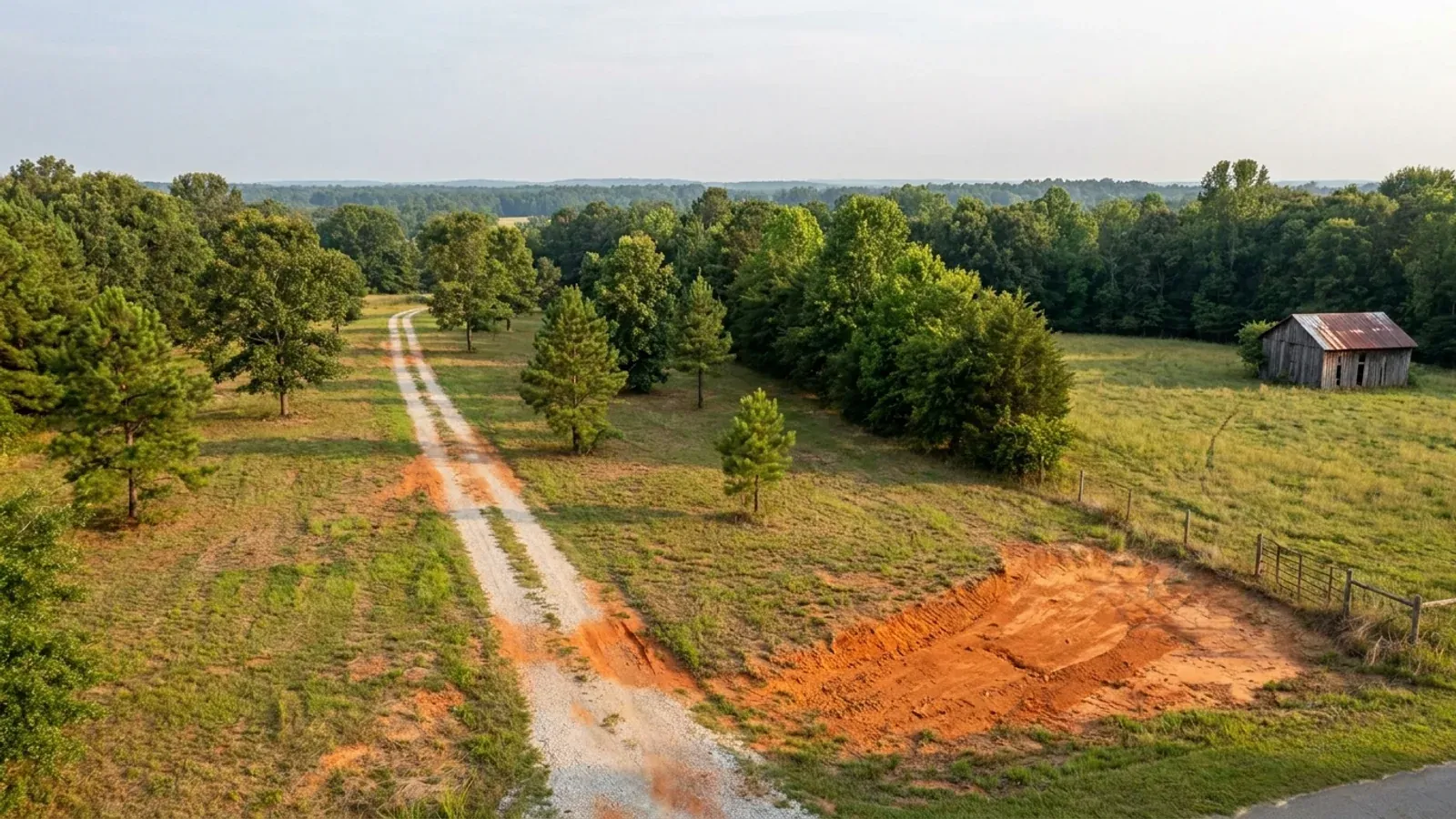
Aerial view of an undeveloped rural lot with cleared grass, a mixed oak, hickory and pine treeline, exposed red clay in one corner and a pale gravel access track.
Stage one

The parcel

Zoning, setbacks, flood zone and utility access get checked before anything is drawn.

An excavator grading a compacted building pad on a cleared lot, with survey stakes, a drainage swale and a silt fence along the downhill edge.
Stage two

Pad and permit

Clearing, grading and a compacted pad, while the septic authorization and the building submittal work through whichever offices cover your parcel.
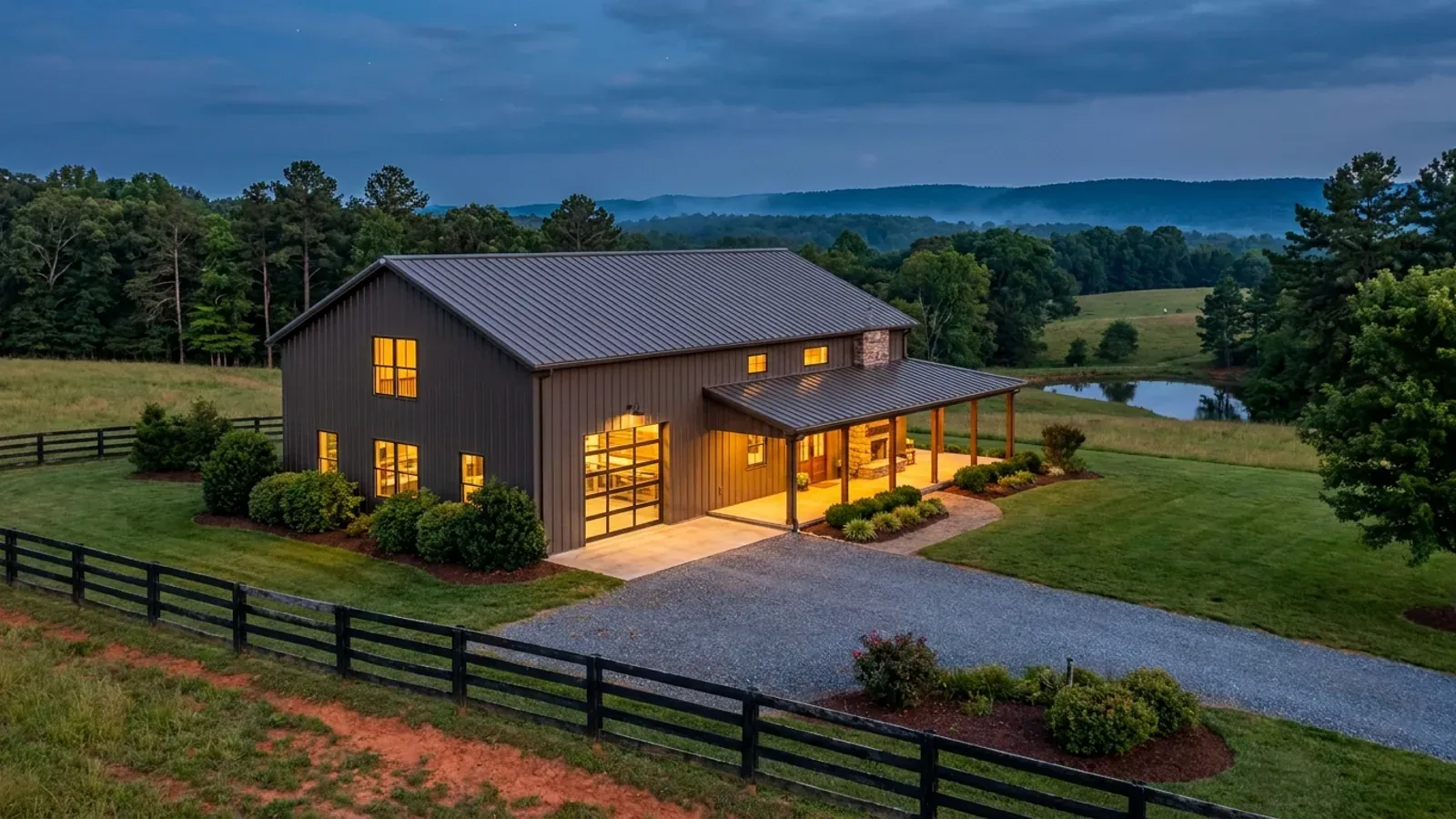
A finished barndominium at dusk with warm interior lighting glowing through its large windows.
Stage three

Frame to finish

Shell erected and dried in, then systems, insulation and interior finish through to CO.

Those are the rules where you are building in Cabarrus County. Tell us what you want to build and we will draw it to them.

Where we build around Cabarrus County

Cabarrus County and the rural land around it. The buildable acreage for a project this size usually sits outside the town limits — which does not automatically put it under the county, because a town's zoning and building-code enforcement reach one to three miles past its limits into its extraterritorial jurisdiction. Inside the limits, in the ETJ, or in neither are three different answers to who issues your permit.

The Cabarrus County service area, including the rural acreage outside the built-up edge, which is where the parcels big enough for a build like this usually sit. The map marks the territory we build in. It is not a branch location, and there is no office at this pin.

Nearby areas we build in

Others we cover nearby. Every North Carolina municipality sits inside a county — there are no independent cities here — but that does not settle who regulates a given parcel. A town's zoning, subdivision rules and building-code enforcement extend one to three miles beyond its limits, by population, into what the statute calls its extraterritorial jurisdiction; town taxes and town elections do not follow. So the office that issues the permit, what it charges and how the land is zoned can all differ from one card to the next, and the mailing address will not tell you which case you are in.

Building in Cabarrus County: common questions

8 questions we get asked most often about building in Cabarrus County. If yours is not on the list, ask it directly.

Where in Cabarrus County can I actually buy land?
East. The county's own Development Ordinance describes the Agricultural/Open Space district as comprising mostly lands usually found on the eastern side of the county which, because of soil type and topography, should remain agrarian — and adds that public utilities will not be planned for those areas. The population numbers agree: of 249,725 residents, 56,557 live outside every municipality, and the six municipal parts are concentrated on the Mecklenburg and Rowan sides at Concord, Kannapolis and Harrisburg. So the buildable rural acreage runs out toward Mount Pleasant, Midland and the Stanly County line. The farmland statistics tell you what is there when you arrive: 630 farms on 64,227 acres, 27.8 percent of the county, at a median farm size of 30 acres — the smallest median in the Charlotte ring. Small pieces, and not many of them.
Who issues the building permit in Cabarrus County?
The county, everywhere. Cabarrus County Construction Standards at 65 Church Street SE in Concord states that it provides building inspections and permitting services for all areas within Cabarrus County, and the City of Concord's own licences-and-permits page sends applicants to the city for zoning permits and to Cabarrus County Building Inspections for building permits. So the split inside a town is not city-versus-county for the whole job — it is zoning at the town and the building permit at the county. That is worth knowing because it is not the arrangement in every neighbouring county: Monroe, in Union County, runs its own permit centre and administers the building code inside its own limits. The third case is the extraterritorial jurisdiction. Cabarrus County commissioners appoint ETJ members to the Concord Planning and Zoning Commission, the Harrisburg Planning and Zoning Board and the Mount Pleasant Planning and Adjustment Board, which is G.S. 160D-307 in practice and tells you those three towns exercise zoning beyond their limits. On that land the town's zoning applies, the county still issues the building permit, and no town property tax is levied.
How big a lot do I need, and how much of it can I cover?
Under the conventional subdivision standards in Chapter 5 § 5-5, the Agricultural/Open Space minimum lot is 3 acres at a maximum density of 0.33 dwelling units per acre, and Countryside Residential is 2 acres at 0.50 units per acre. Both require a 150-foot minimum average lot width and set front yards at 75 feet on a minor collector and 50 feet on a local road, with a 20-foot side yard and a 30-foot rear yard. Height is capped at 40 feet, which is comfortable for a tall shop bay. The number people miss is the impermeable surface cap: 15 percent in AO and 20 percent in CR. On a three-acre AO lot, 15 percent is roughly 19,600 square feet for the house, the shop, the apron, the drive and the turnaround combined — generous for one building and tight once a gravel yard appears. Separately, the septic result can demand more area than the zoning does, because 15A NCAC 18E .0508 requires room for both the initial system and a repair area and makes a site unsuitable if it cannot hold both.
Who does the septic permit in Cabarrus County, and what does it cost?
Cabarrus Health Alliance, which is a public health authority rather than a county department, through its Environmental Health Division; applications go through the county's Accela portal. Its published schedule prices the soil evaluation application at $350 for the first acre and $350 for each additional acre where applicable, then the Construction Authorization — the septic tank permit — by design flow: $350 at 360 gallons per day or less for one to three bedrooms, $450 at 600 gpd or less for four to five bedrooms, $550 at 601 gpd or more for six or more bedrooms, plus $150 for any system with a pump. A site revisit is $75 plus $25 per additional visit. Wells are $50 to apply and $500 for the permit. The county Development Ordinance ties the two together: its dimensional footnote requires all lots to meet Cabarrus Health Alliance requirements for septic system installation before any zoning or building permit is approved. That mirrors 15A NCAC 18E .0201(c), under which the Construction Authorization is what lets you obtain a building permit under G.S. 130A-338. On a rural Cabarrus parcel, the health authority goes first.
Is the soil here the red clay everyone talks about?
Sometimes, and the exception is the one that matters. Cecil — the state soil, the red Piedmont clay — is kaolinitic with low shrink-swell, and it does not heave foundations. Its real vices are different ones: it is slow to drain, it is unworkable when wet so a wet spring can simply stop grading, and its surface is a sandy loam over a clay subsoil, so once you strip topsoil for a pad you are working on something that behaves worse than what you walked on. But Cabarrus County sits on the Concord Plutonic Suite, a belt of gabbro, norite, hornblende gabbro, syenite and metadiabase that the U.S. Geological Survey names for the county seat and maps across Cabarrus, Davie, Iredell, Rowan and Mecklenburg Counties. Mafic rock like that is the stated parent material of the Iredell series, which USDA classes as Vertic with very high shrink-swell in the argillic horizon, slickensides, very slow permeability and a perched water table one to two feet down from December through April. On a mafic-soil lot both ordinary assumptions fail at once: bearing and drainage. The tell you can use standing on the land is colour — Cecil is red, Iredell's surface is dark greyish brown. Section R401.4 lets the building official require a soil test where characteristics are questionable, and an evaluation by a licensed soil scientist on the actual pad location is what settles it.
Can I put the shop up before the house?
Only on an agricultural parcel, and it cannot be lived in. Section 7-3(7) of the Development Ordinance permits a barn or greenhouse as a primary structure in the AO, CR, LDR and MDR districts, but only when agriculture as defined in Chapter 2 is the primary use of the parcel; it may not be used as a dwelling unit, and it must meet the district's primary-structure setbacks. Note what that does not say: there is no square-foot cap on that provision itself. The cap appears elsewhere, in the Rural Home Occupation standards, which limit the separate building a home business may occupy by parcel acreage — 2,500 square feet at one to five acres, 3,000 at five to ten, 3,500 at ten to fifteen, 4,000 at fifteen to twenty, 4,500 above twenty acres, and 5,000 where the tract over twenty acres qualifies as a bona fide farm. And whatever it looks like from the road, anything with living space in it is a dwelling under the 2018 NC Residential Code and is permitted and inspected as one.
Are there Cabarrus County amendments to the building code I need to find?
No. G.S. 143-138(e) provides that the North Carolina State Building Code shall apply throughout the State, and the only instruments a city or county may adopt of their own are a fire prevention code — which requires Residential Code Council approval and may not reach one- and two-family dwellings beyond what the Residential Code prescriptively requires — and floodplain management regulations. There is no general local building-code amendment power, so there is no Cabarrus package of structural or energy modifications to hunt down, and no county here can make a house harder to build than the state code does. What genuinely varies, and what this page is about, is a different list: zoning and subdivision regulation under Chapter 160D, the extraterritorial jurisdictions of Concord, Harrisburg and Mount Pleasant, the permit fee schedule, the environmental health authority, floodplain and watershed regulation, and the wind, seismic and climate-zone values that the one statewide code publishes county by county.
Will a metal or post-frame building need an engineer here?
Usually, and North Carolina gives no residential exemption from it. Section R301.1.2 requires framing systems outside the code's prescriptive scope to demonstrate detailing equivalent to what the code requires, and while § 83A-13(c)(1) exempts a family residence from the architect requirement, § 89C-25 carries no equivalent residential carve-out for engineering — the subdivisions that would have provided one were repealed. So a post-frame or steel-framed barndominium in Cabarrus County is normally an engineered building, sealed by a professional engineer licensed in North Carolina, and that engineering is a real line in the budget rather than a formality. One related surprise: building in steel does not satisfy termite protection here. The model code accepts cold-formed steel framing as one method under R318; North Carolina deleted that option and deleted physical barriers as well, so a steel shell still needs chemical treatment, a baiting system, pressure-preservative-treated wood or naturally durable wood.

Building in Cabarrus County?

Start with the plan. Tell us what you want to build and we will draw it, then confirm which office issues the permit for your parcel, what it will let you put there, and what wind load it has to meet. That conversation costs nothing.