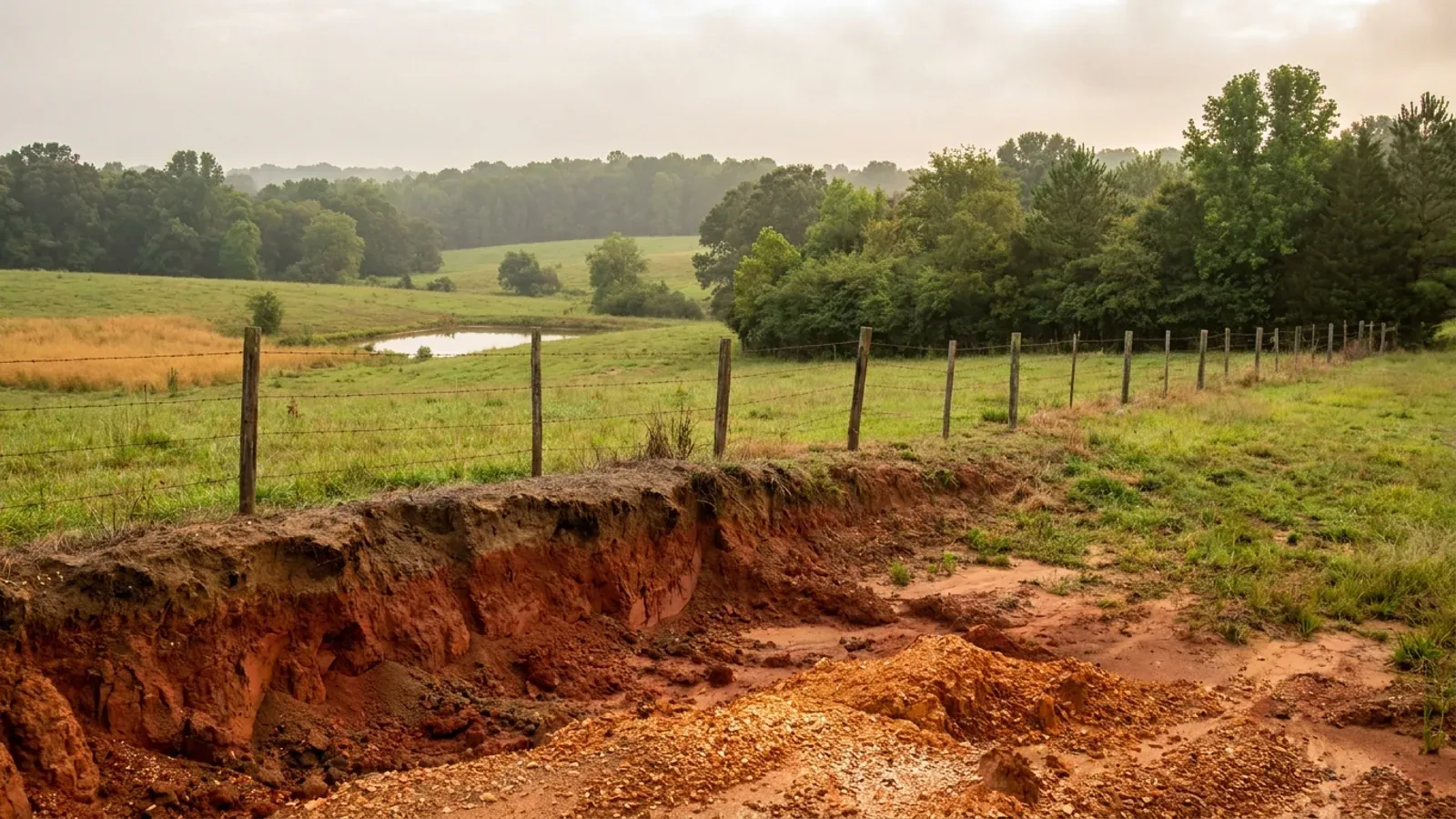
Rolling southern Piedmont farmland with vivid red clay exposed at a field edge, mixed oak, hickory and pine woodland and a small farm pond.
Mecklenburg County 2018 NC Residential Code, statewide

Barndominium Builders in Charlotte, NC

Charlotte is North Carolina's largest city — 964,784 people on the Census Bureau's 2025 estimate, up from a 2020 base of 874,708 — and it sits in the state's densest county. Mecklenburg holds 1,233,383 people on 524 square miles, about 2,356 to the square mile, and the 2022 Census of Agriculture ranks it 96th of North Carolina's 100 counties for land in farms: 165 farms on 7,704 acres, 2.3 percent of the county, at a median farm size of 13 acres. That is the honest starting point for a barndominium search here. The land is not in Mecklenburg. It is in Union, Cabarrus, Iredell, Lincoln and Stanly, and this page's job is to say so and then tell you what changes when you cross each of those lines. Two things about Charlotte itself are worth knowing before you shop. The first is that the building permit and the zoning come from different governments: Mecklenburg County Code Enforcement, a division of the county's Land Use and Environmental Services Agency, runs building-code enforcement countywide on a consolidated basis, while the City of Charlotte's own Unified Development Ordinance governs zoning inside the city limits and its extraterritorial jurisdiction. The second is how Mecklenburg prices that permit. It is the only county in this part of the state that charges on construction value rather than square footage, and it defines the value as the higher of the figure you declare and the figure its own valuation table produces — so a low declared number does not buy a low fee. That single rule shapes how a kit-built barndominium should be budgeted here, and almost nobody publishes it.

Charlotte at a glance

County
Mecklenburg County
City rules outside city limits
The City of Charlotte's Unified Development Ordinance applies inside the corporate limits and inside the city's extraterritorial jurisdiction under G.S. 160D-202 — city zoning and subdivision rules on land that pays no city property tax and votes in no city election.
Population
964,784
ZIP codes
28202, 28205, 28208, 28210, 28213, 28216, 28226, 28269, 28273, 28277
Site visits
Same week across Charlotte and the surrounding counties

Building conditions in Charlotte

The building code does not change at a county line here. Under § 143-138(e) the North Carolina State Building Code applies throughout the state, and a city or county may adopt only a fire prevention code and floodplain regulations of its own — there is no general local amendment power, so there are no county amendments to look up. The edition in force is still the 2018 NC Residential Code, effective 1 January 2019; the 2024 edition has been delayed three times and carries no effective date at all. What genuinely differs is who issues the permit and inspects the work, what that office charges, how the parcel is zoned, what the local floodplain ordinance requires of the foundation — and two design numbers the code publishes county by county, the ultimate design wind speed and the seismic design category. The rest of Table R301.2 is set once for everyone: a flat 20 psf roof live load, a 12-inch frost line, Moderate weathering, and termite protection required everywhere in the state with no exemption. There is no ground snow load column in the residential code at all.

Build conditions for Charlotte , Mecklenburg County, North Carolina : ultimate design wind speed 115 mph. BUILD CONDITIONS CHARLOTTE, NCMecklenburg County2018 NC RESIDENTIAL CODEULTIMATE DESIGN WIND SPEED115 mphMecklenburg is unlisted in Table R301.2(4) of the 2018 NC Residential Code, so it takes thattable's 115 mph default — the code's floor. Union, Cabarrus, Iredell and Lincoln are unlisted too.WHO ISSUES THE PERMITMecklenburg County Code Enforcement…Building and trade permits countywide, including inside Charlotte.Zoning comes from the City of Charlotte's Unified Development…
Build conditions for Charlotte, drawn from the sourced facts on this page. Every figure above is cited in the quick-facts panel below, with its source and vintage.
The densest county in the state, and 96th of 100 for farmland
Mecklenburg County holds 1,233,383 people on 524 square miles of land — about 2,356 to the square mile, the highest density of any county in North Carolina, against 1,506 in Wake and 1,208 in Durham. The 2022 Census of Agriculture puts the other side of that: 165 farms on 7,704 acres, 2.3 percent of the county, median farm size 13 acres, ranking Mecklenburg 96th of the 100 counties for land in farms. Union County shares a line with it and is 52.4 percent farmland — 882 farms on 212,066 acres, fourth in the state. That is not a gentle gradient. It is a wall, and it is why a Charlotte barndominium search that stays inside Mecklenburg does not find anything.

U.S. Census Bureau, Vintage 2025 county population estimates and 2025 Gazetteer county land areas, census.gov; USDA NASS, 2022 Census of Agriculture, county profiles for Mecklenburg and Union, nass.usda.gov

Mecklenburg takes the higher of your declared value and its own table
Mecklenburg is the odd one out among North Carolina's big counties: it prices a new dwelling on construction value, not on square footage. Its LUESA Fee Ordinance sets the permit from a tiered table of dollars per $1,000 of Total Construction Permit Value — $907.12 plus $5.93 per $1,000 over $100,000 in the $100,001 to $150,000 tier, $1,203.52 plus $4.59 over $150,000 in the next, $1,662.37 plus $5.05 over $250,000 above that. The part that matters is how the value is set. The ordinance defines Total Construction Permit Value as the higher of the value determined by the owner or the owner's agent and the value calculated from the Building Valuation Data the department is using at the time of application, and it requires the value to include every project cost other than the land — site and building improvement labour and materials, contractor fees and design professional fees. A low declared number does not buy a low fee, because the county's own valuation floor applies underneath it. That is a genuinely unusual rule, and it is the single most important thing a kit buyer in Mecklenburg can know: the invoice for the shell is a fraction of the permit value, not the permit value.

Mecklenburg County LUESA Fee Ordinance, Section II.A and its notes, revision stack topped 1 July 2026, published through Mecklenburg County's own document library at mecknc.widen.net/s/gxrbpbswt9/fees, read 5 September 2026

The permit and the zoning come from two different governments
In most North Carolina cities the town writes the zoning and the town or the county inspects. Charlotte splits it. Mecklenburg County Code Enforcement, a division of the county's Land Use and Environmental Services Agency, runs building-code enforcement on a consolidated countywide basis, so a Charlotte house is inspected on a county permit. Zoning is what fragments by municipality: the City of Charlotte's Unified Development Ordinance, adopted 22 August 2022 and effective 1 June 2023, applies inside the corporate limits and the city's extraterritorial jurisdiction, while the county's own ordinance carries one zoning fee table for unincorporated Mecklenburg together with Matthews and Pineville, a second for Cornelius and Davidson, and states that Mint Hill and Huntersville provide their own zoning services. So the answer to who regulates a parcel here is two answers, from two governments, and the mailing address settles neither.

Mecklenburg County LUESA Fee Ordinance, Zoning Fee Schedule, mecknc.widen.net/s/gxrbpbswt9/fees, read 5 September 2026; Charlotte Unified Development Ordinance Article 1, charlotteudo.org, read 6 September 2026

The energy code's zone line runs right through the Charlotte ring
Table N1101.7 of the 2018 NC Residential Code assigns Mecklenburg County to IECC climate zone 3A. Wake County, 140 miles east on the same interstate, is 4A — so North Carolina's two largest metros build to different envelope requirements, which almost no page in this trade distinguishes. The line also runs inside Charlotte's own commuter ring, and not where instinct puts it: Union, Cabarrus, Gaston, Stanly and Rowan are 3A along with Mecklenburg, but Iredell and Lincoln are 4A. Drive east to Monroe or north-east to Concord and the zone does not change; drive north up to Mooresville or west to Lincolnton and it does. The practical difference is in the amendments themselves — the air-impermeable insulation alternative to R-38 ceiling insulation is R-20 in zone 3 and R-25 in zone 4. A kit or plan package quoted for Charlotte has been specified to one of those zones, and the quote will not usually say which.

2018 NC Residential Code Table N1101.7 and the 2018 NC Energy Conservation Code amendments, NC Office of the State Fire Marshal, ncosfm.gov

Everything around Charlotte is at the code's floor for wind and seismic
Mecklenburg, Union, Cabarrus, Iredell, Lincoln, Gaston, Rowan and Stanly are all absent from Table R301.2(4) of the 2018 NC Residential Code, so every one of them takes that table's unlisted default of 115 mph ultimate design wind speed — the floor of the code, which 51 of the 100 counties share. None of them appears on Table R301.2(7), the list of thirteen Seismic Design Category C counties, so all sit in Category A or B under that table's own note. Under the edition in force the only non-mountain SDC C counties in the state are Brunswick, Columbus, Robeson and Scotland, a contiguous block along the South Carolina line two hundred miles away — and the 2024 edition, adopted but with no effective date, removes all four. The useful version of this is a negative: nothing about the Charlotte market's structural design criteria is elevated, and a quote that prices hurricane-grade engineering here is pricing a hazard the code does not recognise at this location.

2018 NC Residential Code, Tables R301.2(4) and R301.2(7), and the 2024 edition's equivalent tables, NC Office of the State Fire Marshal, ncosfm.gov

Where the acreage actually is, county by county
The 2022 Census of Agriculture, read against the Census Bureau's 2025 county estimates, ranks the ring plainly. Union County: 882 farms on 212,066 acres, 52.4 percent of the county, median farm 35 acres, population up 12.4 percent since 2020. Iredell: 894 farms on 119,481 acres, 32.5 percent, median 41 acres, up 13.5 percent. Stanly: 649 farms on 109,164 acres, 43.2 percent, median 45 acres, up 10.1 percent. Cabarrus: 630 farms on 64,227 acres, 27.8 percent, median 30 acres, up 10.6 percent. Lincoln: 552 farms on 49,038 acres, 25.9 percent, median 36 acres, and the fastest-growing of the five at 13.7 percent. The statewide median farm is 48 acres. So the parcel a barndominium wants is an ordinary transaction in all five of those counties and an extraordinary one in Mecklenburg, where the median farm is 13 acres and there are 165 of them left.

USDA NASS, 2022 Census of Agriculture, county profiles; U.S. Census Bureau, Vintage 2025 county population estimates, census.gov

Also worth knowing before you build in Charlotte

In Union County, attaching the shop bay is a 3.5x decision on the permit
Union County Building Code Enforcement operates a one-stop permitting counter, and its fee schedule effective 1 August 2026 charges a new single-family dwelling at $0.84 per square foot — with the base stated as total gross building floor area under roof, heated or unheated, attached. That one rate covers the building, electrical, plumbing and mechanical work together, with a $100 minimum. A detached, unheated structure — a standalone shop, barn or garage — sits on a separate line at $0.24 per square foot, covering building and electrical only. So on the shop area of a barndominium, attached against detached is a 3.5-fold difference in what the county charges for the permit. That is a published, checkable, county-specific consequence of a design decision, and it appears on no competitor page. It is a fee consequence and nothing more: whether to attach a shop is a question about how you want to live and work, not about the permit.

Union County Development Services, new fee schedule effective 1 August 2026, unioncountync.gov, read 5 September 2026

There is a soil series named Mecklenburg, and it is not the red clay you are picturing
The USDA maintains an official soil series called Mecklenburg, established in Mecklenburg County, North Carolina, in 1910. It forms on residuum weathered from intermediate and mafic crystalline rocks, is classed as a fine, mixed, active, thermic Ultic Hapludalf, runs very deep and well drained with a seasonal high water table below 60 inches, and carries a Moderate shrink-swell potential. That matters because this part of the Piedmont is mafic-rock country, and the clays it produces do not all behave the same. Cecil, the state soil and the famous red clay, is kaolinitic with low shrink-swell — it does not heave. Iredell, formed over diabase, diorite and gabbro, is classed Vertic with very high shrink-swell in its argillic horizon, slickensides, very slow permeability and a perched water table one to two feet down from December through April. Cecil's surface is red; Iredell's is dark grayish brown. Colour is a tell and not a test, and the only thing that settles a specific slab is a soil report on the specific lot.

USDA NRCS Official Series Descriptions, MECKLENBURG (revised 11/2025), IREDELL and CECIL, soilseries.sc.egov.usda.gov, read 6 September 2026

One acre of disturbance is the permit nobody budgets for
Under the Sedimentation Pollution Control Act, G.S. Chapter 113A Article 4, an erosion and sediment control plan must be approved before work begins wherever more than one acre of land on a tract is to be disturbed. NC DEQ issues those approvals through its Land Quality Section regional offices, or a delegated local government erosion and sedimentation control program does, and a local program is allowed to be stricter than the state minimum. Civil penalties run to $5,000 per day per violation. The reason this catches barndominium sites specifically is that nobody counts the acre in pieces: a building pad, a long gravel drive, a septic field with its required repair area, a laydown and stockpile yard and the equipment turning space add up past an acre on a rural lot without anyone deciding to disturb one.

NC DEQ, Erosion and Sediment Control Laws and Rules, deq.nc.gov, read 5 September 2026; G.S. Chapter 113A, Article 4, and 15A NCAC 04
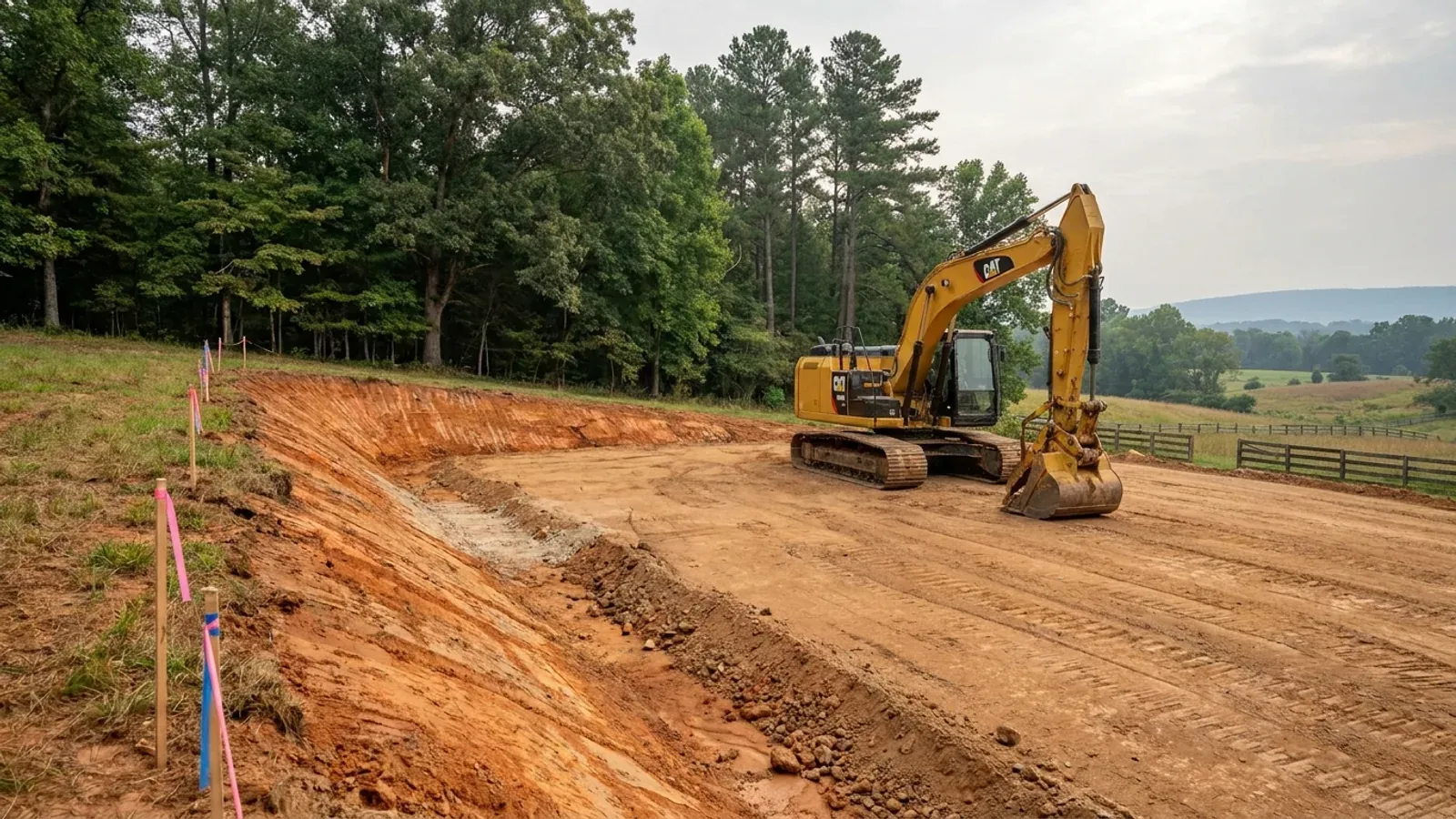
An excavator grading a compacted building pad on a cleared lot, with survey stakes, a drainage swale and a silt fence along the downhill edge.
Below the slab

The expensive surprises are in the ground, not the building

What moves a North Carolina budget is usually below grade, and the thing most often got wrong is which clay to worry about. Cecil — the red Piedmont clay everyone pictures, and the state soil — is kaolinitic and low shrink-swell; it does not heave. The soil that does is Iredell, formed over diabase and gabbro, which the USDA describes as vertic, very high shrink-swell, with a perched water table a foot or two down from December through April. The tell is colour: Cecil is red and Iredell is dark grey-brown, and they sit within a few miles of each other across the central Piedmont. West of that the question stops being clay and becomes slope, rock and colluvium; east of the fall line it becomes water, and in the Tidewater it becomes organic soil that subsides irreversibly once it is drained. Then the same ground decides the septic system, and North Carolina rewrote those rules recently enough that most of what is published about them is out of date. 15A NCAC 18E replaced the old subchapter on 1 January 2024 and was amended again on 1 June 2026: the site is classified on soil morphology — the word "percolation" does not appear anywhere in it — and there is no "provisionally suitable" any more, only suitable or unsuitable, on a single failed parameter. There is no statewide minimum lot size either; the area you need is derived from the soil result and then doubled, because a site that cannot fit both the initial field and its repair area is unsuitable. And the order matters more than people expect: the county health department's Improvement Permit and Construction Authorization come first, and the building permit is available on the strength of the Construction Authorization, not before it. One more thing that catches people: disturb more than an acre and you need an approved erosion and sedimentation control plan in hand before work starts, with penalties up to $5,000 a day, and a pad plus a drive plus a drainfield plus a laydown area crosses an acre faster than it sounds. So the site work, the foundation and the drainfield get resolved together rather than one at a time. We price the dirt before we price the building.

What a build looks like

Three stages every Charlotte project passes through, from a raw parcel to a finished home. Site work first, because that is where the budget is decided.
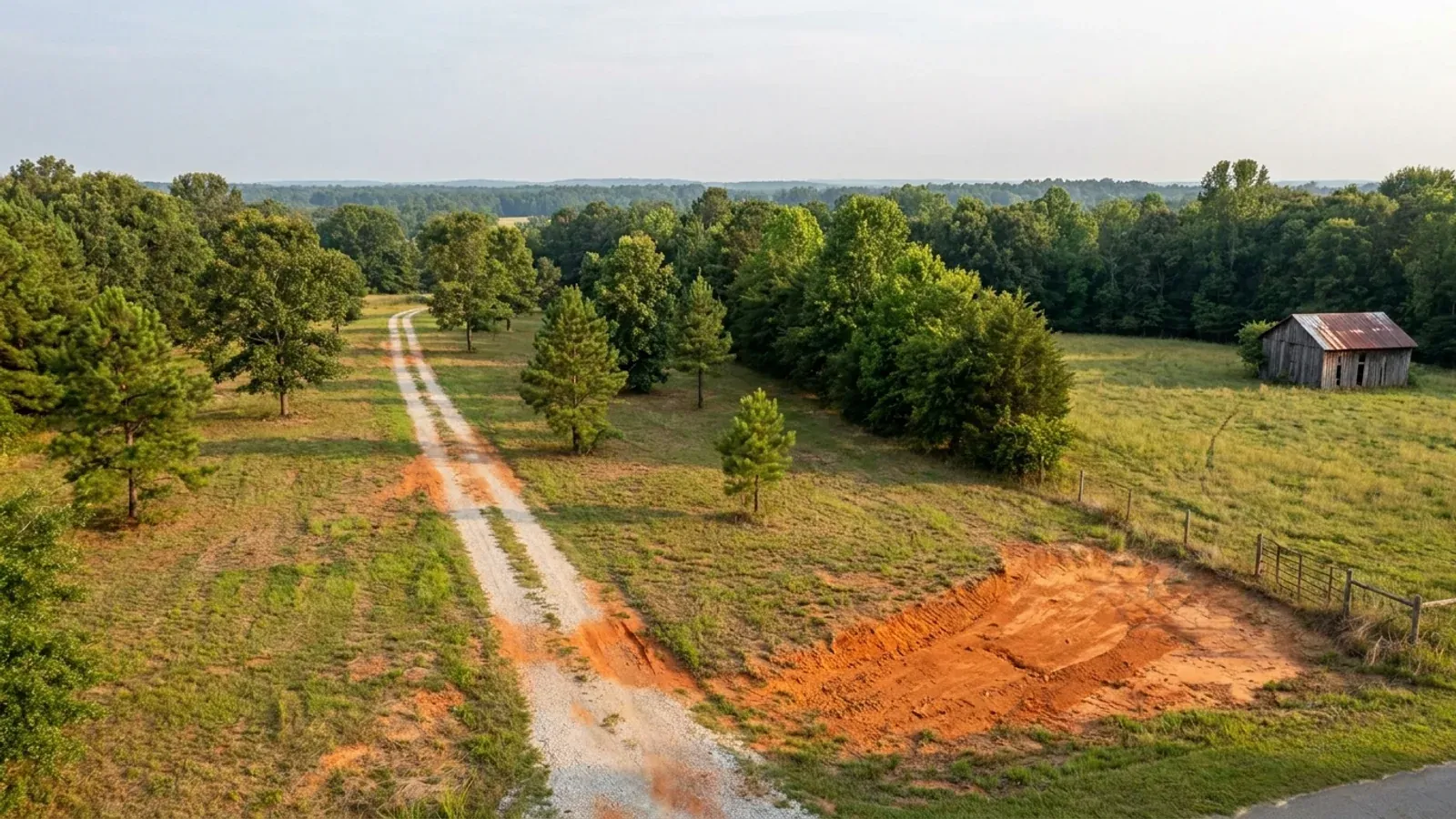
Aerial view of an undeveloped rural lot with cleared grass, a mixed oak, hickory and pine treeline, exposed red clay in one corner and a pale gravel access track.
Stage one

The parcel

Zoning, setbacks, flood zone and utility access get checked before anything is drawn.

An excavator grading a compacted building pad on a cleared lot, with survey stakes, a drainage swale and a silt fence along the downhill edge.
Stage two

Pad and permit

Clearing, grading and a compacted pad, while the septic authorization and the building submittal work through whichever offices cover your parcel.
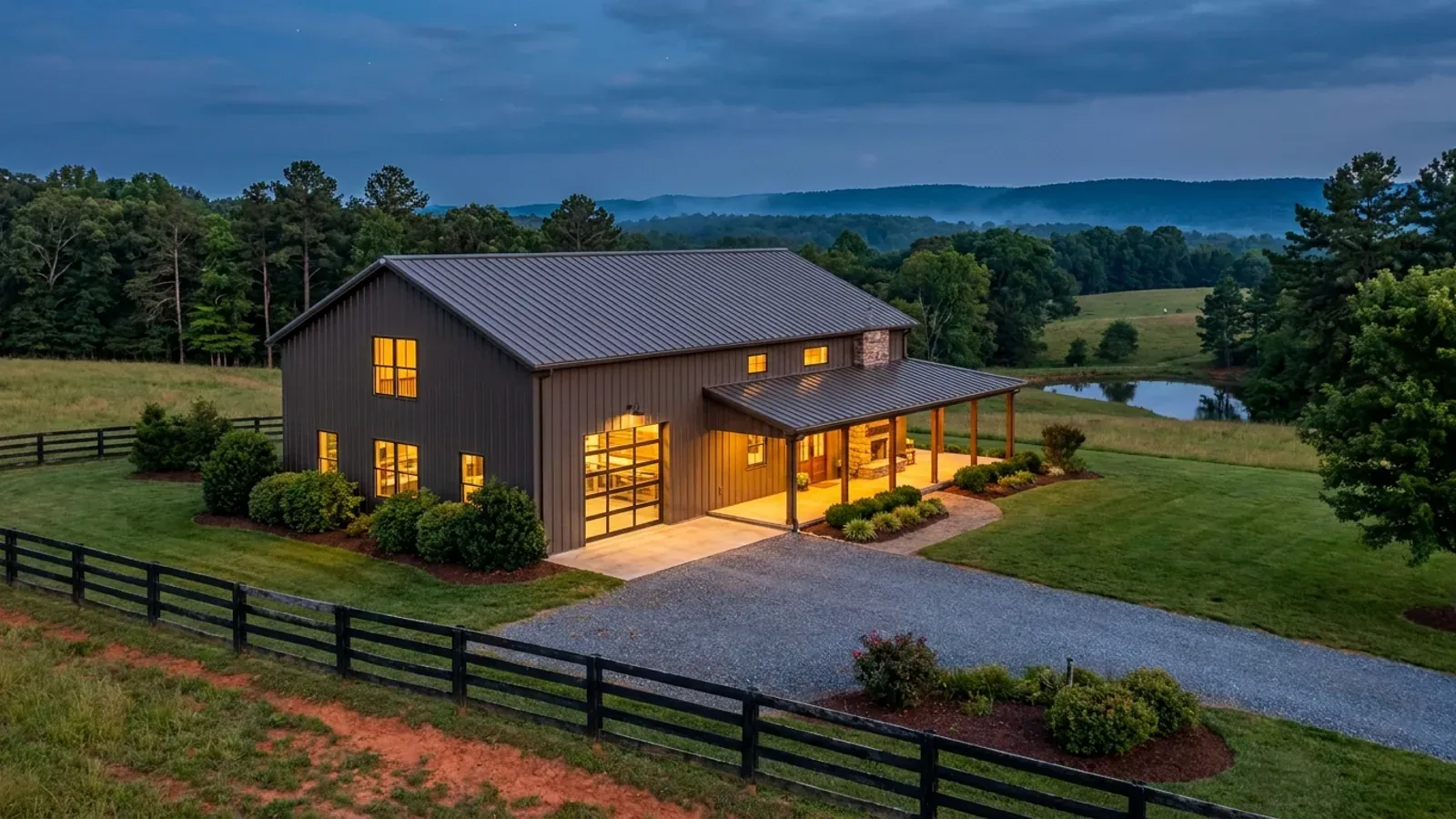
A finished barndominium at dusk with warm interior lighting glowing through its large windows.
Stage three

Frame to finish

Shell erected and dried in, then systems, insulation and interior finish through to CO.

Those are the rules where you are building in Charlotte. Tell us what you want to build and we will draw it to them.

Where we build around Charlotte

Mecklenburg County and the rural land around it. The buildable acreage for a project this size usually sits outside the town limits — which does not automatically put it under the county, because a town's zoning and building-code enforcement reach one to three miles past its limits into its extraterritorial jurisdiction. Inside the limits, in the ETJ, or in neither are three different answers to who issues your permit.

The Charlotte service area, including the rural acreage outside the built-up edge, which is where the parcels big enough for a build like this usually sit. The map marks the territory we build in. It is not a branch location, and there is no office at this pin.

Nearby areas we build in

Others we cover nearby. Every North Carolina municipality sits inside a county — there are no independent cities here — but that does not settle who regulates a given parcel. A town's zoning, subdivision rules and building-code enforcement extend one to three miles beyond its limits, by population, into what the statute calls its extraterritorial jurisdiction; town taxes and town elections do not follow. So the office that issues the permit, what it charges and how the land is zoned can all differ from one card to the next, and the mailing address will not tell you which case you are in.

Building in Charlotte: common questions

8 questions we get asked most often about building in Charlotte. If yours is not on the list, ask it directly.

Can I buy land and build a barndominium in Charlotte?
Inside Mecklenburg County, almost certainly not on the kind of parcel this building type wants, and it is fairer to open with that than to bury it. Mecklenburg is the densest county in North Carolina — 1,233,383 people on 524 square miles — and the 2022 Census of Agriculture ranks it 96th of the 100 counties for land in farms: 165 farms on 7,704 acres, 2.3 percent of the county, median farm 13 acres. Acreage at that scarcity does not trade at a price that makes sense against a building. The realistic search is the ring, and the five counties differ enough to be worth choosing between. Union is the largest supply by a distance at 212,066 acres in farms, 52.4 percent of the county and fourth in the state. Stanly is 43.2 percent farmland with the largest median farm of the five at 45 acres. Iredell offers 119,481 acres and the Lake Norman corridor. Cabarrus is closest in from the north-east. Lincoln is the fastest-growing at 13.7 percent since 2020. All five are inside a Charlotte commute, and all five are places where a ten-acre parcel is an ordinary purchase.
Who actually issues the building permit for a Charlotte address?
Mecklenburg County, not the City of Charlotte. Code Enforcement, a division of the county's Land Use and Environmental Services Agency, runs building-code enforcement on a consolidated countywide basis, so the building and trade permits for a house inside Charlotte come from the county. Zoning is the half that stays municipal: the City of Charlotte's Unified Development Ordinance, adopted 22 August 2022 and effective 1 June 2023, applies within the corporate limits and within the city's extraterritorial jurisdiction under G.S. 160D-202 — which means city zoning and subdivision rules can reach land that pays the city no property tax and cannot vote in a city election. The county's own ordinance shows the rest of the pattern, carrying one zoning table for unincorporated Mecklenburg together with Matthews and Pineville, another for Cornelius and Davidson, and stating that Mint Hill and Huntersville provide their own zoning services. Once you cross into Union, Cabarrus, Iredell, Lincoln or Stanly, both halves change at once.
How is the permit fee calculated in Mecklenburg, and can it be kept down?
Not by declaring a low number, and that is the part worth knowing before you plan a budget. Mecklenburg's LUESA Fee Ordinance prices a new dwelling from a tiered table of dollars per $1,000 of Total Construction Permit Value rather than from square footage — for example $1,203.52 plus $4.59 per $1,000 above $150,000 in the $150,001 to $250,000 tier, and $1,662.37 plus $5.05 per $1,000 above $250,000 in the tier above it. The ordinance then defines that value as the higher of the figure the owner or the owner's agent determines and the figure produced by the Building Valuation Data the department is using at the time of application, and requires it to include all project costs other than the land: site and building improvement labour and materials, contractor fees and design professional fees. So the county's own valuation sits underneath your declaration as a floor. Two related notes from the same ordinance: plan review is not an add-on, because the permit fee and the plan review fee together equal the fee the table produces; and work started without a permit is charged at 3.75 times the original permit fee, the harshest such penalty found in any of the state's large counties. Septic and well fees are a different department again, Groundwater and Wastewater Services, on their own schedule.
I am buying a barndominium kit. Does the kit price set the permit value?
No, and in Mecklenburg that distinction has money attached to it. A kit invoice covers a shell — frame, sheeting, fasteners, sometimes doors and windows — and not the slab, the site work, the utilities, the interior, the trades or the design fees. Mecklenburg's fee ordinance defines Total Construction Permit Value as everything but the land, expressly including labour, materials, contractor fees and design professional fees, and then takes the higher of that declared figure and its own Building Valuation Data calculation. A kit buyer who declares the shell invoice is declaring a fraction of what the ordinance is asking for, and the county's table simply overrides it. The useful way to think about a kit in this market is that it fixes the price of one component early and leaves the larger part of the project — foundation, site, trades, finish and engineering — to be priced locally. Separately, and worth knowing before you compare kit brochures: North Carolina deleted cold-formed steel framing from the accepted methods of termite protection, so a steel-framed kit here still needs chemical treatment or baiting like any other house, and it deleted AISI S230 from the accepted high-wind design methods.
Do I need to check Mecklenburg's or Charlotte's building-code amendments?
There are none to check, and saying so is the opposite of what most sites in this trade imply. N.C.G.S. § 143-138(e) provides that the North Carolina State Building Code applies throughout the State from the time of its adoption, and the only two things a local government may adopt of their own are a fire prevention code — which requires Residential Code Council approval and may not reach one- and two-family dwellings beyond what the Residential Code prescriptively requires — and floodplain management regulations. There is no general local building-code amendment power anywhere in the state, so no county or city here can impose a stricter structural, foundation or energy requirement on a house, and there is no Mecklenburg amendment package to hunt down. What genuinely varies between Mecklenburg and its ring is a different list entirely: zoning and subdivision regulation under Chapter 160D, the extraterritorial jurisdiction, the permit fee schedule and the basis it is calculated on, the health department, floodplain and watershed regulation, the erosion-control program, and the wind, seismic and climate-zone values published county by county inside the one statewide code.
What are the design numbers around Charlotte?
Modest, and it helps to know that before anyone sells you an upgrade. Mecklenburg County is unlisted in Table R301.2(4) of the 2018 NC Residential Code and so takes its default of 115 mph ultimate design wind speed — as do Union, Cabarrus, Iredell, Lincoln, Gaston, Rowan and Stanly. None of those counties is on Table R301.2(7)'s list of thirteen Seismic Design Category C counties, so all are Category A or B. Mecklenburg is IECC climate zone 3A under Table N1101.7, but Iredell and Lincoln are 4A, so the envelope specification is the one design input that genuinely moves inside this market. Several figures hold everywhere in the state and are worth carrying: a flat 20 psf roof live load, a 12-inch frost line depth, Moderate weathering, and termite protection required in all of North Carolina at a Moderate-Heavy severity. There is no ground snow load column in the code at all, because Section R301.2.3 is deleted, and R403.3 — the frost-protected shallow foundation route — is deleted too, which matters to a slab design. Name the edition on your drawings: the 2018 code governs and the 2024 edition has no effective date.
Will a metal or post-frame barndominium need an engineer here?
Usually yes, and it is a real cost rather than an optional extra. Section R301.1.2 requires framing systems outside the residential code's prescriptive scope to demonstrate equivalent detailing, and North Carolina provides no residential escape from the engineering requirement: § 83A-13(c)(1) exempts a family residence from the architect requirement, but § 89C-25 carries no equivalent carve-out for engineering — the subdivisions that would have provided one were repealed in 2011 and 2014. So a metal-frame or post-frame barndominium in the Charlotte market is normally an engineered building sealed by a professional engineer licensed in North Carolina. There is a second reason to settle the drawings early. § 87-14(a)(1) requires an owner-builder to personally superintend the work, bars delegating it to unlicensed persons, and requires personal attendance at every inspection — unless the plans were drawn and sealed by a licensed architect. And § 87-14(b) makes it unlawful for an inspector to issue a permit for a job costing $40,000 or more to anyone not licensed under Article 1 of Chapter 87 or exempt from it, a threshold a barndominium clears without effort.
Are you based in Charlotte?
No, and it is better to answer that directly than to let it be discovered. This business works from the Raleigh area — the address published on this site is in Raleigh, roughly 165 miles east by road — and it serves the Charlotte market by travelling to it. The phone number carries a 980 prefix, which is a Charlotte area code overlaying 704, and that is a phone number rather than a street address: it does not stand for an office, a yard or a crew based in Mecklenburg County. What this page offers instead of a local storefront is the Charlotte-specific homework a buyer here actually needs — that the county rather than the city issues the building permit, that Mecklenburg prices it on the higher of your declared value and its own valuation table, that the energy climate zone changes between Mecklenburg and Iredell, and that the land is in the ring counties rather than in the county the city sits in.

Building in Charlotte?

Start with the plan. Tell us what you want to build and we will draw it, then confirm which office issues the permit for your parcel, what it will let you put there, and what wind load it has to meet. That conversation costs nothing.