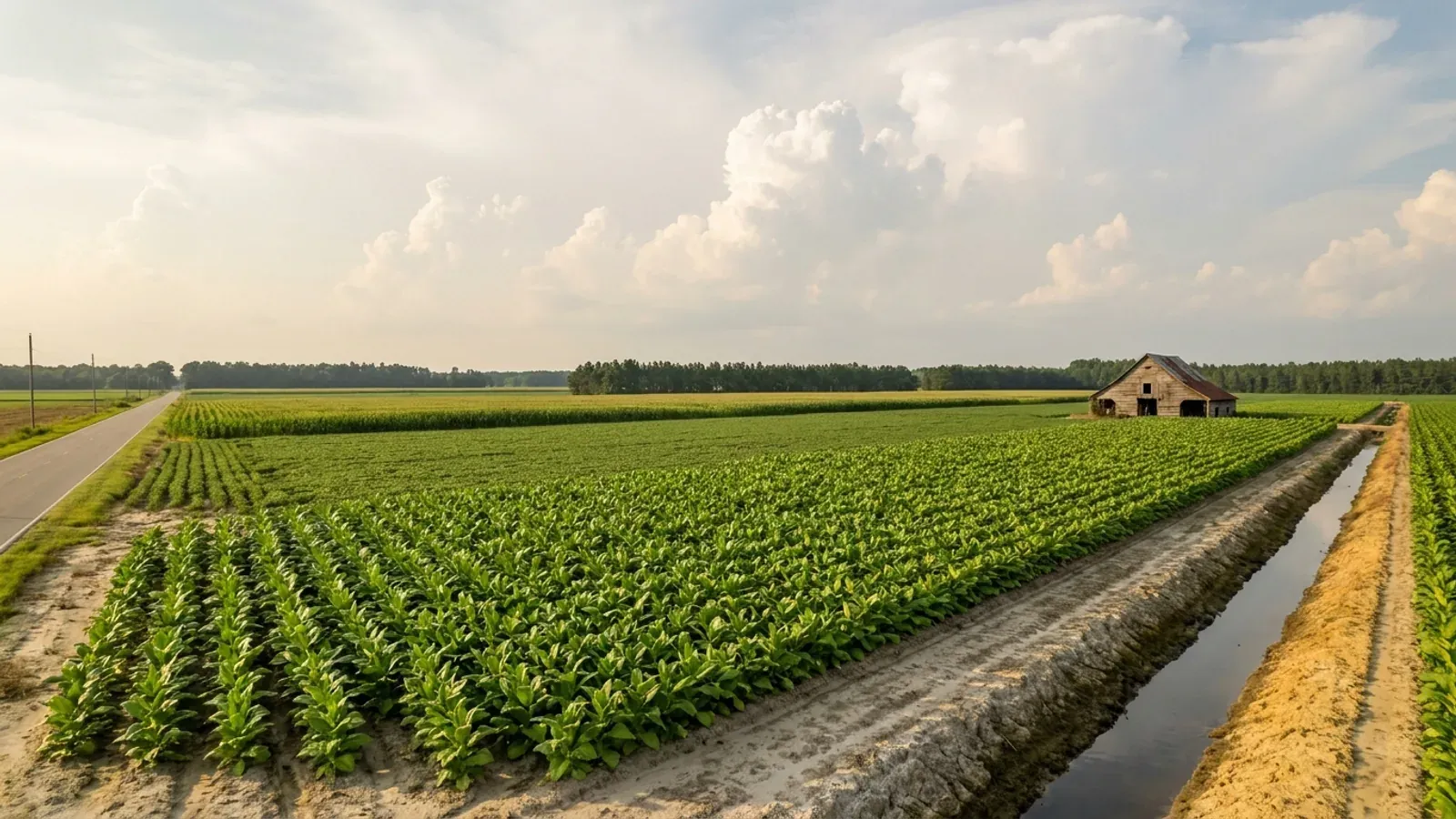
Flat eastern North Carolina cropland with long rows of green tobacco in grey-tan sandy soil, a straight field-edge ditch, dark loblolly pine windbreaks and a derelict tobacco barn in the distance.
Duplin County 2018 NC Residential Code, statewide

Barndominium Builders in Duplin County, NC

Duplin County ranks third in North Carolina for land in farms — 949 farms across 254,164 acres, 48.7 percent of the county — and the median farm here is 90 acres, close to double the statewide median of 48. That is the shortest honest answer to whether there is land: yes, and at a parcel size that suits a barndominium rather than a subdivision lot. Two things then decide how a build goes. The first is that Duplin County's Planning Department states plainly on its own site that the county has a Unified Development Ordinance in effect but does not currently have countywide zoning, and that property in the unincorporated area outside any town or extraterritorial jurisdiction is unzoned. That is a genuine advantage and it is not a blank cheque: the UDO's subdivision, mobile home park, solar farm and other land-use ordinances still apply everywhere in the unincorporated county, and there is a Land Use and Height Restriction Ordinance within a one-mile radius of Duplin County Airport at Kenansville and Henderson Field at Wallace that the county says may not appear on the GIS map at all. The second is that this is the heart of North Carolina's hog and poultry country — Duplin ranks second in the United States for the market value of hogs and pigs sold and fourth for poultry and eggs, with a hog inventory of 1,884,573 and 20.8 million broilers — and the state's right-to-farm statute, G.S. 106-701, is a real planning fact for anyone buying next to an existing operation. On the design side, Table R301.2(4) of the 2018 NC Residential Code puts Duplin County at 130 mph ultimate design wind speed, and Duplin is one of only six counties where the pending 2024 edition disagrees: it would split the county at 130 mph west of U.S. 41 and 140 mph east.

Duplin County at a glance

County
Duplin County
City rules outside city limits
Duplin has no countywide zoning, so the question is only whether your parcel falls inside a town's limits or its ETJ — and the county publishes GIS layers that answer it.
Population
51,571
ZIP codes
28325, 28341, 28349, 28398, 28453, 28458, 28464, 28466, 28508, 28518, 28521
Site visits
Same week across Duplin County

Building conditions in Duplin County

The building code does not change at a county line here. Under § 143-138(e) the North Carolina State Building Code applies throughout the state, and a city or county may adopt only a fire prevention code and floodplain regulations of its own — there is no general local amendment power, so there are no county amendments to look up. The edition in force is still the 2018 NC Residential Code, effective 1 January 2019; the 2024 edition has been delayed three times and carries no effective date at all. What genuinely differs is who issues the permit and inspects the work, what that office charges, how the parcel is zoned, what the local floodplain ordinance requires of the foundation — and two design numbers the code publishes county by county, the ultimate design wind speed and the seismic design category. The rest of Table R301.2 is set once for everyone: a flat 20 psf roof live load, a 12-inch frost line, Moderate weathering, and termite protection required everywhere in the state with no exemption. There is no ground snow load column in the residential code at all.

Build conditions for Duplin County , North Carolina : ultimate design wind speed 130 mph. BUILD CONDITIONS DUPLIN COUNTY, NCDuplin County2018 NC RESIDENTIAL CODEULTIMATE DESIGN WIND SPEED130 mphDuplin County is named at 130 mph in Table R301.2(4) of the 2018 NC Residential Code. Theadopted-but-not-effective 2024 edition would split it: 130 mph west of U.S. 41 and 140 mph east.ZONINGNo countywide zoning; the Unified De…Duplin County's Planning Department states that the county has aUnified Development Ordinance in effect but does not currently have…WHO ISSUES THE PERMITDuplin County Building InspectionsBuilding, electrical, mechanical and plumbing permits, issued fromKenansville. Zoning, where it exists, belongs to the town — the…
Build conditions for Duplin County, drawn from the sourced facts on this page. Every figure above is cited in the quick-facts panel below, with its source and vintage.
No countywide zoning — and an ordinance that still applies anyway
Duplin County's Planning Department states on its own page that the county "has a Unified Development Ordinances in effect; however, Duplin County does not currently have countywide zoning", that municipalities have zoning within their town limits and extraterritorial jurisdictions, and that if a property is in the unshaded, unincorporated area of the county outside any municipal jurisdiction, "then the property is unzoned." The sentence immediately after is the one people skip: "Duplin County land use ordinances are applicable in all unincorporated areas of the county." So there is no district, no minimum lot size and no use table waiting for you out there — but the subdivision ordinance, the mobile home park ordinance, the solar farm ordinance and the rest of the UDO still are. Unzoned is not unregulated, and the two are worth keeping apart when you read a listing that says "no zoning".

Duplin County Planning Department, duplinnc.gov, read 6 September 2026; Duplin County Unified Development Ordinance, published by the county at duplinnc.gov.

Within a mile of either airport there is zoning the map does not show
The same county page carries a warning almost nobody looking at land here would think to ask about: if a property is within a one-mile radius of Duplin County Airport at 260 Airport Road, Kenansville, or Henderson Field Airport at 250 Skydive Lane, Wallace, "there may be zoning on the site that is not shown on GIS as part of the Duplin County Land Use and Height Restriction Ordinance," and the county directs readers to contact the Planning Department. In a county the county itself describes as having no countywide zoning, those two circles are the exception — and a height restriction ordinance is exactly the instrument that reaches a barndominium, because the thing that makes the building useful is a tall shop bay with a big door. Two phone calls before you make an offer on anything near Kenansville or Wallace.

Duplin County Planning Department, Zoning & Land Use section, duplinnc.gov, read 6 September 2026.

A base fee to 1,800 square feet, then an escalator — and four separate permits
Duplin County's consolidated fee schedule prices a new residential building permit at $275.00 up to 1,800 square feet, plus $0.28 per square foot in addition to the base fee. The trades are separate and each carries its own permit: residential electrical $80.00, residential plumbing $80.00, residential mechanical $80.00. That matters because in most North Carolina counties the trades are folded into one combined residential permit, and the competitor habit of listing four separate costs is wrong in most of the state — here it is right. Two figures deeper in the same schedule are pure Duplin: an electrical permit for a poultry or swine house is priced per house, and bulk barns are priced per barn. The schedule does not define whether the residential square footage is heated area or gross area under roof, which is the question that decides what an unheated shop bay costs, so ask before you budget. The document carries a footnote reading "Effective 7/1/2026".

Duplin County fee schedule, Building Inspections section, duplinnc.gov, read 6 September 2026 (extracted in two modes; the figures published here are the ones both modes agree on, cross-checked against a line in the schedule that states its own value in the item text).

The well-water price list is written for farm country
Duplin County's health fees read like the place they were written for. A private drinking water well permit is $300.00 and an irrigation or agricultural well permit is $200.00. Then the sampling menu: coliform $60.00; a full panel of coliform, nitrate and inorganics $150.00; a pesticide sample for organochlorines $150.00; a pesticide sample for nitrogen and phosphorous compounds $150.00; a herbicide sample including glyphosate $150.00; and a petroleum sample including volatile organic compounds $150.00. Very few North Carolina counties publish a priced glyphosate test at all. On a parcel that has been in row crop, or that sits downgradient of a sprayfield, a $150 line item is a cheap answer to a question you cannot answer by looking. On the septic side the same schedule lists a site evaluation application at $250.00, an Improvement Permit with Construction Authorization at $150.00 for 480 gallons per day or less and $250.00 above that, a repair permit at $75.00 and the EOP/AOWE engineered route at $35.00.

Duplin County fee schedule, Health section, duplinnc.gov, read 6 September 2026.

Second in the United States for hogs — and the nuisance clock has already run
USDA's 2022 Census of Agriculture puts Duplin County second in North Carolina and second in the United States for the market value of hogs and pigs sold, at $940,950,000, and second in the state and fourth in the nation for poultry and eggs at $914,519,000. The December 2022 inventory was 1,884,573 hogs and pigs, 20,844,828 broilers and other meat-type chickens and 2,152,073 turkeys, in a county of about 51,000 people. Livestock, poultry and products are 93 percent of the county's agricultural sales. For a residential buyer that is a planning fact, not scenery, and the statute cuts one way. G.S. 106-701(a) bars a nuisance action against an agricultural or forestry operation unless the plaintiff is a legal possessor of the affected property, the property is within one half-mile of the source, and the action is filed within one year of the operation's establishment or of a fundamental change to it. Subsection (a1) then says a fundamental change does not include a change in ownership or size, an interruption of farming for up to three years, participation in a government programme, new technology, or a change in the type of product produced. So the one-year clock does not restart when the farm next door changes hands or gets bigger. Walk the parcel on a warm still evening with the wind out of the usual quarter, because that is the diligence the statute leaves you.

USDA NASS 2022 Census of Agriculture, Duplin County profile (cp37061); N.C.G.S. § 106-701, read 6 September 2026 from FindLaw's reproduction of the statute (current as of 1 January 2023) — ncleg.gov, the primary host, refuses automated access with a Cloudflare block and nothing was done to get around it.

Third in the state for farmland, and the largest median farm on this axis
The 2022 Census of Agriculture ranks Duplin County third of North Carolina's 100 counties for land in farms: 949 farms across 254,164 acres, 48.7 percent of the county, at a median farm size of 90 acres. The statewide median is 48 acres and 26.1 percent of North Carolina is in farms, so Duplin is roughly double the state on both measures — and 90 acres is the largest median of the three big farm counties in this part of the state. Of the county's farms, 264 are between 10 and 49 acres and 322 are between 50 and 179, which is the size band a barndominium buyer is actually shopping in. Population was 51,571 in 2025, up 5.9 percent since 2020, across 815 square miles at 63 people per square mile. Cropland is 173,062 acres, woodland 44,042 and pasture 13,173; the top crops by area are soybeans at 60,290 acres, corn at 43,727, hay and forage at 21,454, wheat at 15,453 and miscanthus at 13,800.

USDA NASS 2022 Census of Agriculture, Duplin County profile (cp37061) and North Carolina county rankings; U.S. Census Bureau Vintage 2025 county population estimates and 2025 Gazetteer land areas.

Also worth knowing before you build in Duplin County

The whole county drains to the Cape Fear, and no buffer rule covers it
Duplin County's own Land Use Plan states that the county "is located within the Cape Fear River Basin" and contains portions of two of its subbasins, 03-03-00-07 (Northeast Cape Fear River) and 03-03-00-06 (Black River). That answers a question a lot of eastern North Carolina buyers ask badly. Riparian buffer rules in this state run by river basin, not by county, and there are five programmes: the Neuse at 15A NCAC 02B .0714, Tar-Pamlico at .0734, Catawba at .0614, Randleman at .0724 and Jordan at .0267. The Cape Fear is not one of them. So the 50-foot two-zone buffer that governs building setbacks from a mapped blue line an hour north of here does not reach a Duplin County parcel. Wetlands, the flood map and the septic setbacks in 15A NCAC 18E still do, and those are the water constraints to plan around here.

Duplin County Land Use Plan, published by Duplin County at duplinnc.gov, read 6 September 2026; 15A NCAC 02B .0267, .0614, .0714, .0724 and .0734, NC Office of Administrative Hearings, read 5 September 2026.

The county publishes a soil-by-soil development rating, and drainage is the limit
The Duplin County Land Use Plan says that most county soils outside the floodplains are suitable for agriculture and capable of supporting structures, and that "the major limiting factor is poor drainage." It places the county across two major land resource areas — 133A Southern Coastal Plain and 153A Atlantic Coast Flatwoods — with soils derived from marine sediments across four marine terraces, and notes that a large percentage of the county's soils are hydric, meaning they are less able to absorb stormwater runoff and less able to support septic systems. Its Appendix A rates each mapped soil series three ways: for dwellings without basements, for local roads and streets, and for septic tank absorption fields. That is a county-published answer to the first question anyone should ask about a parcel here, and it lines up with the rule that actually decides it — 15A NCAC 18E .0504(b) makes a site unsuitable where the soil wetness condition is less than 12 inches below the natural surface, or less than 18 inches where more than six inches of Group I sandy soils are present. Sandier ground raises the required depth, not lowers it.

Duplin County Land Use Plan, Soils section and Appendix A, duplinnc.gov, read 6 September 2026; 15A NCAC 18E .0504, NC Office of Administrative Hearings, read 5 September 2026.

A $25 flood permit, and a county that owns its own flood history
Duplin County's fee schedule prices a Special Flood Hazard Permit at $25.00 in the Planning section, alongside a $100.00 minor subdivision, a $150.00 major subdivision preliminary plat plus $10.00 per lot, and a $25.00 zoning letter. The flood line is small and the reason for it is not: the county owns and leases out a set of parcels acquired through buyout grants after Hurricanes Floyd, Matthew and Florence, restricted to cultivation, grazing, open space or recreation and to no other use, and it publishes them as a "Flood Buyout Property" layer under the Environmental folder of its GIS site. Turning that layer on is a fast, free way to see which parts of a township the federal government has already paid to empty — which is worth doing before an offer, not after.

Duplin County fee schedule, Planning section, and Duplin County Planning Department buyout lease programme page, duplinnc.gov, both read 6 September 2026.
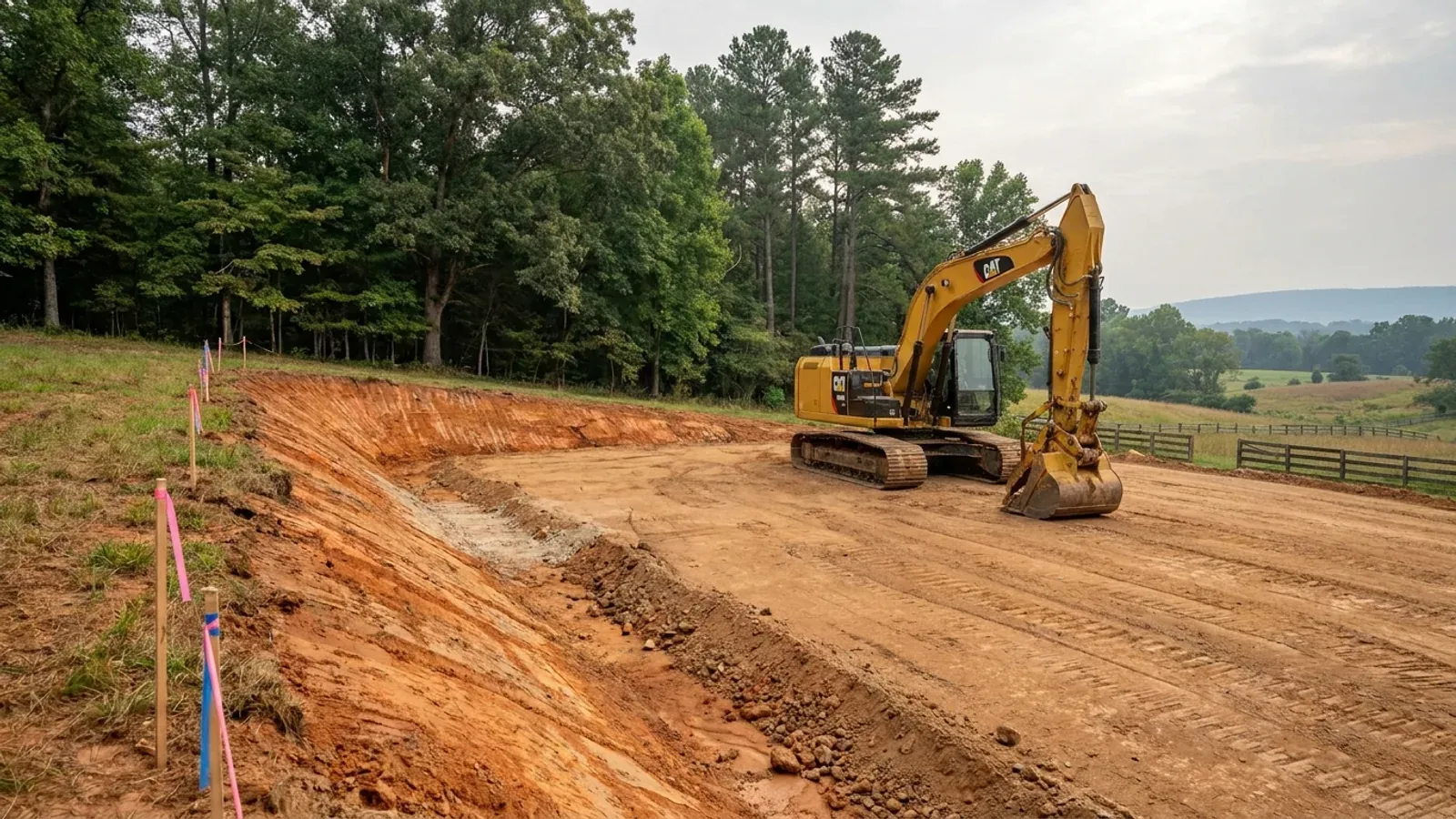
An excavator grading a compacted building pad on a cleared lot, with survey stakes, a drainage swale and a silt fence along the downhill edge.
Below the slab

The expensive surprises are in the ground, not the building

What moves a North Carolina budget is usually below grade, and the thing most often got wrong is which clay to worry about. Cecil — the red Piedmont clay everyone pictures, and the state soil — is kaolinitic and low shrink-swell; it does not heave. The soil that does is Iredell, formed over diabase and gabbro, which the USDA describes as vertic, very high shrink-swell, with a perched water table a foot or two down from December through April. The tell is colour: Cecil is red and Iredell is dark grey-brown, and they sit within a few miles of each other across the central Piedmont. West of that the question stops being clay and becomes slope, rock and colluvium; east of the fall line it becomes water, and in the Tidewater it becomes organic soil that subsides irreversibly once it is drained. Then the same ground decides the septic system, and North Carolina rewrote those rules recently enough that most of what is published about them is out of date. 15A NCAC 18E replaced the old subchapter on 1 January 2024 and was amended again on 1 June 2026: the site is classified on soil morphology — the word "percolation" does not appear anywhere in it — and there is no "provisionally suitable" any more, only suitable or unsuitable, on a single failed parameter. There is no statewide minimum lot size either; the area you need is derived from the soil result and then doubled, because a site that cannot fit both the initial field and its repair area is unsuitable. And the order matters more than people expect: the county health department's Improvement Permit and Construction Authorization come first, and the building permit is available on the strength of the Construction Authorization, not before it. One more thing that catches people: disturb more than an acre and you need an approved erosion and sedimentation control plan in hand before work starts, with penalties up to $5,000 a day, and a pad plus a drive plus a drainfield plus a laydown area crosses an acre faster than it sounds. So the site work, the foundation and the drainfield get resolved together rather than one at a time. We price the dirt before we price the building.

What a build looks like

Three stages every Duplin County project passes through, from a raw parcel to a finished home. Site work first, because that is where the budget is decided.
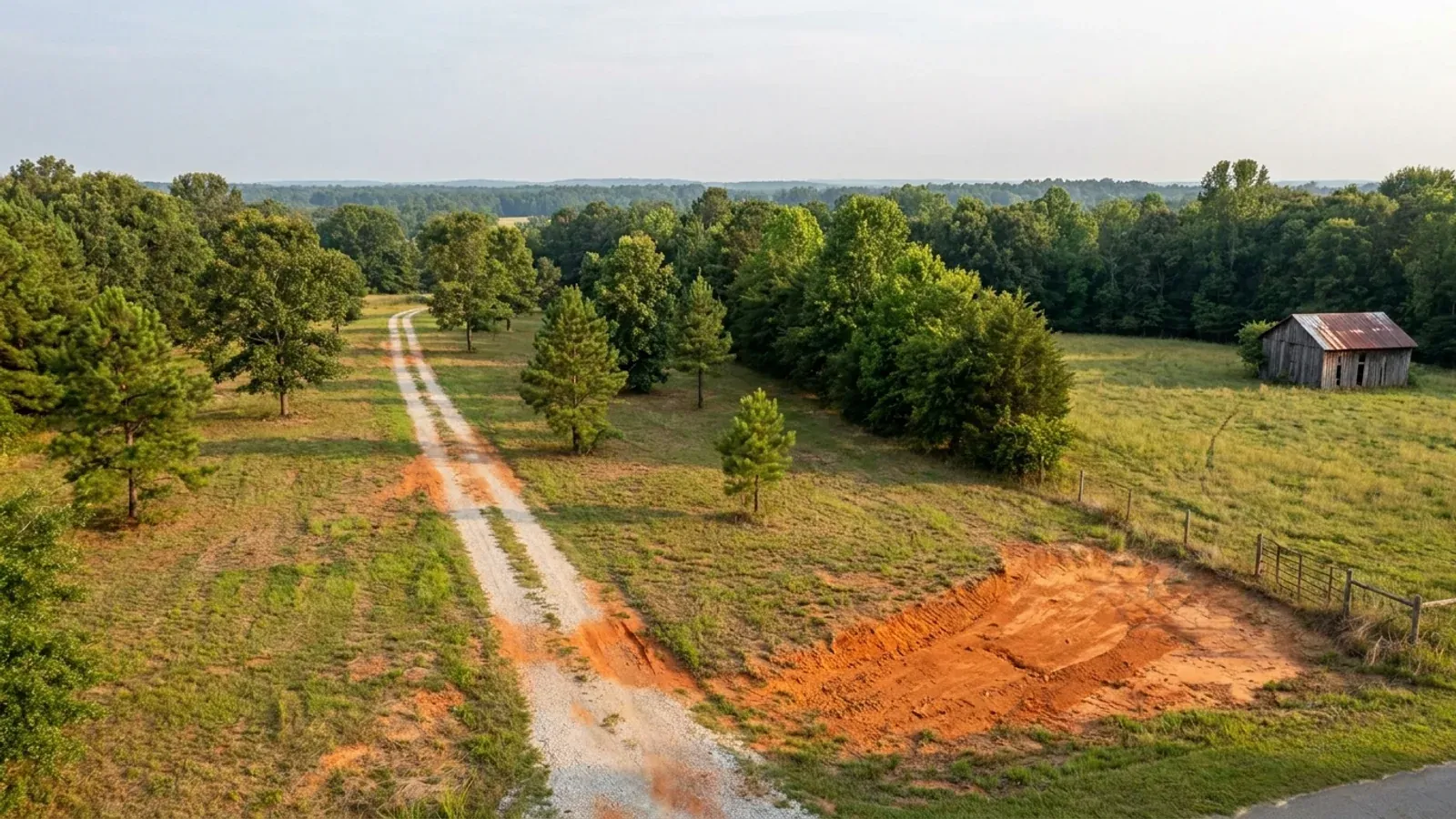
Aerial view of an undeveloped rural lot with cleared grass, a mixed oak, hickory and pine treeline, exposed red clay in one corner and a pale gravel access track.
Stage one

The parcel

Zoning, setbacks, flood zone and utility access get checked before anything is drawn.

An excavator grading a compacted building pad on a cleared lot, with survey stakes, a drainage swale and a silt fence along the downhill edge.
Stage two

Pad and permit

Clearing, grading and a compacted pad, while the septic authorization and the building submittal work through whichever offices cover your parcel.
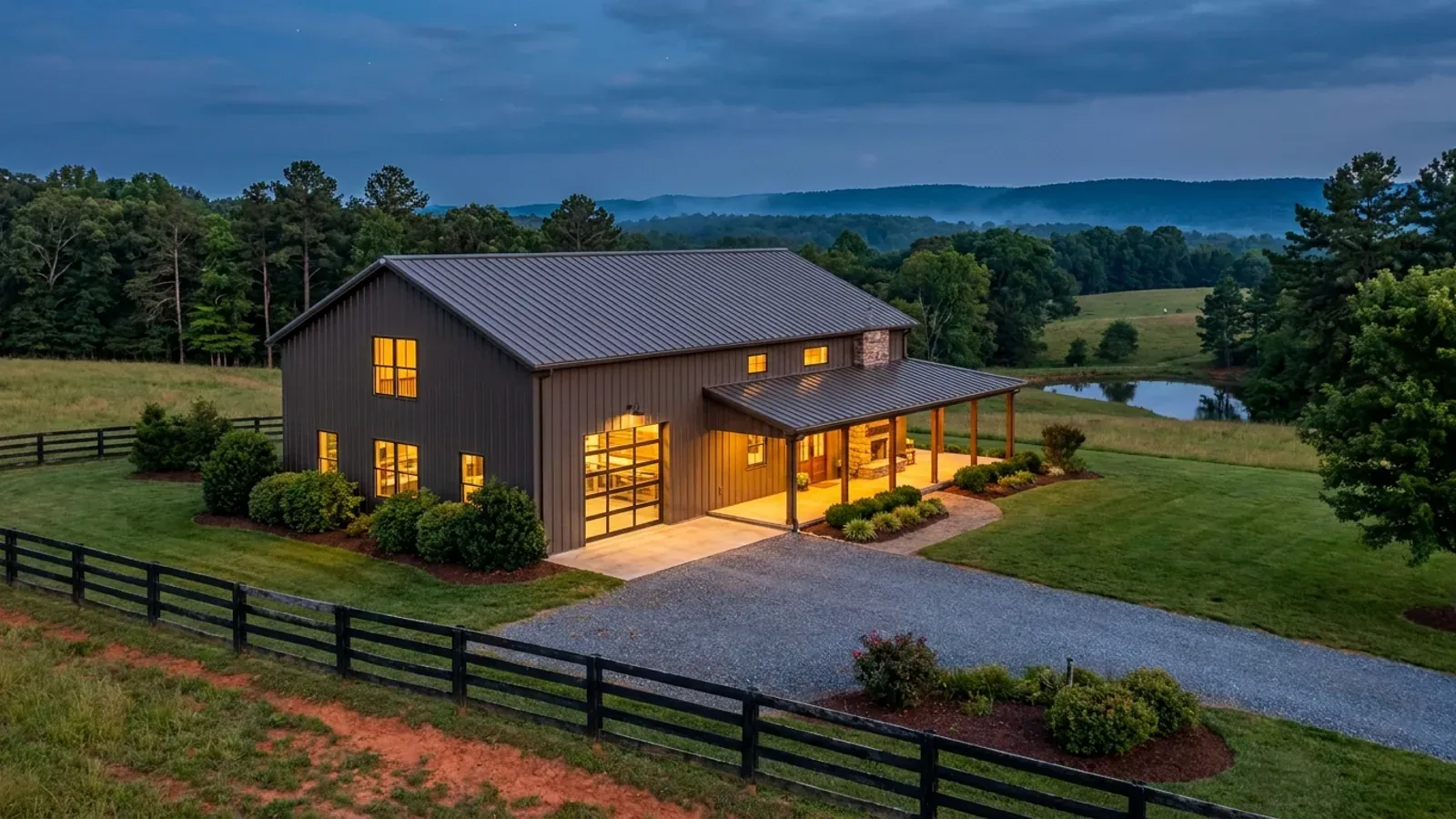
A finished barndominium at dusk with warm interior lighting glowing through its large windows.
Stage three

Frame to finish

Shell erected and dried in, then systems, insulation and interior finish through to CO.

Those are the rules where you are building in Duplin County. Tell us what you want to build and we will draw it to them.

Where we build around Duplin County

Duplin County and the rural land around it. The buildable acreage for a project this size usually sits outside the town limits — which does not automatically put it under the county, because a town's zoning and building-code enforcement reach one to three miles past its limits into its extraterritorial jurisdiction. Inside the limits, in the ETJ, or in neither are three different answers to who issues your permit.

The Duplin County service area, including the rural acreage outside the built-up edge, which is where the parcels big enough for a build like this usually sit. The map marks the territory we build in. It is not a branch location, and there is no office at this pin.

Nearby areas we build in

Others we cover nearby. Every North Carolina municipality sits inside a county — there are no independent cities here — but that does not settle who regulates a given parcel. A town's zoning, subdivision rules and building-code enforcement extend one to three miles beyond its limits, by population, into what the statute calls its extraterritorial jurisdiction; town taxes and town elections do not follow. So the office that issues the permit, what it charges and how the land is zoned can all differ from one card to the next, and the mailing address will not tell you which case you are in.

Building in Duplin County: common questions

6 questions we get asked most often about building in Duplin County. If yours is not on the list, ask it directly.

Is Duplin County really unzoned, and what does that mean in practice?
Partly, and the county says so in its own words: "Duplin County has a Unified Development Ordinances in effect; however, Duplin County does not currently have countywide zoning." Municipalities have zoning inside their town limits and extraterritorial jurisdictions, and the county's page states that if your property is in the unshaded, unincorporated area outside any municipal jurisdiction, "then the property is unzoned." The county even gives the procedure for finding out: open the Duplin County GIS site, search by address, owner, parcel or account number, open the Layers tab, and tick "ETJ (Shaded)" and "City Limits (Shaded)". A shaded parcel is a town's to zone, and the county Planning Department states that it does not maintain or provide any town's zoning information. What no zoning does not mean is no rules. The county's own next sentence is that Duplin County land use ordinances apply in all unincorporated areas of the county — the subdivision ordinance, the mobile home park ordinance, the solar farm ordinance and the rest of the UDO. And there is a specific exception the map will not show you: within a one-mile radius of Duplin County Airport at Kenansville or Henderson Field at Wallace, the county says there may be zoning on the site under its Land Use and Height Restriction Ordinance that does not appear on GIS. Building permits, of course, apply everywhere regardless — zoning and the building code are different instruments and they behave differently.
What does a building permit cost in Duplin County?
Duplin County's fee schedule prices a new residential building permit at $275.00 up to 1,800 square feet plus $0.28 per square foot in addition to the base fee, and it prices the trades separately: $80.00 each for residential electrical, plumbing and mechanical. Manufactured or modular homes are $150.00, and decks, porches and small storage buildings are $50.00. The schedule does not define whether the residential square footage counts heated area only or everything under the roof, and that is the number that decides what an unheated shop bay costs you — get the answer from the department in writing before you set a budget. It is worth understanding why this cannot be answered generically. There is no North Carolina permit fee: the fee basis itself takes at least six different forms across the state, from flat fees by size to dollars per square foot to a multiplier on an ICC valuation table. Some counties charge on heated area only, so the shop rides free; others charge on gross area under roof, so it does not. Two counties an hour apart can price the same 3,000 square foot half-shop building very differently, and the basis matters more than the rate. The Duplin figures here were read from the county's own published schedule on 6 September 2026; the document carries a footnote reading "Effective 7/1/2026".
What wind speed do Duplin County plans have to be drawn to, and is that about to change?
Today, 130 mph. Table R301.2(4) of the 2018 NC Residential Code — the edition in force — names Duplin County at an ultimate design wind speed of 130 mph, flat, with no footnote and no road split. But Duplin is one of only six counties in the state where the two editions genuinely disagree, and the disagreement is a split rather than a number: the 2024 edition, adopted but with no effective date at all, would put Duplin County at 130 mph west of U.S. 41 and 140 mph east of it. The 2024 code takes effect twelve months after the State Fire Marshal certifies a fully constituted Residential Code Council, which had not happened, so a permit pulled today is designed to 130. Two practical consequences. If you are buying east of U.S. 41 and expect to build in a year or two, ask the engineer to price both. And make sure any plan set names the edition it was drawn to, because "130 mph" alone will not tell a future inspector which table it came from. Duplin County is absent from Table R301.2(7), the Seismic Design Category C list, so it sits in Category A or B. Statewide and true everywhere: a flat 20 psf roof live load, no ground snow load column at all because Section R301.2.3 is deleted, and termite protection required under Section R318 — with cold-formed steel framing deleted from the accepted methods of termite protection, so a steel building still needs treatment or baiting.
What should I know about buying land near a hog or poultry operation in Duplin County?
That the law here is settled, that it mostly protects the farm, and that the diligence is therefore yours. Duplin County ranks second in the United States for the market value of hogs and pigs sold and fourth for poultry and eggs; the December 2022 inventory was 1,884,573 hogs and pigs and nearly 21 million broilers. Three statutes shape what that means for a house. First, G.S. 106-803 sets the siting rules — but on the farm, not on you. A swine house or lagoon must be at least 1,500 feet from any occupied residence, 2,500 feet from a school, hospital, church, outdoor recreational facility, park, listed historic property or licensed child care centre, 500 feet from any property boundary and 500 feet from a well supplying water for human consumption, and the waste application area must be at least 75 feet from the boundary of a property with an occupied residence and from any perennial stream. Those distances constrain where a farm may be built or expanded; nothing in them stops you building a dwelling closer than 1,500 feet to an operation that is already there. Second, G.S. 106-803(b) allows closer siting where the property owner gives written permission recorded with the register of deeds — so a previous owner of the parcel you are looking at may already have signed one, and it is a title-search item. Third, G.S. 106-701 bars a nuisance action unless the property is within a half mile of the source and the action is filed within one year of the operation's establishment or a fundamental change, and expressly excludes a change of ownership, a change in size, an interruption of up to three years, new technology and a change in product from counting as a fundamental change. One thing does cut the other way over time: G.S. 143-215.10I bars the Commission from permitting the construction, operation or expansion of a lagoon-and-sprayfield swine waste system unless the action does not increase permitted capacity or the system meets five performance standards, one of which is substantially eliminating odour detectable beyond the parcel boundary. The existing operations are not going away, but under that technology they are not getting bigger either.
Do I need the septic permit before the building permit in Duplin County?
Yes, and on this ground it is the item most likely to decide whether a parcel works at all. Under 15A NCAC 18E the health department evaluates the soil and site and, if it classifies the site suitable, issues an Improvement Permit fixing the design daily flow, the bedroom count, the setbacks and the location of both the initial dispersal field and the repair area; .0201(c) then provides that on issuance of the Construction Authorization the applicant may obtain a building permit under G.S. 130A-338. The classification is binary now — .0509(a) makes a site suitable only if every parameter is suitable, and any single unsuitable parameter makes the whole site unsuitable. "Provisionally suitable" was repealed and does not appear anywhere in the current subchapter, though it still shows on older permits and county records. On the Inner Coastal Plain the parameter that fails is soil wetness: .0504(b) makes a site unsuitable where the seasonal soil wetness condition is less than 12 inches below the natural surface, or less than 18 inches where more than six inches of Group I sandy soils are present. Sandier ground raises the bar rather than lowering it, because effluent moves faster through it — which is why the county's own Land Use Plan says the major limiting factor is poor drainage and flags the county's hydric soils as less able to support septic systems. And .0508(b) makes a site unsuitable if it cannot fit both the initial system and a repair area, so the land you need is the drainfield the soil group buys you, doubled, plus every setback in the rule. Duplin County lists a site evaluation application at $250.00, an Improvement Permit with Construction Authorization at $150.00 for 480 gallons per day or less, and a private drinking water well permit at $300.00. This is checkable ground: walk it in March, not August.
Which Duplin County amendments to the building code should I check?
None exist to check, and that is a useful thing to know rather than a technicality. G.S. 143-138(e) provides that the North Carolina State Building Code shall apply throughout the State from the time of its adoption. The only two instruments a city or county may adopt of its own are a fire prevention code — which needs Residential Code Council approval and cannot reach one- and two-family dwellings beyond what the Residential Code prescriptively requires — and floodplain management regulations. No county here can impose a stricter structural, foundation or energy requirement on a house. What is genuinely local is a different list, and it is what the rest of this page covers: zoning under Chapter 160D, which Duplin County does not exercise countywide; the fee schedule; the health department; extraterritorial jurisdiction; floodplain regulation; and the wind and seismic figures published county by county inside the one statewide code. There is one more thing worth knowing about agricultural land, and it is the best argument on this site. A "farm building" is defined at G.S. 143-138(b4)(1) as a nonresidential building or structure, so a dwelling is outside the building-code exemption from the start. G.S. 160D-903(b) then bars a county from prohibiting a dwelling on an agricultural lot over ten acres, or requiring road frontage or connection to public water and sewer — but only for one "constructed in accordance with the North Carolina State Building Code." The legislature wrote code compliance in as the price of the land-use right. On a large unzoned parcel in Duplin County that is a good trade.

Building in Duplin County?

Start with the plan. Tell us what you want to build and we will draw it, then confirm which office issues the permit for your parcel, what it will let you put there, and what wind load it has to meet. That conversation costs nothing.