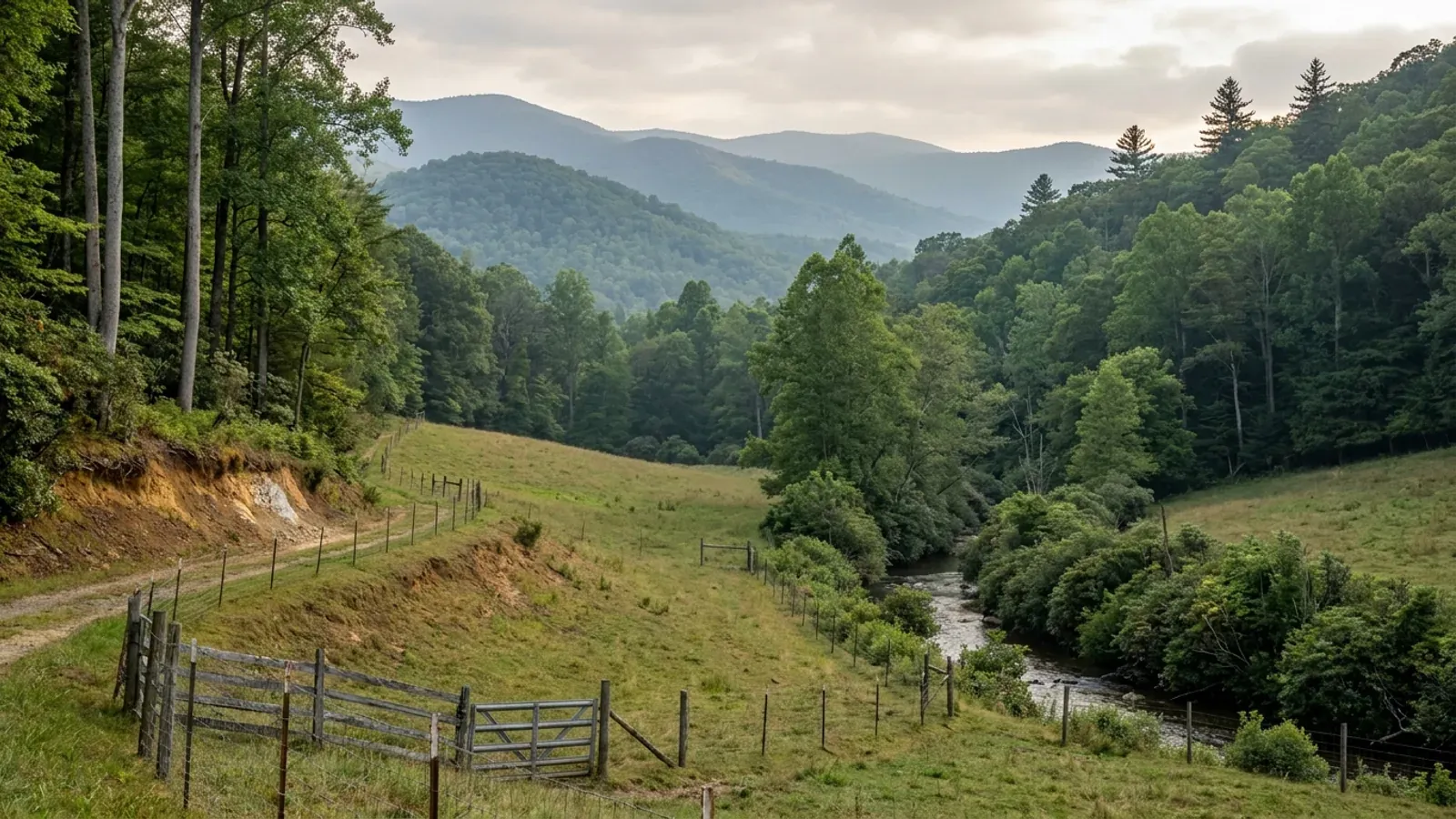
A small sloping hayfield and pasture on a mountain valley floor with contour fencing, a rhododendron-lined creek and rounded forested ridges receding in blue-grey layers behind.
Henderson County 2018 NC Residential Code, statewide

Barndominium Builders in Henderson County, NC

Henderson County is south of Asheville, around Hendersonville. The TOWN of Henderson is a different place — it is the seat of Vance County, near the Virginia line about 250 miles east.

Henderson County is the apple county — south of Asheville, wrapped around Hendersonville, Flat Rock and Fletcher, with the French Broad running north through the middle of it and the Blue Ridge escarpment along the southern rim. Start with the name, because it sends people 250 miles in the wrong direction: the TOWN of Henderson is a separate place, the seat of Vance County up near the Virginia line, and 15,013 people live there. This page is about the mountain county, whose seat is Hendersonville. Some 122,375 people live in Henderson County across 373 square miles, at 328 to the square mile — dense for the mountains, and the reason the land question here is sharper than the permitting question. Only 13.7 percent of the county is in farms: 520 of them on 32,743 acres, averaging 63 acres with a median of 22. That median is the smallest of any county in the Asheville metro, and it is the first thing a buyer looking for ten workable acres runs into. What Henderson does have is orchard land, and orchard land comes with a tax status and a set of zoning consequences that a house changes. Two other things shape a build here and neither is obvious: the county deleted the state ridge law's 3,000-foot elevation floor back in 1983, so ridge protection reaches ground that looks ordinary; and the zoning dimensional tables carry a 60-percent slope rule that doubles the minimum lot area rather than banning anything. The design numbers, by contrast, are the simple case — Henderson is not one of the twelve counties that set wind speed by elevation.

Henderson County at a glance

County
Henderson County
City rules outside city limits
Henderson County zoning stops at the edge of any municipality's extraterritorial jurisdiction, and the City of Hendersonville's zoning ordinance reaches its ETJ in terms.
Population
122,375
ZIP codes
28726, 28729, 28731, 28732, 28739, 28742, 28759, 28784, 28791, 28792, 28793
Site visits
Same week for most of the county

Building conditions in Henderson County

The building code does not change at a county line here. Under § 143-138(e) the North Carolina State Building Code applies throughout the state, and a city or county may adopt only a fire prevention code and floodplain regulations of its own — there is no general local amendment power, so there are no county amendments to look up. The edition in force is still the 2018 NC Residential Code, effective 1 January 2019; the 2024 edition has been delayed three times and carries no effective date at all. What genuinely differs is who issues the permit and inspects the work, what that office charges, how the parcel is zoned, what the local floodplain ordinance requires of the foundation — and two design numbers the code publishes county by county, the ultimate design wind speed and the seismic design category. The rest of Table R301.2 is set once for everyone: a flat 20 psf roof live load, a 12-inch frost line, Moderate weathering, and termite protection required everywhere in the state with no exemption. There is no ground snow load column in the residential code at all.

Build conditions for Henderson County , North Carolina : ultimate design wind speed 115 mph. BUILD CONDITIONS HENDERSON COUNTY, NCHenderson County2018 NC RESIDENTIAL CODEULTIMATE DESIGN WIND SPEED115 mphHenderson County is unlisted in Table R301.2(4) of the 2018 NC Residential Code and takes thedefault 115 mph ultimate design wind speed. It is not one of the twelve special mountain region…ZONING · R-40 ESTATE RESIDENTIAL AND THE OTHE…40,000 sq ft in R-40 — doubled on tr…Henderson County zones by an Official Zoning Map, and § 42-4 isexplicit that the Chapter applies to no area which is not…WHO ISSUES THE PERMITHenderson County Permits and Inspect…Permits and Inspections, Code Enforcement, Planning, EnvironmentalHealth, Site Development and Sedimentation Control, the Watershed…
Build conditions for Henderson County, drawn from the sourced facts on this page. Every figure above is cited in the quick-facts panel below, with its source and vintage.
The permit is a bracket, not a rate — and the detached shop is priced differently
Henderson County's approved fee schedule prices residential inspections on square feet of unit, in flat brackets rather than per square foot: $475 for 0 to 1,499 square feet, $500 to 1,999, $625 to 2,499, $750 to 2,999, $875 to 3,499, $1,000 to 3,999, $1,125 to 4,499, $1,250 to 4,999, and $1,375 plus $0.30 for each additional square foot at 5,000 and above. There is no heated-versus-unheated split on the house. But a residential accessory structure over 400 square feet is on a completely different line — $75 plus $0.15 per gross square foot over 400, with $75 per trade to add mechanical, plumbing, electrical or gas to it. So whether the shop bay sits under the house roof or stands on its own concrete changes which of two bases the county prices it on, and that is a decision made on the plan, not at the counter.

Henderson County FY 2027 Approved Fee Schedule, Inspections section, hendersoncountync.gov/budget

Henderson threw out the ridge law's 3,000-foot floor in 1983
The Mountain Ridge Protection Act of 1983 protects ridges that are both 3,000 feet in elevation and 500 or more feet above the adjacent valley floor — but G.S. 113A-206(6) lets a county elect to drop the 3,000-foot half. Section 42-251 of the Henderson County Code records that Henderson did exactly that: the 3,000-foot elevation requirement is eliminated for Henderson County, and the Act's provisions were requested for ALL mountain ridges in the county standing 500 or more feet above an adjacent valley floor, beginning 1 January 1984. Very few counties made that election. What the Act actually regulates is height, not slope: a tall building or structure is one more than 40 feet from the top of the foundation to its uppermost point, with any foundation height over three feet above the crest counted into the 40, and a hard bar on protruding more than 35 feet above the ridge crest. A single-storey barndominium with a 14-foot shop bay is nowhere near either number — but the ordinance reaches far more Henderson ground than the state default would.

Henderson County Code § 42-251 (Protected Mountain Ridges), re-codifying a 1983 county ordinance, hendersoncountync.gov; N.C.G.S. §§ 113A-205 to 113A-214

Sixty percent slope doubles the minimum lot
Henderson County's slope rule is not a construction ban and not a percentage of grade at which a permit stops — it is a density penalty written into the dimensional tables. Footnote 1 to Table 2.11, the R-40 density and dimensional requirements, provides that the minimum lot area for portions of a tract with a slope of 60 percent or greater shall be twice the minimum lot area of the district, where those slope areas account for ten percent or more of the tract. In R-40 that turns 40,000 square feet into 80,000. Neighbouring mountain counties measure different things at different thresholds and the numbers are not interchangeable; Henderson's are 60 percent, a ten-percent-of-tract trigger, and a doubling. Read together with the ridge ordinance, the county regulates steep ground twice, in two entirely different ways: once by the height of what is built and once by how much land each dwelling has to sit on.

Henderson County Land Development Code § 42-37 (Estate Residential District R-40), Table 2.11 and footnote 1, hendersoncountync.gov

The apple county, and what a house does to orchard land
N.C. Cooperative Extension records Henderson County as the largest apple producer in the No. 7 apple-producing state, growing around 85 percent of North Carolina's crop — and notes that if Henderson County were a state it would rank eighth in the nation for apple production. That matters to a build because orchard ground is normally enrolled in present-use value taxation, and the Department of Revenue's own programme guide is explicit about what happens next: horticultural land qualifies on at least one tract of 5 acres in actual production, agricultural land needs 10 and forestland 20, and homesites are NOT acreage in production and are to be valued at market value. Most counties initially allow one acre for the homesite, but no statute fixes the figure at one acre — it can be assessed as more or less depending on what the ground shows. On an orchard parcel that means the barndominium and its yard step out of present-use value while the trees stay in it, and where the house goes decides how much steps out.

N.C. Cooperative Extension, Homegrown, "How Sweet It Is: North Carolina's Apple Economy", homegrown.extension.ncsu.edu; NC Department of Revenue, Present-Use Value Program Guide, August 2023 Edition, ncdor.gov

The smallest median farm in the Asheville metro — 22 acres
The 2022 Census of Agriculture counts 520 farms in Henderson County on 32,743 acres, 13.7 percent of the county, averaging 63 acres with a median of 22. Across the five counties of the Asheville metro that median is the smallest: Buncombe is 25, Haywood 30, Transylvania 36 and Madison 43. It is a small number in absolute terms too — the statewide median farm is 48 acres. This is the honest constraint on a Henderson County land search and it is worth saying before anyone starts driving. Ten contiguous, buildable, septic-suitable acres exist here, but they are not the typical parcel, and the ones that come up are usually orchard blocks or hillside tracts where the slope rule and the drainfield decide the answer between them. The county runs a Farmland Preservation programme under Chapter 45 with voluntary and enhanced voluntary agricultural districts, which is the local response to exactly this pressure.

USDA NASS, 2022 Census of Agriculture county data, nass.usda.gov; U.S. Census Bureau Vintage 2025 county population estimates and 2025 Gazetteer county file, census.gov; Henderson County Code Chapter 45 (Farmland Preservation), hendersoncountync.gov

Three code answers that pull in three directions here
Henderson County lands in an unusual combination and no two of the three lines up. Wind: unlisted in Table R301.2(4) of the 2018 NC Residential Code, so 115 mph, the code's floor, and NOT one of the twelve counties that set wind by first-floor finish elevation — so one number really does apply across the county however steep the ground looks. Seismic: Henderson is absent from the 2018 edition's thirteen-county Seismic Design Category C list, which puts it in A or B — but the 2024 edition, adopted and carrying no effective date at all, ADDS Henderson and Transylvania to that list. Radon: Henderson is one of only eight North Carolina counties printed in the code's own high radon-potential Zone 1 table, alongside Alleghany, Buncombe, Cherokee, Mitchell, Rockingham, Transylvania and Watauga. And the code mandates radon-resistant construction in no county at all — Appendix F is permissive and applies where a jurisdiction adopts it. Elevated seismic pending, code-minimum wind, high radon potential, no radon mandate: that is Henderson's actual profile and it is not what a mountain address suggests.

2018 NC Residential Code, Tables R301.2(4), R301.2(5), R301.2(7), Appendix F Table AF101(1) and Section R102.5, ncosfm.gov; 2024 NC Residential Code Table R301.2(7)

Also worth knowing before you build in Henderson County

The septic permit is a four-figure line item before the building permit exists
Henderson County Environmental Health charges $1,000 for the Improvement Permit and Construction Authorization on a wastewater system of 3,000 gallons per day or less — which is every house. A new well inspection permit and the state-required water analysis for new wells are separate charges again. Two things follow. First, that money is spent before a building permit can be applied for, because 15A NCAC 18E .0201(c) bars the building permit until the Construction Authorization has issued. Second, the soil evaluation is what decides whether the parcel works at all: under 15A NCAC 18E .0509(a) a site is suitable or unsuitable with no middle category, the old provisionally-suitable tier having gone when the .1900 rules were replaced on 1 January 2024. On sloping Henderson ground that evaluation belongs before the offer, not after it.

Henderson County FY 2027 Approved Fee Schedule, Environmental Health Department section, hendersoncountync.gov/budget; 15A NCAC 18E .0201, .0508 and .0509

Land disturbance is priced by the acre, and the drive is the acre
Henderson County's Site Development and Sedimentation Control schedule charges $200 per plan for review, and then $300 per disturbed acre or any portion of an acre above the one-acre threshold. A watershed permit for grading under an acre is $20; a residential zoning permit is $50. The acre-or-any-portion wording is the part worth reading twice, because on a mountain parcel the number that crosses one acre is rarely the building footprint. A quarter-mile gravel drive climbing to a bench site is a meaningful fraction of an acre on its own, before the pad, the septic area, the repair area and the material laydown are added. Working the disturbed area out early is cheaper than the plan, and sometimes designing to stay under the threshold is possible.

Henderson County FY 2027 Approved Fee Schedule, Site Development and Sedimentation Control and Code Enforcement sections, hendersoncountync.gov/budget

The county's farm exemption names agritourism in its own text
Section 42-9 of the Henderson County Land Development Code is one sentence and it does a lot of work: Articles II, V and VI shall in no way regulate, restrict, prohibit or otherwise deter any use of property for agriculture, agritourism farm or bona fide farm and its related uses, except that any use of such property for non-farm purposes is subject to the Chapter. Naming agritourism alongside the bona fide farm is apple-country drafting — pick-your-own blocks, cider rooms and farm events are a real land use here. But note what the exemption is: it is a ZONING exemption, and it is not a building-code exemption. G.S. 143-138(b4)(1) defines a farm building as a NONRESIDENTIAL building, so a dwelling was never inside the building-code exemption, and G.S. 160D-903 grants the farm-residence zoning right only to residences constructed to the applicable residential building code. You get the land-use right; building to the 2018 NC Residential Code is the price of it.

Henderson County Land Development Code § 42-9 (Farm Exemption), hendersoncountync.gov; N.C.G.S. § 143-138(b4)(1) and § 160D-903

Flood mapping is a county board here, not just a form
Henderson County is one of the counties designated under federal disaster declaration DR-4827-NC, declared 28 September 2024 for an incident period of 25 September to 18 December 2024. The practical consequence for someone buying land is narrow and specific: stream channels, floodway limits and floodplain information can change after an event of that size, and a parcel's flood status is worth confirming against current information rather than a memory of the old map. Henderson County is better set up for that question than most — the Land Development Code seats a Floodplain Administrator at § 42-310 and a standing Flood Damage Prevention Board at § 42-306, and the county runs its own Floodplain Development Local Program. The state's flood risk information system at flood.nc.gov is the other place to look, and both are worth a visit before a parcel is under contract rather than after.

OpenFEMA DisasterDeclarationsSummaries, disaster 4827, fema.gov/api/open/v2/DisasterDeclarationsSummaries; Henderson County Land Development Code §§ 42-306 and 42-310, hendersoncountync.gov; NC Flood Risk Information System, flood.nc.gov
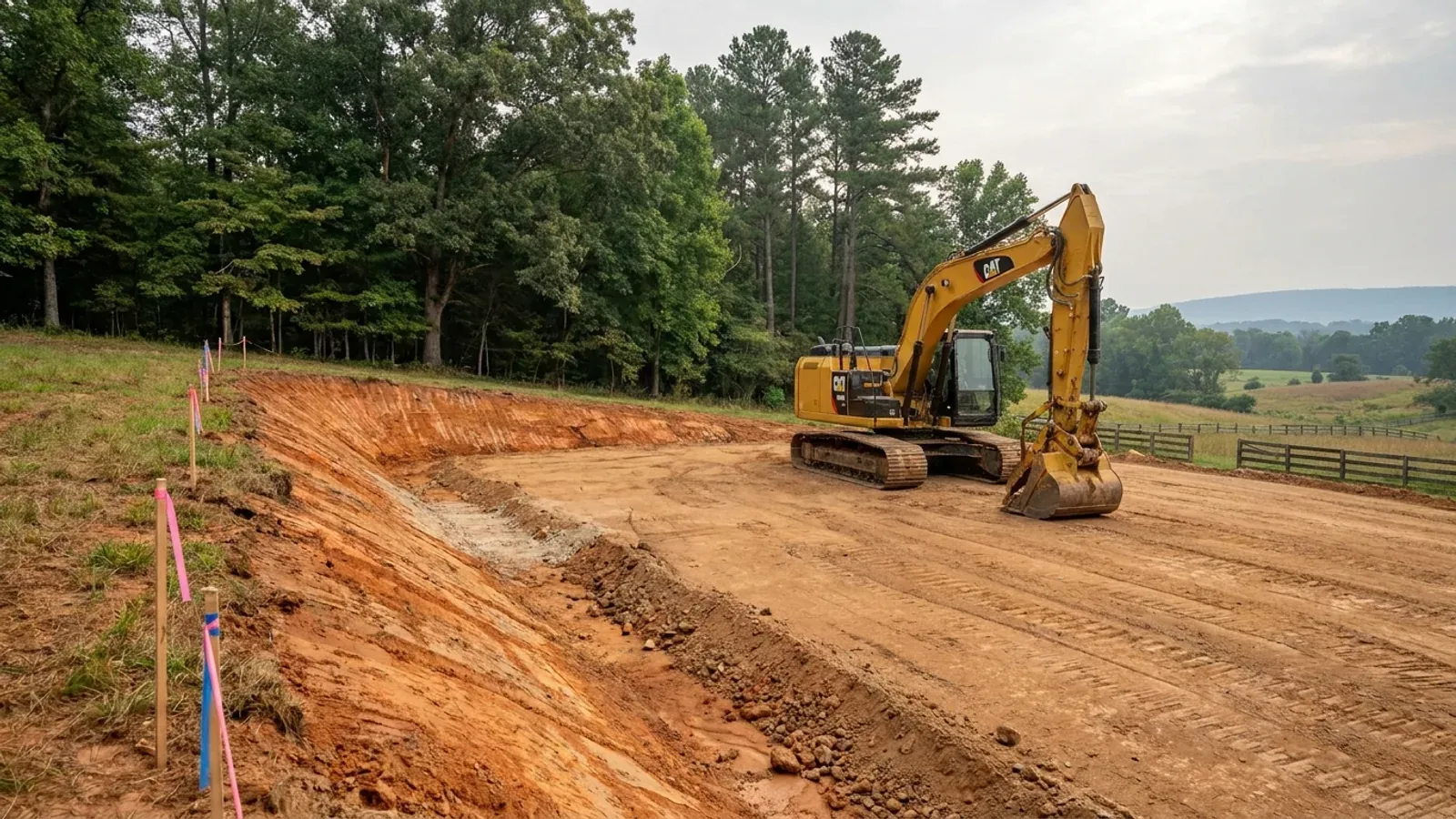
An excavator grading a compacted building pad on a cleared lot, with survey stakes, a drainage swale and a silt fence along the downhill edge.
Below the slab

The expensive surprises are in the ground, not the building

What moves a North Carolina budget is usually below grade, and the thing most often got wrong is which clay to worry about. Cecil — the red Piedmont clay everyone pictures, and the state soil — is kaolinitic and low shrink-swell; it does not heave. The soil that does is Iredell, formed over diabase and gabbro, which the USDA describes as vertic, very high shrink-swell, with a perched water table a foot or two down from December through April. The tell is colour: Cecil is red and Iredell is dark grey-brown, and they sit within a few miles of each other across the central Piedmont. West of that the question stops being clay and becomes slope, rock and colluvium; east of the fall line it becomes water, and in the Tidewater it becomes organic soil that subsides irreversibly once it is drained. Then the same ground decides the septic system, and North Carolina rewrote those rules recently enough that most of what is published about them is out of date. 15A NCAC 18E replaced the old subchapter on 1 January 2024 and was amended again on 1 June 2026: the site is classified on soil morphology — the word "percolation" does not appear anywhere in it — and there is no "provisionally suitable" any more, only suitable or unsuitable, on a single failed parameter. There is no statewide minimum lot size either; the area you need is derived from the soil result and then doubled, because a site that cannot fit both the initial field and its repair area is unsuitable. And the order matters more than people expect: the county health department's Improvement Permit and Construction Authorization come first, and the building permit is available on the strength of the Construction Authorization, not before it. One more thing that catches people: disturb more than an acre and you need an approved erosion and sedimentation control plan in hand before work starts, with penalties up to $5,000 a day, and a pad plus a drive plus a drainfield plus a laydown area crosses an acre faster than it sounds. So the site work, the foundation and the drainfield get resolved together rather than one at a time. We price the dirt before we price the building.

What a build looks like

Three stages every Henderson County project passes through, from a raw parcel to a finished home. Site work first, because that is where the budget is decided.
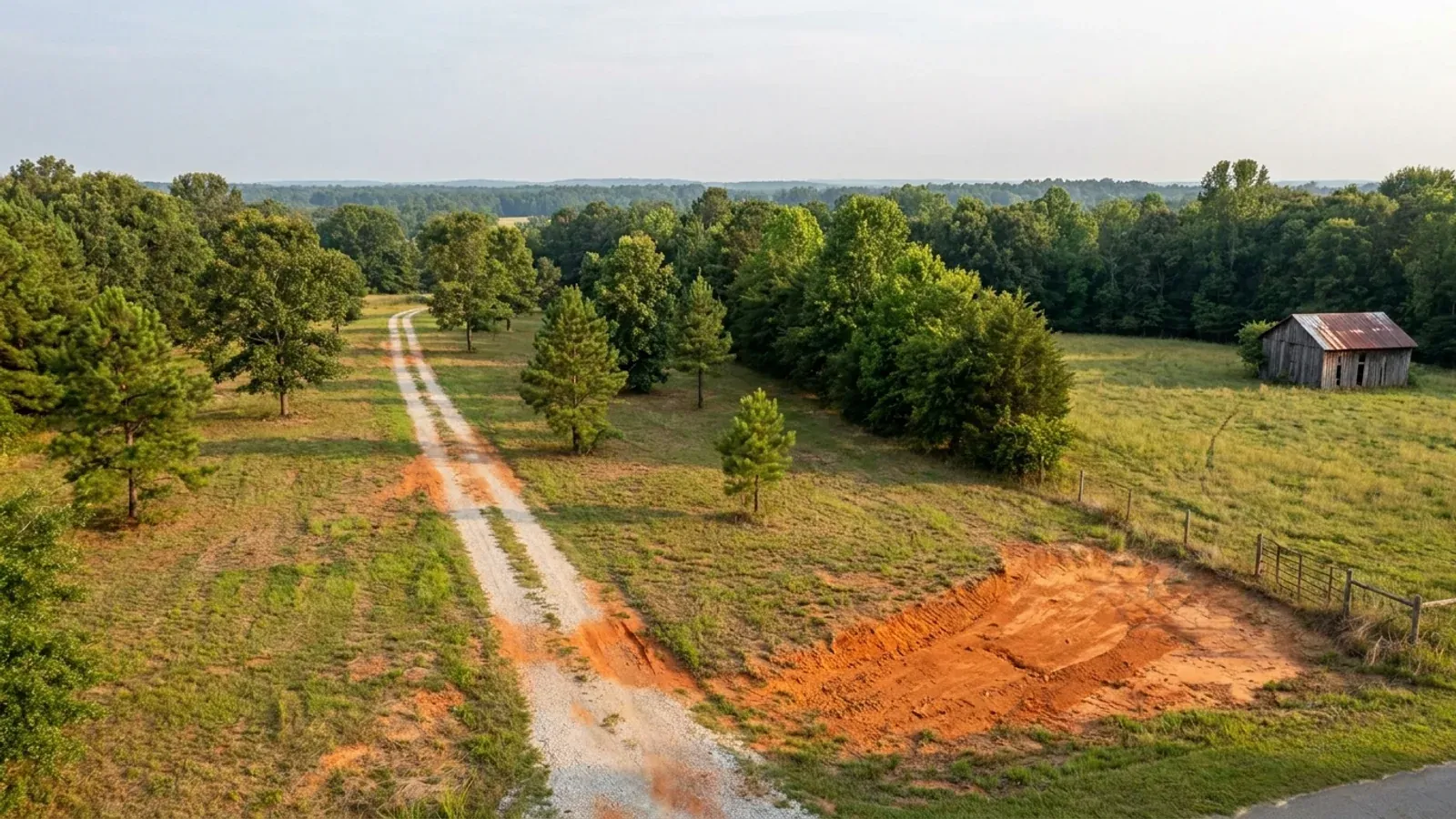
Aerial view of an undeveloped rural lot with cleared grass, a mixed oak, hickory and pine treeline, exposed red clay in one corner and a pale gravel access track.
Stage one

The parcel

Zoning, setbacks, flood zone and utility access get checked before anything is drawn.

An excavator grading a compacted building pad on a cleared lot, with survey stakes, a drainage swale and a silt fence along the downhill edge.
Stage two

Pad and permit

Clearing, grading and a compacted pad, while the septic authorization and the building submittal work through whichever offices cover your parcel.
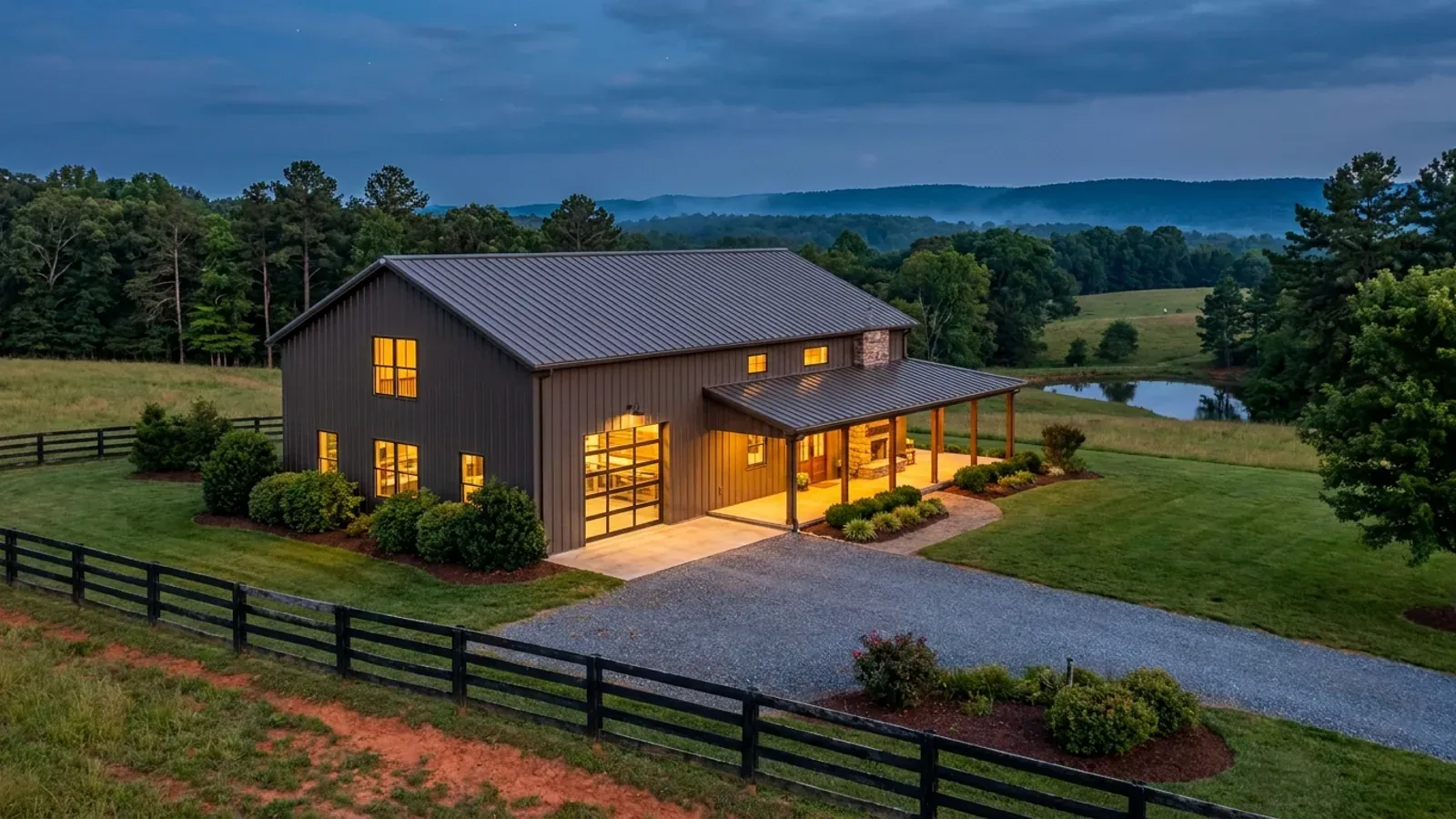
A finished barndominium at dusk with warm interior lighting glowing through its large windows.
Stage three

Frame to finish

Shell erected and dried in, then systems, insulation and interior finish through to CO.

Those are the rules where you are building in Henderson County. Tell us what you want to build and we will draw it to them.

Where we build around Henderson County

Henderson County and the rural land around it. The buildable acreage for a project this size usually sits outside the town limits — which does not automatically put it under the county, because a town's zoning and building-code enforcement reach one to three miles past its limits into its extraterritorial jurisdiction. Inside the limits, in the ETJ, or in neither are three different answers to who issues your permit.

The Henderson County service area, including the rural acreage outside the built-up edge, which is where the parcels big enough for a build like this usually sit. The map marks the territory we build in. It is not a branch location, and there is no office at this pin.

Nearby areas we build in

Others we cover nearby. Every North Carolina municipality sits inside a county — there are no independent cities here — but that does not settle who regulates a given parcel. A town's zoning, subdivision rules and building-code enforcement extend one to three miles beyond its limits, by population, into what the statute calls its extraterritorial jurisdiction; town taxes and town elections do not follow. So the office that issues the permit, what it charges and how the land is zoned can all differ from one card to the next, and the mailing address will not tell you which case you are in.

Building in Henderson County: common questions

9 questions we get asked most often about building in Henderson County. If yours is not on the list, ask it directly.

Is Henderson County the same as the town of Henderson?
No, and the two are about 250 miles apart. Henderson COUNTY is in the mountains just south of Asheville; its seat is Hendersonville and its towns are Fletcher, Flat Rock, Laurel Park, Mills River and part of Saluda. The town of HENDERSON is the seat of Vance County, up on the Virginia line north-east of Raleigh, with about 15,013 people. North Carolina does this a lot — 21 towns share a name with a county and 15 of those are in a different county. Lenoir is in Caldwell, Franklin is in Macon, Washington is in Beaufort and Beaufort is in Carteret. It matters here because the permitting office, the fee schedule, the design criteria and the septic rules are all county-level, so getting the county wrong gets every one of those wrong at the same time.
What will the county permit cost in Henderson County?
Henderson County's approved fee schedule prices residential inspections in flat brackets by square feet of unit rather than per square foot: $475 up to 1,499 square feet, then $500, $625, $750, $875, $1,000, $1,125 and $1,250 through the 4,500-to-4,999 bracket, and $1,375 plus $0.30 per additional square foot at 5,000 and above. Additions and remodels have their own bracket tables. A residential accessory structure over 400 square feet is charged separately at $75 plus $0.15 per gross square foot over 400, with $75 per trade for mechanical, plumbing, electrical or gas on it. On top of the building permit sit a $50 residential zoning permit and the $10 General Contractor Recovery Fund charge, with $200 plus the permit fee if work starts without a permit. Environmental Health and Site Development charge separately again. No build cost appears on this page, in this county's documents or anywhere on this site — a fee schedule is a fee schedule, not an estimate of what a house costs.
What are Henderson County's design numbers?
Henderson County is unlisted in Table R301.2(4) of the 2018 NC Residential Code, so it takes the default 115 mph ultimate design wind speed — the code's floor, and the same figure as the Piedmont. It is NOT one of the twelve special mountain region counties whose wind speed is set by first-floor finish elevation through Table R301.2(5), so a ridge site and a valley site in Henderson County design to the same number, which is not true one county north in Buncombe. Henderson is absent from the 2018 edition's Seismic Design Category C list, putting it in A or B; the 2024 edition, which has no effective date, would add it. Climate zone 4A. Statewide and true everywhere: a flat 20 psf roof live load, a 12-inch frost line depth, Moderate weathering, and termite protection required across the state at a Moderate-Heavy severity. Section R301.2.3 is deleted, so there is no ground snow load column in the code at all — any snow figure quoted for this county did not come from it.
Who issues the permit — Henderson County or the town?
It depends on the corporate line and on the extraterritorial jurisdiction beyond it. Section 42-4 of the Land Development Code applies county zoning to the unincorporated county lying outside the ETJ of any municipality, and adds that the Chapter reaches no area not established as a zoning area on the Official Zoning Map. Section 3-1 of the City of Hendersonville Zoning Ordinance applies that ordinance inside the city limits and within the City's extraterritorial jurisdiction. Under G.S. 160D-202 an ETJ runs one mile out for a municipality under 10,000, two miles from 10,000 to 24,999 and three miles at 25,000 or more, and inside it the town enforces zoning, subdivision regulation and the building code while collecting no town tax and giving no town vote. One provision runs the other way in Henderson County: § 42-4 allows a city or town to request county enforcement inside its own limits and ETJ, under G.S. 160D-105 and with the Board of Commissioners' agreement. Check the boundary before the offer, not after.
Is my land too steep to build on in Henderson County?
Two separate rules answer that and they measure different things. The zoning dimensional tables carry a slope rule: where ground at 60 percent slope or greater makes up ten percent or more of a tract, the minimum lot area doubles — 80,000 square feet instead of 40,000 in R-40. That is a density rule, not a prohibition. Separately, § 42-251 protects mountain ridges standing 500 or more feet above an adjacent valley floor, with the state law's 3,000-foot elevation requirement eliminated for Henderson County since 1984 — and what it regulates is a tall building over 40 feet from the top of the foundation to the uppermost point, not the slope itself. A single-storey barndominium is well under that. In practice the binding constraint on steep ground is neither of these: it is the septic soil evaluation, because 15A NCAC 18E .0508(b) requires room for both the initial drainfield and a full repair area, and slope is one of the parameters that can make a site unsuitable outright.
Can I build a house on my orchard and keep the present-use value?
You can keep the qualifying land in it; the homesite comes out. The Department of Revenue's Present-Use Value Program Guide, August 2023 Edition, states that homesites are not acreage in production and should be valued at market value, and that while most counties initially establish a homesite as one acre, no statute requires it to be one acre — it can be assessed as more or less if that is what the ground shows. The qualifying thresholds are 5 acres in actual production for horticulture, 10 for agriculture and 20 for forestry, and an apple block is horticulture. Zoning is a separate question with a separate answer: § 42-9 of the Land Development Code exempts agriculture, agritourism farm and bona fide farm uses from Articles II, V and VI, but G.S. 160D-903 conditions the farm-residence exemption on the dwelling being constructed to the applicable residential building code. Talk to the Henderson County tax office before the site plan is drawn, because where the house goes decides how much acreage leaves present-use value.
Will my parcel pass for septic?
That is decided by soil morphology, not by a percolation test — the word percolation does not appear anywhere in 15A NCAC 18E, the subchapter that replaced the old .1900 rules on 1 January 2024 and was itself amended effective 1 June 2026. Under .0509(a) a site is suitable or unsuitable, full stop; the old provisionally-suitable middle category is gone and one failed parameter ends it. The sequence is Improvement Permit, then Construction Authorization, then Operation Permit, all through Henderson County Environmental Health, and .0201(c) is the rule to know because the building permit cannot issue until the Construction Authorization has. Henderson County charges $1,000 for the Improvement Permit and Construction Authorization together on a system of 3,000 gallons per day or less. Under .0508(b) the site must hold both the initial drainfield and a full repair area, which doubles the ground the system needs. On a Henderson County hillside that evaluation is the whole decision.
Do I need an erosion and sedimentation control plan?
The trigger is one acre of cumulative land disturbance and the approval has to be in hand before any earth moves, with state penalties reaching $5,000 a day. Henderson County runs its own local erosion programme and prices it: $200 per plan review, and $300 per disturbed acre or any portion of an acre above the first. There is also a $20 watershed permit for grading under an acre, and separate Stormwater Phase II post-construction permits that start at $1,000 for a project with no more than one stormwater control measure. The number to watch on a mountain parcel is the driveway rather than the house. A long gravel drive climbing to a building bench, plus the pad, the septic field, the repair area and the laydown, adds up faster than people expect. Work the disturbed acreage out during design.
Is there actually land to buy in Henderson County?
Less than the map suggests, and the honest version is more useful than the optimistic one. Only 13.7 percent of Henderson County is in farms — 520 farms on 32,743 acres — and the median farm is 22 acres, the smallest of any county in the Asheville metro and well under the statewide median of 48. The county holds 122,375 people on 373 square miles, 328 to the square mile, which is dense for the mountains. What that means in practice is that large flat tracts are rare and expensive, and the parcels that do come up are usually orchard blocks, hillside acreage, or land already in a voluntary agricultural district under the county's Chapter 45 farmland preservation programme. It is a real market, but it rewards patience and a septic evaluation before the offer. Buyers who want more acreage for the money generally look north into Madison, west into Haywood, or east down the escarpment.

Building in Henderson County?

Start with the plan. Tell us what you want to build and we will draw it, then confirm which office issues the permit for your parcel, what it will let you put there, and what wind load it has to meet. That conversation costs nothing.