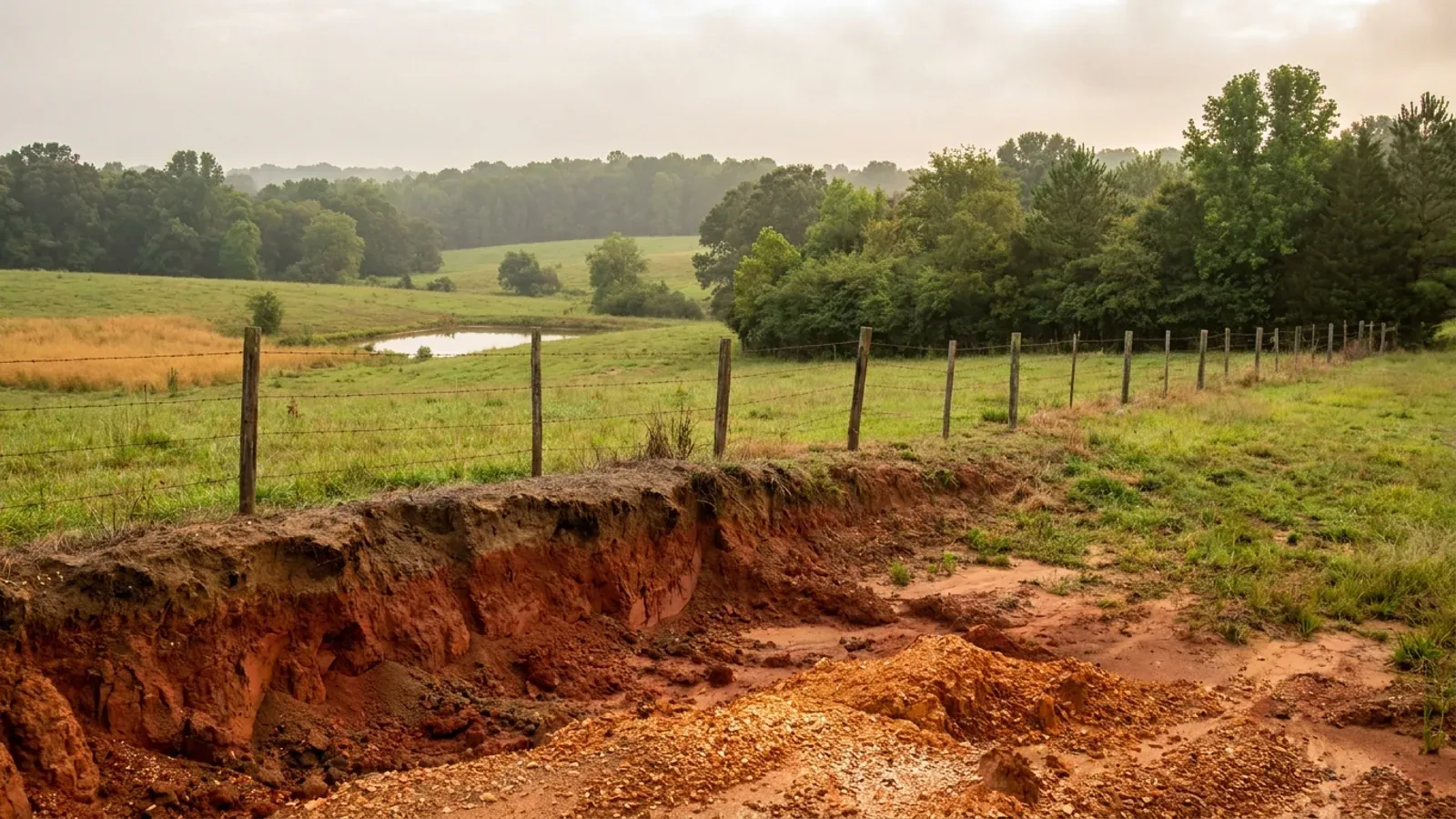
Rolling southern Piedmont farmland with vivid red clay exposed at a field edge, mixed oak, hickory and pine woodland and a small farm pond.
Rowan County 2018 NC Residential Code, statewide

Barndominium Builders in Rowan County, NC

Rowan County sits on Interstate 85 where Charlotte's ring runs into the Triad, with Salisbury as the seat and China Grove and Landis strung down the interstate toward Cabarrus. Kannapolis straddles that county line: of its 61,708 people, 50,152 are in Cabarrus and 11,556 in Rowan, so a Kannapolis address does not tell a buyer whose inspections department they answer to. Rowan is the ring county that did not boom — it grew 5.6 percent since 2020 to an estimated 155,096, against 13.5 percent in Iredell and 13.7 in Lincoln — and that is precisely why the land is still here: 801 farms working 104,888 acres, 32.0 percent of the county, at a median farm size of 40 acres. Two things set the build apart. The county charges its building permit off the IBC valuation table rather than a rate on floor area, and it permits the trades separately, with plumbing billed by the fixture. And the USDA named a national soil series for this county — the ROWAN series, first described near the town of Cleveland — whose own description is the clearest published statement of where Piedmont shrink-swell actually sits on a mafic-rock lot. It is not on the ridge.

Rowan County at a glance

County
Rowan County
City rules outside city limits
Rowan permits unincorporated land; Salisbury, Kannapolis, China Grove, Landis and the smaller towns each run their own jurisdiction, and a town’s ETJ can reach up to three miles past its limits.
Population
155,096
ZIP codes
28144, 28146, 28147, 28023, 28088, 28159, 28039, 28072, 28041, 28138, 28125, 28071, 27013, 27054
Site visits
Same week for most of the county

Building conditions in Rowan County

The building code does not change at a county line here. Under § 143-138(e) the North Carolina State Building Code applies throughout the state, and a city or county may adopt only a fire prevention code and floodplain regulations of its own — there is no general local amendment power, so there are no county amendments to look up. The edition in force is still the 2018 NC Residential Code, effective 1 January 2019; the 2024 edition has been delayed three times and carries no effective date at all. What genuinely differs is who issues the permit and inspects the work, what that office charges, how the parcel is zoned, what the local floodplain ordinance requires of the foundation — and two design numbers the code publishes county by county, the ultimate design wind speed and the seismic design category. The rest of Table R301.2 is set once for everyone: a flat 20 psf roof live load, a 12-inch frost line, Moderate weathering, and termite protection required everywhere in the state with no exemption. There is no ground snow load column in the residential code at all.

Build conditions for Rowan County , North Carolina : ultimate design wind speed 115 mph. BUILD CONDITIONS ROWAN COUNTY, NCRowan County2018 NC RESIDENTIAL CODEULTIMATE DESIGN WIND SPEED115 mphRowan County is not listed in Table R301.2(4) of the 2018 NC Residential Code, so it carries theunlisted default of 115 mph. Fifty-one of the state’s hundred counties sit at that figure, the…ZONING · RA RURAL AGRICULTURAL (WITH RR RURAL…20,000 sq ft in RA on septic and an…Section 21-84's table of dimensional requirements sets the RAminimum zone lot at 20,000 square feet where the lot is served by a…WHO ISSUES THE PERMITRowan County Planning and DevelopmentPlanning and Development administers the Chapter 21 zoningordinance, the Water Supply Watershed overlays and the Airport…
Build conditions for Rowan County, drawn from the sourced facts on this page. Every figure above is cited in the quick-facts panel below, with its source and vintage.
A national soil series is named for this county, and it says where the bad clay sits
The USDA established the ROWAN series in Rowan County in 2009, with its type location 0.8 mile north on Academy Street in the town of Cleveland. It formed in residuum from intermediate or mafic metamorphic and igneous rock — amphibolite, hornblende-biotite gneiss, biotite gneiss — and it is very deep, well drained, with a seasonal high water table below 60 inches and, importantly, shrink-swell potential LOW. It sits on interstream divides, ridges and side slopes. The useful part is the company it keeps: the same description lists Iredell soils as an associated soil, moderately well drained to somewhat poorly drained and clayey, on lower-lying landforms. That is the USDA saying, in its own words, that on mafic Piedmont ground the difficult clay lives in the low places and the good bearing is on the rise. Where the pad goes within one parcel can matter as much as which parcel it is.

USDA NRCS Official Series Description, ROWAN series, soilseries.sc.egov.usda.gov/OSD_Docs/R/ROWAN.html (read 2026-09-06; a bogus slug on that host returns a genuine 404)

The permit fee runs off a valuation table, and the trades are billed separately
Rowan's Building Inspections fee schedule sets permit fees for new construction from the IBC's most current valuation tables, which give national average construction costs by building type and occupancy classification, and the schedule carries February 2024 Building Valuation Data as its latest version. For residential single-family dwellings, duplexes, townhouses, carports, garages, detached accessory buildings and pools, the fee is $2.64 per $1,000 of that valuation up to $60,000 and $1.95 per $1,000 above it. The minimum on any permit is $75, and plan review for new construction or additions is a separate $0.03 per square foot with a $75 minimum. The $10 Homeowner's Recovery Fund charge is listed. Because the fee is calculated from table valuation rather than from a rate on floor area, the heated-versus-under-roof question that decides the fee in several other North Carolina counties does not arise in the same form here — and because the table values are not printed on the schedule, no honest total can be quoted from it.

Rowan County Building Inspections Department fee schedule, rowancountync.gov/DocumentCenter/View/2770/Fee-Schedule-PDF (read 2026-09-06; a bogus document id on that host returns a genuine 404)

Plumbing is charged by the fixture here — $8 each on a new house
Most North Carolina counties fold the trade sub-permits into one residential building permit. Rowan does not. Its schedule prices new-construction residential plumbing at $8 per fixture, against $12 per fixture on a commercial job; residential mechanical at $75 per system; and electrical separately again, with a new single-phase service at $150 and a service change at $120. A $75 minimum applies to any permit. That fixture count is a real barndominium variable rather than a rounding error: a shop bathroom, a utility sink, a hose bibb and a laundry each add to it, and a building with a workshop half tends to accumulate them. The county's schedule is the place to price a specific fixture schedule.

Rowan County Building Inspections Department fee schedule, Plumbing, Mechanical and Electrical sections, rowancountync.gov/DocumentCenter/View/2770/Fee-Schedule-PDF

A watershed overlay can quadruple the minimum lot
Rowan runs Water Supply Watershed Overlays under G.S. 143-214.5, and inside them the single-family minimum lot replaces the base zoning minimum outright. In a WS-II critical area the low-density option for single-family residential development is 80,000 square feet, or 6 percent built-upon area — four times the 20,000 square feet the RA district asks on a septic-and-well lot outside the overlay. The balance of a WS-II watershed and the WS-III critical area are both 40,000 square feet, and the balance of a WS-III watershed drops back to 20,000. Built-upon area is calculated over the total project area, which is the whole lot less any public road right-of-way — so on a large parcel a barndominium footprint with a shop apron and a gravel drive is a small fraction of the allowance, and on a small one it is not.

Rowan County Code of Ordinances Chapter 21 (Zoning), § 21-33(2) Water Supply Watershed Overlays, rowancountync.gov/DocumentCenter/View/7414/Zoning-Ordinance-PDF

The RA constraint is frontage and depth, not just acreage
Section 21-84's dimensional table sets the RA Rural Agricultural minimum zone lot at 20,000 square feet with a septic tank and an individual or multi-connection well, 15,000 square feet with public or community water, and 10,000 with public water and sewer. But it also sets a minimum lot width of 35 feet at the right-of-way and 70 feet at the building setback line, and a minimum lot depth of 150 feet where public water and sewer are absent. That pair is what a long, narrow flag-shaped tract off a rural road fails on, even when the acreage is generous. Principal-structure yards are 30 feet front, 20 feet side street, 10 feet side and 10 feet rear; accessory structures take 30 feet front, 10 feet from any right-of-way and 10 feet side and rear. Section 21-6 puts bona fide farms outside the ordinance altogether, subject to non-farm uses still being regulated.

Rowan County Code of Ordinances Chapter 21 (Zoning), §§ 21-6 and 21-84, as of 15 September 2025, rowancountync.gov/DocumentCenter/View/7414/Zoning-Ordinance-PDF

Kannapolis is two counties, and the town of Cleveland is not Cleveland County
Kannapolis had 61,708 people at the 2020 census, of whom 50,152 were counted in Cabarrus County and 11,556 in Rowan — so the city is genuinely split, and a Kannapolis address settles neither the county nor the inspections department. The other name trap runs the other way: the town of Cleveland, population 902, is in Rowan County, while Cleveland County is a separate jurisdiction roughly eighty miles west, past Charlotte toward the South Carolina line. Twenty-one North Carolina towns share a name with a North Carolina county and fifteen of them are in a different one. On a deed and on a permit application, the county is the fact that governs.

U.S. Census Bureau, 2020 Census place-by-county counts (ncgeo2020.pl, SUMLEV 155) and 2025 place population estimates

Also worth knowing before you build in Rowan County

No state riparian buffer runs here — the county's own watershed rules do
North Carolina runs riparian buffer programmes on five basins only — Neuse, Tar-Pamlico, Jordan, Randleman and Catawba — each 50 feet in two zones. The Catawba rule, the nearest of them geographically, applies along the Catawba River mainstem below Lake James and along the mainstem lakes in that basin, and nowhere else; none of that is in Rowan. So the buffer that constrains a Lake Norman lot an hour west does not constrain a creek here. What does apply is Rowan's own Water Supply Watershed Overlay, with its built-upon caps and enlarged minimum lots, and the statewide requirement for an approved erosion and sediment control plan before disturbing more than one acre on a tract.

15A NCAC 02B .0614(7) (Catawba), .0714, .0734, .0724 and .0267 (the other four buffered basins), and Rowan County Zoning Ordinance § 21-33(2); erosion threshold from NC DEQ, Erosion and Sediment Control Laws and Rules, deq.nc.gov

The ring county that did not boom, which is why there is still land
Rowan went from a 2020 census base of 146,883 to an estimated 155,096 in July 2025 — up 5.6 percent on 9,560 of net migration. Set against Lincoln at 13.7 percent, Iredell at 13.5 and Cabarrus at 10.6, Rowan is the slow one in the Charlotte ring, and it sits at 303 people per square mile across 512 square miles. The farm base is intact to match: the 2022 Census of Agriculture counts 801 farms on 104,888 acres, an average of 131 acres and a median of 40, covering 32.0 percent of the county — thirtieth in North Carolina for farmland acreage. That combination, an interstate corridor with an unspent farm base, is the whole argument for looking here rather than one county south.

U.S. Census Bureau, Vintage 2025 county population estimates and 2025 Gazetteer county file; USDA NASS 2022 Census of Agriculture county profile, Rowan County

A second series from this county, and it is the shallow one
The USDA also established the SAW series in Rowan County, in 1996, with its type location 4.3 miles west of China Grove on NC 152. Saw is a different animal from Rowan: it formed in residuum weathered from felsic igneous rock such as porphyritic granite, it is fine, kaolinitic, thermic Typic Kanhapludults with a red 2.5YR 4/8 subsoil, and it is classed moderately deep — hard bedrock at 20 to 40 inches. That depth is the number to notice. A septic trench needs soil under it, and 15A NCAC 18E .0505 declares a site unsuitable where soil depth to rock, saprolite or parent material is under 18 inches, with a slope correction added on top of that. Shallow rock also changes what a footing excavation costs before anyone talks about the building.

USDA NRCS Official Series Description, SAW series, soilseries.sc.egov.usda.gov/OSD_Docs/S/SAW.html; septic depth rule at 15A NCAC 18E .0505
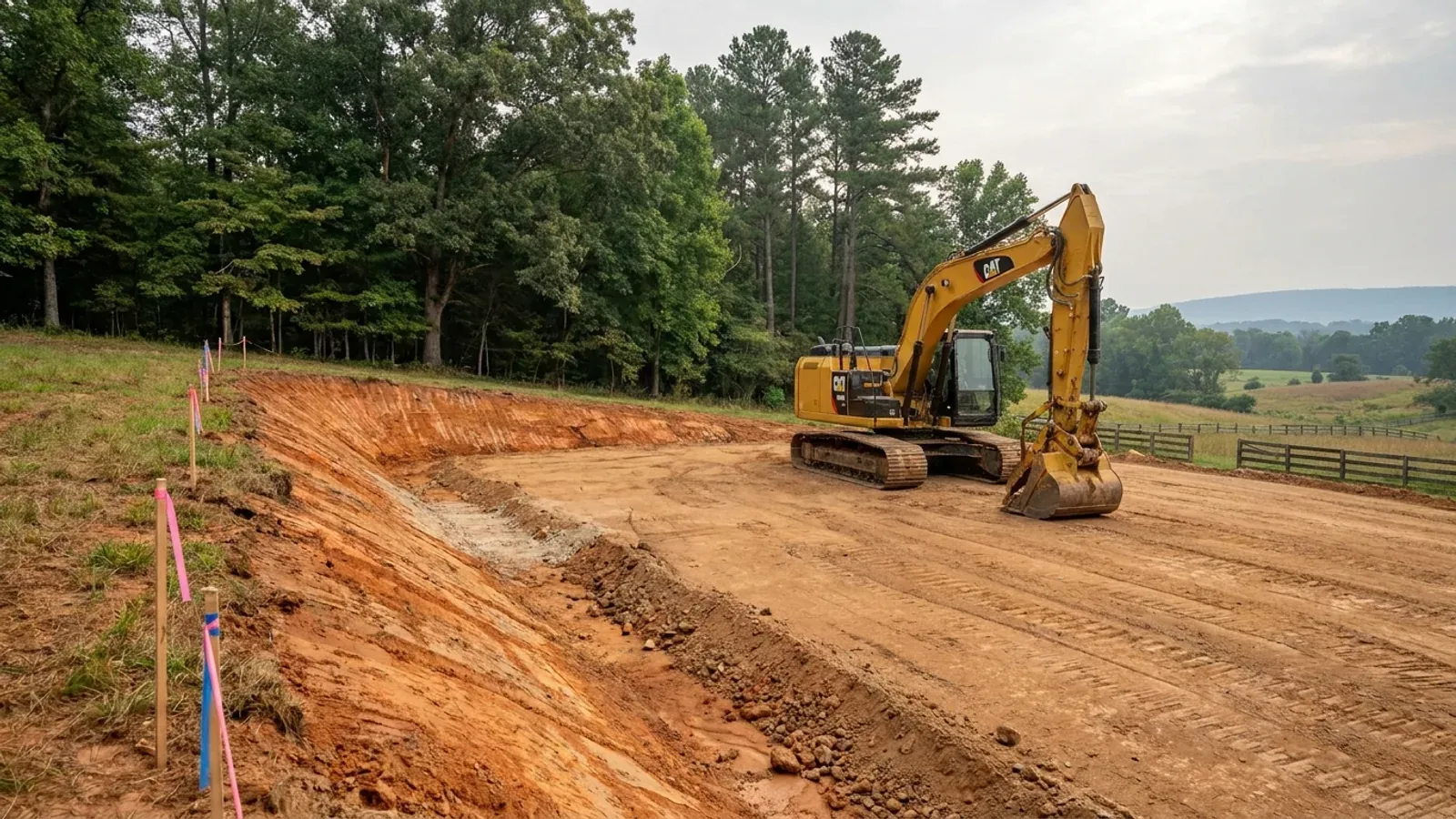
An excavator grading a compacted building pad on a cleared lot, with survey stakes, a drainage swale and a silt fence along the downhill edge.
Below the slab

The expensive surprises are in the ground, not the building

What moves a North Carolina budget is usually below grade, and the thing most often got wrong is which clay to worry about. Cecil — the red Piedmont clay everyone pictures, and the state soil — is kaolinitic and low shrink-swell; it does not heave. The soil that does is Iredell, formed over diabase and gabbro, which the USDA describes as vertic, very high shrink-swell, with a perched water table a foot or two down from December through April. The tell is colour: Cecil is red and Iredell is dark grey-brown, and they sit within a few miles of each other across the central Piedmont. West of that the question stops being clay and becomes slope, rock and colluvium; east of the fall line it becomes water, and in the Tidewater it becomes organic soil that subsides irreversibly once it is drained. Then the same ground decides the septic system, and North Carolina rewrote those rules recently enough that most of what is published about them is out of date. 15A NCAC 18E replaced the old subchapter on 1 January 2024 and was amended again on 1 June 2026: the site is classified on soil morphology — the word "percolation" does not appear anywhere in it — and there is no "provisionally suitable" any more, only suitable or unsuitable, on a single failed parameter. There is no statewide minimum lot size either; the area you need is derived from the soil result and then doubled, because a site that cannot fit both the initial field and its repair area is unsuitable. And the order matters more than people expect: the county health department's Improvement Permit and Construction Authorization come first, and the building permit is available on the strength of the Construction Authorization, not before it. One more thing that catches people: disturb more than an acre and you need an approved erosion and sedimentation control plan in hand before work starts, with penalties up to $5,000 a day, and a pad plus a drive plus a drainfield plus a laydown area crosses an acre faster than it sounds. So the site work, the foundation and the drainfield get resolved together rather than one at a time. We price the dirt before we price the building.

What a build looks like

Three stages every Rowan County project passes through, from a raw parcel to a finished home. Site work first, because that is where the budget is decided.
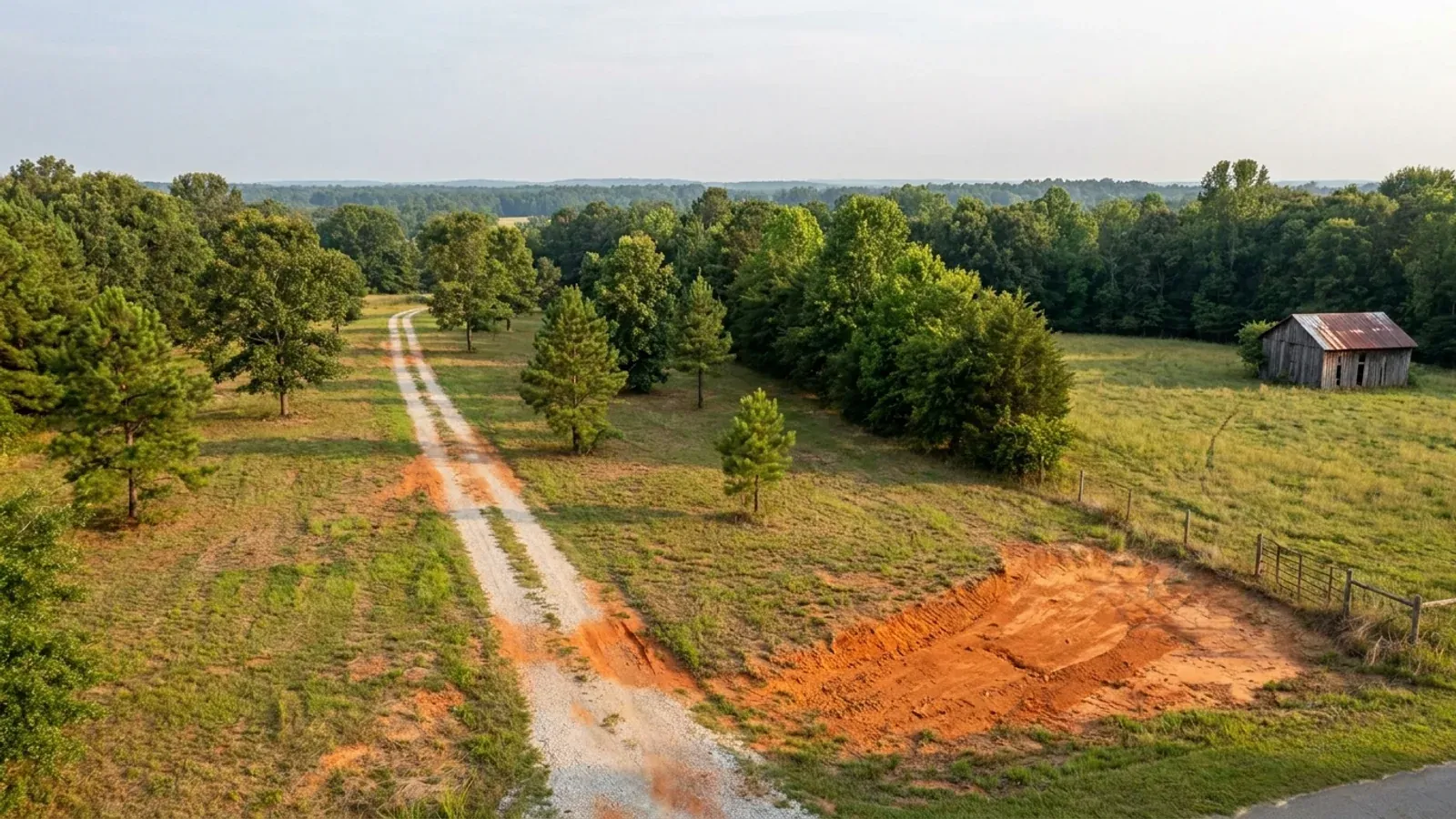
Aerial view of an undeveloped rural lot with cleared grass, a mixed oak, hickory and pine treeline, exposed red clay in one corner and a pale gravel access track.
Stage one

The parcel

Zoning, setbacks, flood zone and utility access get checked before anything is drawn.

An excavator grading a compacted building pad on a cleared lot, with survey stakes, a drainage swale and a silt fence along the downhill edge.
Stage two

Pad and permit

Clearing, grading and a compacted pad, while the septic authorization and the building submittal work through whichever offices cover your parcel.
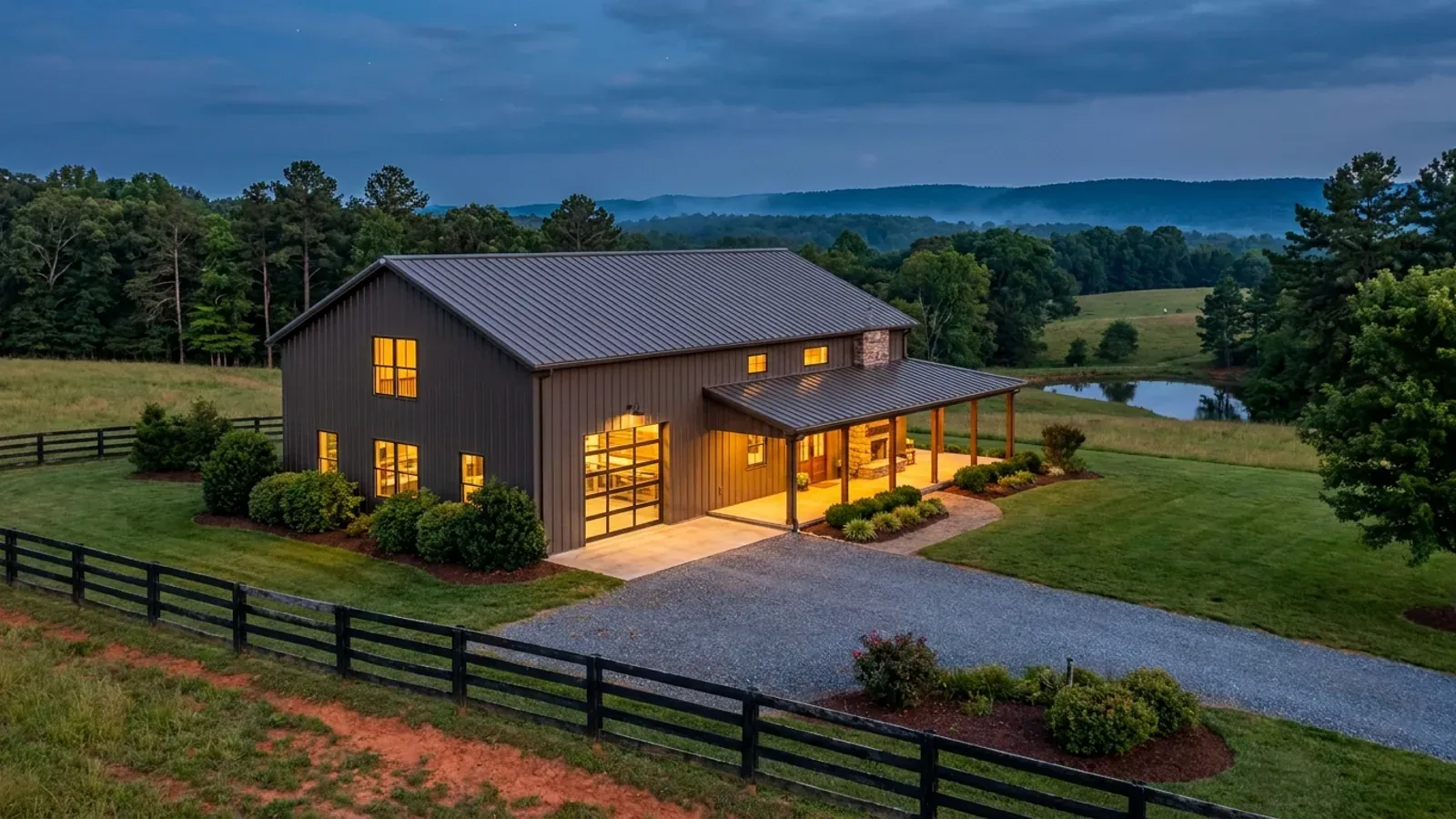
A finished barndominium at dusk with warm interior lighting glowing through its large windows.
Stage three

Frame to finish

Shell erected and dried in, then systems, insulation and interior finish through to CO.

Those are the rules where you are building in Rowan County. Tell us what you want to build and we will draw it to them.

Where we build around Rowan County

Rowan County and the rural land around it. The buildable acreage for a project this size usually sits outside the town limits — which does not automatically put it under the county, because a town's zoning and building-code enforcement reach one to three miles past its limits into its extraterritorial jurisdiction. Inside the limits, in the ETJ, or in neither are three different answers to who issues your permit.

The Rowan County service area, including the rural acreage outside the built-up edge, which is where the parcels big enough for a build like this usually sit. The map marks the territory we build in. It is not a branch location, and there is no office at this pin.

Nearby areas we build in

Others we cover nearby. Every North Carolina municipality sits inside a county — there are no independent cities here — but that does not settle who regulates a given parcel. A town's zoning, subdivision rules and building-code enforcement extend one to three miles beyond its limits, by population, into what the statute calls its extraterritorial jurisdiction; town taxes and town elections do not follow. So the office that issues the permit, what it charges and how the land is zoned can all differ from one card to the next, and the mailing address will not tell you which case you are in.

Building in Rowan County: common questions

8 questions we get asked most often about building in Rowan County. If yours is not on the list, ask it directly.

What will a Rowan County building permit cost?
Rowan calculates it from the IBC's valuation tables rather than from a rate per square foot of floor area. For residential single-family dwellings, duplexes, townhouses, carports, garages, detached accessory buildings and pools, the fee is $2.64 per $1,000 of that table valuation up to $60,000 and $1.95 per $1,000 above it, with a $75 minimum on any permit. Plan review for new construction or additions is a separate $0.03 per square foot with a $75 minimum, and the $10 Homeowner's Recovery Fund charge is listed. The schedule carries February 2024 Building Valuation Data as its latest version. Because the table figures themselves are not printed on the county's schedule, no honest total can be produced from the published document — the department is the place to get a number for a specific building. Note also that the trades are permitted separately in Rowan, unlike most North Carolina counties: new-construction residential plumbing is $8 per fixture, mechanical is $75 per system, and electrical has its own schedule.
Does the shrink-swell clay problem apply to my Rowan lot?
It depends where on the lot you build, and the USDA's own description of the soil series named for this county is the clearest statement of that. The ROWAN series — type location on Academy Street in Cleveland — formed over mafic and intermediate rock and is very deep, well drained, with a water table below 60 inches and low shrink-swell. Its associated-soils list then names Iredell soils as sitting on the lower-lying landforms nearby: moderately well drained to somewhat poorly drained, clayey, and separately classed Vertic with very high shrink-swell and a perched water table one to two feet down from December through April. So the same parcel can carry good ground on the rise and difficult ground in the swale. The colour is the practical tell — the deep red Piedmont clay is kaolinitic and does not heave, while the dark grey-brown clay is the one to ask about. NRCS Web Soil Survey shows the mapped units for a parcel, and a licensed soil scientist looking at the actual pad location is what settles it.
How much land do I need to build here?
In the RA Rural Agricultural district the zoning minimum is 20,000 square feet where the lot is on a septic tank and an individual or multi-connection well, 15,000 square feet with public or community water, and 10,000 with public water and sewer. But two other numbers bind more often. Inside a Water Supply Watershed Overlay the single-family minimum can rise to 80,000 square feet in a WS-II critical area or 40,000 in the balance of that watershed and in a WS-III critical area. And the septic evaluation can want more area than the zoning does, because 15A NCAC 18E .0508 makes a site unsuitable if it cannot fit both the initial dispersal field and a repair area with all setbacks met — which on a slow Piedmont clay roughly doubles the drainfield footprint. Also check the frontage rule: RA asks 35 feet of width at the right-of-way, 70 feet at the building setback line, and 150 feet of lot depth where there is no public water and sewer.
I have a Kannapolis address — is that Rowan County?
Partly. Kannapolis is one city across two counties: of its 61,708 residents at the 2020 census, 50,152 were counted in Cabarrus County and 11,556 in Rowan. So a Kannapolis address answers neither which county's health department evaluates the septic nor which county's zoning ordinance governs the lot, and a parcel inside the city limits answers to the city's own zoning either way. The same care applies to the town of Cleveland, which is in Rowan County while Cleveland County is a separate jurisdiction about eighty miles west. Twenty-one North Carolina towns share a name with a county and fifteen of them are in a different one, which is why the county on the deed, not the mailing address, is the fact to work from.
What are Rowan County's design numbers?
Rowan is not listed in Table R301.2(4) of the 2018 NC Residential Code, so it takes the unlisted default ultimate design wind speed of 115 mph — the code's floor. It is not among the thirteen counties Table R301.2(7) places in Seismic Design Category C, which puts it in A or B. Applying here as everywhere in the state: a flat 20 psf roof live load, a 12-inch frost line depth, Moderate weathering, and termite protection required in all of North Carolina at a Moderate-Heavy severity. There is no ground snow load column in the code at all, because Section R301.2.3 is deleted, so any ground snow figure quoted for a build here came from somewhere other than the code. Section R403.3 frost-protected shallow foundations is also deleted in North Carolina. On the energy side Rowan is in IECC climate zone 3A, while Iredell across its western line is 4A.
Does a riparian buffer apply to the creek on my land?
Not a state one. North Carolina buffers five river basins — Neuse, Tar-Pamlico, Jordan, Randleman and Catawba — at 50 feet in two zones each, and Rowan is in none of them; the Catawba rule, which is the nearest, reaches only the Catawba mainstem below Lake James and the mainstem lakes in that basin. What can apply here instead is the county's own Water Supply Watershed Overlay, which caps built-upon area and raises minimum lot sizes inside the mapped watersheds, together with the county's vegetated-setback requirements. And the statewide rule stands regardless: more than one acre of land disturbance on a tract needs an approved erosion and sediment control plan before work begins, with penalties running to $5,000 per day per violation. On a rural build the acre counts the pad, the driveway, the septic area, trenching and stockpiles together, not just the building.
Do I need an engineer for a post-frame or metal building in Rowan?
Usually yes. Section R301.1.2 requires framing systems outside the code's prescriptive scope to demonstrate equivalent detailing, and North Carolina gives no residential exemption from the engineering requirement — § 83A-13(c)(1) exempts a family residence from the architect requirement, but § 89C-25 has no equivalent carve-out, the subdivisions that would have provided one having been repealed. So a post-frame or steel-framed barndominium here is normally an engineered building sealed by a professional engineer licensed in North Carolina. It matters more on this building type than on a conventional house because the frame concentrates load into a small number of column footings, and on a residual Piedmont profile two footings thirty feet apart can land on genuinely different material — firm saprolite, soft clay, or a corestone that reads as bedrock until you dig past it.
Does a steel building skip the termite treatment?
No. The model IRC treats cold-formed steel framing as one accepted method of termite protection; North Carolina deleted that option from R318.1, and deleted physical barriers as well. A steel barndominium in Rowan still needs chemical termiticide treatment, a baiting system operated under the rules of the NC Structural Pest Control Committee, pressure-preservative-treated wood, or naturally durable wood. Termite protection is required in all of North Carolina, at the code table's Moderate-Heavy severity. Steel does buy one thing: an entirely noncombustible structure escapes the R318.4 restriction on foam plastic below grade.

Building in Rowan County?

Start with the plan. Tell us what you want to build and we will draw it, then confirm which office issues the permit for your parcel, what it will let you put there, and what wind load it has to meet. That conversation costs nothing.