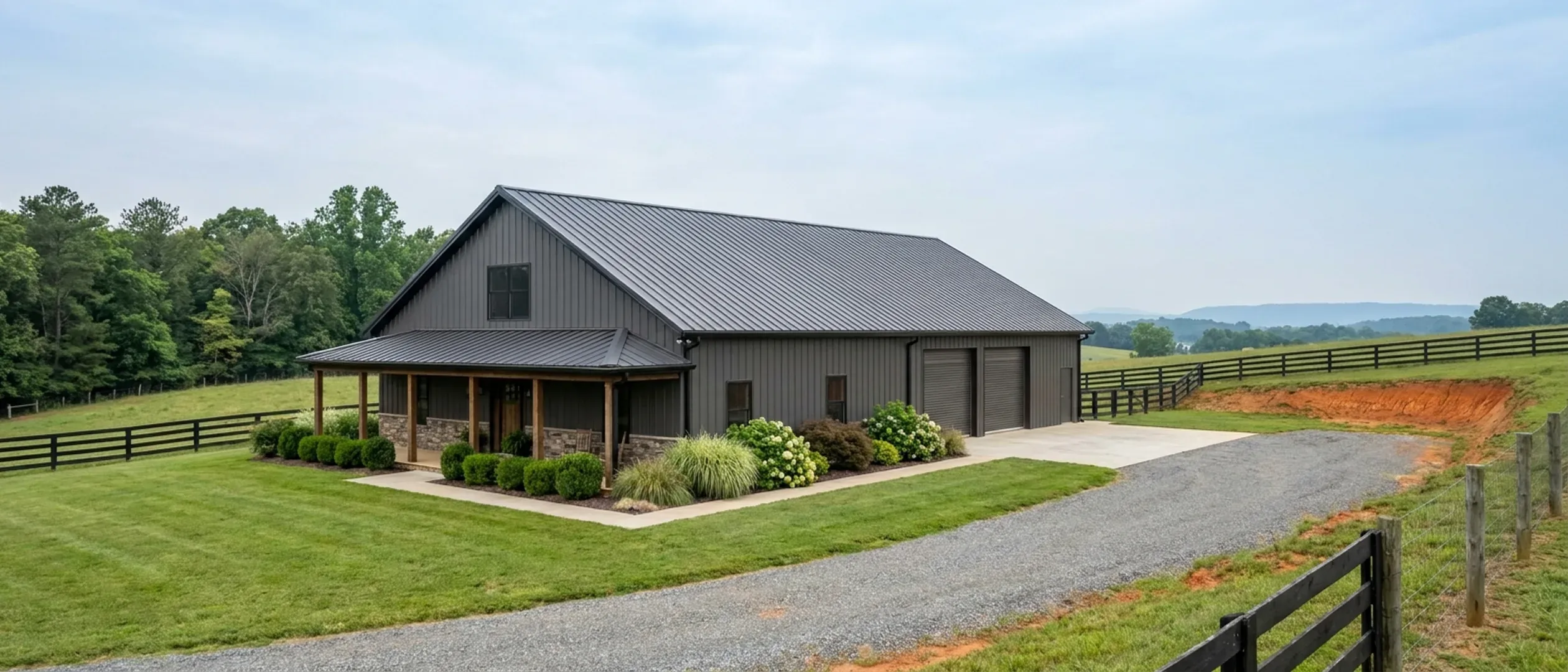
Barndominium Financing in North Carolina: Appraisal, Lending and Insurance
A barndominium is an awkward object to lend against, and it is worth understanding exactly why before anyone talks to you about money. It is not that lenders dislike steel. It is that an appraiser has to form a reliable opinion of market value for a house with a workshop in it, using sales of buildings that may not exist within any sensible distance of the parcel. That is the whole problem, it is a county-level problem rather than a state-level one, and it is the thing almost nobody writing about North Carolina barndominiums addresses at all. Everything below is somebody else's published rule, attributed in the sentence that uses it: Fannie Mae's Selling Guide, a Department of Veterans Affairs circular dated 31 March 2025, the North Carolina Housing Finance Agency's own program guides, the North Carolina Rate Bureau's filed homeowners rates, the North Carolina General Statutes and named counties' own schedules. This site states no rate, no term, no qualifying criterion and no premium of its own, places no cover, and gives no lending or investment advice. It also publishes no build-cost figure for North Carolina, and the first section explains why no honest one exists.
Figures on this page are cited third-party or government data, not a quote from North Carolina Barndominium Builders.
The appraisal is the gate, and it turns on evidence rather than on metal
None of this is a rumour about what banks think. It is what the published rulebook says, and what it turns on is whether anything comparable has sold near your parcel. One caveat travels with the whole section: Fannie Mae is not a government body, and its Selling Guide binds loans sold to Fannie Mae. A portfolio lender, a state-chartered credit union or a Farm Credit association writes its own rules.
There is no price statistic for this building type, and that is a measurable fact
The Census Bureau's Survey of Construction, the only genuinely representative federal survey of what American houses cost to build, publishes price for four geographies only — the United States, Northeast, Midwest, South and West. There is no state row and no South Atlantic row. So no per-square-foot number for North Carolina can be traced back to that survey, because the survey does not produce one, and the figures circulating on the subject are not measurements of this state. That absence is not a curiosity. It follows the building all the way to the appraisal, where the appraiser faces exactly the same shortage of evidence that the statisticians do.
Fannie Mae's rule for unique housing is a test, not a ban
Fannie Mae's Selling Guide, B4-1.3-05, Improvements Section of the Appraisal Report, page-stamped 06/04/2025, makes loans secured by unique or nontraditional housing types eligible for sale to Fannie Mae provided the appraiser has adequate information to develop a reliable opinion of market value. Its own named examples are earth houses, geodesic domes and log houses. A barndominium is not one of the guide's named examples, and nobody should tell you it is — what the guide sets is a general rule for the category, and comparable sales are expressly not required to match the subject property's design.
The same topic states both outcomes, and the second one is the honest half
Where the appraiser cannot find recent comparable sales of the same design, the property is still acceptable if the appraiser can determine sound adjustments for the differences against the comparables that are available and can demonstrate marketability using older comparable sales, sales in competing neighbourhoods or other reliable market data. Where there is no evidence of market acceptance at all and the property's characteristics are too different for a reliable opinion of value, it is ineligible. Nothing in that turns on the framing material. It turns on whether anything like it has sold nearby, and on whether the appraiser can bridge the gap in writing.
So the answer is a county answer, not a North Carolina answer
Comparables come from the market area around the parcel. The counties with buildable acreage are the ring counties — the ones people move to in order to buy land and commute back — and those are precisely the places where the fewest buildings of this kind have changed hands. Two lots an hour apart can produce two different appraisal conversations for reasons that have nothing to do with the drawings. This is the single most useful question to ask a local lender before you make an offer on land: what has sold near here that an appraiser could use, and who has appraised one before.
Ask which rulebook the lender is working from
The Selling Guide governs loans sold to Fannie Mae. A portfolio lender that intends to hold the loan, a credit union, or a Farm Credit association lending on agricultural land, each apply their own underwriting and each may reach a different answer on the same building. On rural North Carolina acreage the agricultural lenders are often the ones with the most experience of large outbuildings, and asking early costs nothing.
Design decisions have appraisal consequences, and they are worth making early
The evidence problem is easiest to solve where the residential half of the building reads as an ordinary house — a conventional room programme, a conventional bedroom and bathroom count, finishes an appraiser can match against real sales — with the individuality expressed in the shop. That is not a rule anyone publishes; it is the practical consequence of a rule that resolves to comparable sales. It is also, quietly, a decision about the exit, because every future appraisal on the property faces the same test.
The VA-guaranteed loan, and what changed on 31 March 2025
North Carolina has Fort Bragg, Marine Corps Base Camp Lejeune, Seymour Johnson Air Force Base and Marine Corps Air Station Cherry Point. The VA-guaranteed loan is a live option here rather than a footnote, and the Department of Veterans Affairs changed how new construction works under it in 2025. This is the one part of the financing picture that has a dated primary document behind it.
The builder identification number is gone
Department of Veterans Affairs, Veterans Benefits Administration Circular 26-25-1, dated March 31, 2025, is titled "Elimination of Builder Identification Number for Certain Guaranteed Loans and Updates to Builder Complaint Process". It states that a VA-issued builder identification number is no longer necessary for issuing the Notice of Value or for processing a loan on a new or proposed construction property for VA-guaranteed loans, and that all references to builder identification numbers in Chapters 7, 10 and 13 of the Lenders Handbook will be removed in a future revision. The circular is effective immediately by its own terms.
But the licensing expectation stays, and in North Carolina it has teeth
The same circular says, in one short sentence, that builders are still expected to meet any state and local licensing requirements. In North Carolina that sentence points straight at Chapter 87 and the Licensing Board for General Contractors. N.C.G.S. § 87-14(a)(1) requires an applicant for a building permit on an undertaking of forty thousand dollars or more to furnish satisfactory proof that the applicant, or another person contracting to superintend or manage the construction, is licensed under Article 1 or exempt under § 87-1(b) — and § 87-14(b) makes it unlawful for the inspector to issue the permit otherwise. Removing a federal paperwork step did not remove the state one.
Two programmes are expressly unchanged
Circular 26-25-1 states that there is no change in the requirement for a VA-issued builder identification number for processing a Specially Adapted Housing grant or a Native American Direct Loan for an eligible Veteran. If either of those is the route, the old procedure still applies and the rescission does not reach it.
The inspection that matters is the county's, and it has been since February 2006
The circular's background section is the part worth reading twice. It records that in February 2006 the Department of Veterans Affairs ceased compliance inspections for new and proposed construction properties secured by VA-guaranteed loans, relying instead on local building inspections and construction warranties of one or ten years — and that despite that change VA did not update how its employees handled construction complaints, leaving many Veterans with the impression that VA has authority to compel builders to correct defects. Two decades of buyers have assumed a federal inspector was checking the work. The document says plainly that the county inspector is.
And complaints now go where the authority actually sits
Under the same circular, when a Veteran submits a builder complaint VA will provide resources for resolving it instead of interceding — which, depending on the nature of the complaint, could include the services and expertise of the local building department, licensing boards, or a recommendation to seek legal counsel in a serious matter. It adds that VA will continue to process complaints received during the one-year warranty period on loans whose Notices of Value were issued before the update. That is a redirection of authority, published, dated and checkable, and it changes who you call.
Which makes the inspection file the asset
If the local record is what the loan programme relies on, the local record is worth protecting. N.C.G.S. § 160D-1104(c) prohibits an inspector from requiring affidavits attesting that work complies with the Residential Code in lieu of conducting the inspections the Code requires. § 160D-1104(e)(2) requires each permit to carry the name, phone number and email address of the supervisor of each inspector, together with notice of the department's informal internal review process. Keep every inspection result, every approved plan revision and the certificate of occupancy. They are the documentation the next lender and the next buyer will ask for.
What the North Carolina Housing Finance Agency actually reaches
The Agency's programmes come up in every conversation about affordable financing in this state, and the honest answer for someone building rather than buying is specific rather than encouraging. All of it is read out of the Agency's own published program guides.
It is a purchase mortgage programme with a construction-to-permanent door
The NC Home Advantage Mortgage program guide published by the North Carolina Housing Finance Agency, July 2026 edition, defines new construction as a dwelling unit that is new and/or never occupied, including spec construction and builder inventory. Construction-to-permanent loans are addressed directly: the guide requires that construction loans be less than 24 months old from the origination date, and that the automated underwriting submission and the Closing Disclosure be run as a purchase, or as a refinance where the loan has a valid sales purchase contract. Construction-to-permanent loans may use the down payment option.
The $15,000 down payment assistance programme excludes new construction outright
The Agency publishes a separate program guide for the $15,000 down payment assistance product, and its definitions section carries the same new-construction wording with one extra sentence appended: not allowed on the $15,000 DPA program. That is a clean, checkable exclusion, and it is the single most common misunderstanding about state assistance on a self-directed build. The main programme's own down payment option is a different thing and remains available.
The limits that decide eligibility
The July 2026 guide publishes a single statewide income limit for the NC Home Advantage Mortgage product, stated in the guide as $158,000 and expressly subject to change, and it states that there is no NCHFA sales price limit on a home financed through the programme — sales price limits come from the loan program and insurer guidelines instead. Borrowers must occupy the property as a principal residence within sixty days after closing, the residence must be in North Carolina, and it must be eligible for mortgage insurance under FHA, VA, USDA or conventional guidelines as a principal residence.
Property type is where a barndominium has to fit, and the table is published
The same guide sets out eligible property types by loan type. Across FHA, USDA and VA it lists single-family detached, townhomes, condominiums, modular homes new or existing, duplexes on FHA only, and manufactured homes subject to further restrictions; on the conventional side it lists single-family detached, townhomes, condominiums and modular homes on a permanent foundation, and notes that duplexes and manufactured homes are not eligible under the conventional program. A site-built barndominium presents as single-family detached. A modular one presents as a modular home. Settle which of those you are ordering before anyone quotes it, because the table treats them differently and manufactured housing is a third category again.
Insurance is a financing input, and North Carolina files its rates
A mortgage requires cover, so an insurance problem is a financing problem. North Carolina is unusual in that the underlying rate structure is a filed public instrument rather than a survey or a comparison site, which makes it the best third-party source available on this subject. It is also the source that shows most starkly what a coastal lot costs.
Why the Rate Bureau is a better source than a quote comparison
The North Carolina Rate Bureau is a statutory body that files homeowners rates on behalf of its member companies, and G.S. 58-36-30(a) makes it unlawful for an insurer to issue a policy in this state that does not conform to the rates, rating plans, classifications and rules the Bureau has filed, absent an approved deviation. That is what makes it different in kind from every cost figure attached to this subject. It is not an average, an estimate or a scrape. It is the filed and approved rate structure the industry works from, and it is public.
What was asked, what was heard, and what was settled
North Carolina Rate Bureau Circular P-25-1, "Revised Homeowners Insurance Rates and Rules", dated 17 January 2025, records the sequence. On 3 January 2024 the Bureau filed a proposed overall statewide average rate level change of plus 42.2 percent, varying by form and territory. A rate hearing began on 7 October 2024 and ran nineteen days. The parties settled on a two-year change: plus 7.5 percent overall statewide average effective 1 June 2025, and a further plus 7.5 percent overall statewide average effective 1 June 2026, with revised windstorm-or-hail exclusion credits, revised wind mitigation credits and revised wind-only rates in both years. Both percentages are statewide averages, and the circular says twice in its own words that rate level changes vary by form and territory.
The number that shows what the coast costs, and how to read it
Exhibit B-2 of that Rate Bureau circular reproduces the Homeowners Policy Program Manual's Rule 301 base class premium table for the year beginning 1 June 2026. On form HO 00 03, the standard homeowners form, the Rate Bureau's filed base class premium runs from $620 in Territory 380 to $4,606 in Territory 120 — a factor of 7.4 across one state, on the same policy form, in the same year. Read it as what it is: the filed base rate a premium is computed from, multiplied by a key factor for the limit of liability, not a bill anybody pays. As a ratio between territories it is the clearest published statement of what location does to the cost of owning a house here.
The coastal territories are identified by the manual itself
It would be easy to infer which territories are coastal and get it wrong. The manual removes the guesswork: Rule A3 offers the Windstorm or Hail Exclusion in Territories 110, 120, 130, 140, 150 and 160 only. The five most expensive territories on the base class premium table are all inside that set. That is the manual's own rule text identifying the coastal wind territories, not an inference drawn from the prices.
One city, two territories, decided by ZIP code
The territory tables split the coastal counties across three bands and resolve the boundary by explicit ZIP code, which produces a result worth knowing before you choose a lot. A Wilmington address in 28403, 28405, 28409, 28411 or 28412 falls in Territory 140, whose filed base class premium for the year beginning 1 June 2026 is $2,924. A Wilmington address in 28401 falls in Territory 160, at $1,776. Same city, same policy form, filed base rates roughly 65 percent apart, decided by which side of a ZIP boundary the parcel sits on. That is a land-buying decision, not a renewal surprise.
What the filed material does not settle, stated plainly
The construction split visible in the windstorm and hail supplement of that circular is Frame against Masonry. Where a post-frame or steel-framed dwelling falls between them is a question to put to a carrier in writing at design stage, with the actual wall and roof assemblies, the fastener schedule and the engineer's drawings described, rather than a question to settle from a rate manual. Whether the shop is under the same roof or standing on its own can also change which coverage of a homeowner policy responds and to what limit. This site places no cover and states no policy terms.
The North Carolina paperwork that money depends on
These are statutes and rules rather than lender policy, and each one has a direct consequence at closing, at appraisal, or years later when somebody else's lender asks a question about the building.
Owner-building saves a margin and buys an obligation
N.C.G.S. § 87-1(b)(2) exempts a person who constructs a building on land they own, provided the building is intended solely for occupancy by that person and their family after completion and provided they comply with § 87-14. § 87-14(a)(1) sets out what that means: a verified affidavit attesting that the applicant owns the property; that the applicant will personally superintend and manage all aspects of the construction and will not delegate that duty to any person not licensed under the Article; and that the applicant will be personally present for all inspections required by the North Carolina State Building Code. For a working owner on a rural site, that third clause is a great many weekday mornings.
And there is a documented way out of the attendance clause
The same clause carries an exception in its own words: the personal-attendance requirement does not apply where the plans for the building were drawn and sealed by an architect licensed pursuant to Chapter 83A of the General Statutes. Sealed architectural drawings buy an owner-builder out of standing on site for every inspection. Note the wording carefully — the statute as printed names an architect under Chapter 83A. It does not say "architect or engineer", and a professional engineer's seal under Chapter 89C is not named in that clause.
The affidavit is audited, and a bad one costs the permit
§ 87-14(a)(1) requires the building inspector to transmit a copy of the affidavit to the Licensing Board for General Contractors, which shall verify that the applicant was validly entitled to claim the exemption under § 87-1(b)(2). If the Board determines that the applicant was not entitled to it, the building permit shall be revoked pursuant to G.S. 160D-1115. The common arrangement in which an owner pulls the permit while an unlicensed consultant actually runs the job is exactly what that affidavit exists to catch.
The twelve-month rule is a presumption, not a sale ban
§ 87-1(b)(2) provides that if the building is not occupied solely by that person and their family for at least 12 months following completion, it shall be presumed that they did not intend it solely for their own occupancy. That flips a burden of proof; it does not forbid a sale. Most consumer pages render it as "you cannot sell for a year", which is not what the sentence says. Worth knowing too that § 87-1(b) as printed carries no cap of one structure per year and no acreage or square-footage limit.
An unlicensed contractor cannot enforce its own contract
In Brady v. Fulghum, 309 N.C. 580 (1983), the North Carolina Supreme Court held that an unlicensed contractor cannot enforce its own construction contract, and the defect cannot be cured by obtaining a licence afterwards. That is a consumer protection with an obvious corollary: verify the licence before signing, at the Licensing Board's own public search, and note that every North Carolina general contractor licence expires on 1 January, so the year matters as much as the number.
The farm bargain is a financing fact as much as a zoning one
N.C.G.S. § 160D-903(b) provides that a county zoning regulation shall not prohibit single-family detached residential uses constructed in accordance with the North Carolina State Building Code on lots greater than 10 acres in zoning districts where more than fifty percent of the land is in agricultural or silvicultural use, and shall not require that such a lot have frontage on a public road or a county-approved private road, or be served by public water or sewer lines. On a construction budget, a connection that cannot be forced on you is a line item that never appears. The condition attached to all of it is the phrase "constructed in accordance with the North Carolina State Building Code" — you get the land-use right, and code compliance is its price.
The building that was never inspected is the one that will not finance
§ 143-138(b4)(1) defines a farm building as any nonresidential building or structure used for a bona fide farm purpose. Put living space inside one and it stops being a farm building; it becomes a dwelling that must comply with the North Carolina Residential Code. But the footing, foundation, framing, rough-in and insulation inspections it never had are inspections of work that is now concealed, and verifying them after the fact means opening up what is finished. Whatever that costs in the moment, the people who eventually ask about it are an appraiser and the next buyer's lender.
Reading this because you are weighing a build? The next step is a plan drawn for your program.
What's different about North Carolina
The appraisal turns on evidence, not on framing material
Fannie Mae's Selling Guide B4-1.3-05 makes unique and nontraditional housing eligible where the appraiser has adequate information to develop a reliable opinion of market value, and sets out the refusal limb as well. Whether that test is met is a question about your county's sales, not about steel.
The Selling Guide binds loans sold to Fannie Mae, and nothing else
A portfolio lender, a credit union or a Farm Credit association underwrites to its own rules. On rural acreage in this state the agricultural lenders often have the most experience of buildings with large workshops in them.
Federal compliance inspections on VA-guaranteed new construction ended in February 2006
Circular 26-25-1, dated 31 March 2025, records that VA ceased those inspections in February 2006 and relies instead on local building inspections and one- or ten-year construction warranties. Your county's inspection record is the record.
A VA builder identification number is no longer needed for a guaranteed loan
The same circular rescinds the procedure for new and proposed construction on VA-guaranteed loans, while leaving the requirement in place for a Specially Adapted Housing grant and a Native American Direct Loan, and leaving state and local licensing expectations untouched.
State down payment assistance draws a line at new construction
The North Carolina Housing Finance Agency's $15,000 down payment assistance program guide states that new construction is not allowed on that product, while the main NC Home Advantage Mortgage guide addresses construction-to-permanent loans and allows its own down payment option on them.
Filed homeowners base rates run 7.4 times higher at one end of the state than the other
North Carolina Rate Bureau Circular P-25-1 reproduces a base class premium table on which form HO 00 03 runs from $620 in Territory 380 to $4,606 in Territory 120 for the year beginning 1 June 2026. It is a ratio between locations, and it is filed rather than estimated.
Sealed architectural drawings change what an owner-builder has to do
§ 87-14(a)(1) requires an owner-builder to be personally present for every Code-required inspection unless the plans were drawn and sealed by an architect licensed pursuant to Chapter 83A. That exception is written into the statute.
Pros and cons, honestly
Pros
- The rules that decide the appraisal are published and readable in advance, so the questions an underwriter will ask can be answered before the application rather than during it.
- No rule quoted on this page excludes the building type — Fannie Mae's unique-housing provision is an evidence test, satisfied by comparable sales, sound adjustments and a competent appraisal.
- The VA-guaranteed route lost a paperwork step on 31 March 2025: a builder identification number is no longer needed for a new or proposed construction property on a guaranteed loan.
- North Carolina's building code is uniform statewide, so the code question behind "is it legally permitted" has one document behind it rather than a hundred adoption histories.
- County permit and health-department fees are published by the jurisdictions that charge them, so the government share of the budget can be costed exactly rather than estimated.
- On a lot over ten acres in an agricultural district, § 160D-903(b) bars a county from requiring road frontage or a connection to public water or sewer — costs that simply never arrive.
- The insurance picture is filed and public here, so the cost consequence of choosing one lot over another can be compared before the offer rather than discovered at the first renewal.
Cons
- There is no representative price statistic for this building type in North Carolina, because the federal survey that measures construction price publishes it for four broad regions and no state.
- Where nothing similar has sold nearby, the appraisal is genuinely uncertain — the Selling Guide sets out an ineligibility limb as well as an eligibility one.
- The answer varies county to county for reasons that have nothing to do with the drawings, and the counties with the most buildable land tend to have the thinnest evidence.
- State down payment assistance at the $15,000 level is closed to new construction by the Agency's own program guide.
- Filed homeowners base rates on the coast are multiples of those inland, and inside a single coastal city the territory boundary is drawn by ZIP code.
- How a post-frame or steel-framed dwelling is classified for rating is not settled by the filed material, so it has to be put to a carrier in writing with the assemblies described.
- An owner-builder must personally superintend the work and attend every Code-required inspection unless the plans were drawn and sealed by an architect under Chapter 83A.
- A farm building finished out as a dwelling later has no inspection record for concealed work, which is a problem for the appraisal and for whoever tries to lend on it next.
Can you get an ordinary mortgage on a barndominium in North Carolina?
Why does the appraisal matter more than the loan approval?
Did the VA change anything for new construction recently?
Does the VA inspect the construction?
Can I use North Carolina Housing Finance Agency assistance to build one?
Is a barndominium harder to insure in North Carolina?
How much does the coast really change the cost of owning one?
Does building it myself make it cheaper to finance?
Why does this site not publish a cost per square foot for North Carolina?
What should I settle before I make an offer on land?
Questions answered? Tell us what you want to build and we will put real numbers against it.
Keep reading
The pages that answer the next question this one raises.
North Carolina barndominium law
The farm exemption read properly, the statewide code, and what the licensing statutes actually require of whom.
Read itBuild timeline and sequence
Why the septic Construction Authorization comes before the building permit, and where a draw schedule really lands.
Read itCustom plans
Keeping the residential half recognisably residential is a design decision with appraisal consequences.
Read itTurnkey builds
How a single-contract build lines a draw schedule up against the inspections a lender's file will want.
Read itWilmington
One city split across two filed rate territories by ZIP code, and what that does to a lot comparison.
Read itBrunswick County
A high-growth coastal county, on the seaward side of both the insurance territory lines and the design-criteria lines.
Read itWant a real number instead of a range?
Start your plans and we will come back with a budget for what you actually want to build, not a national average. Send the parcel ID or an address when you have one and we will price it against your land. That conversation costs nothing.