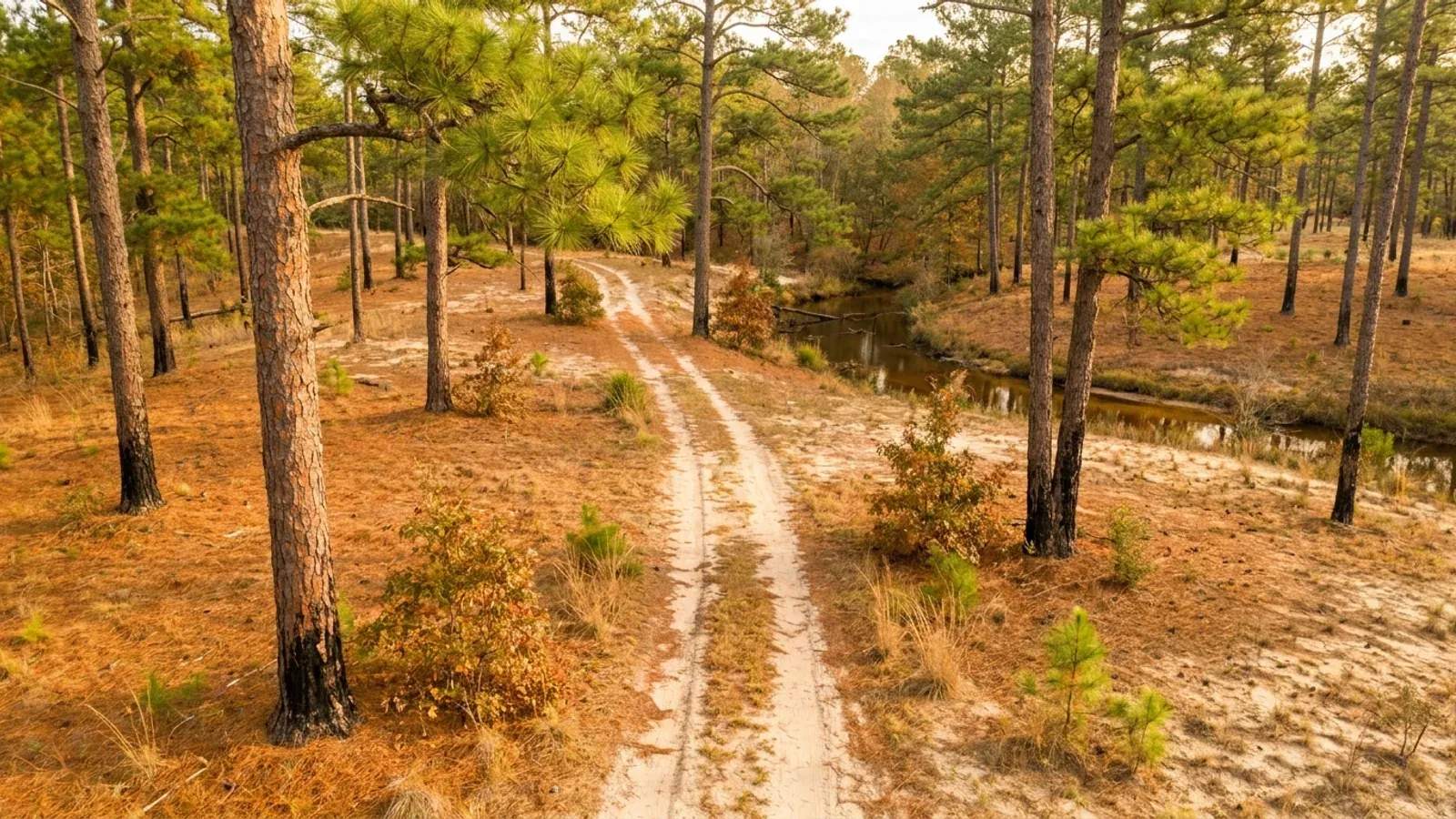
Open park-like longleaf pine woodland on low sand ridges, with pale yellow sand, a rust-orange pine straw carpet, wiregrass understorey and a bare sand two-track road.
Hoke County 2018 NC Residential Code, statewide

Barndominium Builders in Hoke County, NC

Hoke County is Sandhills ground, and that inverts the usual order of problems. Almost everywhere else in North Carolina the septic answer is the hard one and the foundation answer is routine; here it is the other way round. The soil under Raeford is deep sand — the representative Sandhills series, Candor, is classed as a Grossarenic Kandiudult, meaning the sandy surface runs on the order of forty inches or more before it reaches any clay-enriched horizon, it is somewhat excessively drained, and there is no bedrock within two metres. Water leaves quickly. That is close to ideal for a conventional septic field and it takes wet-weather delay largely out of the schedule. What it does instead is move the difficulty to the slab. Clean sand has essentially no cohesion, so an excavation sidewall sloughs, a footing bearing near an unconfined edge or a slope crest loses support, and the failure mode is loose, uncompacted fill rather than the shrink-swell clay a Piedmont builder is watching for. The fix is usually densification and proof-rolling rather than undercut and replacement, but it has to be specified and it has to be verified. One correction worth making while we are here, because it turns up in almost every description of this landscape: Sandhills sand is not white. The soil survey's own Munsell readings for the Candor series run from light yellowish brown 10YR 6/4 through pale yellow 2.5Y 7/4. Bright white sand belongs to the modern beach. And on the code side, Hoke is not a default county: Table R301.2(4) of the 2018 NC Residential Code names it at 120 mph, five miles per hour above the floor that half the state sits at.

Hoke County at a glance

County
Hoke County
City rules outside city limits
Hoke County's zoning ordinance applies only to unincorporated land lying outside the extraterritorial jurisdiction of any municipality — so Raeford's development rules reach out past the city line onto land the county does not regulate.
Population
56,939
ZIP codes
28376
Site visits
Same week across Hoke County and the Sandhills

Building conditions in Hoke County

The building code does not change at a county line here. Under § 143-138(e) the North Carolina State Building Code applies throughout the state, and a city or county may adopt only a fire prevention code and floodplain regulations of its own — there is no general local amendment power, so there are no county amendments to look up. The edition in force is still the 2018 NC Residential Code, effective 1 January 2019; the 2024 edition has been delayed three times and carries no effective date at all. What genuinely differs is who issues the permit and inspects the work, what that office charges, how the parcel is zoned, what the local floodplain ordinance requires of the foundation — and two design numbers the code publishes county by county, the ultimate design wind speed and the seismic design category. The rest of Table R301.2 is set once for everyone: a flat 20 psf roof live load, a 12-inch frost line, Moderate weathering, and termite protection required everywhere in the state with no exemption. There is no ground snow load column in the residential code at all.

Build conditions for Hoke County , North Carolina : ultimate design wind speed 120 mph. BUILD CONDITIONS HOKE COUNTY, NCHoke County2018 NC RESIDENTIAL CODEULTIMATE DESIGN WIND SPEED120 mphTable R301.2(4) of the 2018 NC Residential Code names Hoke County at 120 mph ultimate design windspeed — not the unlisted 115 mph default that 51 counties take. The 2024 edition prints the same…ZONING · RP RURAL PRESERVATION / RA-20 RESIDE…217,800 sq ft (5 acres) in RP; 20,00…Table 1 of the Hoke County Zoning Ordinance sets the RP RuralPreservation minimum lot at 217,800 square feet — five acres — with…WHO ISSUES THE PERMITHoke County Inspection DepartmentRaeford. Planning, building inspections and environmental healthshare one office. The county zoning ordinance stops at Raeford's…
Build conditions for Hoke County, drawn from the sourced facts on this page. Every figure above is cited in the quick-facts panel below, with its source and vintage.
The fee counts the shop, and then checks a second calculation
Hoke County's permit fee schedule, effective 1 July 2024, heads its New Construction/Residential block with the words "Heated/Unheated" and charges a $200 non-refundable processing fee plus $0.35 per square foot for the building permit. An unheated shop bay is inside that base, which puts Hoke on the same side of the line as Wake, Union and New Hanover and the opposite side from Guilford and Buncombe, where the fee is charged on heated area only. Two further features of the schedule are unusual enough to be worth naming. The trades are priced separately rather than folded in — electrical panel $200, mechanical $100, plumbing $200 per dwelling, insulation $100 per dwelling, plus the $10 residential recovery fee. And the schedule opens with a rule found on no other county schedule read for this site: "Square foot and Graduated Fee Scale will be calculated for each permit as listed. The higher permit fee calculated will be used." The graduated scale is 0.015 times the cost of the project up to $100,000. So Hoke computes the fee two ways and charges the larger.

Hoke County Inspection Department Permit Fee Schedule, effective 7/1/2024, hokecounty.net, read 6 September 2026. Figures confirmed in two independent extraction modes.

120 mph, and two SDC C counties on the border
Hoke County is named in Table R301.2(4) of the 2018 NC Residential Code at an ultimate design wind speed of 120 mph. That matters mostly because of what it is not: it is not the unlisted 115 mph default that 51 of North Carolina's 100 counties take, so a plan set drawn to the code floor is not a plan set for Hoke. It is also not one of the ten counties split on a road — Cumberland, immediately east, is split by I-95 at 120 and 130 mph, and Robeson to the south is a flat 130. On seismic, Hoke is absent from Table R301.2(7), the list of thirteen Seismic Design Category C counties, so it falls under that table's note placing unlisted counties in Category A or B. Robeson and Scotland, both of which Hoke borders, are on the SDC C list — two of only four coastal-plain counties North Carolina has ever put there, and the 2024 edition removes all four. The 2018 edition is the one in force; the 2024 edition has no effective date.

2018 NC Residential Code, Tables R301.2(4) and R301.2(7), NC Office of the State Fire Marshal, read 6 September 2026, with the 2024 edition's tables read alongside for comparison.

The Sandhills sand is pale yellow, not white — and that changes the slab
The representative soil series for the Sandhills, Candor, is described by the USDA soil survey as a sandy, kaolinitic, thermic Grossarenic Kandiudult formed in marine and wind-blown deposits. "Grossarenic" is the operative word: it means the sandy surface layer runs roughly forty inches or more before any clay-enriched horizon, and the profile is very deep, more than two hundred centimetres to bedrock, somewhat excessively drained, with a deep seasonal water table for three to five months of the year. The Munsell colours in the official series description run from light yellowish brown 10YR 6/4 through pale yellow 2.5Y 7/4 — so the common description of this landscape as white sand is wrong, and the bright white belongs to the beach and the dune rather than to the Sandhills. For building, the consequence is that the difficulty moves from drainage to bearing. Clean sand has no cohesion; the risks are sloughing excavation sidewalls, footings bearing near an unconfined edge or slope crest, and uncontrolled loose fill. It also compacts and proof-rolls well, so the remedy is usually densification and verification rather than undercut and replacement — but it has to be in the specification.

USDA NRCS Official Series Description, CANDOR series, soilseries.sc.egov.usda.gov, read 5 September 2026. Slab and bearing consequences are our reading of those published properties, not a site-specific engineering opinion.

The US 401 corridor overlay restricts metal on a front façade
Hoke County's zoning ordinance establishes a Corridor Overlay District running 200 feet deep on both sides of US Highway 401, measured perpendicular to the right-of-way, from the City of Raeford's zoning jurisdiction east to the Cumberland County line — which is the exact stretch a Fort Bragg commuter buys land on. Inside it, Section 2.6.6 provides that "No front façade may be covered with sheet or corrugated aluminum, iron, steel, plain concrete block, or exterior panelized plywood, including foundation materials," and permits those materials as secondary exterior finishes only where they cover no more than fifty percent of the surface area. The exemption the ordinance gives single-family and duplex residential development, at Section 2.6.4, is from the district's fifty-foot front yard setback requirement — it is not written as an exemption from the façade materials rule. For a metal-clad building this is the single most consequential sentence in the county's ordinance, and it applies to a strip of land no wider than a suburban lot is deep.

Hoke County Zoning Ordinance, Section 2.6 Corridor Overlay District, hokecounty.net, read 6 September 2026.

A hundred-foot height cap under the Fort Bragg flightpath
Section 2.7 of the Hoke County Zoning Ordinance establishes a Flightpath Overlay District covering land in proximity to the Fort Bragg military base as delineated on the Hoke County Flightpath Overlay District Map maintained by the Zoning Administrator, and provides that no structure within it may exceed a maximum height of one hundred feet. A house is not going to hit that, but a grain leg, a communications mast, a wind turbine or a tall accessory structure could, and the more useful point is that the map exists and is held by the county rather than being derivable from any public dataset. A large part of Fort Bragg lies inside Hoke County, and this overlay is how that shows up on a private parcel. The county's other overlay, the US 401 corridor, is unrelated to it and a parcel can be in both.

Hoke County Zoning Ordinance, Section 2.7 Flightpath Overlay District, hokecounty.net, read 6 September 2026.

One of the fastest-growing counties, on a small base
Hoke County grew 9.3 percent between 2020 and 2025, from 52,074 to 56,939, on net migration of plus 2,577 — a rate that puts it among the state's leaders while its absolute numbers keep it at 48th of 100 for population. It is a small county in area too, 390 square miles at 146 people per square mile, and it ranks 78th of 100 for land in farms: 185 farms across 36,788 acres, 14.7 percent of the county, at a median farm size of 49 acres. Two things follow for a buyer. The median farm here is larger than Harnett's 40 acres and much larger than the Triangle counties', so parcels of the right size for this building type genuinely exist. But there are only 185 of them in farms at all, and the county is physically small — this is a market where the supply is real and thin at the same time. Cumberland County next door, by contrast, has been losing migrants, with net migration of minus 7,664 over the same period.

U.S. Census Bureau Vintage 2025 county population estimates and components of change; USDA NASS 2022 Census of Agriculture county profiles; U.S. Census Bureau 2025 Gazetteer land areas.

Also worth knowing before you build in Hoke County

Deep sand is the easy septic case, and the repair area is still the constraint
Under 15A NCAC 18E the county health department evaluates the soil and site and classifies it suitable or unsuitable — the old "provisionally suitable" middle category was removed in the 2024 rule replacement, so the result is now binary. Deep, well-drained Sandhills sand is the profile that classifies suitable most readily in North Carolina, which is why septic is rarely the obstacle here that it is in the eastern flatwoods. What still binds is the repair area: the rule requires one, which means the parcel has to physically carry roughly twice the dispersal field actually installed. The sequence is Improvement Permit, then Construction Authorization, then the building permit, and 15A NCAC 18E .0201(c) provides that upon issuance of the Construction Authorization the applicant may obtain a building permit in accordance with G.S. 130A-338. Where the Improvement Permit carried no conditions, the Construction Authorization can issue at the same time.

15A NCAC 18E .0201 through .0205 and the repair-area provisions, NC Office of Administrative Hearings, read 6 September 2026.

The county's rural district is a five-acre district
Table 1 of the Hoke County Zoning Ordinance sets the minimum lot size in the RP Rural Preservation District at 217,800 square feet — exactly five acres — with a 100-foot minimum lot width, a 30-foot front setback, 15-foot sides and a 50-foot rear. RA-20 Residential Agricultural, the next district down, is 20,000 square feet with an 80-foot width and a 25-foot rear setback. The ordinance describes RP as accommodating low-intensity agricultural operations and low-density residential development and as intended to protect natural vistas, undeveloped land and the landscape features that define rural areas, while RA-20 additionally allows low-intensity, community-based commercial activity. A buyer comparing two rural-looking tracts in Hoke is often comparing a five-acre minimum with a half-acre one.

Hoke County Zoning Ordinance, Section 2.2 General Use Zoning Districts and Section 2.8 Table 1, General Use District Dimensional Requirements, hokecounty.net, read 6 September 2026. Dimensional figures confirmed in two independent extraction modes.

Bare sand erodes, and an acre of disturbance is easy to reach
Excellent drainage is not the same as erosion resistance, and bare sand on an open Sandhills site moves. NC DEQ requires an erosion and sediment control plan where more than one acre of land on a tract is to be disturbed, with approval from a Land Quality Section regional office or a delegated local government programme, and publishes civil penalties of up to $5,000 per day per violation. The acre counts the pad, the drive, the septic field and its repair area and the stockpile and laydown areas together — and on sand the drive is often long and the pad wide, so a single house on a five-acre RP lot crosses the threshold more easily than the same house on a compact Piedmont lot. Delegated local programmes are permitted to be stricter than the state floor.

NC DEQ, Erosion and Sediment Control Laws and Rules, deq.nc.gov, read 6 September 2026 (G.S. Chapter 113A Article 4; 15A NCAC 04).
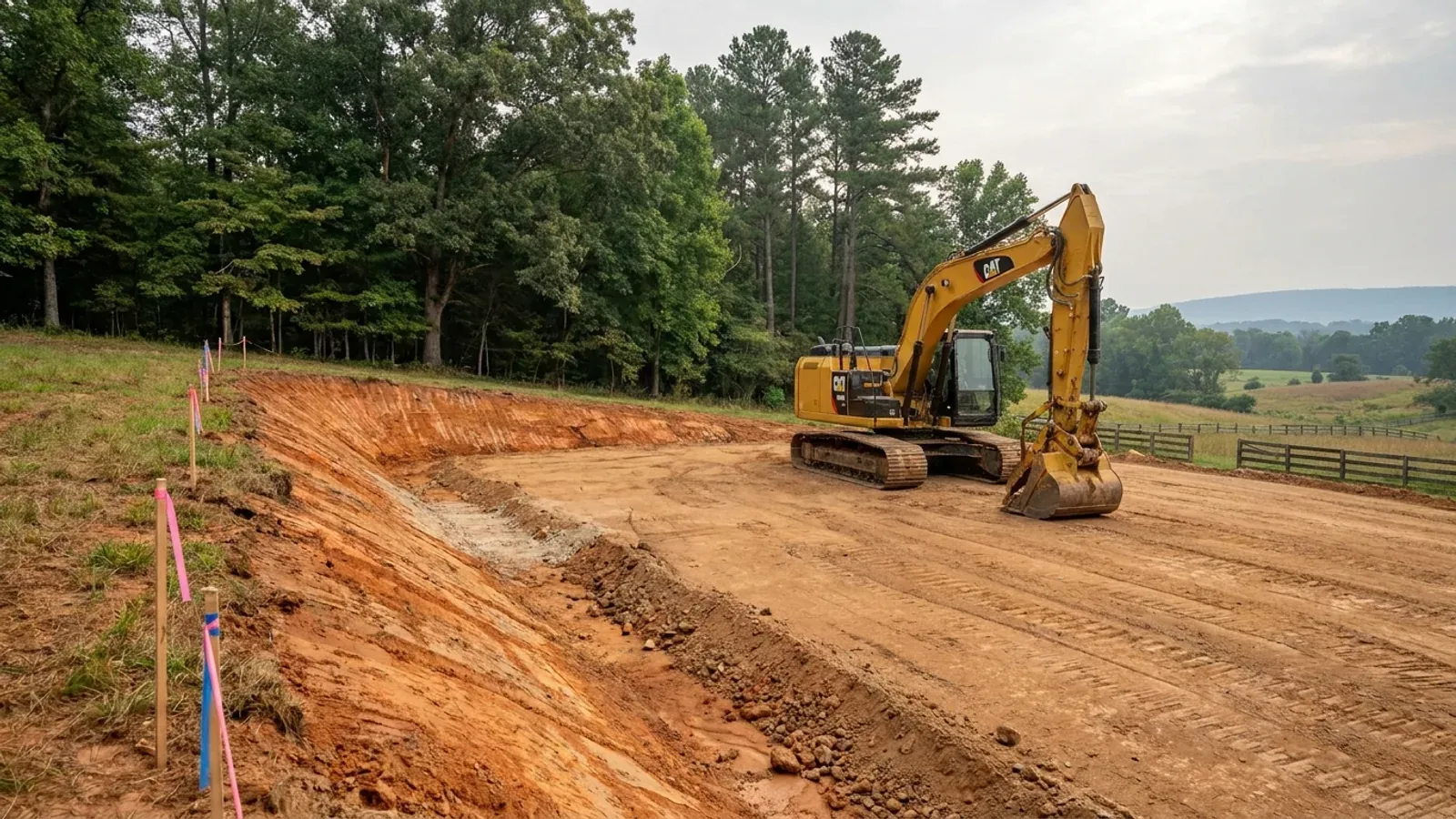
An excavator grading a compacted building pad on a cleared lot, with survey stakes, a drainage swale and a silt fence along the downhill edge.
Below the slab

The expensive surprises are in the ground, not the building

What moves a North Carolina budget is usually below grade, and the thing most often got wrong is which clay to worry about. Cecil — the red Piedmont clay everyone pictures, and the state soil — is kaolinitic and low shrink-swell; it does not heave. The soil that does is Iredell, formed over diabase and gabbro, which the USDA describes as vertic, very high shrink-swell, with a perched water table a foot or two down from December through April. The tell is colour: Cecil is red and Iredell is dark grey-brown, and they sit within a few miles of each other across the central Piedmont. West of that the question stops being clay and becomes slope, rock and colluvium; east of the fall line it becomes water, and in the Tidewater it becomes organic soil that subsides irreversibly once it is drained. Then the same ground decides the septic system, and North Carolina rewrote those rules recently enough that most of what is published about them is out of date. 15A NCAC 18E replaced the old subchapter on 1 January 2024 and was amended again on 1 June 2026: the site is classified on soil morphology — the word "percolation" does not appear anywhere in it — and there is no "provisionally suitable" any more, only suitable or unsuitable, on a single failed parameter. There is no statewide minimum lot size either; the area you need is derived from the soil result and then doubled, because a site that cannot fit both the initial field and its repair area is unsuitable. And the order matters more than people expect: the county health department's Improvement Permit and Construction Authorization come first, and the building permit is available on the strength of the Construction Authorization, not before it. One more thing that catches people: disturb more than an acre and you need an approved erosion and sedimentation control plan in hand before work starts, with penalties up to $5,000 a day, and a pad plus a drive plus a drainfield plus a laydown area crosses an acre faster than it sounds. So the site work, the foundation and the drainfield get resolved together rather than one at a time. We price the dirt before we price the building.

What a build looks like

Three stages every Hoke County project passes through, from a raw parcel to a finished home. Site work first, because that is where the budget is decided.
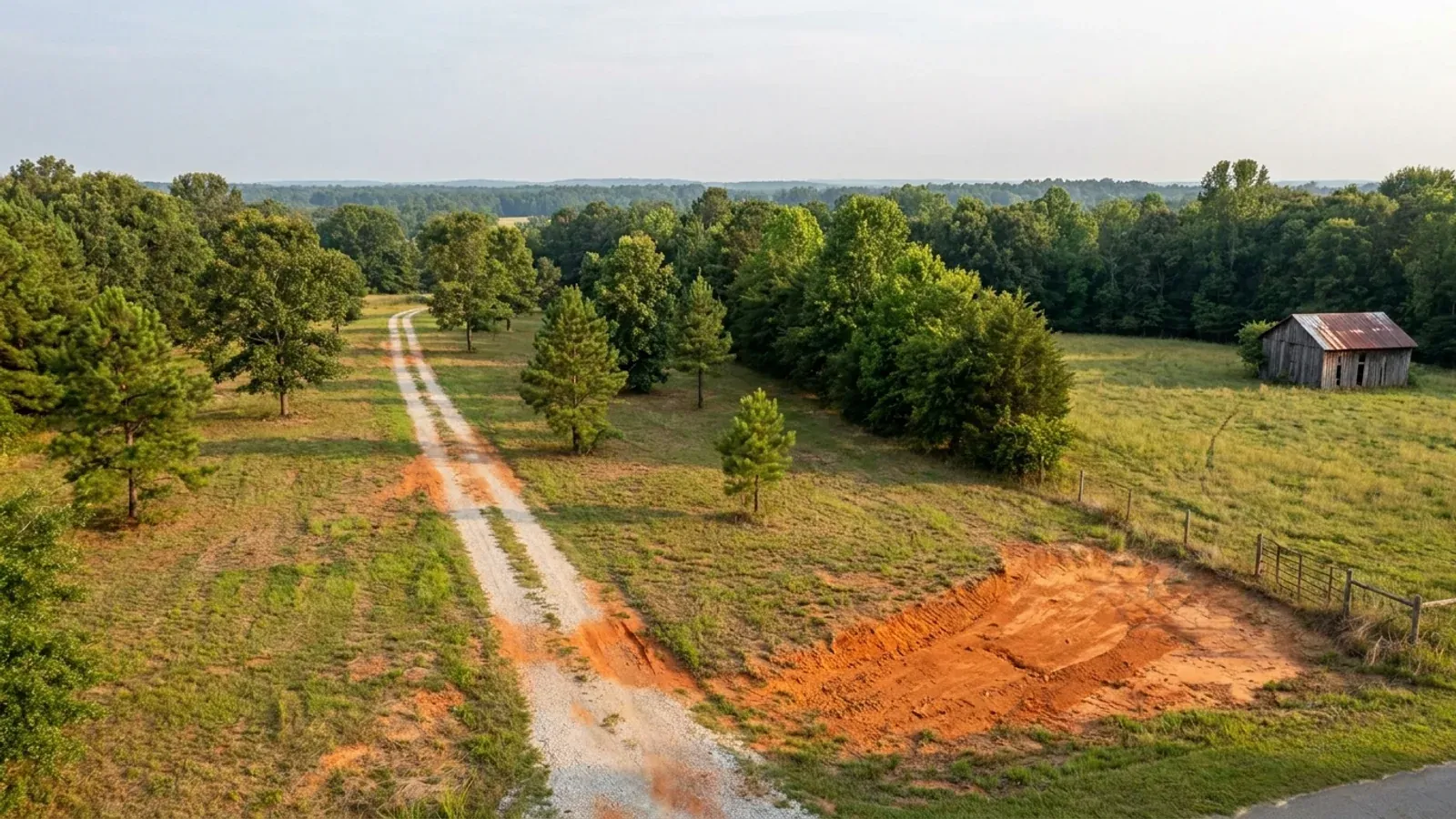
Aerial view of an undeveloped rural lot with cleared grass, a mixed oak, hickory and pine treeline, exposed red clay in one corner and a pale gravel access track.
Stage one

The parcel

Zoning, setbacks, flood zone and utility access get checked before anything is drawn.

An excavator grading a compacted building pad on a cleared lot, with survey stakes, a drainage swale and a silt fence along the downhill edge.
Stage two

Pad and permit

Clearing, grading and a compacted pad, while the septic authorization and the building submittal work through whichever offices cover your parcel.
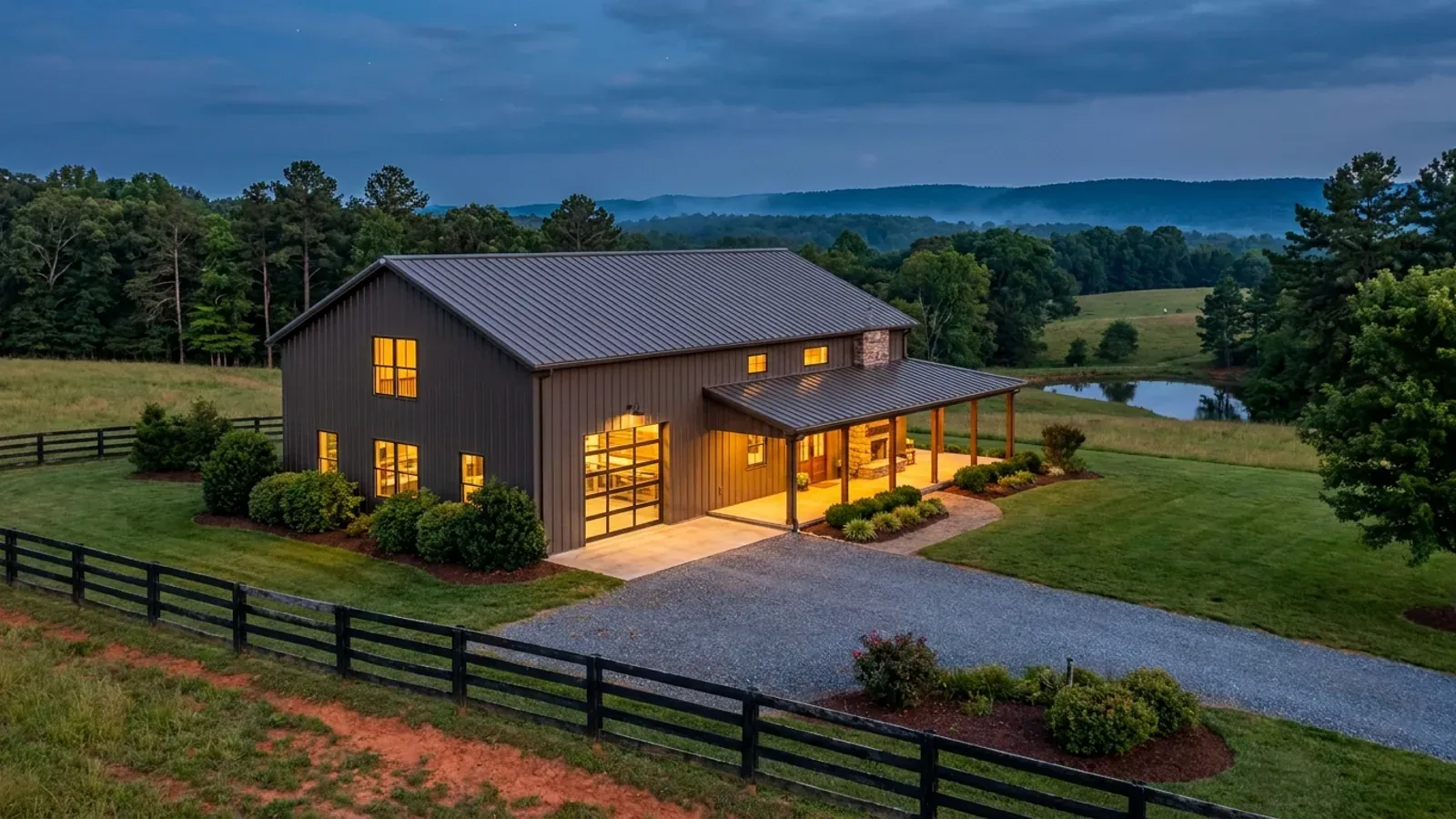
A finished barndominium at dusk with warm interior lighting glowing through its large windows.
Stage three

Frame to finish

Shell erected and dried in, then systems, insulation and interior finish through to CO.

Those are the rules where you are building in Hoke County. Tell us what you want to build and we will draw it to them.

Where we build around Hoke County

Hoke County and the rural land around it. The buildable acreage for a project this size usually sits outside the town limits — which does not automatically put it under the county, because a town's zoning and building-code enforcement reach one to three miles past its limits into its extraterritorial jurisdiction. Inside the limits, in the ETJ, or in neither are three different answers to who issues your permit.

The Hoke County service area, including the rural acreage outside the built-up edge, which is where the parcels big enough for a build like this usually sit. The map marks the territory we build in. It is not a branch location, and there is no office at this pin.

Nearby areas we build in

Others we cover nearby. Every North Carolina municipality sits inside a county — there are no independent cities here — but that does not settle who regulates a given parcel. A town's zoning, subdivision rules and building-code enforcement extend one to three miles beyond its limits, by population, into what the statute calls its extraterritorial jurisdiction; town taxes and town elections do not follow. So the office that issues the permit, what it charges and how the land is zoned can all differ from one card to the next, and the mailing address will not tell you which case you are in.

Building in Hoke County: common questions

6 questions we get asked most often about building in Hoke County. If yours is not on the list, ask it directly.

What wind speed and seismic category apply in Hoke County?
Hoke County is named at 120 mph ultimate design wind speed in Table R301.2(4) of the 2018 NC Residential Code, and the 2024 edition prints the same figure. That is worth checking rather than assuming, because 51 of North Carolina's 100 counties are not named in that table at all and take its unlisted default of 115 mph — so a stock plan set drawn to the state's most common figure is drawn five miles an hour short here. Hoke is also not one of the ten counties the table splits on a road: Cumberland immediately east is 120 mph west of I-95 and 130 mph east of it, and Robeson to the south is a flat 130. On seismic, Hoke is absent from Table R301.2(7), the list of thirteen Seismic Design Category C counties, and that table's note places every unlisted county in Category A or B. Two of Hoke's neighbours, Robeson and Scotland, are on the SDC C list — among only four coastal-plain counties ever placed there, all of which the 2024 edition removes. Alongside those, three figures are the same everywhere in the state: a flat 20 psf roof live load, no ground snow load column at all because Section R301.2.3 is deleted, and termite protection required in all of North Carolina under Section R318, with cold-formed steel framing removed from the accepted methods.
Is deep Sandhills sand a problem for a slab?
It is a different problem, not a worse one, and it is the reverse of what most North Carolina building advice prepares you for. The Candor series that represents this landscape is classed as a Grossarenic Kandiudult — sand running on the order of forty inches or more before any clay-enriched horizon — somewhat excessively drained, very deep, with more than two hundred centimetres to bedrock. Water is not the issue. Cohesion is. Clean sand has essentially none, so an unsupported excavation sidewall sloughs, and a shallow footing bearing near an unconfined edge or the crest of a slope can lose support without anything visible going wrong first. The good news is that clean sand densifies and proof-rolls well, so the remedy is normally compaction and verification rather than the undercut-and-replace that organic soil in the eastern pocosins demands, and wet-weather access is far less of a schedule risk here than east of I-95. What matters is that the compaction is specified and tested rather than assumed, and that uncontrolled loose fill is not allowed to accumulate under the pad. Since Section R301.1.2 of the residential code requires framing systems outside its prescriptive scope to demonstrate equivalent detailing, a steel or post-frame building here is generally an engineered building, and the foundation is the part of that engineering the ground makes non-routine.
Does Hoke County's permit fee include the shop bay?
Yes — the schedule says so on its face. Hoke County's fee schedule, effective 1 July 2024, heads the New Construction/Residential block "Heated/Unheated" and charges $200 as a non-refundable processing fee plus $0.35 per square foot for the building permit. An unheated workshop is inside that base. That puts Hoke with Wake, Union, New Hanover and Harnett, and against Guilford and Buncombe, where the fee is charged on heated area only and the shop bay adds nothing. There is no such thing as a North Carolina permit fee — across the county schedules read for this site the basis itself takes six different forms — and Hoke adds a seventh wrinkle that no other county schedule read here carries: the document opens by stating that both the square-foot calculation and a graduated scale on the cost of the project will be run for each permit, and "The higher permit fee calculated will be used." The graduated scale starts at 0.015 times project cost up to $100,000. Separately, Hoke prices the trades individually rather than folding them into one permit — an electrical panel at $200, mechanical at $100, plumbing at $200 per dwelling and insulation at $100 per dwelling — so a buyer reading only the per-square-foot line will under-budget.
Can I clad a Hoke County barndominium in metal?
Almost everywhere in the county, yes — but there is one strip where the ordinance says otherwise, and it is a strip a lot of buyers are looking at. Hoke County's Corridor Overlay District runs 200 feet deep on both sides of US Highway 401, from the City of Raeford's zoning jurisdiction east to the Cumberland County line. Section 2.6.6 provides that no front façade within it may be covered with sheet or corrugated aluminium, iron, steel, plain concrete block or exterior panelized plywood, including foundation materials, and allows those materials as a secondary exterior finish only where they cover no more than fifty percent of the surface area. Section 2.6.4 exempts single-family and duplex residential development from the district's fifty-foot front yard setback requirement; it is not written as an exemption from the materials rule. Outside that 200-foot band the county's general districts carry no equivalent restriction — which is a genuine and checkable difference from Moore County next door, where the Highway Corridor Overlay District expressly exempts single-family homes, duplexes and their accessory buildings from its standards altogether. If the parcel fronts US 401 in Hoke, the elevation drawing is a zoning question before it is an aesthetic one.
Do I need the septic permit before the building permit in Hoke County?
Yes, and in Hoke it is usually the least troublesome part of the schedule rather than the worst. Under 15A NCAC 18E the county health department evaluates the soil and site and classifies it suitable or unsuitable — a binary result since the 2024 rule replacement removed the old "provisionally suitable" category. If the site is suitable, the department issues an Improvement Permit fixing the design daily flow, the bedroom count, the setbacks and the location of both the initial dispersal field and the required repair area. The Construction Authorization follows, and 15A NCAC 18E .0201(c) provides that upon its issuance the applicant may obtain a building permit under G.S. 130A-338; where the Improvement Permit carried no conditions the Construction Authorization can issue at the same time. The Operation Permit issues only after the installed system is inspected before it is covered. Deep, well-drained Sandhills sand is the profile that classifies suitable most readily in this state, so the usual constraint here is not soil quality but geometry: the repair area means the lot has to carry roughly twice the drainfield you install, and that is what caps the bedroom count on a tight parcel. If a site is classified unsuitable the rule entitles you to a signed written report describing the unsuitable characteristics and citing the rules relied on.
Which Hoke County code amendments should I be checking?
None, and this is a genuinely useful thing to know because the advice given nearly everywhere else in this trade is the opposite. G.S. 143-138(e) provides that the North Carolina State Building Code shall apply throughout the State from the time of its adoption. The only things a city or county may adopt of its own are a fire prevention code — which requires Residential Code Council approval and may not reach one- and two-family dwellings beyond what the Residential Code prescriptively requires — and floodplain management regulations. There is no general local building-code amendment power in North Carolina, so there is no Hoke County amendment package to hunt for and no county here can impose a stricter structural, foundation or energy requirement on a dwelling. What is genuinely local, and what this page is about, is a different list entirely: zoning under Chapter 160D, including the county's two overlay districts; the fee schedule and its unusual higher-of-two-calculations rule; the health department; extraterritorial jurisdiction, which is where the county's own zoning ordinance stops; floodplain regulation; and the wind and seismic figures published county by county inside the one statewide code.

Building in Hoke County?

Start with the plan. Tell us what you want to build and we will draw it, then confirm which office issues the permit for your parcel, what it will let you put there, and what wind load it has to meet. That conversation costs nothing.