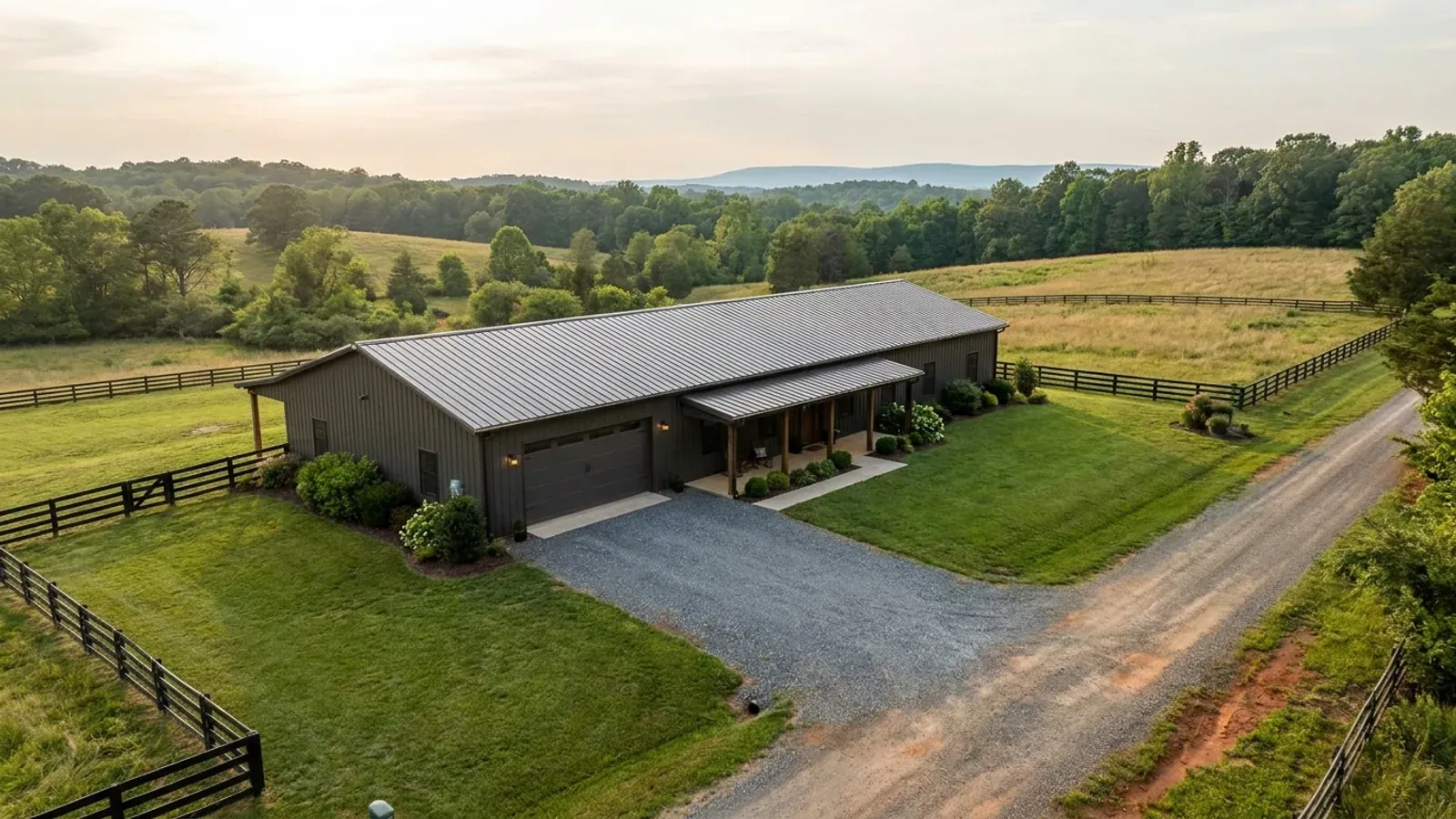
Small Barndominium in NC
Building small in North Carolina saves less than the square-foot arithmetic suggests, and the reasons are all checkable. Septic is the biggest one: under 15A NCAC 18E the county health department issues an Improvement Permit that fixes the design daily flow and the bedroom count, and Rule .0508(b) makes a site unsuitable unless it holds both the initial dispersal field and a repair area — so the land the system occupies is roughly double the drainfield, whatever the house measures. Guilford County prices its residential soil evaluation at $100 per bedroom; Chatham County prices the Improvement Permit from $150 at two bedrooms to $400 at six. Neither line moves when the floor plan shrinks. Permit fees are the second reason. There is no North Carolina permit fee — the basis takes at least six forms — and where a county prices by area it usually sets a floor: Gaston County's schedule carries a $990 minimum for a new residential home and computes the rest from construction valuation rather than area at all; Chatham charges $0.40 per square foot with a $400 minimum, so under about a thousand square feet the effective rate climbs. Where small genuinely does pay is the fee basis itself, and that is a county-by-county question worth settling before a plan is drawn.
What actually changes with this feature
The look is the easy part. These are the decisions that follow from it.
Septic is sized on bedrooms, and priced on them too
Under 15A NCAC 18E .0203 the Improvement Permit fixes the design daily flow, the bedroom count, the setbacks and the location of both the initial dispersal field and the repair area. A smaller floor plan with the same bedroom count is the same design flow. Guilford County publishes no line called an Improvement Permit and instead charges Residential Soil Evaluations at $100 per bedroom, with its own permit guidance requiring the bedroom count on the plans to match the application and the septic design. Chatham County's environmental health schedule runs $150 at two bedrooms, $225 at three, $300 at four, $350 at five and $400 at six. Cabarrus County prices the Construction Authorization by design flow instead: $350 at 360 gallons per day or less for one to three bedrooms, $450 at 600 gpd or less for four to five, $550 above that. A loft or a flex room drawn as a bedroom is priced as one.
The repair area is why a small house still needs real acreage
15A NCAC 18E .0508(a) requires available space for both the initial wastewater system and a repair area, meeting every setback, with access for operation and maintenance; .0508(b) makes the site unsuitable if it cannot hold both. There is no statewide minimum lot size to fall back on — the area is derived from the soil group and its long-term acceptance rate, then effectively doubled. The only carve-out is .0508(c), for a lot described in a deed or plat recorded on or before 1 January 1983 at no more than 480 gallons per day of domestic flow, and .0508(e) spends that exemption the first time it is used. .0508(g) requires the fields to be staked on-contour before the Improvement Permit issues, and .0508(h) bars altering them afterwards — so the staked repair area is not spare yard to park a crane on.
Minimum fees raise the effective rate on a small build
Gaston County's Building and Development Services schedule sets a $990 minimum for a new residential home and computes the rest from ICC construction valuation or the stated contract price, whichever is greater — a small building does not reduce it much and cannot fall below it. Chatham County charges $0.40 per square foot with a $400 minimum, so the minimum governs under roughly a thousand square feet, and its $3,500 education impact fee on a single-family dwelling is flat regardless of size. Currituck County charges $0.50 per square foot with a $50 minimum and a $1.00 technology fee, then $100.00 each for plumbing, mechanical, electrical and gas — $400 of trade permits that do not vary with area. Catawba County's minimums are $90 for building and $60 for each trade. Wilkes County's minimum permit fee is $45.00, but a detached building under 900 square feet carries a $90.00 minimum on its own line.
Where small genuinely pays, and it is the fee basis
Guilford County charges $150 plus $0.35 per heated square foot for a new detached single-family structure in the area it inspects, so an unheated shop bay adds nothing to the base and a compact heated core is directly cheaper. Wilkes County charges heated area in brackets — $0.20 per square foot from 1,000 to 2,499 square feet, rising to $0.36 at 10,000 and up — and prices an attached unheated bay at $0.04 per square foot, about a sixth of the heated rate. Wake County runs the other way at $75 plus $0.25 per square foot of gross floor area, with the schedule defining that area as everything finished within the inside perimeter of the exterior walls and taking no deduction for garage, corridors, stairs or closets. Union County charges $0.84 per square foot on area under roof, heated or unheated. The same compact plan is rewarded in one county and billed in full in another.
Small shrinks the building. It does not shrink the septic, the land or the minimum fee.
Three things a compact plan does not reduce. First, the drainfield: 15A NCAC 18E .0203 has the Improvement Permit fix the design daily flow and the bedroom count, and .0508(b) makes a site unsuitable unless it has space for both the initial system and a repair area — the spare field is required, so the ground the system needs is about twice what gets installed. Second, the land: a county's own minimum lot area is set by the zoning district, not by the house. Robeson County's Residential-Agricultural district asks 20,000 square feet per dwelling unit and 110 feet of lot width; Davidson County's RA districts ask 30,000 square feet on well and septic; Iredell County's A-C Agricultural Conservation district asks 87,120 square feet — exactly two acres — per dwelling unit. Third, the fee floor: Gaston County sets a $990 minimum on a new residential home, Chatham County a $400 minimum against a $0.40 per square foot rate, Union County a $100 minimum, Wilkes County $45, and Currituck County $50 plus separate $100 plumbing, mechanical, electrical and gas permits that do not scale with area at all. On a small building those flat lines are a larger share of the bill, not a smaller one.
Common ways to build this
Common configurations we see. Yours does not have to match one exactly — this is a starting point for the conversation, not a catalog.
Compact core with an attached unheated bay
1,200 sq ft heated / 900 sq ft unheated bay, one structure
One building, one roof, one permit. On a heated-area basis this is the cheapest arrangement in the state: Guilford County's $0.35 per heated square foot never touches the bay, and Wilkes County prices an attached unheated bay at $0.04 per square foot against $0.20 or more for heated space. On a gross-area basis it is the most expensive — Wake County takes no deduction inside the exterior perimeter, and Union County bills every square foot under roof at $0.84. Union County's attached rate is 3.5 times its detached rate; Wilkes County's ordering is the exact inverse. Settle which basis the county uses before deciding whether the bay touches the house.
Small dwelling beside a detached shop
1,000 sq ft dwelling / 1,600 sq ft detached shop
Separating the shop changes the fee, the zoning question and sometimes the sequence. Union County drops from $0.84 per square foot attached to $0.24 detached; Wilkes County goes the other way, from $0.04 attached to $0.10 per square foot detached at 900 square feet and over. Robeson County's Residential-Agricultural district caps the principal building and all accessory buildings together at twenty percent of lot area, so on a small parcel the two structures compete for one allowance. Sampson County's Residential Accessory Structure Site Plan Requirements permit an accessory structure with no principal dwelling only in the Residential Agricultural district on five acres or more; below that, the house has to exist first. Stanly County's amendment ZA21-07 permits one barn or shed as the primary structure on RA parcels over three acres, capped at 2,500 square feet.
Two-bedroom compact plan
1,100 sq ft heated / two bedrooms / one dispersal field plus its repair area
The bedroom count is the lever that actually moves the septic number, and it is the one most often drawn carelessly. Chatham County prices the Improvement Permit at $150 for two bedrooms against $400 for six; Guilford County charges $100 per bedroom on the soil evaluation; Cabarrus County brackets the Construction Authorization at $350 for one to three bedrooms and $450 for four to five. Johnston County's own permit checklist stresses that the bedrooms shown on the septic permit must match the bedrooms in the residence — which is a live trap on a barndominium where a bonus room over the shop reads as a bedroom to an inspector and as storage to the owner. Draw the flex space so that the plans, the application and the septic design all agree.
Small footprint, second storey
1,400 sq ft over a 700 sq ft footprint
Where the binding constraint is lot coverage or site disturbance rather than floor area, stacking clears it. Stokes County caps lot coverage by the principal building at 20 percent of the lot; Madison County caps principal plus accessory at 20 percent; Robeson County caps principal plus all accessory buildings at twenty percent; Cabarrus County caps impermeable surface at 15 percent in its Agricultural/Open Space district; Buncombe County's steep-slope standards cap gross site disturbance at 0.3 acres on lots under two acres and impervious surface at 0.16 acres, counting drives and stormwater controls as well as the building. The cost of going up is a height cap that a shop bay can reach — 35 feet in the Davidson, Iredell, Stokes and Madison rural districts, 40 feet in Cabarrus and in Sampson's RA.
Ways to build this size
A footprint can go together several ways. These are the service lines most relevant to it.
Custom Plans
Barndominium floor plans drawn for your parcel, your county's design figures and the septic system your bedroom count will actually need.
Read moreBarndominium Kits
Engineered shell packages drawn to your own county's wind and seismic numbers under the 2018 NC Residential Code, with the exclusions written down.
Read morePost-Frame Homes
Pole barn homes across NC: post-frame houses built as dwellings under the NC Residential Code — not farm buildings, and not equipment sheds.
Read moreSite Preparation
Clearing, grading, pad, drainage and driveway on NC ground — and the erosion control plan that has to be approved before any of it begins.
Read moreSmall Barndominium: common questions
8 questions we get asked most often about this footprint. If yours is not on the list, ask it directly.
Is there a minimum size for a house in North Carolina?
If I build smaller, do I get a smaller septic system?
How much land does a small barndominium actually need?
Do permit fees really fall if I build small?
Is there a point where a building is too small to be worth permitting separately?
Can I put a small shop up first and build the house later?
Will a small barndominium still need an engineer?
Does a compact plan change the design criteria?
Keep reading
The pages that answer the next question this one raises.
Greensboro and Guilford County
Guilford County prices the permit on heated area alone — $150 plus $0.35 per heated square foot — and the septic soil evaluation at $100 per bedroom.
Read itChatham County
A $400 minimum against a $0.40 per square foot rate, an Improvement Permit priced by bedroom count, and a flat $3,500 education impact fee.
Read itWilkes County
The one county on this axis where attaching the bay makes it cheaper — $0.04 per square foot attached against $0.10 detached.
Read itWant this drawn for your program and your parcel? That is where a build actually starts.
Start your plans
Tell us what you want to build and we will draw this for your program, then confirm what it looks like on your parcel, the wind load it has to meet, and a realistic budget range. That conversation costs nothing.