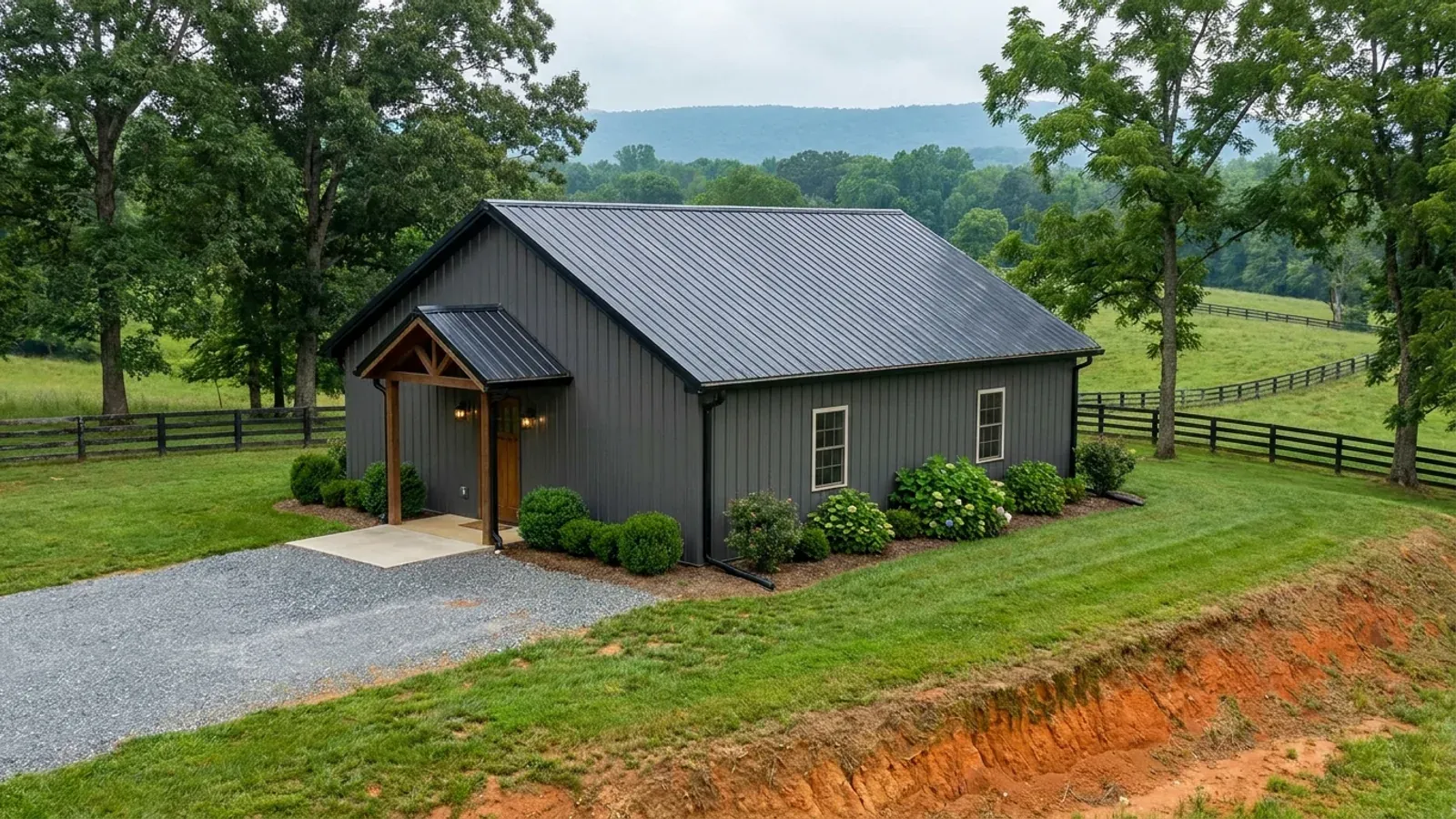
3-Bedroom Barndominium in NC
A three-bedroom barndominium is the plan North Carolina's septic rules price most kindly, and the reason has nothing to do with square footage. Under 15A NCAC 18E the county health department classifies the soil, then issues an Improvement Permit that fixes the design daily flow, the bedroom count, the setbacks and the location of both the initial dispersal field and its repair area. Bedrooms are the unit of measure; the shop bay, the porch and the height of the ridge are not in that calculation at all. Several counties then publish their fees on exactly that basis. Cabarrus County Environmental Health prices the Construction Authorization at $350 for a system of 360 gallons per day or less, and its own schedule reads that band as one to three bedrooms — so three is the top rung of the cheapest step, and the plan that gets everything the band allows without crossing it. Catawba County charges $300 for an Authorization to Construct on any system of 360 gallons per day or less, a figure that includes the Improvement Permit fee. Guilford County prices residential soil evaluations at $100 per bedroom, which makes a three-bedroom $300 on that line rather than $100. And Chatham County scales the Improvement Permit itself by bedroom count, from $150 at two bedrooms to $400 at six, with a three-bedroom at $225. None of these counties charges by the size of the house.
What actually changes with this feature
The look is the easy part. These are the decisions that follow from it.
The Improvement Permit is written in bedrooms, not square feet
15A NCAC 18E .0201(b) sets the order — application, Improvement Permit, Construction Authorization, Operation Permit — and the Improvement Permit is the document that fixes the design daily flow, the bedroom count, the effluent standard, every setback, and the staked location of both the initial dispersal field and its repair area. Nothing in that sequence measures the building. A three-bedroom barndominium with a 3,000 square foot shop bay and a three-bedroom ranch with no shop at all are the same application to the health department. What the shop does change is the building fee, which is a different schedule at a different counter.
Two counties price the evaluation per bedroom, and three is $300 or $225
Guilford County's environmental health schedule has no line item called an Improvement Permit. It prices the two halves separately: residential soil evaluations at $100 per bedroom, and an Authorization to Construct at $100 for type I and II systems. So the soil evaluation on a three-bedroom plan is $300, and the county's own permit guidance requires the bedroom count on the plans to match the permit application and the septic design, with a change in that count explicitly requiring a permit amendment. Chatham County Public Health scales the Improvement Permit itself — the schedule calls the line a Site Evaluation — at $150 for two bedrooms, $225 for three, $300 for four, $350 for five and $400 for six, then prices the Construction Authorization separately by system type from $160 for Type I to $1,000 for Type VI.
The soil turns the bedroom count into ground, and then doubles it
North Carolina classifies a septic site on soil morphology rather than on a timed water drop — the word percolation does not appear anywhere in 15A NCAC 18E. The county describes the soil profile in borings or pits to at least 48 inches or to a limiting condition, assigns a long-term acceptance rate from the soil group, and turns the design flow into a trench length. Then .0508(b) requires room for both the initial system and a full repair area, and a site that cannot hold both is unsuitable. So the bedroom count sets the flow, the soil group sets how much field that flow buys, and the repair-area rule doubles the ground it takes. There is no statewide minimum lot size to fall back on; the acreage is derived from the soil result every time.
One failed parameter kills the site, and there is no middle answer any more
15A NCAC 18E replaced the old 18A .1900 rules on 1 January 2024 and was amended again effective 1 June 2026. Under .0509(a) a site is suitable only when every parameter is suitable, and any single unsuitable parameter makes the whole site unsuitable; .0509(d) then bars an Improvement Permit on an unsuitable site. The classification Provisionally Suitable, which most real-estate and septic content still uses, does not appear anywhere in the current subchapter. The parameters that fail rural Piedmont lots most often are soil depth under .0505 — at least 18 inches to rock, saprolite or parent material — a restrictive horizon shallower than 18 inches under .0507, and a soil wetness condition higher than 12 inches under .0504(b). If the site is classified unsuitable, .0203(c) entitles the applicant to a signed written report describing the unsuitable characteristics and citing the rules relied on.
Three bedrooms sits at the top of the bottom band in the counties that band by flow
Cabarrus County Environmental Health publishes its Construction Authorization — the septic tank permit — by design flow, and it prints the bedroom equivalence alongside each band: $350 at 360 gallons per day or less for one to three bedrooms, $450 at 600 gallons per day or less for four to five bedrooms, and $550 at 601 gallons per day or more for six or more, with $150 added for any system carrying a pump. The soil evaluation application is separate again, at $350 for the first acre and $350 for each additional acre where applicable. Catawba County Environmental Health draws the same line in a different place on the page: $150 for the site and soil evaluation, then $300 for the Authorization to Construct on any system of 360 gallons per day or less, with the Improvement Permit fee folded into that figure, stepping to $450, $650 and $900 as daily flow rises. In both counties a one-bedroom cottage and a three-bedroom barndominium pay the same septic fee, and the third bedroom is the last one that is free. That is the practical meaning of a bedroom-based rule: the count is not a description of the house, it is the number the permit is written against.
Common ways to build this
Common configurations we see. Yours does not have to match one exactly — this is a starting point for the conversation, not a catalog.
Three bedrooms on one level with the shop attached
Three bedrooms, one storey, shop bay under the same roof
The standard barndominium arrangement, and the one the health department treats most simply: three bedrooms, one design daily flow, no part of the shop in the calculation. The fee that does move is the building permit, and the base varies sharply by county. Guilford County Inspections charges $150 plus $0.35 per heated square foot, so an unheated shop bay adds nothing there. Wake County charges $75 plus $0.25 per square foot and states that there is no deduction for a garage. Alamance County charges $525 up to 1,500 gross square feet and $0.36 per square foot above that, and defines gross square footage in the schedule itself as any floored area under roof, porches, garages, storage areas and basements included. Randolph and Davidson compute the fee from construction value on the ICC tables and never measure the building at all.
Three bedrooms plus a study that is not a bedroom
Three bedrooms on the permit, one room drawn as an office
This is the decision most three-bedroom barndominium buyers actually face, and it is worth making deliberately at design stage rather than at plan review. Whether a room is a bedroom on the septic file is a question the health department answers, and the answer follows how the room will be used and sold, not what the drawing calls it. Guilford County requires the count on the plans, the permit application and the septic design to agree, and requires a permit amendment when it changes. Johnston County's own permit checklist stresses that the number of bedrooms on the septic permit has to match the number of bedrooms actually in the residence. The honest way to use that is to decide the real count first and price it, not to relabel a room after the fact.
Three bedrooms with a fourth bedroom's soil proven at the same visit
Three bedrooms permitted, a larger repair area staked
Because the flow is set on the Improvement Permit, adding a bedroom later is a fresh health-department decision rather than a change to the drawings, and in Guilford County it is expressly a permit amendment. The cheaper sequence is to have the soil looked at once. 18E .0202(g) allows an applicant to contract with a licensed soil scientist to carry out the soil and site evaluation and submit it to the local health department as part of the application, which front-loads the fieldwork instead of waiting in the county's queue. If a fourth bedroom is even possible, the evaluation is the moment to establish whether the ground carries it, because .0508(g) requires the dispersal field to be field located and staked on contour before the Improvement Permit issues.
Three bedrooms where the county does not count bedrooms at all
Three bedrooms, a fee set by system type instead
Not every county bands by bedroom, and on the coast the basis flips entirely. Onslow County's Environmental Health fee schedule for FY 2026-2027 charges a flat $325 for an Improvement Permit on an individual dwelling and then prices the Construction Authorization by the system the soil turns out to require: $325 for Type I, II, IIIa and IIIc-g, $425 for Type IIIb, $625 for Type IV, $825 for Type V and $1,000 for Type VI. A three-bedroom and a five-bedroom pay the same there; a good soil result and a poor one do not. Craven County, immediately north, does the opposite and prices both halves by bedroom count — $200 for the soil evaluation and $200 for the Authorization to Construct at fewer than five bedrooms. Two adjacent coastal counties, two different bases, and the same three-bedroom plan.
Ways to build this size
A footprint can go together several ways. These are the service lines most relevant to it.
Custom Plans
Barndominium floor plans drawn for your parcel, your county's design figures and the septic system your bedroom count will actually need.
Read morePost-Frame Homes
Pole barn homes across NC: post-frame houses built as dwellings under the NC Residential Code — not farm buildings, and not equipment sheds.
Read moreSite Preparation
Clearing, grading, pad, drainage and driveway on NC ground — and the erosion control plan that has to be approved before any of it begins.
Read morePermitting & Engineering
What the jurisdiction actually requires on an NC barndominium: one statewide code, no county amendments, and a permit package built to clear review.
Read more3-Bedroom Barndominium: common questions
7 questions we get asked most often about this footprint. If yours is not on the list, ask it directly.
How much does the septic permit cost for a three-bedroom barndominium in North Carolina?
Does the shop bay change the septic sizing?
What happens if I want a fourth bedroom later?
Can I pull the building permit while the septic application is still running?
How much land does a three-bedroom barndominium need for septic?
Is a three-bedroom barndominium permitted differently from a three-bedroom house?
What does a suitable or unsuitable classification actually mean now?
Keep reading
The pages that answer the next question this one raises.
Cabarrus County
The county whose septic schedule prints the bedroom equivalence next to each flow band, with one to three bedrooms at $350.
Read itChatham County
Improvement Permit scaled by bedroom count from $150 to $400, with the Construction Authorization priced separately by system type.
Read itGreensboro and Guilford County
Soil evaluations at $100 per bedroom, a heated-area building fee, and a bedroom count that must match in three places.
Read it4-bedroom barndominium
What actually changes when the fourth bedroom crosses a county's flow band — and the counties where it does not.
Read itWant this drawn for your program and your parcel? That is where a build actually starts.
Start your plans
Tell us what you want to build and we will draw this for your program, then confirm what it looks like on your parcel, the wind load it has to meet, and a realistic budget range. That conversation costs nothing.