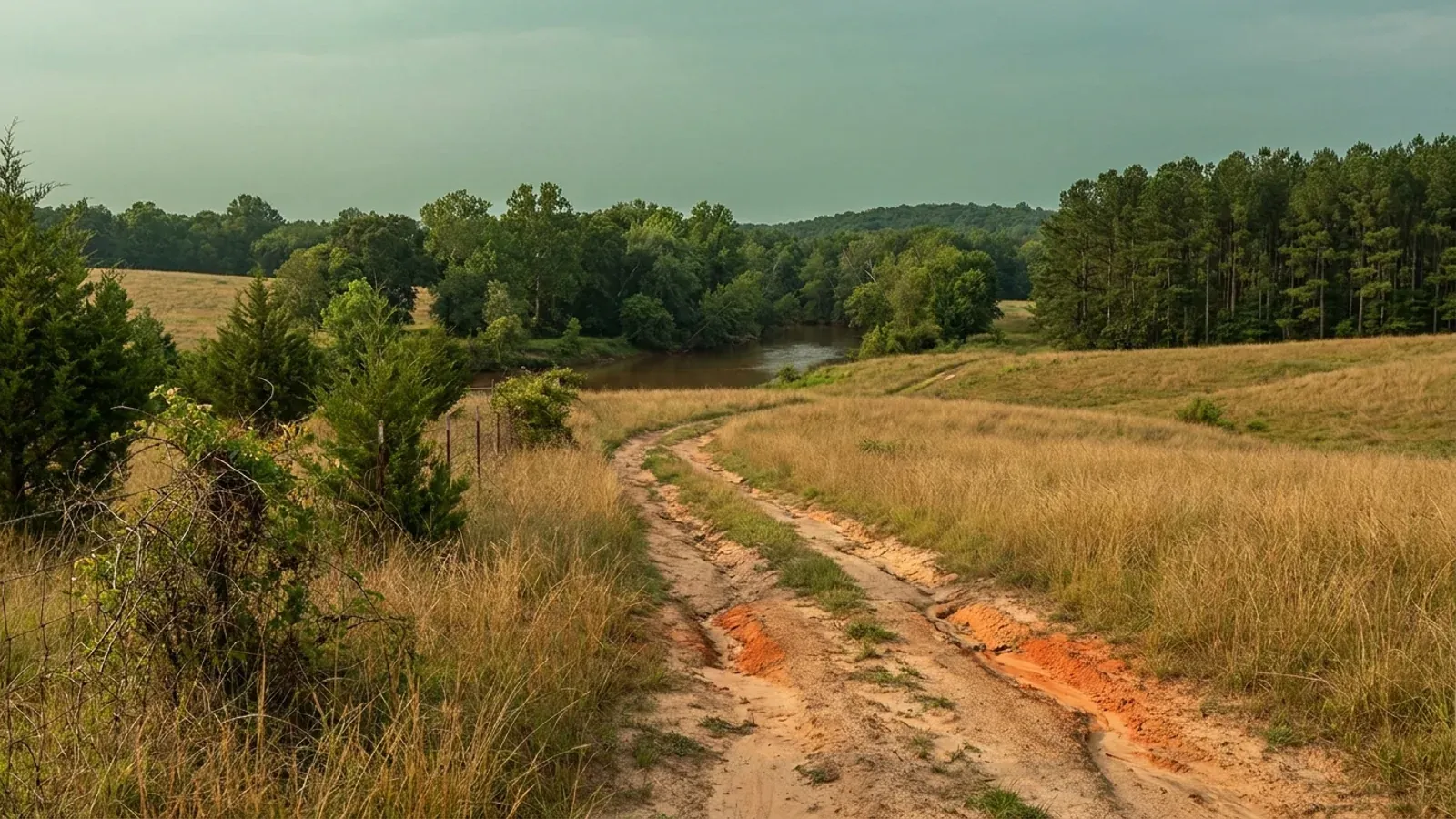
Rolling farmland and mixed hardwood near the fall line with red soil showing in a farm track, dense loblolly pine on one edge and a wooded creek bottom beyond.
Harnett County 2018 NC Residential Code, statewide

Barndominium Builders in Harnett County, NC

Harnett County is the county that faces two ways. It is in the Raleigh-Durham-Cary combined statistical area and it is in the Fayetteville commuter shed, and the northern end of it — Angier, Fuquay-Varina's southern edge, the NC 55 corridor — is Triangle land while Dunn, Erwin and Spring Lake look south to Cumberland County. It grew +12.4 percent between 2020 and 2025 on the Census Bureau's Vintage 2025 estimates, to 150,137 people on +13,174 of net migration, and it still holds 563 farms on 109,179 acres, 28.7 percent of its 595 square miles, at a median farm size of 40 acres. Two facts shape a barndominium here more than anything else. The first is the fee base, and it is the expensive side of the split: Harnett's residential bracket table is measured on heated area and garage together, so a 2,400 square foot house with a 1,200 square foot shop bay measures 3,600 and lands in the 3,501 to 4,000 square foot bracket at $1,200 rather than the 2,001 to 2,500 bracket at $805 — where Guilford County in the Triad, charging on heated square footage only, would not count the shop at all. The second is that Harnett runs a genuine one-stop counter. Harnett County Central Permitting at 420 McKinney Parkway in Lillington puts building, the trades, environmental health, the fire marshal, land use and utility fees on one schedule and takes them at one desk, which is unusual in North Carolina, where septic and wells are almost always a separate department on a separate document. That is a real advantage on a rural build and it is worth knowing before you assume the Wake County sequence applies. The county sits on the Cape Fear River, which runs through Lillington, and the ground changes underneath you as you cross it — Sandhills sand in the south, inner Coastal Plain in the east, Piedmont at the northern edge.

Harnett County at a glance

County
Harnett County
City rules outside city limits
Angier, Dunn and Lillington issue their own building permits — but Harnett County still does the Fire Marshal review and the septic permit on those parcels, and Coats and Erwin want the town's written acknowledgment first.
Population
150,137
ZIP codes
27546, 28334, 28335, 27501, 27521, 28339, 27506, 28323, 28326, 27552, 28368, 28390
Site visits
Same week across Harnett County

Building conditions in Harnett County

The building code does not change at a county line here. Under § 143-138(e) the North Carolina State Building Code applies throughout the state, and a city or county may adopt only a fire prevention code and floodplain regulations of its own — there is no general local amendment power, so there are no county amendments to look up. The edition in force is still the 2018 NC Residential Code, effective 1 January 2019; the 2024 edition has been delayed three times and carries no effective date at all. What genuinely differs is who issues the permit and inspects the work, what that office charges, how the parcel is zoned, what the local floodplain ordinance requires of the foundation — and two design numbers the code publishes county by county, the ultimate design wind speed and the seismic design category. The rest of Table R301.2 is set once for everyone: a flat 20 psf roof live load, a 12-inch frost line, Moderate weathering, and termite protection required everywhere in the state with no exemption. There is no ground snow load column in the residential code at all.

Build conditions for Harnett County , North Carolina : ultimate design wind speed 120 mph. BUILD CONDITIONS HARNETT COUNTY, NCHarnett County2018 NC RESIDENTIAL CODEULTIMATE DESIGN WIND SPEED120 mphTable R301.2(4) of the 2018 NC Residential Code names Harnett County at 120 mph ultimate designwind speed. Cumberland County to the south is split by that same table — 120 mph west of I-95 and…WHO ISSUES THE PERMITHarnett County Central PermittingLillington. One desk for building, trades, environmental health,fire marshal and land use. Angier, Dunn and Lillington issue their…
Build conditions for Harnett County, drawn from the sourced facts on this page. Every figure above is cited in the quick-facts panel below, with its source and vintage.
Harnett measures the bracket on heated area and garage together
Harnett County does not use a rate per square foot and does not use a valuation table. It uses square-footage brackets, and the dimension the schedule names is heated area and garage. A new dwelling runs $600.00 at 1,000 to 1,200 square feet, $700.00 at 1,201 to 2,000, $805.00 at 2,001 to 2,500, $940.00 at 2,501 to 3,000, $1,045.00 at 3,001 to 3,500, $1,200.00 at 3,501 to 4,000, $1,290.00 at 4,001 to 4,500 and $1,390.00 at 4,501 to 5,000. For a barndominium that is the whole point: 2,400 square feet of house plus a 1,200 square foot shop bay measures 3,600 and lands in the 3,501 to 4,000 bracket at $1,200.00 rather than the 2,001 to 2,500 bracket at $805.00 — the shop moves you three brackets and adds $395. Guilford County in the Triad charges on heated square footage only, so the same unheated bay adds nothing there. One fee covers all the trades; Harnett does not charge separate building, electrical, plumbing and mechanical permits on a new dwelling. Residential plan review is a separate $25.00 line and a Land Use Permit is $25.00. The schedule's own header carries the date 08/11/2023 and states no fiscal year, and it is the only fee schedule published on the county's site, so treat these as the last published figures and confirm them with Central Permitting before you budget.

Harnett County Central Permitting fee schedule, harnett.org (document header dated 08/11/2023), read 5 September 2026; Guilford County Inspections Department fee panels, guilfordcountync.gov. Control test on harnett.org: genuine 404 on a bogus path.

Three towns write your building permit, and the county still writes your septic
Harnett County Central Permitting publishes an ETJ Submittal Guide, and it answers the who-permits-me question more directly than almost any document in the state. Properties located in Angier, Dunn or Lillington's zoning jurisdiction obtain their building permits from their respective Towns — but they go through Harnett County for their Fire Marshal Review and for their Septic Permit. A notification of acknowledgement from the town, being a zoning permit, an email or a letter, is required before any forms can be submitted to the county. Where the county's GIS viewer populates the zoning jurisdiction as Coats or Erwin, that town's acknowledgement is required the same way. And effective 1 July 2025 all City of Dunn fire plan reviews and fire inspections are processed by Harnett County and billed separately from the City of Dunn. So a single rural parcel can have its zoning and building permit from a town, its fire review and its septic permit from the county, and its inspections booked in two systems. The county's guide tells you to check the jurisdiction on the GIS viewer first, which is the correct first step and is not what a mailing address will tell you.

Harnett County Central Permitting, "ETJ Submittal Guide" — Fire Marshal Plan Review and Environmental Health Plan Review sections, read 6 September 2026; G.S. 160D-202.

One schedule, one desk — which is not how the rest of the state does it
Harnett County Central Permitting, 420 McKinney Parkway in Lillington, puts building, the trades, environmental health for septic and wells, the fire marshal, land use and utility fees on one published schedule and takes them at one counter. That is unusual in North Carolina. Of the counties whose schedules have been read side by side, most run septic and wells as an entirely separate department on an entirely separate document — Wake, Guilford, Forsyth, New Hanover, Johnston, Iredell and Union all do, and Johnston's environmental health pages are not even on the same web domain as its inspections office. A buyer who reads only the building schedule in one of those counties under-budgets by roughly six hundred to sixteen hundred dollars. Harnett, along with Pitt and Buncombe, is the exception. Two consequences: the number you read on Harnett's schedule is closer to the real total than the equivalent number elsewhere, and the septic permit, the well permit, the land use permit and the building permit are all obtained at the Central Permitting Department rather than chased across departments. The county publishes its septic and well fees on that same sheet, and repeats them in its ETJ guide.

Harnett County Central Permitting fee schedule and ETJ Submittal Guide, harnett.org, read 5 and 6 September 2026; county fee schedules for Wake, Guilford, Forsyth, New Hanover, Johnston, Iredell and Union read from those counties' own sites, 5 September 2026.

Harnett faces two markets whose design numbers do not match
Table R301.2(4) of the 2018 NC Residential Code names Harnett County at an ultimate design wind speed of 120 mph. Look either direction from that and the numbers move. To the north, Wake County is not named in the table at all and takes its unlisted default of 115 mph. To the south, Cumberland County — Fayetteville, the other half of Harnett's commute — is one of the ten counties the table splits on a named road: 120 mph west of I-95 and 130 mph east of it, so a single Cumberland address does not have one wind speed. The energy code splits the same two markets the other way. Table N1101.7 puts Harnett County in IECC climate zone 4A with Wake and the Triangle, while Cumberland is in 3A. So a barndominium designed for a Fayetteville lot and a barndominium designed for a Lillington lot differ in both their wind load and their envelope requirements, in opposite directions, and Harnett sits on the seam. Harnett County is absent from Table R301.2(7), the list of the thirteen Seismic Design Category C counties, whose note places every county not listed in Category A or B. The 2018 edition is the one in force; the 2024 edition carries no effective date at all.

2018 NC Residential Code, Tables R301.2(4), R301.2(7) and N1101.7, transcribed from the code chapter published by ICC Digital Codes; NC Office of the State Fire Marshal, Codes — Current and Past, ncosfm.gov, read 5 September 2026.

$750 for the soil analysis and the Improvement Permit together, and a five-year clock
Harnett County combines the soil analysis and the Improvement Permit into a single $750.00 line — New Soil Analysis / Improvement Permit — and publishes no separately priced Construction Authorization. An existing septic evaluation is $100.00 and a new well permit is $250.00. Related lines: reinspection $100.00, revision $100.00, expansion or relocation $375.00, drainfield redesign $100.00. The county's own ETJ guide repeats the $750.00 new septic and $250.00 new well figures and adds the timing rule that matters most on a slow rural build: the Improvement Permit is valid for five years from its issue date, or six months if the tank is installed. Five years is generous by the standards of this trade and it means a buyer can secure the septic answer on a parcel well before drawing a plan — but installing the tank starts a six-month clock, so the sequence to avoid is tank first, decisions later. The county also states that its permit fees are double where work is done without a permit. Steps one and two of the environmental health submission must be complete and the fee paid before review begins.

Harnett County Central Permitting fee schedule, harnett.org (header dated 08/11/2023), read 5 September 2026; Harnett County Central Permitting ETJ Submittal Guide, Environmental Health Plan Review section, read 6 September 2026.

563 farms, and the two biggest communities in the county are not towns
The 2022 Census of Agriculture puts Harnett County at 563 farms on 109,179 acres, 28.7 percent of the county, at an average of 194 acres and a median of 40 — against a statewide median of 48. Across 595 square miles that is 252 people per square mile. The county reached 150,137 people in July 2025 on the Census Bureau's Vintage 2025 estimates, +12.4 percent from the 2020 base on +13,174 of net migration. The detail that changes how you read a map of this county: its two largest population centres are unincorporated. Anderson Creek had 13,636 people at the 2020 Census and Spout Springs 11,040 — both larger than Lillington, Dunn, Angier, Coats or Erwin, both census-designated places rather than towns, and both therefore permitted by Harnett County rather than by any municipality. Buies Creek, the Campbell University community, is another at 3,253. A location list built from incorporated municipalities misses the two places where most of the county's recent growth actually landed.

USDA NASS 2022 Census of Agriculture, county profiles; U.S. Census Bureau Vintage 2025 county population estimates, 2020 Census census-designated place counts and 2025 Gazetteer land areas.

Also worth knowing before you build in Harnett County

Three towns from three other counties own empty ground inside Harnett
Harnett County's boundary is crossed by more municipalities than any other county in the Triangle ring, and most of the crossings carry nobody. The Census Bureau's subcounty county-part records show Fuquay-Varina, a Wake County town of 48,536, holding a Harnett County part with a population of zero. Benson, a Johnston County town of 4,660, holds a Harnett part with a population of zero. Broadway, a Lee County town of 1,380, does the same. Angier is the one that genuinely splits — 7,977 people in Harnett and 1,433 in Wake — so the town straddles the line in both directions. Those zero-population pieces are exactly the kind of parcel a barndominium buyer looks at: rural ground on the edge of a growing town. On such a parcel the town sets the zoning while the parcel sits in a county the town does not belong to, and the building permit follows the town's own arrangement rather than the county's default. Nothing about the address reveals it. The county GIS viewer and the register of deeds do.

U.S. Census Bureau Vintage 2025 subcounty population estimates, county-part records (sub-est2025_37), read 5 September 2026.

The fall line runs through this county, and the septic answer changes with it
Harnett County crosses three of North Carolina's physiographic regions and the ground behaves differently in each. The southern part sits in the Sandhills, a buried former shoreline of deep, nearly white sand — the representative soil there, the Candor series, is classed Grossarenic, meaning sand continues on the order of forty inches or more before any clay-enriched horizon. That matters under 15A NCAC 18E .0504, because the Soil Wetness Condition rule declares a site unsuitable where wetness is less than 12 inches below the surface, or less than 18 inches where more than six inches of Group I sandy soils are present. Sand raises the required depth rather than lowering it, because effluent moves through it faster, so the sandiest ground in the county carries the strictest wetness clearance. The eastern side is inner Coastal Plain and the northern edge grades into Piedmont, where the constraint is usually not wetness but soil morphology: Group III and Group IV clays get a low long-term acceptance rate, a low rate means a long drainfield, and .0508 requires a repair area on top of it. The practical Piedmont answer is rarely that septic is impossible — it is that the system needs more land than the buyer planned for.

15A NCAC 18E .0501 through .0509, NC Office of Administrative Hearings, read 5 September 2026; USDA Official Series Description, CANDOR series, soilseries.sc.egov.usda.gov, read 5 September 2026.

The Cape Fear runs through Lillington, and the maps have moved
The Cape Fear River crosses Harnett County and runs through Lillington, and on 1 April 2026 NC DEQ announced new advisory floodplain maps for five eastern North Carolina river basins including the Cape Fear. Advisory maps are not the adopted regulatory maps, but they are the state's current best picture and they are the reason to look before you buy rather than after. Floodplain regulation is also the one genuinely local building requirement in North Carolina: G.S. 143-138(e) lets a political subdivision adopt floodplain management regulations, and expressly lists what those may govern — substantial improvement, substantial damage, lowest floor elevation, protection of mechanical and electrical systems, foundation construction, anchorage and acceptable flood-resistant materials. On a Cape Fear bottomland parcel that ordinance can genuinely drive how the foundation is built and how high the finished floor sits. Separately, NC DEQ requires an erosion and sediment control plan wherever more than one acre on a tract is disturbed, with penalties published at up to $5,000 per day per violation — and disturbance means the pad, the drive, the septic field, its doubled repair area and the laydown ground together, which on a river-bottom site with a long approach is an acre before anyone intends it.

NC DEQ press release, "New advisory floodplain maps available for five Eastern North Carolina river basins", deq.nc.gov, 1 April 2026; NC DEQ Erosion and Sediment Control Laws and Rules, read 5 September 2026 (G.S. Chapter 113A, Article 4; 15A NCAC 04); G.S. 143-138(e).
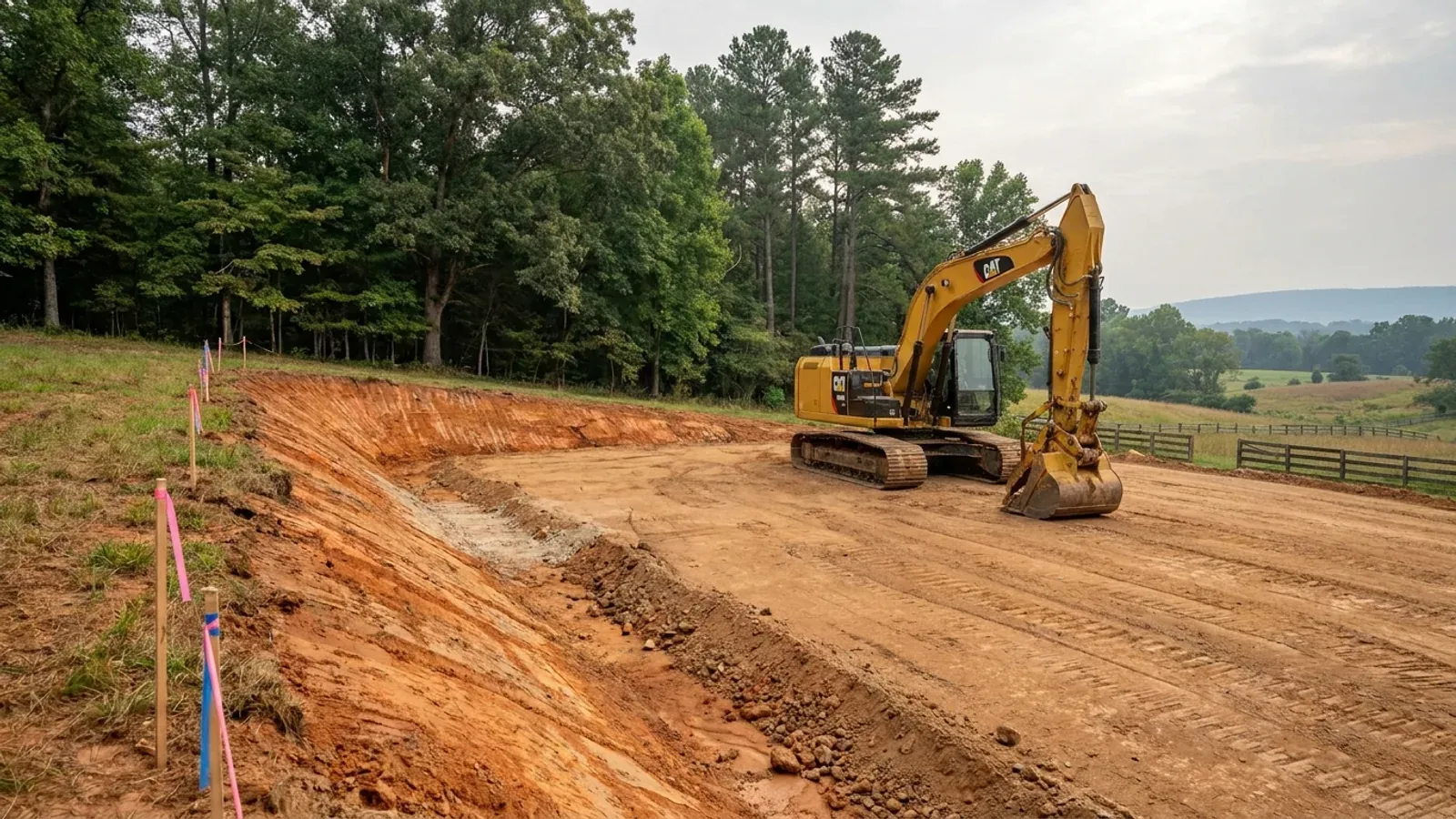
An excavator grading a compacted building pad on a cleared lot, with survey stakes, a drainage swale and a silt fence along the downhill edge.
Below the slab

The expensive surprises are in the ground, not the building

What moves a North Carolina budget is usually below grade, and the thing most often got wrong is which clay to worry about. Cecil — the red Piedmont clay everyone pictures, and the state soil — is kaolinitic and low shrink-swell; it does not heave. The soil that does is Iredell, formed over diabase and gabbro, which the USDA describes as vertic, very high shrink-swell, with a perched water table a foot or two down from December through April. The tell is colour: Cecil is red and Iredell is dark grey-brown, and they sit within a few miles of each other across the central Piedmont. West of that the question stops being clay and becomes slope, rock and colluvium; east of the fall line it becomes water, and in the Tidewater it becomes organic soil that subsides irreversibly once it is drained. Then the same ground decides the septic system, and North Carolina rewrote those rules recently enough that most of what is published about them is out of date. 15A NCAC 18E replaced the old subchapter on 1 January 2024 and was amended again on 1 June 2026: the site is classified on soil morphology — the word "percolation" does not appear anywhere in it — and there is no "provisionally suitable" any more, only suitable or unsuitable, on a single failed parameter. There is no statewide minimum lot size either; the area you need is derived from the soil result and then doubled, because a site that cannot fit both the initial field and its repair area is unsuitable. And the order matters more than people expect: the county health department's Improvement Permit and Construction Authorization come first, and the building permit is available on the strength of the Construction Authorization, not before it. One more thing that catches people: disturb more than an acre and you need an approved erosion and sedimentation control plan in hand before work starts, with penalties up to $5,000 a day, and a pad plus a drive plus a drainfield plus a laydown area crosses an acre faster than it sounds. So the site work, the foundation and the drainfield get resolved together rather than one at a time. We price the dirt before we price the building.

What a build looks like

Three stages every Harnett County project passes through, from a raw parcel to a finished home. Site work first, because that is where the budget is decided.
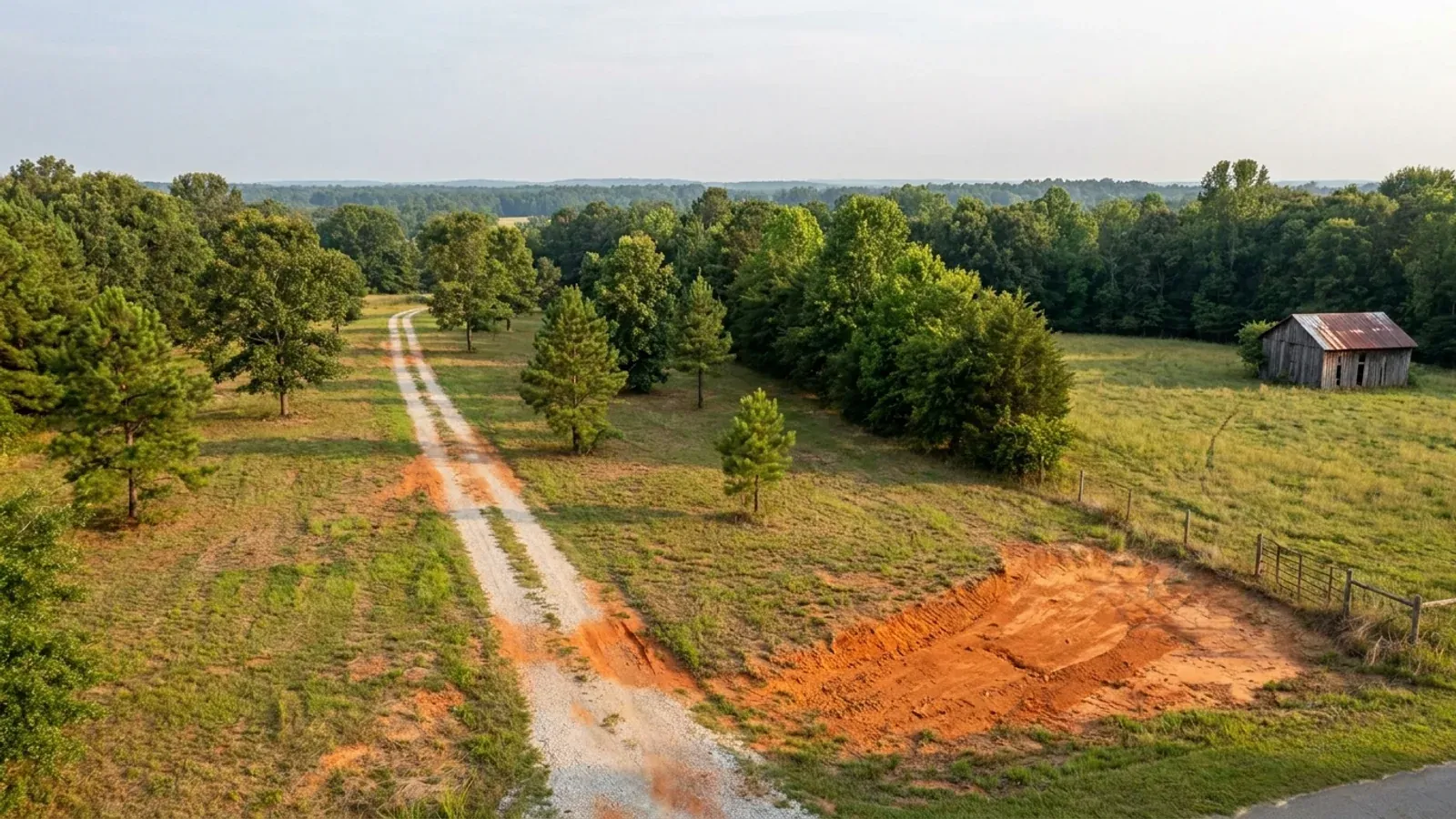
Aerial view of an undeveloped rural lot with cleared grass, a mixed oak, hickory and pine treeline, exposed red clay in one corner and a pale gravel access track.
Stage one

The parcel

Zoning, setbacks, flood zone and utility access get checked before anything is drawn.

An excavator grading a compacted building pad on a cleared lot, with survey stakes, a drainage swale and a silt fence along the downhill edge.
Stage two

Pad and permit

Clearing, grading and a compacted pad, while the septic authorization and the building submittal work through whichever offices cover your parcel.
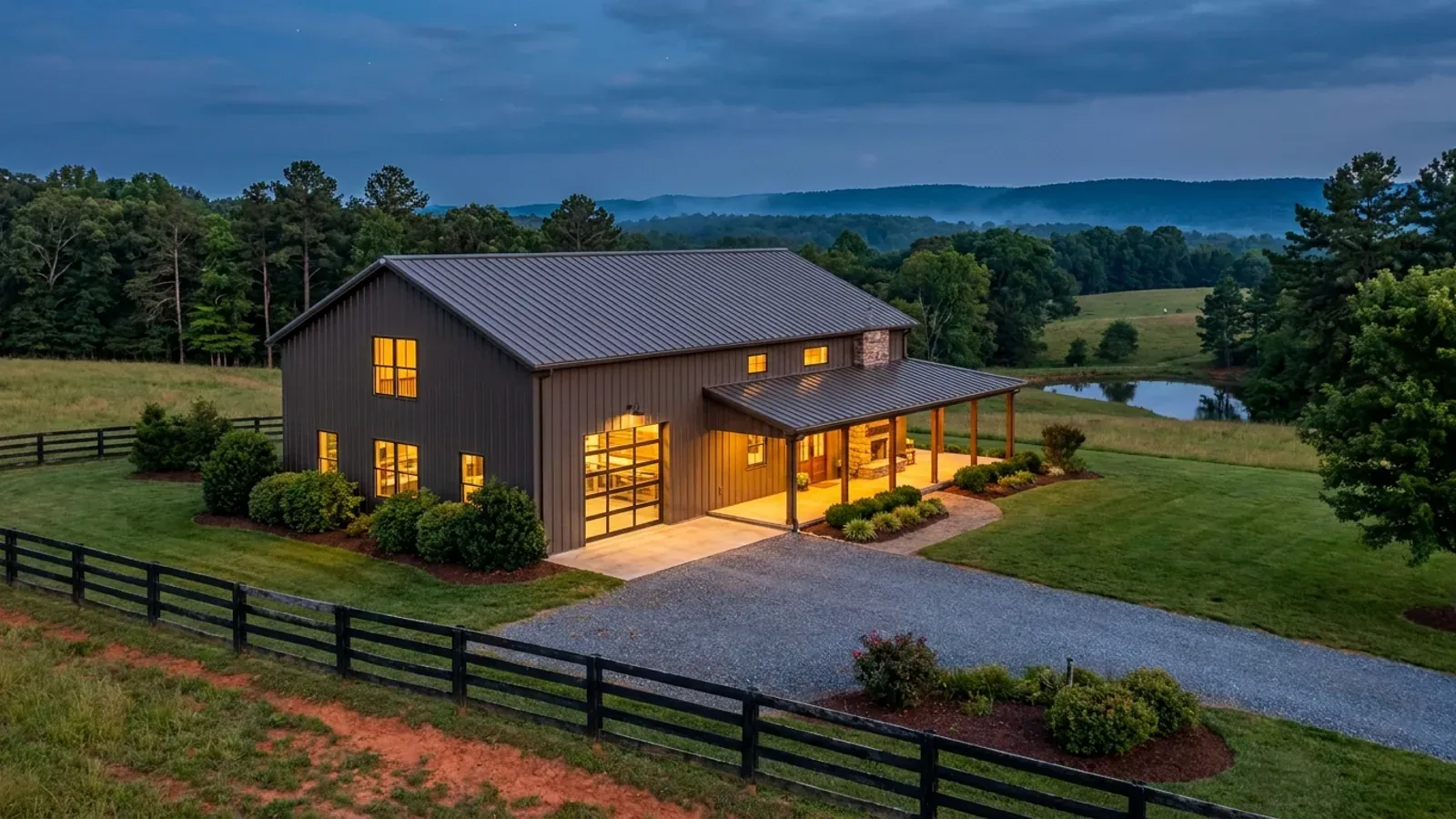
A finished barndominium at dusk with warm interior lighting glowing through its large windows.
Stage three

Frame to finish

Shell erected and dried in, then systems, insulation and interior finish through to CO.

Those are the rules where you are building in Harnett County. Tell us what you want to build and we will draw it to them.

Where we build around Harnett County

Harnett County and the rural land around it. The buildable acreage for a project this size usually sits outside the town limits — which does not automatically put it under the county, because a town's zoning and building-code enforcement reach one to three miles past its limits into its extraterritorial jurisdiction. Inside the limits, in the ETJ, or in neither are three different answers to who issues your permit.

The Harnett County service area, including the rural acreage outside the built-up edge, which is where the parcels big enough for a build like this usually sit. The map marks the territory we build in. It is not a branch location, and there is no office at this pin.

Nearby areas we build in

Others we cover nearby. Every North Carolina municipality sits inside a county — there are no independent cities here — but that does not settle who regulates a given parcel. A town's zoning, subdivision rules and building-code enforcement extend one to three miles beyond its limits, by population, into what the statute calls its extraterritorial jurisdiction; town taxes and town elections do not follow. So the office that issues the permit, what it charges and how the land is zoned can all differ from one card to the next, and the mailing address will not tell you which case you are in.

Building in Harnett County: common questions

6 questions we get asked most often about building in Harnett County. If yours is not on the list, ask it directly.

Who actually issues the building permit for land in Harnett County?
Harnett County Central Permitting, at 420 McKinney Parkway in Lillington, unless the parcel falls inside one of three towns' zoning jurisdictions — and Harnett publishes the answer itself. Its ETJ Submittal Guide states that properties located in Angier, Dunn or Lillington's zoning jurisdiction will obtain their building permits from their respective Towns, but will go through Harnett County for their Fire Marshal Review and for their Septic Permit, and that a notification of acknowledgement from the town — a zoning permit, an email or a letter — is required before any forms can be submitted to the county. Where the county's GIS viewer shows the zoning jurisdiction as Coats or Erwin, the same town acknowledgement is required first. So a rural Harnett parcel can end up with its zoning and building permit at a town hall and its fire review and septic permit at the county counter, in two systems, on one build. The county's guide says to run the parcel through its GIS viewer at the start, and that is the right first move. Under G.S. 160D-202 a town's planning and development jurisdiction reaches one mile past the corporate limits below 10,000 people, two miles from 10,000 to 24,999 and three miles at 25,000 or more, measured from the contiguous corporate boundary — while town property tax, town voting, town police jurisdiction and town business licensing all stop at the corporate line. G.S. 160D-307 answers part of that by requiring extraterritorial residents to be seated on the town's planning board and board of adjustment.
Does Harnett County's permit fee count the shop bay?
Yes, and Harnett is on the expensive side of the split for exactly the kind of building this is. The county uses square-footage brackets rather than a rate, and the dimension its schedule names is heated area and garage. So the shop is in the measurement. Worked through: 2,400 square feet of finished house with a 1,200 square foot attached shop measures 3,600 and lands in the 3,501 to 4,000 bracket at $1,200.00; without the shop it would sit at 2,001 to 2,500 and $805.00. The published brackets run $600.00 at 1,000 to 1,200 square feet, $700.00 at 1,201 to 2,000, $805.00 at 2,001 to 2,500, $940.00 at 2,501 to 3,000, $1,045.00 at 3,001 to 3,500, $1,200.00 at 3,501 to 4,000, $1,290.00 at 4,001 to 4,500 and $1,390.00 at 4,501 to 5,000. The contrast that makes it concrete: Guilford County in the Triad charges $150 plus $0.35 per heated square foot, so an unheated shop bay adds nothing to that base at all. The same building is measured differently two hours apart on the same statewide code. One consolation in Harnett is that the fee is combined — it covers electrical, plumbing and mechanical rather than charging four permits. Residential plan review is a separate $25.00 and a Land Use Permit is $25.00. The schedule's header carries 08/11/2023 and no fiscal year, so confirm the current figures with Central Permitting rather than budgeting from a three-year-old sheet.
What wind speed and seismic category does a Harnett County plan get drawn to?
Table R301.2(4) of the 2018 NC Residential Code names Harnett County at an ultimate design wind speed of 120 mph. Harnett is one of the counties the table lists rather than one of the fifty-one that take the unlisted 115 mph default, and both of its neighbouring markets are different: Wake County to the north is not listed and takes the default, while Cumberland County to the south is split by the table on a named road — 120 mph west of I-95 and 130 mph east of it. Harnett County is absent from Table R301.2(7), the list of the thirteen Seismic Design Category C counties, and that table's note places every county not listed in Category A or B. Some figures are the same everywhere in the state and belong on any drawing set: a flat 20 psf roof live load; no ground snow load column at all, because Section R301.2.3 is deleted; a frost line depth of 12 inches, which governs minimum footing depth; weathering Moderate; and termite protection required in all of North Carolina under Section R318. That last one has a barndominium-specific sting: cold-formed steel framing was deleted from the accepted methods of termite protection, so building the shell in steel does not exempt you and chemical treatment or baiting is still required. Section R301.1.2 requires other framing systems to have equivalent detailing to ensure force transfer, continuity and compatible deformations, and Section R301.2.1 requires a continuous load path transmitting uplift from the roof assembly to the foundation — which is the requirement most often missed on a shell-first metal or post-frame build. Name the edition on the drawings: the 2018 edition governs and the 2024 edition has no effective date.
How does septic work in Harnett County, and what does it cost?
Under 15A NCAC 18E the county health department evaluates the soil and site and either classifies the site suitable and issues an Improvement Permit — fixing design daily flow, bedroom count, setbacks and the location of both the initial dispersal field and its repair area — or classifies it unsuitable. There is no middle answer: 18E replaced 18A .1900 on 1 January 2024 and abolished the old "provisionally suitable" classification, and the word "percolation" does not appear anywhere in the subchapter, so nobody is running a perc test. The Construction Authorization follows, and .0201(c) provides that on its issuance the applicant may obtain a building permit under G.S. 130A-338. Harnett prices this differently from most of the state: it combines the soil analysis and the Improvement Permit into one $750.00 line and publishes no separately priced Construction Authorization. A new well permit is $250.00 and an existing septic evaluation is $100.00. All of it is paid at the same Central Permitting counter as the building permit, which is not how Wake, Johnston or Guilford do it. The timing rule to plan around, from the county's own guide: the Improvement Permit is valid for five years from its issue date, or six months if the tank is installed. And .0508 requires a repair area, which roughly doubles the ground the system occupies — so when you are asking how many acres you need, the answer is the drainfield plus its spare, not the drainfield.
Is Harnett County a Raleigh county or a Fayetteville county?
Both, officially, and that is the useful thing about it. Harnett is a member county of the Raleigh-Durham-Cary combined statistical area on the current OMB delineations, and it is also the northern edge of the Fayetteville commuter shed — the two sheds overlap here and nowhere else in the state does a ring county serve two metros this evenly. In practice the county reads north at the top and south at the bottom: Angier and the NC 55 corridor are Triangle, Lillington and Buies Creek sit in the middle on the Cape Fear, and Dunn, Erwin and the Spring Lake edge look toward Fayetteville and Fort Bragg. That has three consequences for a build. The design numbers differ between the two markets, in both wind and energy zone. The land is cheaper and the parcels larger than in Johnston or Franklin at the same drive time from Raleigh — 563 farms on 109,179 acres, 28.7 percent of the county, median farm 40 acres, 252 people per square mile. And the two largest communities in the county, Anderson Creek at 13,636 and Spout Springs at 11,040 in the 2020 Census, are unincorporated census-designated places rather than towns, so they are permitted by the county and they do not appear on a list of North Carolina municipalities at all. If you are searching by town name you will miss where most of the growth went.
Which Harnett County code amendments should I be looking for?
None, and it is worth saying because the opposite advice is everywhere in this trade. Under G.S. 143-138(e) the North Carolina State Building Code applies throughout the State from the time of its adoption, and the statute then names exhaustively what a political subdivision may adopt on its own: a fire prevention code, which requires Residential Code Council approval and which may not reach one- and two-family dwellings beyond what the Residential Code prescriptively requires, and floodplain management regulations. Nothing else. There is no general local building-code amendment power in this state, so no county can impose a stricter structural, foundation or energy requirement on a house than the statewide code already does. What genuinely varies here is a different list, and it is the substance of this page: zoning under Chapter 160D, which town's jurisdiction a parcel falls in under G.S. 160D-202, the fee schedule and its measuring base, the health department, and the wind and climate-zone numbers published county by county inside the one statewide code. Floodplain regulation is the honest exception. G.S. 143-138(e) expressly allows local floodplain rules to govern lowest floor elevation, foundation construction, anchorage, flood-resistant materials and protection of mechanical and electrical systems — so on Cape Fear bottomland in Harnett County that ordinance really can change how the building is built, and NC DEQ published new advisory floodplain maps for the Cape Fear basin on 1 April 2026.

Building in Harnett County?

Start with the plan. Tell us what you want to build and we will draw it, then confirm which office issues the permit for your parcel, what it will let you put there, and what wind load it has to meet. That conversation costs nothing.